






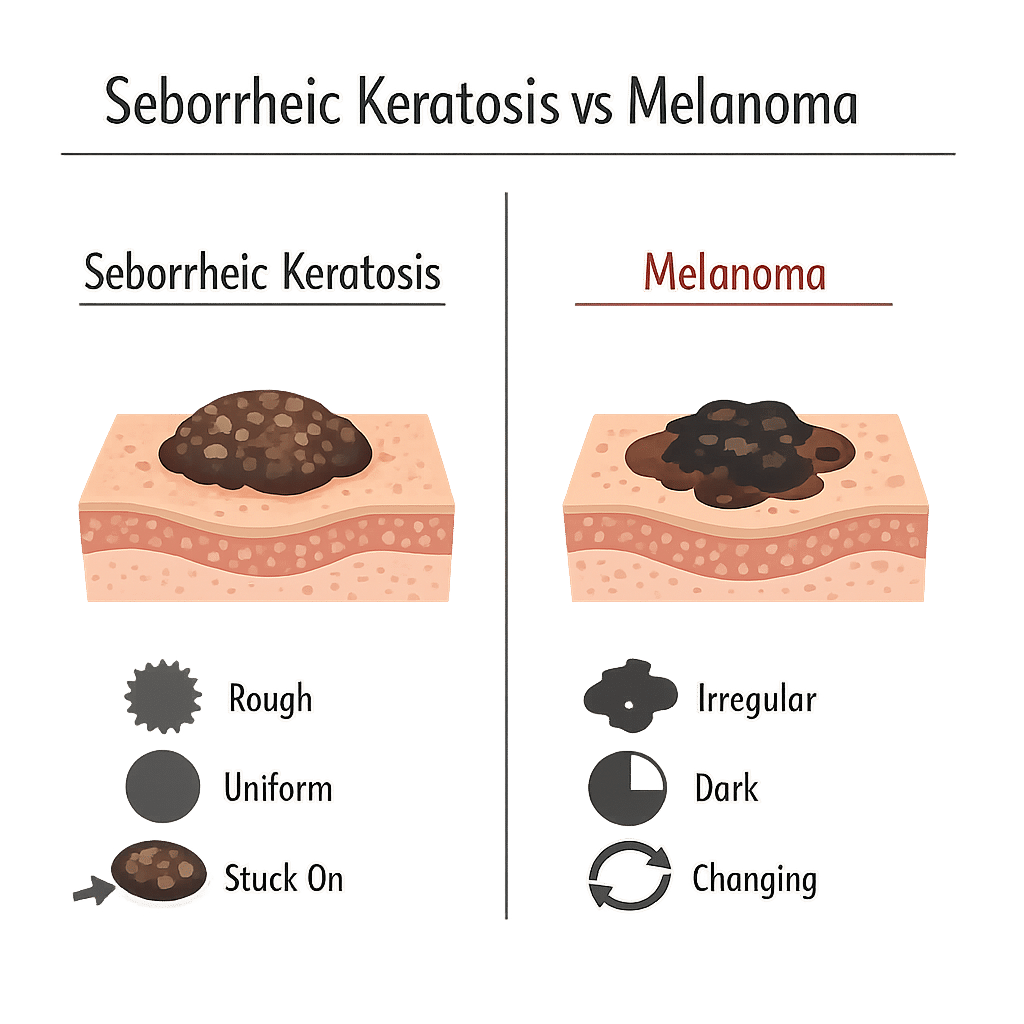
The seborrheic keratosis vs melanoma question is one of the most common worries people bring to a dermatology appointment, and the stakes are not symmetrical: one is a harmless age-related growth, the other is the skin cancer responsible for most skin cancer deaths. The reassuring part is that the two usually look different, and the differences are learnable. The part no honest article can leave out is that they do not always.
In this article you will learn what a typical seborrheic keratosis looks like, which pattern of features raises suspicion of melanoma, where each of those patterns fails, what a dermatologist can see that you cannot, and why no blood test in existence can screen your skin. One sentence governs everything below, and it is worth reading twice: appearance narrows the odds, but only a clinician’s examination and, when it is needed, a biopsy actually settle it.
What each of these growths actually is
Seborrheic keratosis
A seborrheic keratosis is a benign overgrowth of the outermost layer of the skin. The cells involved are keratinocytes, the ordinary building blocks of the epidermis, and they pile up into a raised plaque rather than invading anything underneath. They become common after the age of 40, often run in families, and rarely arrive alone. Despite the name, they have nothing to do with sebum or oily skin, and they are neither contagious nor a pre-cancer.
Melanoma
Melanoma starts in melanocytes, the pigment-producing cells along the base of the epidermis. Unlike a keratosis, it grows by invading: first sideways within the skin, then downwards, from where cells can travel to lymph nodes and distant organs. That downward growth is why timing matters: a melanoma removed while it is still thin is usually cured by the excision itself. Our team covers melanoma symptoms, diagnosis and treatments in a dedicated guide.
What a seborrheic keratosis usually looks like
The classic description is a growth that looks stuck onto the skin rather than growing out of it, as though a drop of candle wax had dried on the surface. Dermatologists use that word, stuck-on, because it captures something real: the growth sits above the surrounding skin with a clean edge all the way round, and the skin next to it looks entirely normal.
Other features that point towards a keratosis:
- A waxy, greasy or velvety surface, often slightly rough or warty to the touch rather than smooth.
- A sharply defined border, so you can trace the outline with your eye without hesitating.
- Small dark dots or pits on the surface, often described as plugs and sometimes compared to a tiny sponge. These are keratin trapped in the openings of the growth.
- A color anywhere from pale tan to dark brown or almost black, but usually one shade or a set of closely related shades.
- Slow, undramatic growth over years rather than visible change over weeks.
- Company. Very few people have exactly one, and several similar growths on the back, chest, scalp or face is a reassuring pattern in itself.
Seborrheic keratoses need no treatment for medical reasons. They are sometimes removed when they catch on clothing, bleed from friction or bother someone cosmetically, and that removal is done by a clinician, not at home.
The melanoma warning pattern
The ABCDE rule
The best-known checklist for a pigmented spot runs through five features. Asymmetry: one half does not mirror the other. Border: the edge is ragged, notched, blurred or fades into the surrounding skin instead of stopping cleanly. Color: several colors in one lesion, such as brown mixed with black, gray, red, white or blue. Diameter: larger than about six millimeters, roughly the width of a pencil eraser, although melanomas are increasingly found smaller. Evolving: the spot is changing in size, shape, color, height or sensation.
Of those five, the last carries the most weight for a person checking their own skin: a spot doing something new deserves an appointment regardless of how it scores on the other four.
The ugly duckling sign
For most people the ugly duckling sign is more useful than the ABCDE rule, and it is far simpler. Your moles tend to look like siblings. They share a family resemblance in color, shape and size. The ugly duckling is the one that breaks the pattern: darker than the rest, or larger, or a different shape, or simply the one your eye keeps returning to. You do not need to know which feature is wrong, only that one lesion is not like its neighbors.
It works because it uses comparison rather than absolute criteria, something the human eye does well. Photographing your skin every few months helps for the same reason: it turns a vague impression of change into something you can check.
Seborrheic keratosis vs melanoma: a feature-by-feature comparison
The table below sets the two patterns side by side. The third column is the one most comparisons leave out: what each feature does not rule out.
| Feature | Typical seborrheic keratosis | Melanoma warning pattern | What this does not rule out |
|---|---|---|---|
| Border | Sharply defined, as if the growth were stuck onto the surface | Ragged, notched or blurred, fading into normal skin | An early melanoma can have a deceptively neat edge in its first months |
| Surface | Waxy, warty or velvety, often with visible plugs or pits | Smooth early on, later raised, firm, sometimes ulcerated or crusted | Some melanomas develop a rough, keratin-covered surface that mimics a keratosis |
| Color | Uniform tan, brown or near-black, usually one family of shades | Several colors in one lesion, or an area of color loss | Amelanotic melanoma can be pink, red or skin-colored with no dark pigment at all |
| Change over time | Slow thickening over years, no sudden change | Visible change over weeks to months in size, shape, color or height | A keratosis that is rubbed or inflamed can change quickly and look alarming |
| Number of similar lesions | Usually several, often many, with a family resemblance | Typically a single lesion that stands apart from the others | You can have dozens of keratoses and one melanoma among them |
| Symptoms | Usually none, occasional itch or catching on clothing | Persistent itch, tenderness, spontaneous bleeding or a sore that will not heal | Most melanomas cause no symptoms at all until late |
Where appearance fails
A melanoma can hide behind a benign label
The most dangerous outcome of a comparison like the one above is a reader deciding their spot matches the left column and needs no attention. Melanomas that imitate a seborrheic keratosis are well described in the dermatology literature, and the imitation goes both ways: keratinocyte skin cancers can also present as an unremarkable rough patch that most people would file under harmless. A recent review of hard-to-recognize squamous cell carcinoma made exactly this point.
The practical consequence is simple: a resemblance to a keratosis is a reason to relax slightly, not a reason to skip the appointment when anything else about the lesion is off.
Amelanotic melanoma breaks the dark spot rule
A minority of melanomas produce little or no pigment. These amelanotic melanomas appear pink, red, pale or the same color as the surrounding skin, and they defeat every mental shortcut built around the phrase dark spot. They are frequently mistaken for a scar, an insect bite, a wart or a small benign lump, and research consistently finds they are diagnosed later than pigmented melanomas as a result.
What this means in practice: a pink or flesh-colored bump that keeps growing, keeps bleeding or refuses to heal is worth showing to a doctor even though nothing about it looks like the melanoma photographs you have seen.
Symptoms that outrank appearance
Some findings should send you to an appointment regardless of what the lesion looks like: a spot that itches persistently, a spot that bleeds without being knocked or scratched, a sore that has not healed after a month, a lesion that has visibly changed over a matter of weeks. Any of these justifies an examination on its own, and none is reassured away by a waxy surface or a neat border.
Never treat a lesion at home
Freezing kits, acid preparations, wart removers, scraping, picking and burning are all bad ideas here, and the reason goes beyond infection and scarring. If the lesion turns out to be a melanoma, the tissue you destroyed is precisely what a pathologist needed in order to measure how deep it had grown, and that measurement drives every subsequent treatment decision. Removing the evidence does not remove the cancer; it removes the information. Leave the lesion intact.
What a dermatologist sees that you cannot
A dermatologist is not simply better at the task you are performing; they are performing a different one. A dermatoscope is a handheld magnifier with polarized light that cancels surface reflection and lets the examiner see structures inside the top layers of the skin: pigment networks, the shape of small blood vessels, and the keratin-filled openings characteristic of a seborrheic keratosis, which largely settle the question when present.
Evidence reviewed in recent dermatology journals supports what this implies: an in-person examination by a dermatologist, dermatoscope in hand, is the most accurate way currently available to assess a suspicious pigmented lesion, and it outperforms assessment from photographs alone. That is worth knowing before relying on an app or an emailed photograph.
Where examination still leaves doubt, the answer is a biopsy: the lesion, or a representative part of it, is removed and examined under a microscope by a pathologist. Nothing short of that is diagnostic. A biopsy is a brief outpatient procedure under local anesthetic, and being offered one is not a signal that your doctor believes you have cancer. It is the normal way to close a question that looking cannot close.
When to see a doctor
Book an appointment, without waiting for a routine check-up, if any of the following applies:
- It is the odd one out among your other moles and growths.
- It has changed in size, shape, color or thickness over the past few weeks or months.
- It itches persistently, stings or feels tender.
- It bleeds or oozes without having been knocked or scratched.
- It is a sore that has not healed within about a month.
- It is pink, red or flesh-colored, is growing, and has no obvious explanation.
- Its edge is blurred, notched or spreading into the surrounding skin.
- You are simply not sure, and you keep checking it.
That last item is not filler: repeated checking is a reasonable signal that a lesion deserves a professional opinion, and no dermatologist considers a benign result a waste of their time. A separate article compares a subungual hematoma and a subungual melanoma, the equivalent question for a dark mark under a nail. For widespread skin problems rather than a single spot, another article describes skin rash causes, symptoms and treatments.
Do blood tests detect melanoma?
No. This deserves to be stated flatly, because it is a widespread and occasionally costly misconception. There is no blood test that screens for melanoma, confirms it or rules it out. A normal blood panel says nothing whatsoever about a spot on your arm. Melanoma is diagnosed by looking and by biopsy.
The confusion usually traces back to lactate dehydrogenase, an enzyme released when cells are damaged. It is measured in melanoma, but only in people who already have a confirmed diagnosis of advanced disease, where the National Cancer Institute notes that a raised level may predict a poorer response to treatment. It is a staging and monitoring marker, not a detection test, and a normal result in a healthy person carries no reassurance about their skin. Our guide explains lactate dehydrogenase blood test results in more detail, and our team also presents the main tumor markers used in oncology and what they can and cannot do.
Blood work does have a legitimate place around the edges of skin cancer care rather than at its center. Before an excision under general anesthetic, a pre-operative panel is usual, and a separate article outlines the blood work usually ordered before surgery. During immunotherapy, monitoring watches for effects on the thyroid, liver and kidneys, which is where our team describes liver function tests and their normal ranges and another guide covers the comprehensive metabolic panel. Treatment also affects red cells, white cells and platelets, and our guide details the complete blood count and what each value means, while a separate guide explains C-reactive protein as an inflammation marker. If you are holding a set of results you cannot interpret, our team explains how to read blood test results line by line.
Latest scientific advances
Research published over the past three years has been unusually clear about where accuracy in skin cancer diagnosis comes from, and it is worth translating into plain terms.
A large 2025 review in JAMA Dermatology pooled studies comparing how skin cancer is diagnosed and found that the type of examination matters as much as who performs it: a dermatologist examining the lesion in person with a dermatoscope was the most accurate approach reviewed, and clearly better than judgments made from photographs. What this means for you is that a store-and-forward photo or a phone app is a reasonable way to get triaged quickly, but it is not equivalent to being seen, and a reassuring app result should not cancel an appointment you were going to make.
Work on amelanotic melanoma, the kind that produces no dark pigment, reinforces the same warning from two directions. A 2023 study found that amelanotic melanomas on the palms, soles and nails were diagnosed later than pigmented ones, and a 2026 comparison of disease progression found these pigment-free tumors behave less favorably overall, with delayed recognition a plausible part of the explanation. What this means for you is that color is a clue, not a filter: a growing pink or skin-colored lesion deserves the same attention as a dark one.
There is encouraging news about the ugly duckling sign as a teaching tool. A 2025 Italian pilot study taught secondary school students to spot the odd lesion out in short peer-led sessions. Beforehand, fewer than one student in ten could describe the sign; afterwards, more than nine in ten could. The skill can evidently be transferred in minutes, roughly the time it takes to read this section.
On the technology side, 2025 reviews of new optical imaging methods and of melanoma screening point the same way: several tools are improving, none replaces the examination or the biopsy yet, and screening research now openly discusses overdiagnosis, meaning the detection of lesions that would never have caused harm. That nuance explains why doctors are careful about how widely they screen. Blood-based work has continued too, but strictly in advanced disease: a 2025 study of a composite index built from routine blood values looked at predicting outcomes in people already being treated for metastatic melanoma. It is a prognosis question, not a detection one, and it does not change the answer given earlier.
Glossary
| Term | Definition |
|---|---|
| ABCDE rule | A five-point checklist for a pigmented spot: Asymmetry, Border, Color, Diameter and Evolving. |
| Amelanotic melanoma | A melanoma that produces little or no pigment, so it appears pink, red or skin-colored instead of dark. |
| Biopsy | Removal of a lesion, or part of it, so a pathologist can examine the tissue under a microscope. It is the only way to confirm or exclude melanoma. |
| Dermoscopy | Examination with a dermatoscope, a magnifier with polarized light that shows structures below the skin surface that are invisible to the naked eye. |
| Excision | Surgical removal of a lesion together with a margin of surrounding skin. |
| Keratin | The tough protein that makes up the outer layer of skin, hair and nails. Trapped keratin forms the visible plugs on a seborrheic keratosis. |
| Lactate dehydrogenase (LDH) | An enzyme released when cells are damaged. In melanoma it is used only for staging and monitoring of advanced disease, never for detection. |
| Melanocyte | The skin cell that produces melanin, the pigment that gives skin and moles their color. Melanoma arises from these cells. |
| Overdiagnosis | The detection of a disease that would never have gone on to cause symptoms or harm during a person’s lifetime. |
| Ugly duckling sign | The observation that a lesion which looks unlike a person’s other moles is more likely to be a melanoma. |
Frequently asked questions
Can a seborrheic keratosis turn into a melanoma?
No. A seborrheic keratosis arises from keratinocytes and a melanoma arises from melanocytes, so one does not become the other. What can happen is that a melanoma develops on skin right next to a keratosis, or that a melanoma is mistaken for one from the start. That is why an existing keratosis that starts to look or behave differently should still be examined rather than assumed to be the same harmless growth it was last year.
Can a melanoma be mistaken for a seborrheic keratosis?
Yes, and it happens often enough to be a recognized diagnostic trap. Some melanomas develop a rough, keratin-covered surface that closely imitates a keratosis, and both can be dark and sharply bordered. Dermoscopy resolves most of these cases because the internal structures differ even when the surface does not, and a biopsy resolves the rest. This is the main reason self-assessment should narrow your concern rather than end it.
Is a seborrheic keratosis the same thing as a mole?
No. A mole, or nevus, is a cluster of pigment cells and is usually present from childhood or early adulthood. A seborrheic keratosis is a thickening of the outer skin layer and typically appears in middle age or later. Moles are generally smooth and flat or gently domed, while keratoses feel rough or waxy and look applied to the surface. Both are benign, but they are different structures with different behavior.
What does a nodular melanoma look like?
Nodular melanoma is the type most likely to be missed, because it does not follow the ABCDE pattern well. It presents as a firm, raised lump that grows over weeks to a few months, and it can be black, blue, red, pink or skin-colored. It may bleed or ulcerate. The features that matter most are firmness, elevation and rapid growth rather than color or irregular edges. Any lump growing steadily over a few weeks should be examined promptly.
Does a seborrheic keratosis need to be removed?
Not for medical reasons. Removal is considered when a growth catches on clothing or jewelry, bleeds repeatedly from friction, becomes uncomfortable, or bothers someone cosmetically. A clinician can remove it by freezing, curettage or shaving, usually in a single short appointment. Removal at home with over-the-counter kits is a poor idea, both because of scarring and infection and because it destroys tissue that might have needed examining.
How often should I check my own skin?
Once a month is the usual recommendation, using a mirror or a partner for the back, scalp and the backs of the legs. Photographs taken on the same schedule make change far easier to spot than memory does. Monthly self-examination is a complement to professional skin checks, not a replacement, and anyone with many moles, a personal or family history of melanoma, or heavy past sun exposure should ask their doctor how often they should be seen.
Sources
- Mayo Clinic — Seborrheic keratosis: symptoms and causes, 2025 — mayoclinic.org
- Cleveland Clinic — Seborrheic keratosis: causes, symptoms and treatment, 2025 — my.clevelandclinic.org
- National Cancer Institute — Melanoma treatment (PDQ), patient version, 2025 — cancer.gov
- MedlinePlus, US National Library of Medicine — Melanoma, 2025 — medlineplus.gov
- Chen JY et al. — Skin cancer diagnosis by lesion, physician and examination type: a systematic review and meta-analysis — JAMA Dermatology, 2025 — doi.org/10.1001/jamadermatol.2024.4382
- Varga NN et al. — Diagnostic accuracy of novel optical imaging techniques for melanoma detection — International Journal of Dermatology, 2025 — doi.org/10.1111/ijd.17828
- Barzilai A et al. — Comparison of disease progression between amelanotic melanoma and melanotic melanoma — Pigment Cell and Melanoma Research, 2026 — doi.org/10.1111/pcmr.70083
- Wu Q et al. — Clinicopathologic features, delayed diagnosis and survival in amelanotic acral melanoma — Journal of the American Academy of Dermatology, 2023 — doi.org/10.1016/j.jaad.2023.08.083
- Korecka K et al. — How do we recognize a difficult squamous cell carcinoma? — Clinical and Experimental Dermatology, 2025 — doi.org/10.1093/ced/llaf255
- Hwang JC, Peacker BL, Hartman RI — Screening and novel diagnostic technologies for melanoma: an update — Melanoma Management, 2025 — doi.org/10.1080/20450885.2025.2536999
- Stanganelli I et al. — Peer education on the ugly duckling sign in secondary schools: the SUNTEL pilot study — Frontiers in Oncology, 2025 — doi.org/10.3389/fonc.2025.1665136
- Acar C et al. — Prognostic utility of the CALLY index in metastatic melanoma — Clinical and Translational Oncology, 2025 — doi.org/10.1007/s12094-025-03888-z
Further reading
- Melanoma: symptoms, diagnosis and treatments
- Subungual hematoma vs melanoma: symptoms and causes
- Skin rash: causes, symptoms and treatments
- LDH (lactate dehydrogenase) blood test interpretation
- Tumor markers explained
Understand your lab results with AI DiagMe
A spot on your skin is answered by a dermatologist, not by a laboratory, and no panel of blood results will tell you what it is. Blood work becomes relevant a step later: the pre-operative panel before an excision, the liver and thyroid values followed during immunotherapy, the full blood count tracked through treatment. Those reports arrive full of abbreviations and reference ranges that mean very little on their own. AI DiagMe reads them with you, in plain language, so you arrive at your next appointment understanding what changed and what to ask. It helps you understand your results; it does not diagnose, and it does not replace your doctor.
Get your results interpreted in minutes