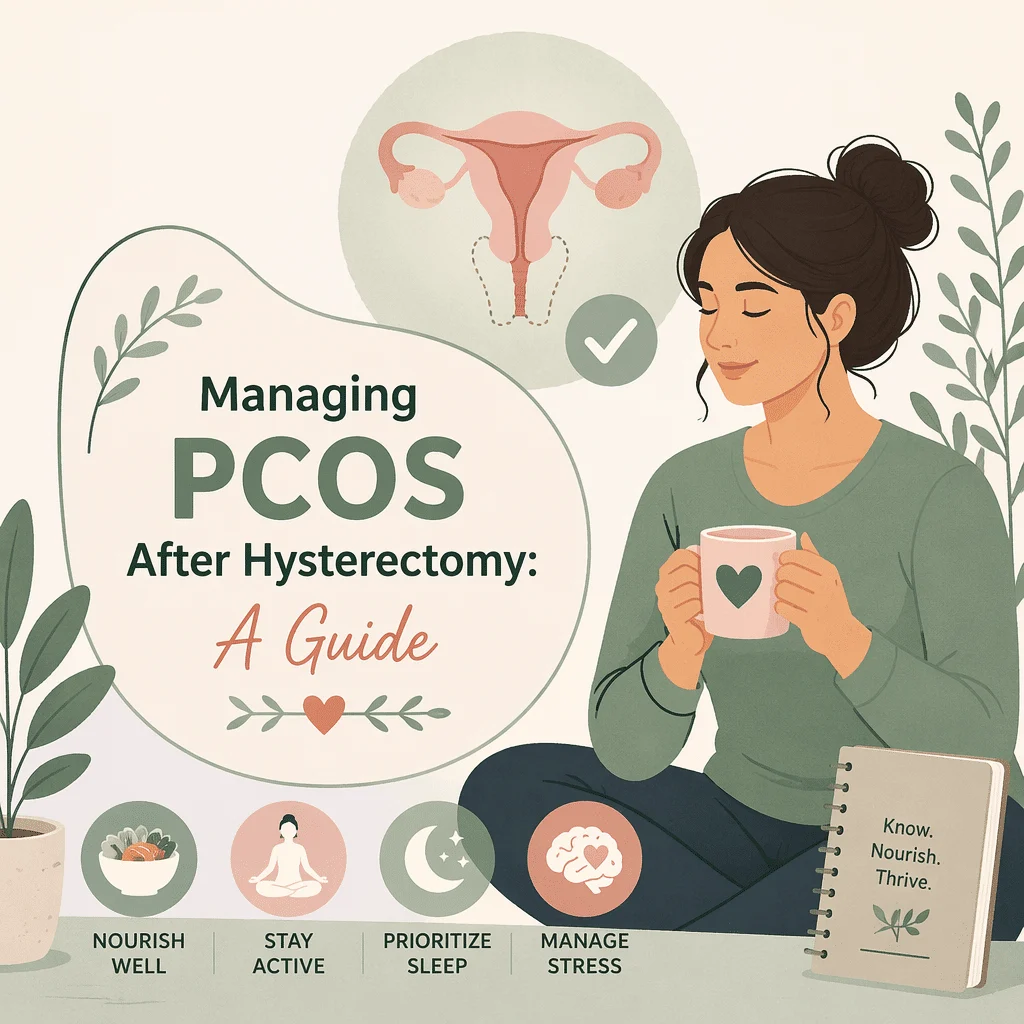
PCOS after a hysterectomy is one of the most misunderstood situations in women’s health. Many women are told, or simply assume, that removing the uterus puts an end to polycystic ovary syndrome. It does not. A hysterectomy removes the uterus; PCOS is a condition of the ovaries and of metabolism. The periods stop, but the syndrome itself carries on. In this article you’ll learn what the surgery actually changes, why the answer depends entirely on whether your ovaries were kept or removed, which single risk genuinely disappears, and how follow-up shifts away from tracking cycles toward tracking symptoms and blood work. The aim is practical: what to watch for, what to test, and when to contact your doctor.
Why PCOS after a hysterectomy does not simply go away
The confusion is understandable. For most women, the visible face of PCOS is the irregular period. When periods disappear, it feels like the condition has been resolved. What has actually been removed is the organ that produced the symptom, not the organ that produces the problem.
What the surgery actually removes
A hysterectomy is the surgical removal of the uterus. The ovaries are separate organs, and they are not removed unless the surgeon removes them deliberately in a second procedure performed at the same time, called an oophorectomy. The naming is genuinely misleading here, and it is worth being precise:
- A total hysterectomy means the uterus and the cervix were removed. Despite the word “total,” it says nothing about the ovaries, which are usually left in place.
- A supracervical or partial hysterectomy means the uterus was removed and the cervix was left behind. Again, the ovaries are a separate question.
- A hysterectomy with bilateral salpingo-oophorectomy means the uterus, both fallopian tubes and both ovaries were removed. This is the only version that takes the ovaries out.
If you are not certain which one you had, your operative report or surgical pathology report will say. It is the single most useful piece of information for understanding what happens next, and it is worth asking for.
The signal you lose is the period, not the syndrome
PCOS is driven by the ovaries producing more androgens than usual, very often alongside insulin resistance, where the body needs more insulin than it should to keep blood sugar steady. Neither of those mechanisms lives in the uterus. If the ovaries stayed, they keep producing hormones exactly as before, and the hormonal and metabolic features of PCOS continue unchanged. Our library explains PCOS symptoms, causes and diagnostic tests in full, including the Rotterdam criteria and standard management, so this article stays focused on what is specific to life after surgery.
Two different situations, two different follow-ups
Almost every question about this topic has the same answer: it depends on the ovaries. The two scenarios are not variations on a theme; they are genuinely different clinical situations with different symptoms and different monitoring.
| Question | Ovaries kept | Both ovaries removed |
|---|---|---|
| Does PCOS continue? | Yes. Hormone production is unchanged. | Ovarian androgen production stops, but the metabolic pattern often persists. |
| Hormonal state | Cycles continue silently until natural menopause. | Surgical menopause, starting immediately. |
| Typical symptoms | Excess hair growth, acne, scalp hair thinning, weight changes. | Hot flashes, night sweats, sleep and mood changes, vaginal dryness. |
| Cardiometabolic risk | Continues as before the surgery. | Continues, and bone and heart health need their own follow-up. |
| Main monitoring tool | Androgen and metabolic blood work. | Metabolic blood work plus menopause follow-up. |
If both ovaries were removed, you have entered surgical menopause rather than a gradual transition, and the change is abrupt rather than spread over years. This guide covers the symptoms and stages of menopause in detail, which is worth reading alongside this one if that applies to you.
The one risk that genuinely disappears
There is a real piece of good news, and it deserves to be said plainly. In PCOS, ovulation is often infrequent, so the uterine lining can be exposed to estrogen for long stretches without the balancing effect of progesterone. Clinicians call this unopposed estrogen, and over years it raises the risk of the uterine lining thickening abnormally and, in some cases, of endometrial cancer. That risk requires an endometrium. Once the uterus has been removed, the tissue at risk is gone, and this particular concern is no longer part of your follow-up.
That is a genuine reassurance, and for many women it was one of the reasons the surgery was discussed in the first place. It is also the only part of PCOS that a hysterectomy resolves.
What stays exactly the same
Everything on the metabolic side of PCOS is untouched by the surgery. Insulin resistance does not improve because the uterus is gone. The tendency toward higher triglycerides and lower protective HDL cholesterol does not improve either. Nor does the elevated long-term risk of type 2 diabetes and cardiovascular disease that runs alongside the syndrome.
This matters because it is easy, after a hysterectomy, to feel that the chapter is closed and to drift away from follow-up. In practice the opposite is true: the surgery removes the symptom that used to prompt appointments, so the metabolic side needs to be monitored deliberately rather than opportunistically.
How PCOS after a hysterectomy is monitored without periods
This is the practical heart of the matter. Before surgery, cycle length was a rough but useful running indicator of how the syndrome was behaving. That indicator is gone permanently. Follow-up therefore shifts onto two things you can still measure: symptoms you can observe, and blood work.
The blood work that replaces cycle tracking
The exact panel is a decision for your doctor, based on your history and symptoms, but the tests below are the ones that typically carry the load once periods are no longer available as a signal.
| Test | What it looks at | Why it matters after surgery |
|---|---|---|
| Total and free testosterone | Androgen levels, overall and the active fraction | The most direct measure of the ovarian side of PCOS when cycles cannot be observed |
| SHBG | The carrier protein that binds testosterone in the blood | A low result can mean symptoms despite a normal total testosterone |
| DHEA-S | Androgen production from the adrenal glands | Separates an adrenal source of androgens from an ovarian one |
| HbA1c or fasting glucose | Average blood sugar control | Tracks the insulin resistance that the surgery does not change |
| Lipid panel | Cholesterol fractions and triglycerides | The pattern typical of PCOS persists and feeds cardiovascular risk |
| TSH and prolactin | Thyroid function and pituitary hormone output | Rules out conditions that imitate PCOS symptoms |
Each of these has its own logic. Our team details the causes and risks of high testosterone in women, and a separate article explains sex hormone-binding globulin levels, which is the reason a total testosterone result on its own can be reassuring and still miss the picture. Another guide describes DHEA levels and what they mean, and our library describes a female hormone panel for the broader reproductive hormone picture.
On the metabolic side, this resource provides an A1C conversion chart that turns an HbA1c result into an average glucose figure, and a separate guide explains a full lipid panel. To rule out the conditions that mimic PCOS, our team outlines normal thyroid level ranges and another article covers high prolactin levels.
Why AMH and ultrasound read differently now
Two familiar tools behave differently after surgery. Anti-Mullerian hormone, or AMH, reflects the pool of small follicles in the ovaries and tends to run high in PCOS. If both ovaries were removed, AMH falls to a very low or undetectable level and no longer carries any information about the syndrome. If the ovaries were kept, AMH still reflects them, but it declines steadily with age, so a single value means much less without a point of comparison.
Pelvic ultrasound has a similar problem. The scan is still technically possible when the ovaries remain, but the report will describe a pelvis without a uterus, and the ovaries may sit differently or be harder to visualize after surgery. Neither of these tools is useless, but neither should be read the way it would have been read before the operation.
Symptoms worth tracking, and when to contact your doctor
Without a cycle to watch, the symptoms you notice yourself become the early warning system. It is worth keeping an informal record of the following, because a slow change over months is easy to miss and easy to describe to a clinician if you have written it down:
- New or increasing hair growth on the face, chest, abdomen or back.
- Thinning hair at the crown or a widening part.
- Acne appearing along the jawline or persisting well beyond the teenage years.
- Weight gain concentrated around the abdomen, especially without a change in habits.
- Increasing thirst, frequent urination or unusual fatigue.
- Darkened, velvety patches of skin at the neck, armpits or groin.
- Loud snoring or waking unrefreshed, which can point toward sleep apnea.
Contact your doctor promptly, rather than waiting for a routine appointment, if you notice a rapid increase in facial or body hair over a few months, a deepening voice, or the development of male-pattern baldness, since a fast change in androgen-related symptoms deserves prompt assessment. The same applies to symptoms suggesting high blood sugar, such as marked thirst with frequent urination and unexplained weight loss. Chest pain, breathlessness on mild exertion, or new pain or swelling in one calf are reasons to seek urgent care rather than to make an appointment.
Everyday management that still applies
Because the drivers of PCOS have not changed, the everyday measures that helped before the surgery still help after it. Regular physical activity that combines aerobic work with some resistance training improves how the body handles insulin, independently of any change in weight. Eating patterns that steady blood sugar rather than spiking it remain the practical foundation, and sleep matters more than it is usually given credit for, since poor sleep worsens insulin resistance directly.
Medication decisions belong with your doctor. Treatments that were used before the surgery for androgen-related symptoms or for insulin resistance may still be appropriate afterward, but some options are chosen differently once there is no uterus and no need for cycle regulation. That is a conversation to have rather than a change to make on your own, and if both ovaries were removed, any discussion of hormone therapy has its own separate considerations that should be individualized with your clinician.
Latest scientific advances
Research published over the past three years has sharpened two things that matter directly here: how seriously the heart and metabolic side of PCOS should be taken, and how the condition can be assessed when the usual signals are unavailable. The findings below come from peer-reviewed studies published between 2023 and 2025, summarized in plain language.
The largest recent analysis pooled twenty studies covering more than a million women and found that those with PCOS were clearly more likely to experience cardiovascular events, including heart attack and stroke, than women without it. On the strength of this work, the 2023 international PCOS guideline now advises that everyone with PCOS should have a full cardiovascular risk assessment. A separate global analysis reached the same conclusion, estimating the overall risk of cardiovascular disease in women with PCOS at roughly one and a half times that of women without the condition. What this means for you: the part of PCOS that a hysterectomy does not touch is precisely the part that carries the long-term risk, so blood pressure, blood sugar and cholesterol follow-up is not optional maintenance.
The 2023 international guideline also made a notable change to diagnosis, accepting AMH as an alternative to ultrasound in adults. A meta-analysis of eighty-two studies then examined how well AMH actually performs, and the conclusion was measured: AMH is a useful supporting test, but it cannot diagnose PCOS on its own, and laboratories do not agree on a single cut-off value. What this means for you: if your doctor orders AMH after a hysterectomy, treat it as one piece of a larger picture rather than a verdict, and expect the interpretation to depend on which laboratory ran it.
On the surgery itself, a systematic review of long-term outcomes found that removing both ovaries at the time of hysterectomy, particularly in younger women, was associated with a higher long-term risk of cardiovascular disease, raised cholesterol, diabetes and high blood pressure, alongside a lower risk of breast cancer. A very large Danish cohort study following nearly 143,000 women after hysterectomy for non-cancerous reasons reached a similar conclusion, supporting current practice of keeping the ovaries in premenopausal women who are not at high risk of ovarian cancer. What this means for you: this is background for a conversation with your surgeon, not a rule, and if the decision has already been made it is context rather than something to revisit.
One more result is worth knowing, with appropriate caution. A study of postmenopausal women found that hysterectomy was associated with faster progression of early artery wall thickening compared with natural menopause, and this held even for women whose ovaries had been conserved. The number of women in that particular group was small, so this is an early result that still needs confirmation. What this means for you: it is one more reason to treat cardiovascular follow-up after a hysterectomy as active rather than assumed, whatever happened to your ovaries.
Glossary of key terms
| Term | Definition |
|---|---|
| Hysterectomy | Surgery to remove the uterus. It does not remove the ovaries unless an oophorectomy is performed at the same time. |
| Oophorectomy | Surgery to remove an ovary. Bilateral means both ovaries were removed. |
| Salpingo-oophorectomy | Removal of an ovary together with its fallopian tube. |
| Surgical menopause | Menopause that begins immediately because both ovaries were removed, rather than developing gradually over years. |
| Androgens | A group of hormones, including testosterone, present in everyone but produced in higher amounts in PCOS. |
| Free testosterone | The fraction of testosterone circulating unbound and available to act on tissues. |
| SHBG | Sex hormone-binding globulin, a protein made by the liver that binds testosterone and controls how much stays active. |
| DHEA-S | Dehydroepiandrosterone sulfate, an androgen made mainly by the adrenal glands rather than the ovaries. |
| Insulin resistance | A state in which the body needs more insulin than usual to keep blood sugar in range. |
| AMH | Anti-Mullerian hormone, a blood marker reflecting the number of small follicles in the ovaries. |
| Unopposed estrogen | Estrogen acting on the uterine lining without the balancing effect of progesterone, which over time can thicken that lining. |
Frequently asked questions
Can you have PCOS after a total hysterectomy?
Yes. The word “total” refers to the removal of the uterus together with the cervix, not to the ovaries. In most total hysterectomies the ovaries are left in place, so they continue producing hormones and the syndrome continues with them. The only version of the surgery that removes the ovaries is a hysterectomy with bilateral salpingo-oophorectomy. If you are unsure which you had, the operative report will state it explicitly, and it is a reasonable thing to ask your surgeon or primary care doctor to confirm.
Does PCOS go away after the ovaries are removed?
Partly, but not entirely. Removing both ovaries stops ovarian androgen production, so hormone-driven symptoms such as excess hair growth and acne generally ease over time. What does not stop is the metabolic side. Insulin resistance, the lipid pattern and the associated long-term risk of type 2 diabetes and cardiovascular disease persist, and they still need monitoring. Removing the ovaries also brings surgical menopause and its own follow-up needs, so it is better described as trading one set of considerations for another than as a cure.
Can PCOS be diagnosed for the first time after a hysterectomy?
It can, and it is not unusual. Many women reach surgery with PCOS that was never formally identified, often because heavy or irregular bleeding was treated as the problem in its own right. After the operation, persistent symptoms such as excess hair growth or a rising blood sugar prompt testing, and the underlying pattern becomes visible. Diagnosis in this situation relies on symptoms and blood work rather than on cycle history, which is no longer available, so it usually takes a slightly different route than a standard diagnosis.
Is metformin still relevant for PCOS after a hysterectomy?
Metformin acts on insulin resistance, not on the uterus, so the reason it may have been prescribed is unaffected by the surgery. Whether it remains appropriate for you is a decision for your doctor, based on your blood sugar results, your other medications and how you tolerate it. What the surgery does change is the rationale for treatments that were being used mainly to regulate periods or to protect the uterine lining, since neither of those purposes still applies. That is worth reviewing at your next appointment rather than acting on independently.
Why is weight still hard to manage after the surgery?
Because the mechanism behind it has not changed. Insulin resistance makes it easier to store fat and harder to release it, and a hysterectomy does nothing to alter that. If both ovaries were removed, the abrupt drop in estrogen can also shift where the body stores fat, typically toward the abdomen. None of this makes change impossible, but it does mean that results tend to come more slowly than they would for someone without PCOS, and that consistency matters more than intensity.
Do I still need a pelvic ultrasound?
Not for diagnosing PCOS in the way it was used before. If your ovaries were removed there is nothing left for the scan to assess. If they were kept, a scan is still possible and may be ordered for a specific reason, such as investigating pelvic pain or a suspected ovarian cyst, but counting follicles no longer serves the purpose it once did. In practice, follow-up after a hysterectomy leans on blood work and symptoms, with imaging reserved for a defined clinical question.
Sources
- Eunice Kennedy Shriver National Institute of Child Health and Human Development — Polycystic Ovary Syndrome (PCOS), National Institutes of Health — nichd.nih.gov
- MedlinePlus — Hysterectomy, U.S. National Library of Medicine — medlineplus.gov
- Cleveland Clinic — Polycystic Ovary Syndrome (PCOS): symptoms, diagnosis and treatment — my.clevelandclinic.org
- Teede HJ, Tay CT, Laven JJE, et al. — Recommendations From the 2023 International Evidence-based Guideline for the Assessment and Management of Polycystic Ovary Syndrome — Journal of Clinical Endocrinology and Metabolism, 2023 — doi.org/10.1210/clinem/dgad463
- Tay CT, Mousa A, Vyas A, et al. — 2023 International Evidence-Based Polycystic Ovary Syndrome Guideline Update: Insights From a Systematic Review and Meta-Analysis on Elevated Clinical Cardiovascular Disease in Polycystic Ovary Syndrome — Journal of the American Heart Association, 2024 — doi.org/10.1161/JAHA.123.033572
- Wan Z, Zhao J, Ye Y, et al. — Risk and incidence of cardiovascular disease associated with polycystic ovary syndrome — European Journal of Preventive Cardiology, 2024 — doi.org/10.1093/eurjpc/zwae066
- van der Ham K, Laven JSE, Tay CT, et al. — Anti-Mullerian hormone as a diagnostic biomarker for polycystic ovary syndrome and polycystic ovarian morphology: a systematic review and meta-analysis — Fertility and Sterility, 2024 — doi.org/10.1016/j.fertnstert.2024.05.163
- Hassan H, Allen I, Sofianopoulou E, et al. — Long-term outcomes of hysterectomy with bilateral salpingo-oophorectomy: a systematic review and meta-analysis — American Journal of Obstetrics and Gynecology, 2023 — doi.org/10.1016/j.ajog.2023.06.043
- Gottschau M, Rosthoj S, Settnes A, et al. — Long-Term Health Consequences After Ovarian Removal at Benign Hysterectomy: A Nationwide Cohort Study — Annals of Internal Medicine, 2023 — doi.org/10.7326/M22-1628
- Chen IJ, Shoupe D, Karim R, et al. — The association of hysterectomy with or without ovarian conservation with subclinical atherosclerosis progression in healthy postmenopausal women — Menopause, 2023 — doi.org/10.1097/GME.0000000000002192
Further reading
- Glucose levels: causes, symptoms and treatments
- Diabetes blood tests: glucose, HbA1c and insulin explained
- Cholesterol ratio explained: meaning and risks
- Understanding low HDL cholesterol: causes and risks
- Advanced lipid panel: what it tests and who needs it
Understand your lab results with AI DiagMe
Once periods are no longer part of the picture, your blood work becomes the main way to follow PCOS over time, and a page of numbers is not always easy to make sense of on your own. AI DiagMe reads your results in context and explains, in plain language, what markers such as total and free testosterone, HbA1c, a lipid panel or thyroid tests are actually saying. It is built to help you understand your own results and prepare better questions for your appointment. It does not make a diagnosis and it does not replace your doctor.
Get your results interpreted in minutes