

































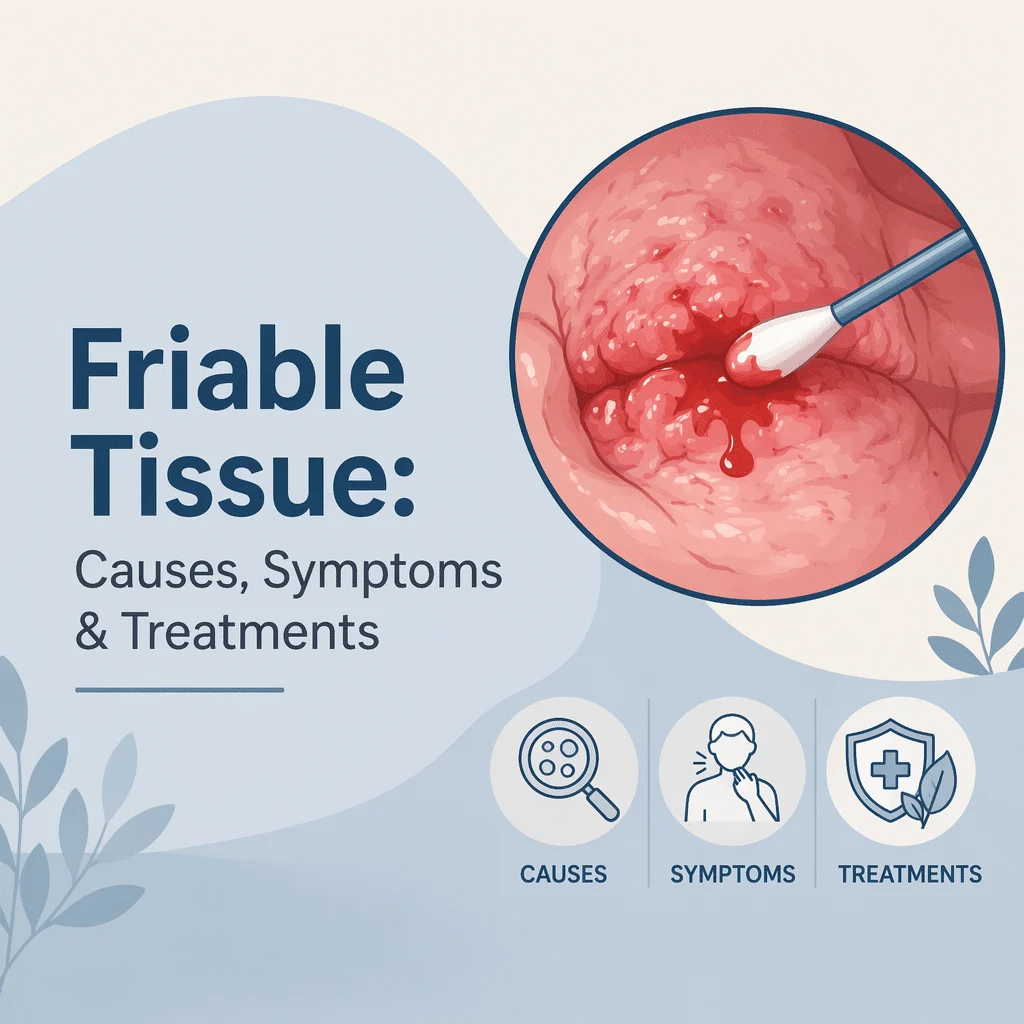
Friable tissue is tissue that is fragile and bleeds easily when something touches it lightly: a swab, a toothbrush, an endoscope, or ordinary contact. If you found the word on a Pap report, a colonoscopy report or a dental chart, the first thing to know is that it describes what the clinician saw, not a disease they diagnosed. The same word can point to harmless irritation in one part of the body and to something that needs prompt attention in another. In this article you will learn what the term means, what makes tissue fragile at the cervix, gums, nose, digestive tract and skin, which blood tests help explain repeated bleeding, and which situations deserve an appointment within the week rather than a wait-and-see approach at home.
What friable tissue means on a medical report
The word friable comes from a Latin verb meaning to crumble. In medicine it describes a surface that breaks or bleeds under minimal pressure. A clinician writes it after watching bleeding start from a light touch: the cervix bleeding as a sampling brush passes, gums bleeding when a dental probe slides along the gum line, the lining of the colon oozing where the scope brushed against it.
A description, not a diagnosis
Friable tissue belongs to the same family of observations as red, swollen or pale. It tells you the surface layer is inflamed, thinned, unusually rich in fragile new blood vessels, or poorly supported by normal clotting. It does not, on its own, tell you why. Two people can have identically fragile tissue from completely different causes: one from a treatable infection, the other from a blood thinner working exactly as prescribed.
What bleeding easily actually looks like
Most people notice one of a few patterns: spotting after sex or after a pelvic exam, pink in the sink after brushing, blood on the tissue after blowing your nose, streaks of blood in stool, or a wound that starts bleeding again at every dressing change. The bleeding is usually small in volume, stops quickly, and returns with the next contact. That repeating pattern, small and contact-triggered, is what pushes clinicians toward fragile tissue rather than a one-off injury.
Friable tissue site by site
Meaning and workup change completely depending on where the fragile tissue sits, which is why a single answer to what does friable tissue mean is never enough. The table below summarizes the sites where the term appears most often, the causes clinicians see most, and the checks that usually follow.
| Site | Common causes | What the clinician usually checks next |
|---|---|---|
| Cervix | Cervicitis from chlamydia, gonorrhea or trichomoniasis; cervical ectropion; polyps; pregnancy or contraception; rarely cervical precancer or cancer | Testing for sexually transmitted infections, Pap and HPV screening status, visual exam, sometimes colposcopy with a biopsy |
| Gums | Plaque-related gingivitis, periodontitis, severe vitamin C deficiency, some medications, low platelet count | Dental exam and professional cleaning, medication review, complete blood count with platelets |
| Nose | Dry indoor air, allergic rhinitis, nasal steroid sprays, anticoagulants, repeated rubbing or picking | Nasal exam, humidification and saline trial, review of blood thinners, clotting tests if bleeding is heavy |
| Digestive tract | Ulcerative colitis, Crohn’s disease, gastritis, infection, radiation proctitis, polyps | Endoscopy or colonoscopy with biopsies, inflammation markers, stool tests, blood count and ferritin |
| Wounds and skin | Normal granulation tissue, stalled or infected chronic wounds, long-term steroids, thin fragile skin with age | Wound assessment, swab or culture, review of steroids and blood thinners, nutritional and protein status |
A friable cervix and bleeding after contact
A friable cervix is the version of this finding people search for most, usually after a routine smear. The tissue around the opening of the cervix bled when the brush or speculum touched it. It is the same observation many people describe as bleeding after sex, which clinicians call contact bleeding or postcoital bleeding.
The usual causes
- Cervicitis, meaning inflammation of the cervix. A 2023 review of infectious cervicitis identifies chlamydia, gonorrhea and trichomoniasis as the organisms most consistently involved, while noting that in many cases no organism is ever found.
- Cervical ectropion, where the softer glandular lining that normally sits inside the canal extends onto the outer surface. It is common in teenagers, during pregnancy and on combined hormonal contraception, and it is not a disease.
- Cervical polyps, small growths that bleed on contact. A 2025 review written for family physicians describes them as almost always benign.
- Hormonal changes. Pregnancy increases blood flow to the cervix and makes it bleed more readily, while low estrogen after menopause thins the tissue instead.
- Cervical precancer and cancer, uncommon in this setting but the reason contact bleeding is always evaluated.
Mayo Clinic sets out in plain language the symptoms and causes of cervicitis. Many people with cervicitis have no symptoms at all beyond what a clinician sees on examination.
How worried should you be about cancer?
Contact bleeding is far more often infection, ectropion or a polyp than cancer. A Danish review published in 2025 followed premenopausal women investigated for bleeding after sex and found cancer in only a very small minority. That is genuinely reassuring, but the reassurance comes from women who were actually examined. Bleeding after sex is not something to watch at home, particularly if you are overdue for screening. Our team explains a normal Pap result with a positive HPV test, and a separate guide covers the prevention and treatment of cervical cancer.
Fragile gums, nose, gut and wounds
Gums that bleed when you brush
Bleeding on brushing is the classic sign of gingivitis: plaque along the gum line inflames the tissue until it bleeds at the lightest touch. Left untreated, gingivitis can progress to periodontitis, which damages the bone anchoring the teeth. MedlinePlus lists the common causes of bleeding gums, from poor brushing technique to medication effects. Severe vitamin C deficiency, still seen in people with very restricted diets, produces swollen purple gums that bleed spontaneously, and it responds quickly to replacement.
A nose that bleeds at the slightest touch
Dry indoor air, allergic rhinitis and nasal steroid sprays all thin and irritate the lining just inside the nostril, where a cluster of small vessels sits very close to the surface. Add an anticoagulant and a light rub becomes a nosebleed. Humidifying the air, using saline gel and aiming steroid sprays away from the central partition solve most cases. Nosebleeds that recur daily, last more than twenty minutes or start on a new blood thinner deserve a medical review rather than another home remedy.
Friable mucosa in the digestive tract
Endoscopy and colonoscopy reports use the word constantly. In ulcerative colitis, friability is part of how activity is graded: a lining that bleeds when the scope touches it counts as active disease, and a lining with no friability is one of the markers of healing. The National Institute of Diabetes and Digestive and Kidney Diseases describes the symptoms and treatment of ulcerative colitis. Gastritis, infections, radiation proctitis after pelvic radiotherapy and polyps produce the same appearance in other parts of the tract. Our library also covers the causes of rectal bleeding and when to seek help, and explains the CRP inflammation marker used to follow bowel disease over time.
Wounds, granulation tissue and fragile skin
Granulation tissue, the bumpy red tissue that fills a healing wound, is naturally packed with new blood vessels and bleeds a little when touched. That is normal healing. Granulation that is dark, overgrown, foul-smelling or bleeding heavily suggests infection or a wound that has stalled, and it needs a wound care review. Skin itself becomes fragile with age, with long-term steroid use and after radiotherapy, which is why minor knocks can tear the skin on the forearms of older adults.
Causes that make every surface fragile at once
Some causes are not local at all. They act throughout the body and can turn ordinary irritation into visible bleeding at several sites at the same time.
- Anticoagulants and antiplatelet drugs such as warfarin, direct oral anticoagulants, aspirin and clopidogrel. They do not make tissue fragile; they make every small bleed last longer and look worse.
- A low platelet count, called thrombocytopenia. Platelets form the first plug at a damaged vessel, so a low count turns a pinprick into prolonged oozing.
- Inherited bleeding disorders, of which von Willebrand disease is the most common. A 2025 study found that bleeding linked to sexual activity is frequent in women living with this condition and is rarely asked about in consultations.
- Liver disease. The liver makes most clotting factors, so advanced liver problems lengthen bleeding time. Our guide explains how to read a liver panel.
- Nutritional deficiencies, especially vitamin C, which is needed to build the collagen supporting small vessels, and vitamin K, which is needed for clotting. Our team also covers the vitamin panel that measures vitamin D, B12 and folate.
- Immunosuppression, from chemotherapy, transplant medication or long-term steroids, which slows tissue repair and raises infection risk at every mucosal surface.
Lab tests that help explain easily bleeding tissue
No blood test diagnoses friable tissue, because the finding is visual. Tests answer the next question: is there a systemic reason the tissue bleeds, and has the bleeding cost you anything?
- Complete blood count with platelets, the first-line test for anemia and for a low platelet count. Our library explains how to read a complete blood count.
- Coagulation testing, which measures how long blood takes to clot. Our guide covers the coagulation panel that reports PT, INR, aPTT and D-dimer.
- Ferritin and iron studies, useful when bleeding has continued for weeks or months, since slow blood loss depletes iron stores long before hemoglobin falls.
- C-reactive protein, which rises with inflammation and helps track bowel and gum disease activity.
- Liver panel, when liver disease or heavy alcohol use is part of the picture.
- Testing for sexually transmitted infections whenever the cervix is involved, since treating an infection often resolves the bleeding entirely.
When friable tissue needs evaluation within the week
Most causes are benign and treatable, but a short list of situations should not wait.
- Bleeding after sex that happens more than once, or any bleeding after menopause.
- Bleeding gums combined with unexplained bruising, or tiny flat red dots on the skin.
- Nosebleeds that recur daily, or any nosebleed lasting more than twenty minutes despite firm pinching.
- Visible blood in stool, black tarry stools, or bleeding with abdominal pain, fever or weight loss.
- A wound that bleeds through dressings, smells bad or stops improving.
- Fatigue, breathlessness or unusual paleness alongside repeated bleeding, which suggests iron loss.
- New bleeding of any kind after starting an anticoagulant, which usually calls for a dose review rather than stopping the drug on your own.
Bleeding that will not stop with direct pressure, heavy vaginal bleeding, or vomiting blood are emergencies and need immediate care rather than an appointment.
Latest scientific advances
Research published in the last three years has sharpened how clinicians handle fragile, easily bleeding tissue. Here is what changed and what it means for you.
Bleeding after sex now has a clear investigation path
A 2023 practice article in a major Canadian medical journal set out a straightforward approach to postcoital bleeding: test for infection, check that cervical screening is up to date, and examine the cervix directly. What this means for you is that a good consultation should include those three steps. If you are told only to keep an eye on it without an examination, it is reasonable to ask for one.
Reassuring numbers on cancer risk, with a condition attached
A 2025 Danish review of premenopausal women investigated for bleeding after sex found cancer in only a very small share of cases. What this means for you is that the odds strongly favor a benign explanation such as infection, ectropion or a polyp. The condition attached is important: that low figure describes women who were assessed, so it is a reason to get checked rather than a reason to skip it.
Cervical polyps are increasingly handled in primary care
A 2025 review for family physicians concluded that cervical polyps are nearly always benign and that many can be assessed, and often removed, without a specialist referral. What this means for you is a faster answer: if a polyp explains the bleeding, the problem is usually settled in one or two visits.
In colitis, absence of friability is now a treatment goal
Large randomized trials of a newer antibody treatment for ulcerative colitis, published in 2024, defined success partly as a bowel lining that no longer bleeds when touched by the scope. What this means for you is that friability on an endoscopy report is not just descriptive language: it is a measurable target, and a follow-up scope showing no friability is real evidence that treatment is working.
For gum disease, thorough cleaning still does the heavy lifting
A 2024 Cochrane review, the kind of review that pools all the trials on a question, examined adding light-activated antimicrobial therapy to standard deep cleaning for gum and dental implant disease. The added treatment showed at best small short-term benefits, and the evidence remains uncertain. What this means for you is that no add-on has yet displaced professional cleaning and daily plaque control as the treatment that reliably stops gums from bleeding.
A bleeding disorder can hide behind contact bleeding
A 2025 study of women with von Willebrand disease, the most common inherited bleeding disorder, reported that bleeding related to sexual activity is common in this group and seldom raised in consultations. What this means for you is that if contact bleeding comes with very heavy periods, easy bruising, prolonged bleeding after dental work, or a family history of bleeding problems, mention all of it together. That combination can point to a diagnosis that a local examination alone would miss.
Glossary
| Term | Definition |
|---|---|
| Friable | Describes tissue that is fragile and bleeds when lightly touched. It is a description of what a clinician sees, not a diagnosis. |
| Contact bleeding | Bleeding triggered by touch, such as after sex, after a pelvic exam or while brushing the teeth. |
| Mucosa | The moist lining of body surfaces such as the mouth, nose, cervix and intestine. |
| Cervicitis | Inflammation of the cervix, often caused by a sexually transmitted infection and frequently symptom-free. |
| Cervical ectropion | A harmless condition in which the softer lining from inside the cervical canal extends onto the outer surface of the cervix. |
| Colposcopy | An examination of the cervix with a magnifying instrument, sometimes including a small biopsy. |
| Granulation tissue | The bumpy red tissue that fills a healing wound. It contains many new blood vessels, so it bleeds easily. |
| Platelets | Small blood cells that clump together to plug a damaged vessel. A low count makes bleeding last longer. |
| Thrombocytopenia | The medical term for a platelet count below the normal range. |
| PT and INR | Prothrombin time and international normalized ratio, two linked measures of how quickly blood clots, used to monitor warfarin and to assess liver function. |
Frequently asked questions
What does friable mean in a medical report?
It means the tissue the clinician looked at was fragile and started bleeding under light contact. The word records an appearance, in the same way as red or swollen. It is not a diagnosis and it does not name a cause. To find the cause, the clinician combines the location, your symptoms, an examination and, when relevant, swabs, biopsies or blood tests. Seeing the word on a report is a prompt to ask what the next step is, not a reason to assume the worst.
Is friable tissue cancerous?
Usually not. Inflammation, infection, dryness, normal healing tissue and blood-thinning medication account for the large majority of cases. Cancers can make tissue bleed on contact, which is why the finding is investigated rather than ignored, but they are a small minority of explanations. The risk depends heavily on the site, your age and other symptoms. Bleeding that is persistent, painless and combined with weight loss or bleeding after menopause deserves prompt assessment.
Does a friable cervix mean cancer?
No. A friable cervix most often reflects cervicitis, a cervical ectropion, a polyp or the hormonal changes of pregnancy or contraception. Studies of women investigated for bleeding after sex find cancer in only a small minority. The important point is that the distinction cannot be made without an examination: the same appearance can have very different causes. Your clinician will typically check your screening history, test for infections and look at the cervix directly.
Can a friable cervix be normal?
In a sense, yes. Cervical ectropion is a normal variant rather than a disease, and it is especially common in teenagers, in pregnancy and on combined hormonal contraception. The exposed glandular tissue is naturally more delicate and can bleed after sex or after a smear. It often needs no treatment at all. It still needs to be identified by someone looking at the cervix, since ectropion cannot be distinguished from other causes on symptoms alone.
Can you have a friable cervix without a sexually transmitted infection?
Yes, and it is common. Many people with cervicitis test negative for chlamydia, gonorrhea and trichomoniasis, and no organism is ever identified. Beyond infection, ectropion, polyps, hormonal contraception, pregnancy, vaginal dryness after menopause and irritation from products or devices can all leave the cervix fragile. A negative infection screen is useful information, not a dead end. It moves the search toward these other explanations.
Does a friable cervix affect pregnancy?
Pregnancy increases blood flow to the cervix and softens it, so light spotting after sex or after an examination is more common than usual and is generally harmless. That said, bleeding in pregnancy should always be reported to your midwife or doctor rather than assumed to be from the cervix, because other causes need to be excluded. Once a fragile cervix is confirmed as the source, no specific treatment is usually required.
Sources
- MedlinePlus, National Library of Medicine — Bleeding gums — https://medlineplus.gov/ency/article/003062.htm
- Mayo Clinic — Cervicitis: symptoms and causes — https://www.mayoclinic.org/diseases-conditions/cervicitis/symptoms-causes/syc-20370814
- National Institute of Diabetes and Digestive and Kidney Diseases — Ulcerative colitis — https://www.niddk.nih.gov/health-information/digestive-diseases/ulcerative-colitis
- Shroff S — Infectious vaginitis, cervicitis, and pelvic inflammatory disease — Medical Clinics of North America, 2023 — https://doi.org/10.1016/j.mcna.2022.10.009
- Ardestani S, Dason ES, Sobel M — Postcoital bleeding — CMAJ, 2023 — https://doi.org/10.1503/cmaj.230143
- Honoré I, et al. — Postcoital bleeding in premenopausal women — Ugeskrift for Laeger, 2025 — https://doi.org/10.61409/V03250162
- Baker E, MacDonald A, Tennant S — Approach to cervical polyps in primary care — Canadian Family Physician, 2025 — https://doi.org/10.46747/cfp.710126
- Louis E, et al. — Risankizumab for ulcerative colitis: two randomized clinical trials — JAMA, 2024 — https://doi.org/10.1001/jama.2024.12414
- Jervøe-Storm PM, et al. — Adjunctive antimicrobial photodynamic therapy for treating periodontal and peri-implant diseases — Cochrane Database of Systematic Reviews, 2024 — https://doi.org/10.1002/14651858.CD011778.pub2
- van Kwawegen CB, et al. — Sexuality and bleeding in von Willebrand disease — Research and Practice in Thrombosis and Haemostasis, 2025 — https://doi.org/10.1016/j.rpth.2025.102712
Further reading
- Low ferritin: causes, symptoms and treatment
- Iron studies panel: ferritin, serum iron, TIBC and transferrin saturation
- Anemia: symptoms, causes, types and how it is diagnosed
- Crohn’s disease: causes, symptoms and treatments
- Chlamydia rash: symptoms, causes and treatment guide
Understand your lab results with AI DiagMe
When tissue bleeds easily, the answer often sits in a handful of ordinary results: a blood count that shows low platelets or anemia, clotting times that explain prolonged oozing, ferritin that reveals slow blood loss, or an inflammation marker that tracks bowel or gum disease. AI DiagMe reads your report and explains what each value means in everyday language, so you arrive at your appointment knowing which numbers matter. It helps you understand your results. It does not make a diagnosis and it does not replace your doctor.
Get your results interpreted in minutes