




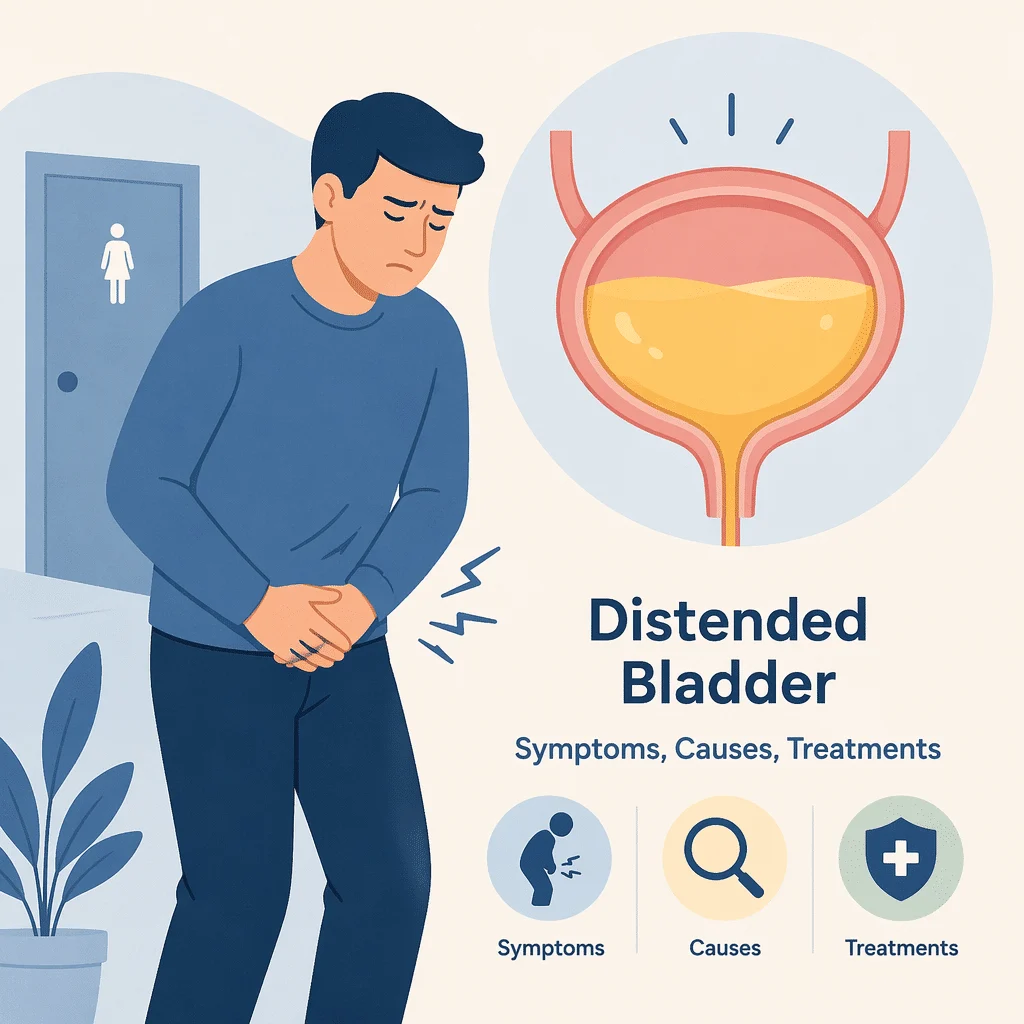
A distended bladder develops when urine builds up and stretches the bladder well beyond its normal size, usually because it cannot empty the way it should. You might feel a tight, uncomfortable fullness low in your belly, struggle to start your stream, or leak small amounts of urine without warning. In some people the problem builds slowly and quietly; in others it arrives suddenly and painfully. This article explains what a distended bladder is, the symptoms and warning signs to watch for, the causes behind it, how doctors diagnose it, and how it is treated. It also flags the one situation that counts as a medical emergency: a sudden, painful inability to pass any urine at all.
What does a distended bladder mean?
The bladder is a muscular, balloon-like organ that stores urine until you are ready to go. A healthy adult bladder comfortably holds around 400 to 600 milliliters, roughly two cups, and the first urge to urinate usually appears once it fills to about 150 to 250 milliliters. A distended bladder is one that has been stretched past this comfortable range because urine keeps collecting faster than it leaves, or because it cannot leave at all.
Doctors sometimes call this bladder distension or an overfilled bladder. It is not a disease in its own right but a sign that something is interfering with normal emptying. The underlying problem is often urinary retention, meaning the bladder holds on to urine that should have been passed. Finding and treating that root cause is what protects the bladder and the kidneys over time.
Acute versus chronic bladder distension
Acute distension comes on quickly. The bladder fills, the urge becomes intense, and yet little or no urine will pass. This is uncomfortable, often severely so, and it needs prompt medical attention.
Chronic distension develops gradually over weeks or months as small amounts of urine are left behind after each trip to the bathroom. Because it builds slowly, some people feel surprisingly few symptoms even when a large volume has collected, which is one reason the problem can go unnoticed until a routine exam or scan reveals it.
Symptoms of a distended bladder
Symptoms depend on how quickly the bladder has stretched and on the cause. Common signs include:
- A feeling of fullness, pressure, or aching low in the abdomen
- Trouble starting the stream, or having to strain to begin
- A weak, slow, or stop-and-start flow
- A sense that the bladder never fully empties
- Passing urine often, but only a small amount each time
- Getting up several times at night to urinate, known as nocturia
- Leaking small amounts of urine without warning, called overflow incontinence
In chronic cases, a swollen bladder can occasionally be felt as a firm bulge low in the abdomen. Because these signs overlap with other urinary problems, a proper evaluation matters. Frequent small voids and dribbling, for example, can be mistaken for a simple overactive bladder when the real issue is a bladder that never drains completely.
Warning signs of acute urinary retention
A sudden and complete inability to urinate, especially alongside a painful, swollen lower belly, is a medical emergency called acute urinary retention. The bladder cannot drain, pressure rises fast, and the discomfort is often intense. Anyone who abruptly cannot pass any urine and feels this kind of pain should seek emergency care without delay, because the bladder needs to be drained promptly to prevent injury.
What causes a distended bladder?
Nearly every cause falls into one of two groups: something is blocking the outflow of urine, or the bladder muscle and its nerves are not working well enough to push urine out. Sometimes both happen at once.
A blockage of the urinary flow
When urine cannot exit freely, it backs up and stretches the bladder. In men, the most common culprit is an enlarged prostate, also called benign prostatic hyperplasia, which squeezes the urethra as the gland grows with age. Other blockages include a narrowed urethra, known as a stricture, from past infection or injury; severe constipation pressing on the bladder neck; and, less often, tumors in the pelvis. Stones near the bladder outlet can also obstruct flow, so doctors may rule out kidney stones.
Nerve and muscle problems, or neurogenic bladder
The bladder depends on a steady conversation between nerves and muscle to squeeze and release at the right moment. When those signals are disrupted, the result is a neurogenic bladder that may not contract strongly enough to empty. Among the nerve-related causes, clinicians frequently see long-standing diabetes. Over years, high blood sugar can quietly damage the nerves that serve the bladder. The same disruption can follow a spinal cord injury, a herniated disc, or a stroke, and it appears in nerve conditions such as multiple sclerosis. In each case urine is retained and the bladder gradually distends.
Medications, surgery, and other triggers
Some medicines reduce the bladder’s ability to contract or tighten its outlet, including certain antihistamines, decongestants, some antidepressants, and opioid painkillers. Retention is also common right after surgery under anesthesia and after childbirth, when swelling, pain, and temporary nerve effects interfere with emptying. These triggers are frequently short-lived, but they can still stretch the bladder enough to need treatment.
| Common cause | Typical clues |
|---|---|
| Enlarged prostate (BPH) | Older man, weak stream, dribbling, gradual onset over years |
| Urethral stricture | Straining to urinate, past infection, injury, or catheter use |
| Neurogenic bladder | Diabetes or a neurological condition, little urge despite a full bladder |
| Medication effect | Symptoms begin after a new drug such as a decongestant or opioid |
| After surgery or childbirth | Difficulty urinating in the hours to days afterward |
| Severe constipation | Hard stools and abdominal fullness alongside the urinary trouble |
Why an untreated distended bladder is risky
A bladder that stays overstretched does not simply bounce back on its own. Over time, holding too much urine can create real complications:
- Urine that sits still is more likely to grow bacteria, which can lead to a urinary tract infection.
- Constant overstretching weakens the bladder muscle, so it contracts even less effectively, a cycle that worsens retention.
- When pressure backs up toward the kidneys, urine can pool there, a condition called hydronephrosis, and, if it continues, injure the kidneys.
- Trapped urine also favors the formation of bladder stones and can, in some cases, cause blood in the urine.
The reassuring part is that these problems are largely preventable when the condition is recognized and its cause is treated. That is why lingering urinary symptoms are worth checking rather than ignoring.
When to see a doctor
Book a medical visit if you regularly strain to urinate, feel that your bladder never empties, wake repeatedly at night to go, or leak urine without warning. Seek emergency care right away if you suddenly cannot urinate at all and your lower abdomen is painful and swollen, or if urinary symptoms arrive with fever, chills, back pain, or vomiting, which can signal an infection or kidney involvement.
How a distended bladder is diagnosed
Diagnosis starts with your story and a physical exam. A clinician asks about your stream, how often you go, your medications, and past surgeries, then feels the lower abdomen, where a distended bladder may be detectable as a rounded firmness above the pubic bone.
The key test is quick and painless: a bladder scan, a small handheld ultrasound that measures how much urine remains after you try to empty. This leftover amount is called the post-void residual, and a high value confirms that the bladder is not draining well. Doctors often add a urinalysis to check for infection or blood in the sample. For a fuller overview of the workup, the National Institute of Diabetes and Digestive and Kidney Diseases outlines the standard steps.
To gauge kidney health, a clinician may order a kidney function panel. The lab will also report your creatinine level and calculate the eGFR filtration rate, two numbers that show how well the kidneys are filtering. In men, doctors may order the PSA blood test and examine the prostate; an abnormal result can prompt further checks for prostate cancer. When the picture is complex, specialized urodynamic tests measure bladder pressure and flow, and a camera exam called cystoscopy looks directly at the urethra and bladder.
How a distended bladder is treated
Treatment has two parts: relieve the immediate pressure, then correct the reason the bladder is not emptying.
For acute urinary retention, the first step is to drain the bladder with a catheter, a thin, flexible tube passed into the bladder to release the trapped urine. This brings fast relief and protects the kidneys. When the outlet is completely blocked or a catheter cannot be passed through the urethra, a temporary tube placed through the lower abdomen, called a suprapubic catheter, may be used instead.
After the bladder is emptied, care shifts to the underlying cause. An enlarged prostate may be treated with medicines that relax or shrink the gland, or with a procedure when medication is not enough. Strictures can be widened or repaired. If a medication is the trigger, a clinician may adjust it. Constipation is managed, infections are cleared, and stones are removed. Steady blood sugar control helps protect bladder nerves in people living with diabetes.
Managing a neurogenic bladder
When nerves are the problem, the goal is to empty the bladder regularly and keep pressure low so the kidneys stay safe. Many people learn clean intermittent catheterization, using a catheter a few times a day to drain the bladder on a schedule. Pelvic floor therapy, timed voiding, bladder training, and specific medications can each play a role. A urologist or a specialized team usually guides this long-term plan.
Can a distended bladder return to normal?
Often, yes, especially when the cause is caught early. Once the obstruction or trigger is treated and the bladder is emptied regularly, a mildly to moderately stretched bladder can regain much of its tone. When distension has been severe or very long-standing, the muscle may not fully recover, and ongoing management may be needed. Early attention gives the bladder the best chance to bounce back.
Latest scientific advances
Research on urinary retention and neurogenic bladder keeps refining how doctors diagnose and manage this condition. Here are a few recent findings, translated into plain language.
How clinicians decide when to drain the bladder is becoming more precise. A 2024 expert panel in the United States built a step-by-step guide recommending that clinicians measure bladder volume with a quick ultrasound scan before reaching for a catheter, and only place one above set volume thresholds. What this means for you: fewer unnecessary catheters and a lower risk of the infections they can cause. (Chrouser and colleagues, JAMA Network Open, 2024.)
The way a bladder is drained may shape recovery, not just infection risk. A 2025 study of more than a thousand people with spinal cord injury found that those managed with intermittent, in-and-out catheters were roughly twice as likely to regain natural bladder control within a year as those with a permanent, indwelling catheter. What this means for you: for many people, scheduled intermittent catheterization is preferred over a long-term indwelling tube. This was an observational study, so it shows a strong link rather than final proof, but it reinforces current practice. (Aude and colleagues, JAMA Network Open, 2025.)
For men, treating an enlarged prostate early can head off retention. A 2025 review reported that combining two common prostate medicines lowers the chance that symptoms progress to urinary retention more than either drug used alone. What this means for you: if you have a slow stream and a gradually distending bladder from prostate enlargement, treatment can do more than ease symptoms; it can reduce the risk of a sudden blockage. (Wei and colleagues, JAMA, 2025.)
Finally, international specialists released new guidance in 2025 for people whose bladder problems stem from neurological disease. The recommendations emphasize simple checks, such as asking about urinary symptoms, keeping a bladder diary, and measuring the post-void residual, the urine left after voiding, and they favor intermittent catheterization for retention while discouraging antibiotics for bacteria found without symptoms. What this means for you: a practical, well-defined roadmap for protecting the bladder and kidneys when nerves are involved. (Panicker and colleagues, European Journal of Neurology, 2025.)
Glossary of key terms
| Term | Definition |
|---|---|
| Distended bladder | A bladder stretched beyond its normal capacity because it cannot empty properly. |
| Urinary retention | The inability to empty the bladder fully or at all; it may be acute or chronic. |
| Post-void residual | The amount of urine left in the bladder right after you try to empty it. |
| Neurogenic bladder | Bladder dysfunction caused by nerve damage or a neurological condition. |
| Benign prostatic hyperplasia (BPH) | A noncancerous enlargement of the prostate that can block urine flow in men. |
| Overflow incontinence | Leaking small amounts of urine because the bladder is too full to hold more. |
| Catheterization | Draining the bladder with a thin, flexible tube called a catheter. |
| Hydronephrosis | Swelling of a kidney when urine backs up and cannot drain normally. |
| Urodynamic testing | Tests that measure bladder pressure, capacity, and urine flow. |
| Nocturia | Waking one or more times during the night to pass urine. |
Frequently asked questions
What does a distended bladder mean?
It means the bladder has filled and stretched beyond its usual size because urine is not leaving properly. The stretching itself is a signal, not a diagnosis. It points to an underlying reason, such as a blockage of the outflow or a nerve or muscle problem that keeps the bladder from squeezing all the urine out. Identifying that cause is the key to treating it and preventing complications.
What causes a distended bladder in women?
In women, common reasons include a neurogenic bladder from conditions like multiple sclerosis or diabetes, pelvic organ prolapse that kinks the outflow, severe constipation, and the temporary retention that can follow childbirth, pelvic surgery, or anesthesia. Certain medications can contribute as well. Because prostate problems are not a factor, evaluation in women focuses on the pelvic floor, the nerves, and any obstruction, guided by a physical exam and a bladder scan.
Is a distended bladder dangerous?
It can be if it is left untreated, because prolonged overstretching may lead to infections, bladder muscle weakness, and, in some cases, kidney strain. The most urgent form is acute urinary retention, when you suddenly cannot urinate at all, which needs emergency care. That said, many cases are caught and treated before harm occurs, and the outlook is generally good once the cause is addressed.
Can a distended bladder return to normal?
Frequently it can, particularly when the problem is found early and the cause is treated. Draining the bladder and keeping it emptied on a regular basis lets a mildly or moderately stretched bladder recover much of its tone. If distension has been severe or has lasted a long time, full recovery is less certain and some people need ongoing management, which is another reason not to delay a check.
Can I treat a distended bladder at home?
A distended bladder is not something to manage on your own, because the trapped urine needs to be released and the underlying cause identified. If you suddenly cannot urinate, treat it as an emergency rather than waiting. For milder, ongoing symptoms, a clinician may suggest measures such as timed voiding or medication review, but these come after a proper assessment, not instead of one.
When is a distended bladder an emergency?
Treat it as an emergency whenever you cannot pass any urine and your lower abdomen is painful and swollen. This is acute urinary retention, and the bladder must be drained quickly to protect it and the kidneys. Also seek prompt care if a distended feeling comes with fever, chills, severe back pain, or vomiting, which may point to an infection or the kidneys being affected.
Sources
- National Institute of Diabetes and Digestive and Kidney Diseases (NIDDK) — Urinary Retention — National Institutes of Health, 2023 — niddk.nih.gov
- Cleveland Clinic — Urinary Retention: Causes, Diagnosis and Treatment — Cleveland Clinic, 2024 — my.clevelandclinic.org
- MedlinePlus — Urination: difficulty with flow — U.S. National Library of Medicine — medlineplus.gov
- Chrouser K, et al. — Urinary Retention Evaluation and Catheterization Algorithm for Adult Inpatients — JAMA Network Open, 2024 — doi.org/10.1001/jamanetworkopen.2024.22281
- Aude CA, et al. — Catheterization Method and Functional Recovery of Neurogenic Bladder in Spinal Cord Injury — JAMA Network Open, 2025 — doi.org/10.1001/jamanetworkopen.2025.22030
- Wei JT, et al. — Lower Urinary Tract Symptoms in Men: A Review — JAMA, 2025 — doi.org/10.1001/jama.2025.7045
- Panicker JN, et al. — EAN, EFAS and INUS guidelines on the assessment and treatment of neurogenic urinary and sexual symptoms — European Journal of Neurology, 2025 — doi.org/10.1111/ene.70119
Further reading
- Bladder cancer: symptoms and warning signs
- BUN-to-creatinine ratio: meaning and levels
- Foamy urine explained: causes and risks
- Urine color: understanding causes and changes
- Erectile dysfunction: causes and related tests
Understand your lab results with AI DiagMe
A distended bladder is often first uncovered through the same tests that reveal what is happening inside your urinary tract. AI DiagMe helps you make sense of results like a urinalysis, your creatinine and kidney function numbers, and a PSA reading, all in clear, everyday language. Understanding these values can help you have a more informed conversation with your doctor about a slow stream or a sense of incomplete emptying. AI DiagMe helps you understand your results; it does not diagnose conditions and does not replace your physician.
Get your results interpreted in minutes