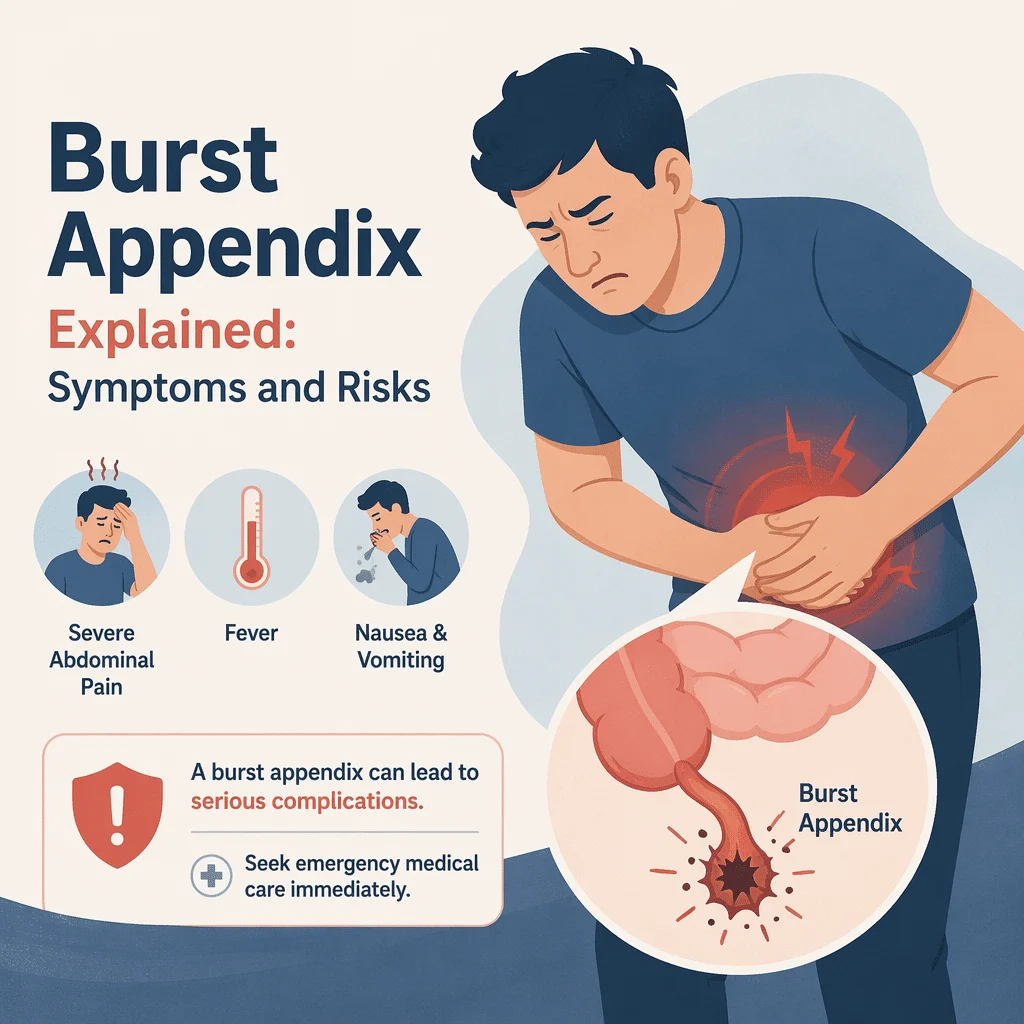
Burst appendix symptoms follow a pattern that catches people out: pain that builds for a day or two, then briefly eases, then comes back worse and spreads across the whole abdomen. That short window of relief is the most dangerous part of the story, because it is the moment many people decide they are getting better and stay home. A burst appendix, also called a ruptured or perforated appendix, is a surgical emergency.
In this article you will learn what happens inside the abdomen when an appendix tears, which signs point to a rupture rather than ordinary appendicitis, who tends to be diagnosed late, what blood tests and imaging can and cannot show, and what recovery realistically involves.
What happens when an appendix bursts
The appendix is a small, finger-shaped pouch attached to the first part of the large intestine, low on the right side of the abdomen. Appendicitis begins when the opening of that pouch is blocked, most often by hardened stool, swollen lymph tissue or, less commonly, a growth. Mucus and bacteria build up behind the blockage, pressure rises, and the wall swells.
As pressure climbs, blood flow to the wall is squeezed off, tissue starts to die and a hole opens. Pus and intestinal bacteria spill into the normally sterile space around the organs. The National Institute of Diabetes and Digestive and Kidney Diseases notes that untreated appendicitis can lead to peritonitis, an infection of the lining of the abdominal cavity, or to a walled-off pocket of pus called an abscess. The same principle applies to other hollow organs, and our team also explains the warning signs of a ruptured gallbladder.
How quickly can an appendix burst?
There is no reliable countdown. The risk of perforation rises with the hours since symptoms began, but it does not switch on at a fixed moment. Cleveland Clinic notes that an appendix can rupture within roughly 36 hours of the first symptoms, which is why surgeons usually aim to operate within a day of diagnosis. The figures repeated online, 48 or 72 hours, are rough clinical generalizations rather than a personal timer, and some appendices perforate sooner. Do not try to time a rupture: persistent, worsening right-sided pain deserves same-day assessment, and pain that spreads or arrives with fever needs emergency care.
Burst appendix symptoms: the pattern that matters
Classic appendicitis starts with vague discomfort around the navel or in the upper abdomen, together with nausea and loss of appetite. Over several hours the pain migrates to the lower right side and becomes sharp and pinpoint. Coughing, walking or a bump in the road makes it worse. If you are working out where lower abdominal pain comes from, this guide covers the causes of a burning sensation in the lower abdomen.
The relief that means the opposite
When the appendix finally tears, the pressure inside it is released. For a short time, sometimes minutes and sometimes a few hours, the sharp localized pain can genuinely feel better. Nothing has healed: infected material is now loose in the abdominal cavity. This deceptive lull is the most important thing to understand about burst appendix symptoms, because it is exactly the point at which people cancel the trip to the emergency department.
What follows: peritonitis
Once the lining of the abdomen becomes inflamed, the picture changes. Pain stops being pinpoint and spreads across the whole belly. The abdominal wall becomes rigid and board-like, and every movement hurts, including coughing and sitting up. Fever climbs, the heart races, and people feel profoundly unwell in a way that ordinary stomach upset does not explain. Vomiting may continue and the abdomen may swell as the bowel stops moving. These are emergency signs.
| Feature | Before perforation | After perforation |
|---|---|---|
| Pain location | Moves from the navel to a single point low on the right | Briefly eases, then spreads across the entire abdomen |
| Abdominal wall | Tender when pressed, but still soft | Rigid, board-like, guarded against any touch |
| Fever | Absent or low grade | Higher and climbing, often with chills |
| Heart rate | Usually normal | Fast, sometimes with low blood pressure |
| General state | Unwell but alert | Visibly ill, exhausted, sometimes confused |
| What to do | Same-day medical assessment | Emergency care immediately |
Who is more likely to arrive with a ruptured appendix
Perforation is not evenly distributed. Some groups reach the hospital later because their symptoms do not look like textbook appendicitis, and any delayed assessment carries the same higher risk.
Young children
Small children cannot localize pain reliably and often show only irritability, refusal to eat, vomiting or diarrhea. Work published in 2024 on delayed diagnosis in children found that some groups are consistently identified later and perforate more often, a reminder that a child who is not improving deserves a second look.
Older adults
Fever and pain responses blunt with age, so an older adult can have a perforated appendix with only a modest temperature and moderate tenderness. A 2024 systematic review of the Alvarado scale, a checklist that scores the likelihood of appendicitis, concluded that it performs less well in older adults, so clinicians lean harder on imaging.
Pregnancy
The growing uterus displaces the appendix upward and outward, so pain often sits higher than expected and is easily attributed to something else. Nausea and a mildly raised white cell count are normal in pregnancy, which blurs the clues further. Ultrasound is the preferred first test, and this guide covers the blood tests used during pregnancy.
What blood tests and imaging can and cannot tell you
This is the honest part that most pages skip. No blood test rules appendicitis in or out, and no blood test proves that an appendix has burst.
White cells and CRP
Most people with appendicitis have a raised white blood cell count with a predominance of neutrophils, the first-responder white cells that surge during bacterial infection. C-reactive protein, released by the liver when inflammation is present, usually rises too and runs higher once the appendix has perforated. Both help, and both are non-specific: a urinary infection, pneumonia or a flare of bowel disease produces the same numbers. A normal white cell count does not exclude appendicitis, particularly in the first hours and in older adults. Our team also explains how to read a complete blood count, the causes of high neutrophil counts, the CRP blood test for inflammation, and the procalcitonin infection marker.
What the research says about single markers
A 2023 scoping review in an emergency medicine journal examined the individual blood markers proposed for separating a complicated appendix from a simple one and concluded that none is ready to be used on its own. A 2024 meta-analysis found that a low blood sodium level is more common when appendicitis is already complicated: an interesting signal, but one clue among many rather than a test.
Scores and imaging
Clinicians combine the story, the examination and the blood results into scoring systems such as the Alvarado score and the AIR score, which rank the probability of appendicitis and guide who needs a scan. The 2024 imaging guidance from the Infectious Diseases Society of America recommends ultrasound first in children and in pregnancy, with CT for most adults and MRI as a radiation-free alternative. Imaging, not blood work, usually shows whether an appendix is inflamed or already ruptured. Other conditions imitate the picture closely, which is why doctors also weigh the symptoms of kidney stones, the symptoms of pancreatitis and, in women of reproductive age, what ovarian cyst measurements mean.
Complications after a rupture
Once bacteria are loose in the abdomen, several things can follow, and they often overlap.
- Abscess: a walled-off pocket of pus near where the appendix sat, often drained through the skin with imaging guidance.
- Peritonitis: widespread inflammation of the abdominal lining, causing the rigid, painful abdomen described above.
- Sepsis: the body’s overwhelming response to infection, affecting blood pressure, kidney function and breathing.
- Ileus: the bowel temporarily stops moving, causing bloating, vomiting and an inability to pass gas or stool.
- Wound infection: more common after surgery for a burst appendix than after a routine appendectomy.
- Adhesions: internal scar bands that form as the abdomen heals and can cause obstruction years later.
Treatment and what recovery involves
Treatment starts with intravenous fluids and antibiotics, followed in most cases by removal of the appendix. Surgery is usually laparoscopic, through small incisions, although an open operation may be needed when infection is widespread. When a large abscess has formed, some teams drain it first and remove the appendix later, once inflammation has settled.
Recovery after a rupture is longer: a longer hospital stay, several days of intravenous antibiotics, sometimes a drain, and a slower return to eating and normal activity. Blood tests are repeated during the stay to track whether the infection is settling, and this guide covers the blood work ordered before surgery.
When burst appendix symptoms need emergency care
Call emergency services or go to an emergency department now if abdominal pain comes with any of the following.
- Severe pain that eased suddenly and then returned worse or spread across the abdomen
- An abdomen that feels hard, rigid or unbearable to touch
- Fever with chills, a racing heart, or feeling faint and clammy
- Repeated vomiting, a swollen belly, or no gas or stool passing
- Pain that stops you standing straight, coughing or walking normally
- Any of the above in a young child, an older adult, a pregnant person, or someone with a weakened immune system
Do not eat, drink or take painkillers or laxatives while waiting for assessment, and do not wait to see whether the pain settles overnight.
Latest scientific advances
Research on appendicitis has moved quickly in the last few years. Here is what it means in practice.
Antibiotics instead of surgery, for a non-burst appendix only
Several teams have tested whether antibiotics alone can treat appendicitis that has not yet perforated. A 2024 meta-analysis pooling randomized trials in adults, and a large international randomized trial in children published in 2025, both found that antibiotics work for a substantial share of people, while a proportion still need an operation later. What this means for you: if appendicitis is caught early and imaging shows no rupture, a non-surgical option may be discussed. It does not apply to a burst appendix, where surgery and antibiotics together remain the standard.
Better use of scans in children
A 2024 pooled analysis compared ultrasound and CT for telling a simple appendix from a complicated one in children. CT gave more accurate answers, but ultrasound performed well enough to stay the sensible first step, because it uses no radiation. What this means for you: an ultrasound first is deliberate, not a shortcut, and a CT or MRI can follow when the answer is unclear.
Drains after surgery: less routine than before
A 2025 Cochrane review examined whether leaving a drain in the abdomen after surgery for a complicated appendix prevents pus collections. The evidence was too uncertain to show a clear benefit, and drains may lengthen the hospital stay. What this means for you: this remains an unsettled area and a case-by-case surgical judgment rather than a rule.
Glossary of key terms
| Term | Definition |
|---|---|
| Appendectomy | The operation to remove the appendix, done either through small keyhole incisions or through one larger opening. |
| Perforation | A hole in the wall of an organ. A perforated appendix is the same thing as a burst or ruptured appendix. |
| Peritonitis | Inflammation and infection of the peritoneum, the thin lining that covers the inside of the abdomen and its organs. |
| Abscess | A pocket of pus walled off by the body. It often needs draining as well as antibiotics. |
| Sepsis | A dangerous, body-wide reaction to infection that can affect blood pressure, breathing and organ function. |
| Neutrophils | The most common type of white blood cell and the first to arrive at a bacterial infection. Their numbers often rise in appendicitis. |
| C-reactive protein (CRP) | A protein made by the liver that rises when inflammation is present anywhere in the body. |
| Alvarado score | A clinical checklist combining symptoms, examination findings and blood results to estimate how likely appendicitis is. |
| Ileus | A temporary halt in the normal movement of the bowel, causing bloating and vomiting. |
Frequently asked questions
How do I know if my appendix has burst?
You cannot confirm it yourself, and that is the point. The pattern that should worry you is severe lower right pain that suddenly eases, then returns worse and spreads, with fever, a fast heartbeat and a rigid abdomen. Only an examination and a scan can tell an inflamed appendix from a ruptured one, so treat that pattern as an emergency rather than something to monitor at home.
Can a burst appendix heal on its own?
No. Once infected material has spilled into the abdomen it does not clear without treatment. Sometimes the body walls the infection off into an abscess, which can look like improvement, but that pocket still needs antibiotics and usually drainage. Untreated peritonitis can progress to sepsis.
Will a normal blood test rule out appendicitis?
No. A normal white blood cell count and a normal CRP make appendicitis less likely, but they do not exclude it, especially in the first hours and in older adults whose inflammatory response is blunted. This is why clinicians combine history, examination, scoring systems and imaging rather than trusting one result. If pain continues after a reassuring blood test, go back and be reassessed.
How long is recovery after a burst appendix?
Longer than after a simple appendectomy. Many people stay in hospital for several days of intravenous antibiotics, and a full return to work, school or exercise usually takes weeks rather than days. Recovery is slower again if an abscess needed draining or an open operation was required. Your surgical team will give you a timeline.
Does a burst appendix cause problems later in life?
Most people recover fully and live normally without an appendix. A minority develop adhesions, internal scar bands that can cause bowel obstruction months or years later, with cramping pain, vomiting and constipation. Persistent abdominal pain after appendix surgery is worth investigating.
Sources
- MedlinePlus Medical Encyclopedia, National Library of Medicine — Appendicitis, 2024 — https://medlineplus.gov/ency/article/000256.htm
- National Institute of Diabetes and Digestive and Kidney Diseases (NIDDK) — Appendicitis: symptoms, causes, diagnosis and treatment — https://www.niddk.nih.gov/health-information/digestive-diseases/appendicitis
- Cleveland Clinic — Appendicitis: signs and symptoms, causes, diagnosis and treatment — https://my.clevelandclinic.org/health/diseases/8095-appendicitis
- Sikander B, Rosenberg J, Fonnes S — Individual biomarkers in the blood are not yet applicable in diagnosing complicated appendicitis: a scoping review — American Journal of Emergency Medicine, 2023 — https://pubmed.ncbi.nlm.nih.gov/36842426/
- Bonomo RA, Tamma PD, Abrahamian FM, et al — 2024 clinical practice guideline update by the Infectious Diseases Society of America on complicated intra-abdominal infections: diagnostic imaging of suspected acute appendicitis in adults, children and pregnant people — Clinical Infectious Diseases, 2024 — https://pubmed.ncbi.nlm.nih.gov/38963819/
- Badlis M, Amari K, Alkheshi M, et al — Ultrasound and computed tomography in differentiating between simple and complicated appendicitis in pediatric patients — Pediatric Surgery International, 2024 — https://pubmed.ncbi.nlm.nih.gov/39520568/
- Shi H, Shen L — Hyponatremia as a predictor of complicated appendicitis: a systematic review and meta-analysis — Biomarkers in Medicine, 2024 — https://pubmed.ncbi.nlm.nih.gov/39360637/
- Trinidad S, Parrado R, Gavulic A, et al — Characterizing inequities in pediatric appendicitis delayed diagnosis and perforation — Journal of Pediatric Clinical Practice, 2024 — https://pubmed.ncbi.nlm.nih.gov/38827485/
- Dominguez-Torres LC, Vega-Pena NV — Diagnostic utility of the Alvarado scale in older adults with suspected acute appendicitis — Cirugia y Cirujanos, 2024 — https://pubmed.ncbi.nlm.nih.gov/38782393/
- Brucchi F, Bracchetti G, Fugazzola P, et al — A meta-analysis and trial sequential analysis comparing nonoperative versus operative management for uncomplicated appendicitis — World Journal of Emergency Surgery, 2024 — https://pubmed.ncbi.nlm.nih.gov/38218862/
- St Peter SD, Noel-MacDonnell JR, Hall NJ, et al — Appendicectomy versus antibiotics for acute uncomplicated appendicitis in children: an open-label, international, multicentre, randomised, non-inferiority trial — The Lancet, 2025 — https://pubmed.ncbi.nlm.nih.gov/39826968/
- Tang Y, Liu J, Bai G, et al — Abdominal drainage to prevent intraperitoneal abscess after appendectomy for complicated appendicitis — Cochrane Database of Systematic Reviews, 2025 — https://pubmed.ncbi.nlm.nih.gov/40214287/
Further reading
- High CRP levels: causes, symptoms and treatments
- CBC vs CMP: what each blood test measures
- Urinary tract infection: symptoms and causes
- Vomiting bile: causes, symptoms and treatments
- Colic in adults: types, causes and red flags
Understand your lab results with AI DiagMe
Suspected appendicitis is decided in an emergency department, not on a website, but the blood work that surrounds it often follows you home. AI DiagMe helps you make sense of results such as a complete blood count, the neutrophil count, C-reactive protein and procalcitonin, in plain language and in context. It is built to help you understand what your numbers mean and what to ask about next. It does not diagnose, and it does not replace your doctor or emergency care.
Get your results interpreted in minutes