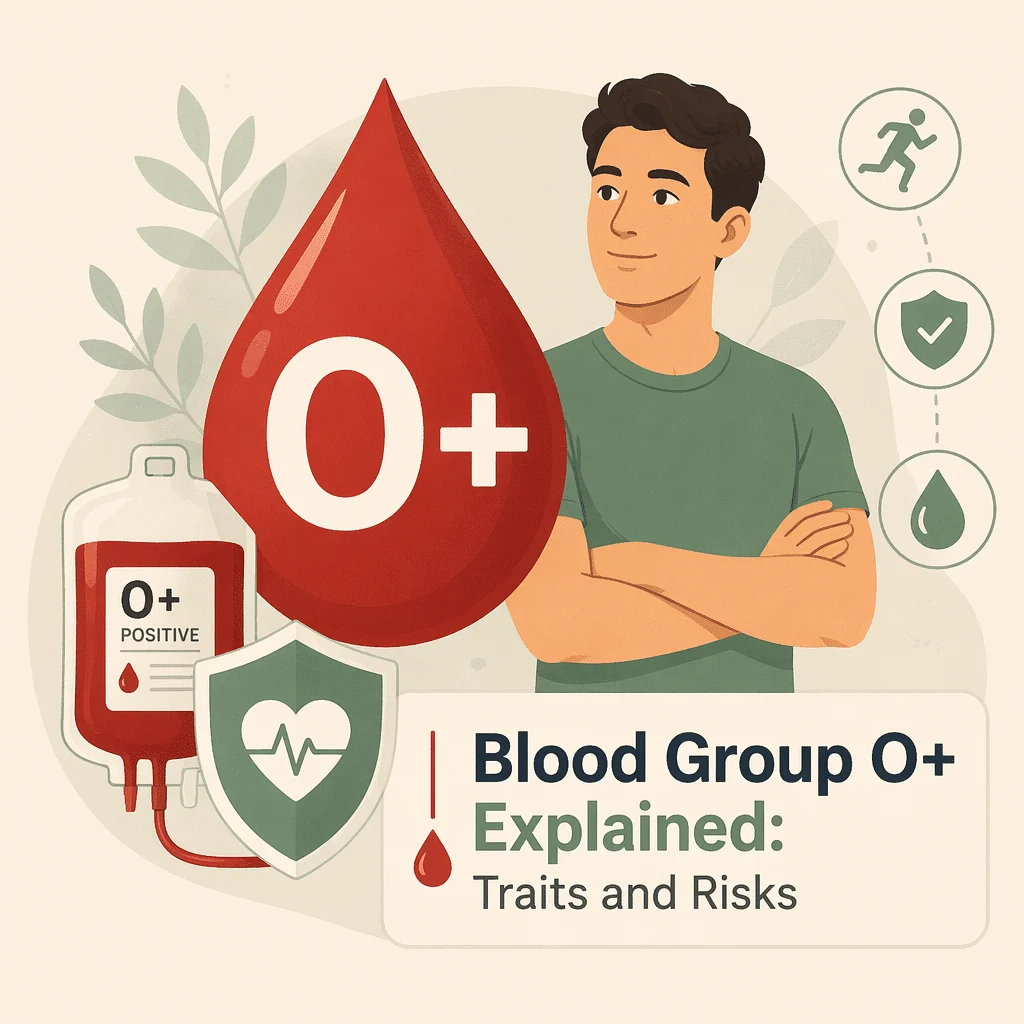
O positive blood is the most common blood type in the United States, and if your lab report reads O Rh positive, you share it with more people than any other group. The label means your red blood cells carry no A or B antigens but do have the Rh(D) protein. That combination shapes who you can give blood to, who you can receive from, and how your blood type is handled in pregnancy. This guide focuses on what is specific to O positive: why it is so common, why blood banks rely on it so heavily, and why being Rh positive is the reassuring side of the pregnancy story. For the basics of what type O means in general, see our guide to blood type O, and for the Rh-negative counterpart, see our guide to O negative blood.
What makes O positive blood different?
O positive brings together two separate blood systems. From the ABO system, the “O” means your red cells display neither the A nor the B antigen. From the Rh system, the “positive” means your cells do carry the Rh(D) protein, the most important Rh marker. So O positive cells are unmarked for A and B, but Rh positive.
That Rh-positive status is the key thing that separates O positive from O negative. It does not change much about everyday health, but it changes two practical things: who can safely receive your red cells, and how your blood type is treated during pregnancy. Both come down to the single Rh(D) protein, which O positive cells carry and O negative cells do not.
For the underlying mechanics of antigens, antibodies, and how O sits beside A, B, and AB, our blood type O guide covers the basics. This article assumes them and concentrates on what is distinctive about being O positive — starting with how common it is.
Why O positive is the most common blood type
O positive is the single most common blood type in the United States, found in roughly 37% of people, according to the Stanford Blood Center. Type O as a whole — O positive plus O negative — accounts for close to half the population, which is why type O sits at the center of almost every blood supply.
Prevalence does vary by ancestry and region. O blood groups are especially common across the Americas, while other ABO types appear more often in parts of Asia and elsewhere. Blood services track these patterns so they can plan collections and keep the right mix of types in stock. You can see how all the groups compare in our overview of the blood groups explained.
Being common has real consequences. Because so many patients are O positive, and because O positive red cells can serve a large share of others, hospitals transfuse more O positive blood than almost any other type. That popularity is exactly why blood banks need a steady stream of O positive donors, even though the type is abundant.
Who O positive blood can help — and what it can receive
For red blood cell transfusions, O positive has a wide reach as a donor and a flexible, though type-O-only, range as a recipient.
| If you are O positive | Red blood cell compatibility |
|---|---|
| Donating to others | All Rh-positive types — O+, A+, B+, and AB+ |
| Receiving from others | O+ and O− (type O, either Rh) |
As a donor, your red cells can go to any Rh-positive recipient, which is most people, since the large majority are Rh positive. That broad usefulness, combined with how common the type is, makes O positive one of the most transfused blood types of all, and an ideal whole blood or double red cell donation.
There is an important distinction from O negative. O positive is not the universal donor: because your cells carry the Rh(D) protein, they should not be given to Rh-negative patients in a planned transfusion. The true universal red cell donor is O negative, which lacks the Rh(D) marker. As a recipient, you have a helpful margin of safety: you can receive type O blood of either Rh, which means both O+ and O− units will work for you.
O positive and pregnancy: why being Rh positive is reassuring
If you are O positive and pregnant, the Rh side of pregnancy is usually the simple part. The well-known Rh problem only affects Rh-negative parents: it happens when an Rh-negative person carries an Rh-positive baby and their immune system makes anti-D antibodies. Because you are Rh positive, your body already treats the Rh(D) protein as its own, so this kind of sensitization does not apply to you, and you will not need anti-D (Rh) immunoglobulin for that reason.
Even so, your blood type is still checked early in pregnancy. Routine prenatal blood tests include ABO and Rh typing and an antibody screen, partly to confirm your Rh status and partly to look for less common antibodies that can occasionally matter.
There is one O-specific point to keep in mind. If you are type O and your baby is type A or B, your natural anti-A or anti-B antibodies can occasionally cause a mild form of newborn jaundice called ABO hemolytic disease of the newborn. It is usually mild and easily managed, and our blood type O guide explains it in more detail. If you happened to be Rh negative instead, the picture would be different — that is the focus of our O negative blood guide.
Donating O positive blood: common but always needed
O positive is in constant demand precisely because it is so widely useful. It is an ideal whole blood and red cell donation, and because it can be transfused to any Rh-positive patient, hospitals go through it quickly. Blood centers frequently list type O as a critical need, even though it is the most common type — an abundance that is matched by equally high demand.
Most healthy adults in the United States can give whole blood about every eight weeks (roughly 56 days), with double red cell donations spaced further apart. Eligibility usually starts at age 16 or 17 depending on the state, along with weight and health requirements. Before donating, the center reviews your health, recent travel, and medications, so it helps to mention any changes.
A few simple habits make the experience easier: drink plenty of water beforehand, eat a normal meal, and rest briefly afterward with a snack. Donating does not change your own blood type or harm your long-term health. For an O positive donor, giving on a regular schedule is one of the most effective ways to support a hospital’s everyday blood supply.
Does being O positive affect your health?
Being Rh positive, on its own, carries no particular health advantage or disadvantage in daily life. It is not something you need to manage outside of transfusion, pregnancy, and donation.
O positive does share the small associations linked to type O in general. People with type O tend to have slightly lower levels of certain clotting proteins, which is linked to a marginally lower risk of some clots and a slightly higher tendency to bleed in rare situations. These effects are minor and rarely change medical care; clinicians assess clotting with a coagulation panel and your overall history, not your blood type. Our guide to blood type O covers these associations in more depth. The practical message for O positive is that your blood type matters in specific clinical settings, not in how you should eat, exercise, or live from day to day.
Knowing and recording your O positive status
Your blood type is confirmed with a quick laboratory test on a small blood sample. Technicians mix your red cells with anti-A, anti-B, and anti-D reagents and watch for clumping; cells that react only with the anti-D reagent, and not with anti-A or anti-B, are reported as O Rh positive. When a result is unclear, labs can confirm it with molecular testing. You can see what the visit involves in our overview of the blood test process, and our guide on how to read blood test results explains how the report is laid out.
It is worth keeping a note of your type — in your patient portal or on a card — because it is useful for donation, pregnancy planning, and procedures. Even so, hospitals always retype a patient before a transfusion rather than relying on a record, card, or tattoo, because the consequences of an error are serious.
When O positive matters most — and when to see a doctor
For everyday life, your blood type has little effect on your health. For O positive, it becomes relevant in a few specific situations:
- Before and during surgery, when a transfusion might be needed — your type is confirmed as part of blood work before surgery
- During pregnancy, for routine ABO and Rh screening
- In emergencies and major trauma, when a fast, safe transfusion is needed
- For organ, bone marrow, or stem cell transplants, where compatibility is checked
- When donating blood, since O positive is one of the most-needed types
Consider talking with a doctor if a lab result confuses you, if you have a personal or family history of unusual bleeding or clotting, or if you are planning a pregnancy and want to understand how your blood type fits in. As always, your blood type is most meaningful when a clinician interprets it alongside your symptoms, history, and other test results — not on its own.
Glossary
| Term | Definition |
|---|---|
| ABO hemolytic disease of the newborn | A usually mild condition in which a type O parent’s anti-A or anti-B antibodies affect a baby with type A or B blood. |
| ABO system | The way blood is grouped into A, B, AB, or O, based on antigens on red blood cells. |
| Antibody screen | A blood test that checks whether a person has formed antibodies against red cell antigens. |
| Antigen | A marker on the surface of a cell that the immune system can recognize as belonging or not belonging. |
| Crossmatch | A lab test that mixes a donor’s and a recipient’s blood to confirm they are compatible before transfusion. |
| Rh positive | Describes blood that carries the Rh(D) protein; most people are Rh positive, as in O positive. |
| Rh(D) antigen | The main Rh protein on red blood cells; having it is what makes a type “positive.” |
| Universal donor | A person whose red cells (O negative, not O positive) can be given to almost any recipient in an emergency. |
Frequently asked questions
Is O positive the rarest or the most common blood type?
O positive is the most common blood type in the United States — found in roughly 37% of people — not a rare one. When you add O negative, the broader type O group makes up close to half the population. So if you are O positive, your type is the one hospitals see and use most often, which is part of why O positive donations are always in demand.
Is O positive a universal donor?
No, and this is a common mix-up. The universal red cell donor is O negative, because it lacks A, B, and Rh(D) markers and can be given to almost anyone in an emergency. O positive carries the Rh(D) protein, so it can be given to Rh-positive patients of any ABO group, but not to Rh-negative patients in a planned transfusion. O positive is extremely useful, but it is not the universal donor.
Can O positive people receive O negative blood?
Yes. If you are O positive, you can receive type O red cells of either Rh — both O positive and O negative work for you. In practice, O negative is usually reserved for patients who can only receive O negative, so you would typically be given O positive when it is available. Either way, hospitals confirm compatibility with a crossmatch before a planned transfusion.
If I am O positive, do I need an anti-D injection during pregnancy?
No. Anti-D (Rh) immunoglobulin is given to Rh-negative parents to stop them from forming antibodies against an Rh-positive baby. Because O positive means you are Rh positive, that concern does not apply to you, and you will not need anti-D for Rh reasons. Your blood type is still checked early in pregnancy, and your care team screens for other antibodies as a matter of routine.
Will my baby be O positive if I am?
Not necessarily. Your child inherits one ABO gene and one Rh gene from each parent, so their blood type depends on both parents, not just you. Two O positive parents are likely to have an O positive or O negative child, but an O parent paired with an A, B, or AB partner can have a child of several types. If you are curious about a specific combination, a clinician or genetic counselor can explain it.
Why is O positive blood always needed if it is so common?
Because demand tracks how widely a type can be used, not just how many people have it. O positive can be transfused to any Rh-positive patient, who make up the large majority, and it is used heavily in surgery, trauma, cancer care, and childbirth. Combined with the fact that it is the most common type among patients too, that broad use means hospitals work through O positive quickly and rely on regular donors to replace it.
Sources
- Stanford Blood Center: Blood Types
- American Red Cross: Blood Types Explained
- MedlinePlus (National Institutes of Health): Blood typing
Further reading
- Blood Type O: Meaning, Risks and Benefits
- O Negative Blood: The Universal Donor, Pregnancy, and Risks
- Understanding the Rh System: Causes & Risks
- Blood Groups Explained: Types, Risks, and Testing
- Blood Tests During Pregnancy: What’s Checked
Understand your lab results with AI DiagMe
Seeing “O Rh positive” on a report is straightforward; making sense of everything around it — from your ABO and Rh grouping to a complete blood count or clotting tests — is harder. AI DiagMe is a tool that explains what your lab results mean in clear, everyday language, so you can ask better questions and feel prepared for your appointments. It is built to support the conversation with your healthcare team, not to diagnose or replace your doctor.
➡️ Get your results interpreted in minutes