



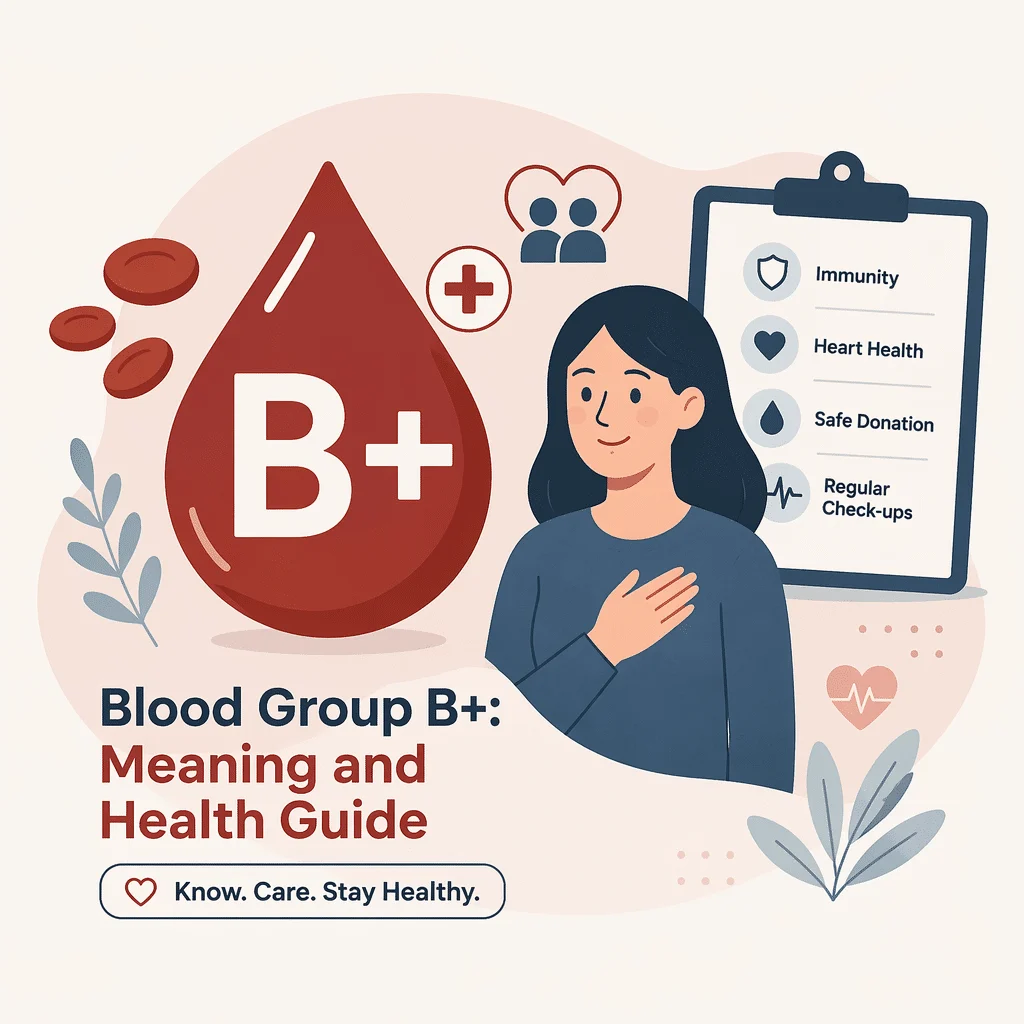
Blood group B positive is one of the more common blood types, found in about 9% of people in the United States, or roughly one person in eleven. It combines the B antigen of the ABO system with a positive Rh status, and that pairing shapes who you can give blood to, who you can receive it from, and what your type means during pregnancy. This article explains what blood group B positive means, how common it is, how it differs from B negative, the rules for transfusion and donation, and the everyday moments when knowing your type helps. For the wider story of the B type, including the popular but unproven personality theory, see our complete guide to blood group B.
In short:
- About 9% of people in the U.S. are B positive, making it one of the more common types.
- B positive patients can receive red cells from four types: B positive, B negative, O positive, and O negative.
- B positive red cells can be given to B positive and AB positive patients.
- As an Rh-positive mother, you do not need anti-D, unlike a B negative mother.
What blood group B positive means: the “B” and the “plus”
Your blood type is set by two separate systems. The first is the ABO system, which sorts red blood cells by the A and B antigens (surface markers) they carry. People in the B group have the B antigen. The second is the Rh system, named for the Rhesus or D antigen. A “positive” result means your red cells do carry the D antigen. Put the two together and you get blood group B positive: B antigen present, D antigen present.
Each system is inherited separately, which is why the B and the plus come from different genes. We cover the ABO biology and the B antigen in our broader blood group B guide, and the Rh side in our explainer on the Rh system. Both the B antigen and the Rh-positive factor are dominant, so a child needs only one copy from either parent to inherit them.
That dominance is why blood group B positive is relatively easy to inherit: if either parent passes a B gene, the child’s ABO type is usually B or AB, and a single Rh-positive gene from either parent makes the child Rh positive. Two B positive parents can still have a child with a different ABO type, because each also carries a second ABO gene that may be O. A genetic counselor can map the specific odds for your family if you are planning a pregnancy.
On a lab report, your type usually appears as a letter and a sign, such as “B Pos” or “B+.” If you are unsure where to find it, our guide to reading blood test results shows where this line sits and what the surrounding values mean.
How common is blood group B positive?
Among the eight main ABO and Rh combinations, blood group B positive sits in the middle of the pack, well above the rarer negative types. U.S. blood-center estimates put it near 9% of the population. Type B overall is more common in people of Asian and African descent than in some other groups, and because the Rh-positive factor is itself common, the B positive combination is far more frequent than B negative.
That relative commonness has a practical side. Because more people are B positive, hospitals use a steady volume of it, so B positive donations are needed regularly to keep supplies healthy. If you want to see how every group compares, our blood groups overview lays out all eight types side by side.
It helps to know where B positive sits relative to the giants. O positive and A positive are the most common types, so B positive is common without being at the very top. It also cannot be given to type O or type A patients, which means it is drawn down mainly by B positive and AB positive recipients. The result is a type that hospitals neither struggle to find nor can take for granted, and one that can still run low during the summer and holiday periods when donations dip.
B positive vs B negative: what the plus sign changes
The only difference between B positive and B negative is the Rh (D) factor. Being Rh positive means your red cells carry the D antigen; being Rh negative means they do not. The B antigen is identical in both. Yet that single difference changes three practical things: how common the type is, the range of blood you can safely receive, and what your status means when you are pregnant.
| Feature | B positive | B negative |
|---|---|---|
| Approximate U.S. frequency | About 9% (roughly 1 in 11) | About 2% |
| Can receive red cells from | B+, B−, O+, O− | B−, O− |
| Can donate red cells to | B+, AB+ | B+, B−, AB+, AB− |
| Rh concern as the mother in pregnancy | None (already Rh positive) | May need anti-D to protect future pregnancies |
If you have followed a relative’s situation and wondered why the advice sounds so different, this is usually why. Our companion article on blood group B negative covers the Rh-negative side in depth, including the preventive anti-D injection that does not apply to B positive mothers.
Transfusion: who B positive can receive from and donate to
Transfusion teams match red cells so the recipient’s immune system does not attack the donated cells. B positive recipients have comparatively flexible options. You can safely receive red blood cells from B positive, B negative, O positive, and O negative donors, since all of these avoid the A antigen and either match or lack the Rh factor in a compatible way. The O negative supply, the universal red cells described in our guide to type O, can serve as a backup in emergencies.
Your own donated red cells go to a narrower group. B positive red cells can be given to B positive and AB positive recipients, including the rarer AB patients.
| Transfusion direction | Compatible red cell types |
|---|---|
| B positive can receive from | B positive, B negative, O positive, O negative |
| B positive can donate red cells to | B positive, AB positive |
Plasma and platelet matching follows different rules, because plasma carries antibodies rather than antigens, so the compatible directions reverse. Before any transfusion, the lab runs a type and screen: it confirms your ABO and Rh type and checks your plasma for unexpected antibodies that pregnancy or previous transfusions can produce. If surgery is ahead, our article on blood work before surgery explains how this fits into your preparation, and a complete blood count is usually part of the same workup. Flexible options do not remove the need to match, so keep a current record of your type for emergencies.
In a true emergency, care may start before your type is confirmed. For a patient already known to be Rh positive, O positive red cells can be used, and when the type is unknown, O negative is the safe default. Once the lab confirms you are B positive, the team switches to type-specific units. This is one more reason that even people with flexible options benefit from carrying their blood type and keeping it in their medical record: it can shorten the window in which only emergency stock is used.
Blood group B positive and pregnancy
For a B positive mother, the headline is reassuring: because you are Rh positive, the Rh-incompatibility problem that drives so much of pregnancy planning for Rh-negative women does not apply to you. You do not need the preventive anti-D injection on Rh grounds, and your Rh status will not cause antibodies against a future Rh-positive baby.
That does not mean blood typing is skipped. Early in pregnancy, your provider still checks your blood type and screens for antibodies as part of a routine prenatal blood panel, because rare antibodies beyond the D antigen can occasionally matter. The baby’s father’s type may also be noted as part of the overall picture.
In practice, a B positive mother can expect a blood type and antibody screen at the first prenatal visit and, in many practices, a repeat screen later in pregnancy. If those screens stay negative, no anti-D is given, because there is no Rh mismatch to prevent. The only time extra steps follow is the uncommon case in which a screen finds an unexpected antibody, which the obstetric team then evaluates on its own merits.
A separate and usually milder issue is ABO incompatibility. This can occur when a type O mother carries a baby who is type A or B, because an O mother naturally carries antibodies against A and B. It can lead to mild newborn jaundice that is monitored and, if needed, treated with light therapy, and it is generally far less serious than Rh disease. For the complete Rh-negative picture and how anti-D works, see our guide to blood group B negative.
Being a blood group B positive donor
Because B positive is common and used in steady volume, B positive donations are valuable and consistently needed. Your red cells help B positive and AB positive patients, and blood centers often encourage B positive donors to give whole blood or platelets, since both are in regular demand. Donating is also a simple way to confirm and document your type if you were never told it.
Eligibility and the best type of donation are decided by the blood center based on your health and travel history and on current needs. Giving on a regular schedule, rather than only during shortages, is the most useful thing a healthy donor can do, because it keeps a common type reliably on the shelf.
Platelet donation is worth a special mention for B positive donors. Platelets are collected in a longer apheresis session that returns your other blood components to you, and because they last only a few days they cannot be stockpiled, so hospitals rely on a steady stream of donors. Whole blood can usually be given about every eight weeks, while platelet donors can give more often. Your blood center will tell you which type of donation, and what schedule, fits you best.
Health and blood group B positive
Being Rh positive is a normal variation and is not, on its own, a cause of disease. Most of the medical relevance of your type lies in transfusion and routine pregnancy care rather than any predisposition to illness.
Researchers have studied links between ABO type and conditions such as blood clots, because people in non-O groups, including B, tend to run slightly higher in certain clotting proteins. Those associations are modest, apply to type B in general rather than to the Rh-positive status, and are covered in our blood group B guide; if your clotting is being assessed, a coagulation panel is the relevant test. For everyday health, well-established factors matter far more than blood type: not smoking, staying active, keeping a healthy weight, and managing blood pressure and cholesterol.
When your blood group B positive status matters
Most of the time your blood type stays in the background. A few moments are worth flagging, because being prepared makes care faster:
- You are scheduled for surgery or a procedure that may need a transfusion; your options are flexible, but the lab still matches your blood.
- You are donating blood and want your common, steadily needed type to reach patients.
- You are pregnant, so routine blood typing and an antibody screen are done even though anti-D is not needed.
- You are in an emergency, where confirming your type quickly speeds safe transfusion.
- You want your records to be right, so the team is not starting from scratch when it counts.
A few habits cover all of these: know your type, carry a blood-type card or wear a medical ID, make sure your electronic health record lists it correctly, and mention it before any procedure. Our guide to blood work before surgery shows how your type fits into the wider plan, and reading blood test results helps you keep track of it.
Glossary
| Term | Definition |
|---|---|
| ABO incompatibility | A usually mild reaction that can occur when a type O mother carries an A or B baby, sometimes causing newborn jaundice. |
| ABO system | The main blood group system, which sorts blood into A, B, AB, and O based on antigens on red cells. |
| Antibody | A protein the immune system makes to find and attack something it sees as foreign, including unfamiliar blood antigens. |
| Antigen | A marker on the surface of a cell that the immune system can recognize as belonging or not belonging. |
| Blood group B positive | A type with the B antigen present and the Rh (D) antigen present on red blood cells. |
| Crossmatch (type and screen) | A lab test that confirms your blood type and checks your plasma for antibodies before a transfusion. |
| Platelets | Cell fragments in blood that help it clot; B positive donors are often asked to give them. |
| Rh (D) factor | A protein on red blood cells; having it means Rh positive, lacking it means Rh negative. |
| Universal red cell donor | A person with O negative blood, whose red cells can be given to any blood type. |
Frequently asked questions
Is B positive a common blood type?
Yes. Blood group B positive is found in roughly 9% of people in the United States, about one person in eleven, which places it among the more common types and well above any of the rarer negative groups. Because so many people share it, hospitals use a steady volume of B positive blood, so donations are needed on a regular basis rather than only during shortages. Knowing your type is still worthwhile for transfusions, surgery, and pregnancy care.
Who can receive blood from a B positive donor?
B positive red blood cells can be given to B positive and AB positive recipients. Both of those groups carry the B antigen or accept it, and both are Rh positive, so they will not react to the Rh factor on your cells. Plasma and platelet matching follows different rules. The blood center decides how each donation is used based on patient needs, but as a red cell donor your contribution most directly helps B positive and AB positive patients.
Can a B positive person receive O positive blood?
Yes. A B positive patient can receive red cells from B positive, B negative, O positive, and O negative donors. O negative is the universal red cell type and is often used in emergencies when there is no time to confirm a patient’s exact group. Having several compatible options is one practical advantage of being Rh positive, although the lab still performs a crossmatch before any transfusion to make sure the specific units are safe for you.
Does being B positive cause any problems during pregnancy?
As a mother, being B positive means you are Rh positive, so the Rh-incompatibility concern that affects Rh-negative women does not apply to you, and you do not need the preventive anti-D injection on Rh grounds. Routine blood typing and an antibody screen are still done early in pregnancy. A separate, usually milder issue called ABO incompatibility can affect a baby when the mother is type O; it is typically managed with monitoring and, if needed, light therapy for jaundice.
Is there a special diet for B positive blood?
No. There is no credible medical evidence that blood type, including B positive, calls for a particular diet. Blood-type diet claims are not supported by reliable research. The better approach is the one recommended for everyone: a balanced diet built around vegetables, whole grains, lean proteins, and healthy fats, with attention to blood pressure, cholesterol, and a healthy weight. If you have specific dietary questions, a clinician or registered dietitian can give advice tailored to you.
Why are B positive blood donors important?
Because B positive is common, hospitals use it in large amounts, and supplies need constant replenishing to stay ready. B positive red cells help B positive and AB positive patients, and B positive donors are also frequently asked to give platelets, which have a very short shelf life and cannot be stockpiled for long. Donating on a regular schedule, rather than waiting for a shortage, is the most reliable way to keep a commonly needed type available for the people who depend on it.
Sources
Further reading
- Blood group B: meaning, traits, and health risks
- Blood group B negative: a guide to a rare type
- Understanding the Rh system
- Blood groups explained: types, risks, and testing
- Blood type O: meaning, risks, and benefits
Understand your lab results with AI DiagMe
Knowing you are B positive is only the start; your type sits alongside many other lines on a lab report. AI DiagMe helps you make sense of results such as your blood typing, an antibody screen, a complete blood count, or a prenatal panel, turning raw numbers into clear, readable explanations. It is built to help you understand your results and prepare better questions for your clinician, not to diagnose or replace medical advice.
➡️ Get your results interpreted in minutes