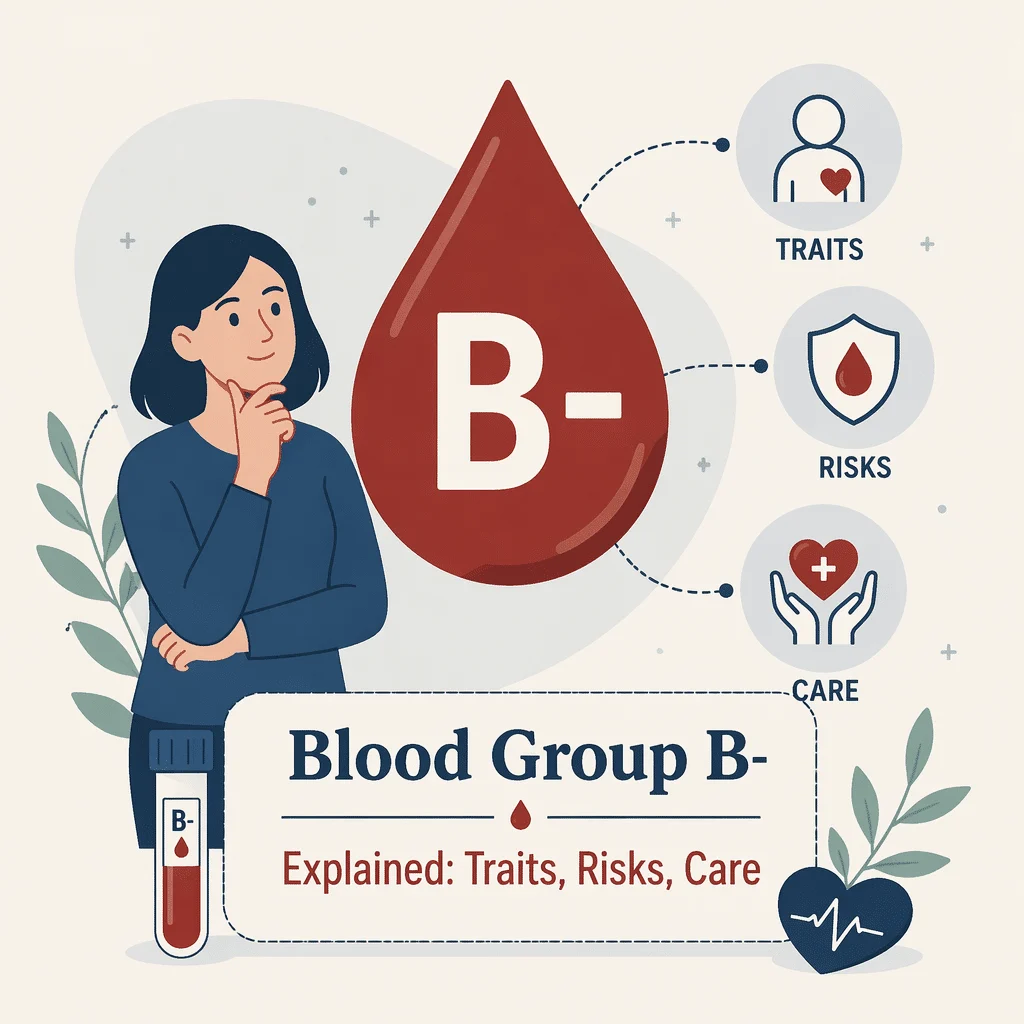
Blood group B negative is one of the rarest of the common blood types, carried by only about 2% of people in the United States. It pairs the B antigen of the ABO system with a “negative” Rh status, and that combination has real, practical consequences for transfusions and pregnancy. This article explains what blood group B negative means, how rare it is, who you can safely give blood to or receive it from, why your Rh status matters during pregnancy, and the everyday steps that help you stay prepared. For the wider story of the B type, including the discredited personality theory, see our complete guide to blood group B.
In short:
- About 2% of people in the U.S. are B negative, making it the second rarest of the main blood types.
- B negative patients can receive red cells only from B negative or O negative donors.
- The “negative” refers to the Rh (D) factor, which matters most during pregnancy.
- A preventive injection called anti-D protects future pregnancies when the mother is Rh negative.
What blood group B negative means: the “B” and the “minus”
Your blood type comes from two separate systems. The first is the ABO system, which sorts red blood cells by the A and B antigens (markers) on their surface. People in the B group carry the B antigen. The second is the Rh system, named for the Rhesus or D antigen. A “negative” result means your red cells do not carry the D antigen. Put the two together and you get blood group B negative: B antigen present, D antigen absent.
Each system is inherited separately, which is why a single person can be “B” for one and “negative” for the other. We keep the ABO biology and the B antigen in our broader blood group B guide, and we cover the Rh side in detail in our explainer on the Rh system. Here, the focus is what the pairing means in practice.
On a lab report, your type usually appears as a letter and a sign, such as “B Neg” or “B−.” If you are unsure how to find it, our guide to reading blood test results walks through where this information sits and what the other lines mean.
Many people also wonder whether they will pass blood group B negative on to their children. Rh-negative status is recessive, so a child is Rh negative only when both parents pass on a non-D version of the gene; if either parent passes a D version, the child is Rh positive. The B antigen is inherited separately through the ABO genes. That is why two Rh-negative parents will have an Rh-negative child, while the child’s ABO type still depends on the exact A, B, or O genes each parent carries. A genetic counselor can walk through the odds for your own family if you are planning a pregnancy.
How rare is blood group B negative?
Among the eight main ABO and Rh combinations, blood group B negative sits near the bottom for frequency. U.S. blood-center estimates put it at roughly 2% of the population, second rarest after AB negative. That scarcity is the single most important fact for blood banks, because supply of rare types runs thin quickly during emergencies.
Type B as a whole is more common in some ancestries than others. Blood centers report that people of Asian and African descent are more likely to carry a B allele, yet Rh-negative status is comparatively uncommon in those same groups. The result is that the specific combination of B and Rh negative stays rare across the population.
| Rh-negative blood type | Approximate share of the U.S. population |
|---|---|
| O negative | ~7% |
| A negative | ~6% |
| B negative | ~2% |
| AB negative | ~1% |
Because the negative types are uncommon and demand is constant, blood centers track these donors closely and send targeted appeals when stocks fall. If you want the full distribution of every group, our blood groups overview lays out all eight types side by side.
Rarity also shapes how hospitals plan. Blood centers may freeze and store rare units for months, maintain rare-donor registries that reach across regions, and, for planned surgeries, arrange for a patient to bank their own blood in advance. These behind-the-scenes systems exist precisely because a type like blood group B negative cannot always be replaced at short notice. For you, the takeaway is simple: the rarer the type, the more it helps to be a known, documented donor and to give the system as much advance notice as possible before any planned procedure.
Transfusion: who B negative can receive from and donate to
Transfusion teams match red cells carefully so the recipient’s immune system does not attack the donated cells. For B negative recipients, the rules are tight. You can receive red blood cells only from B negative donors or from O negative donors, the universal red cell donors described in our guide to type O. Rh-positive blood is generally avoided, because exposure can trigger antibodies that complicate future care.
Your own donated red cells, on the other hand, are widely useful. B negative red cells can be given to B and AB recipients of either Rh status, including the rarer AB patients.
| Transfusion direction | Compatible red cell types |
|---|---|
| B negative can receive from | B negative, O negative |
| B negative can donate red cells to | B negative, B positive, AB negative, AB positive |
Plasma and platelet matching follows different rules, because plasma carries antibodies rather than antigens, so the compatible directions reverse. Hospitals confirm a match with a crossmatch, often called a “type and screen,” before any transfusion. If surgery is on your horizon, our article on blood work before surgery explains how this testing fits into your preparation, and a complete blood count is usually part of the same workup. The simplest thing you can do is keep a current record of your type so emergency teams move quickly.
A type and screen does two things: it confirms your ABO and Rh type, and it screens your plasma for unexpected antibodies. That second step matters for B negative recipients in particular, because pregnancy or previous transfusions can lead the body to form antibodies against red cell markers beyond the D antigen. When the screen is positive, the lab does extra matching to find units that avoid those markers, which can take longer. Sharing your transfusion and pregnancy history helps the blood bank anticipate this and prepare compatible blood ahead of time.
Blood group B negative and pregnancy: the part that matters most
For most people, being B negative rarely affects daily life. Pregnancy is the major exception, and it is worth understanding well. The issue is not the B antigen but the Rh-negative status.
When an Rh-negative mother carries an Rh-positive baby, small amounts of the baby’s blood can cross into the mother’s circulation, most often during delivery. Her immune system may then build antibodies against the D antigen, a process called sensitization. A first pregnancy is usually unaffected. The risk falls on later Rh-positive pregnancies, when those antibodies can cross the placenta and destroy fetal red blood cells, a condition called hemolytic disease of the fetus and newborn.
Care begins with screening. Early in pregnancy, providers check your blood type and look for existing antibodies, often alongside the other tests in a routine prenatal blood panel. A newer option uses a blood test to read the baby’s Rh type from fragments of fetal DNA in the mother’s blood; if the baby is Rh negative, the preventive injection is not needed.
That injection is anti-D, also known as Rh immune globulin or by the brand name RhoGAM. It works only before the immune system has formed antibodies, so timing is everything.
| Situation | Why anti-D may be given | Typical timing |
|---|---|---|
| Routine pregnancy, Rh-negative mother | Fetal blood can cross late in pregnancy | Around 28 weeks |
| After the birth of an Rh-positive baby | The greatest mixing of blood happens at delivery | Within 72 hours of delivery |
| Miscarriage, ectopic pregnancy, or termination | Blood can mix during a pregnancy loss | As soon as possible afterward |
| Amniocentesis, CVS, or turning a breech baby | Procedures can expose maternal blood to fetal cells | At the time of the procedure |
| Abdominal trauma or bleeding in pregnancy | Injury can cause fetal-to-maternal bleeding | Promptly after the event |
Given on schedule, anti-D lowers the chance of sensitization from roughly one in seven at-risk pregnancies to well under 1%. Each pregnancy with an Rh-positive baby needs its own doses; protection does not carry over. Because of a 2024 U.S. shortage of one anti-D product, some providers expanded use of the fetal Rh blood test and turned to alternative anti-D preparations, an example of guidance adapting to real-world supply rather than a change in the underlying science.
In practice, your prenatal team will ask about the baby’s father, because if he is also Rh negative the baby cannot be Rh positive and anti-D may not be needed. When his status is unknown or Rh positive, providers plan as if the baby could be Rh positive. Expect a blood type and antibody check at your first prenatal visit, a repeat screen later in pregnancy, the routine dose around 28 weeks, and a check of the newborn’s Rh type at birth to decide on the final dose. None of this is unusual, and it is among the most successful preventive routines in modern obstetrics.
If antibodies have already formed
Anti-D cannot undo sensitization that has already happened. When a mother already carries anti-D antibodies, the focus shifts to monitoring the pregnancy, usually with antibody level (titer) checks and ultrasound, and to specialist care if signs of fetal anemia appear. This is uncommon today precisely because preventive anti-D is so widely used.
Being a blood group B negative donor
Because the type is scarce and always in demand, B negative donors are valuable. Your red cells can help B and AB patients of either Rh status, and rare Rh-negative units are exactly what hospitals struggle to keep on the shelf during trauma seasons and shortages. Blood centers often encourage B negative donors to give whole blood or a double red cell (Power Red) donation to maximize the red cells collected.
Eligibility and the best donation type are decided by the blood center based on your health and current needs. If you are B negative and able to give, regular donation is one of the most direct ways your blood type can help others. It is also a practical way to confirm and document your type if you were never told it.
Planning ahead with a rare blood type
If you know a hospital stay is coming, a little planning goes a long way with a rare type. For some planned surgeries, doctors can arrange autologous donation, where you give your own blood in the weeks beforehand so your exact type is waiting if a transfusion is needed. In other situations, a relative with a compatible type may be able to give a directed donation aimed at you. Both options need lead time, so the key is to ask your surgical team early rather than on the day of the procedure. Pairing that conversation with an up-to-date record of your blood type gives the care team the best chance of having compatible units ready.
Health risks: what actually matters for B negative
Being Rh negative is not, by itself, linked to chronic disease. It is a normal variation, and the bulk of its medical relevance is the transfusion and pregnancy planning described above rather than any predisposition to illness.
Researchers have studied links between ABO type and conditions such as blood clots, because people in non-O groups, including B, tend to run slightly higher in certain clotting proteins. Those associations are modest, apply to type B in general rather than to the Rh-negative status, and are covered in our blood group B guide; if your clotting is being assessed, a coagulation panel is the relevant test. For day-to-day health, the well-established factors matter far more than blood type: not smoking, staying active, keeping a healthy weight, and managing blood pressure and cholesterol.
When your blood group B negative status matters most
Most of the time you will not think about your blood type at all. A short list of moments is worth flagging, because being prepared makes care faster and safer:
- You are pregnant or planning a pregnancy, so antibody screening and anti-D can be arranged.
- You are scheduled for surgery or a procedure with bleeding risk and may need a transfusion.
- You are in a major accident or emergency, where rare Rh-negative blood can be in short supply.
- You are a newborn’s parent and the mother is Rh negative, so the baby’s Rh type is checked at birth.
- You are donating blood and want your rare type to reach the patients who need it.
A few habits cover all of these. Know your type, carry a blood-type card or wear a medical ID, make sure your electronic health record lists it correctly, and mention it before any procedure. When in doubt, our guide to blood work before surgery shows how your type fits into the wider plan.
Glossary
| Term | Definition |
|---|---|
| ABO system | The main blood group system, which sorts blood into A, B, AB, and O based on antigens on red cells. |
| Antibody | A protein the immune system makes to find and attack something it sees as foreign, including unfamiliar blood antigens. |
| Antigen | A marker on the surface of a cell that the immune system can recognize as belonging or not belonging. |
| Anti-D immunoglobulin (RhoGAM) | An injection that stops an Rh-negative person from making antibodies against Rh-positive blood. |
| Blood group B negative | A type with the B antigen present and the Rh (D) antigen absent on red blood cells. |
| Crossmatch (type and screen) | A lab test that checks a patient’s blood against donor blood for compatibility before a transfusion. |
| Hemolytic disease of the fetus and newborn | A condition in which a mother’s antibodies cross the placenta and destroy the baby’s red blood cells. |
| Rh (D) factor | A protein on red blood cells; having it means Rh positive, lacking it means Rh negative. |
| Rh sensitization | The process by which an Rh-negative person develops antibodies after exposure to Rh-positive blood. |
| Universal red cell donor | A person with O negative blood, whose red cells can be given to any blood type. |
Frequently asked questions
Is blood group B negative the rarest blood type?
It is among the rarest, but not the single rarest. In the United States, AB negative is less common, found in roughly 1% of people, while blood group B negative is in about 2%. That makes B negative the second rarest of the main ABO and Rh combinations. Rarity is one reason blood centers value B negative donors and keep close track of supplies, since uncommon types can run low quickly during emergencies.
Can a B negative person receive B positive blood in an emergency?
Clinicians avoid giving Rh-positive blood to an Rh-negative patient whenever possible, because it can trigger antibodies that complicate future transfusions and pregnancies. In a genuine life-threatening emergency with no compatible Rh-negative units available, a doctor may decide that transfusing Rh-positive blood to save a life is the right call, and then manage the sensitization risk afterward. The decision belongs to the medical team and depends on what is available at that moment.
Does being B negative cause health problems?
Being Rh negative is a normal variation and is not a direct cause of chronic illness. Its main practical importance is in transfusion and in pregnancy, where Rh status guides preventive care. Studies have linked the broader ABO groups to small differences in conditions such as blood clots, but those patterns are modest, cannot predict any one person’s health, and relate to type B in general rather than to the negative status. Everyday risk factors matter far more.
If I am B negative and pregnant, will my baby be affected?
Usually not, especially in a first pregnancy. A problem can arise only if the baby is Rh positive and you have become sensitized, meaning your body has made antibodies against the Rh factor. Routine screening and a well-timed anti-D injection prevent that sensitization in the large majority of cases. Your provider will check your blood type and antibodies early, may test the baby’s Rh type, and will plan anti-D doses accordingly. Discuss your individual situation with your obstetric team.
Do I need a special diet because I am B negative?
No. There is no credible medical evidence that blood type, including B negative, requires a particular diet. Blood-type diet claims are not supported by reliable research. The better approach is the same one recommended for everyone: a balanced diet built around vegetables, whole grains, lean proteins, and healthy fats, with attention to blood pressure, cholesterol, and a healthy weight. If you have specific dietary questions, a clinician or registered dietitian can tailor advice to you.
How do I find B negative blood if I need it?
Hospitals and blood centers maintain inventories and special registries for rarer types, and they issue targeted donor appeals when supplies drop. Because O negative red cells are compatible with B negative recipients, O negative units serve as a backup when B negative is scarce. The most useful thing you can do in advance is keep your blood type documented in your medical record and mention it before any planned procedure so the team can prepare compatible units.
Sources
- American Red Cross — B blood type
- Cleveland Clinic — Rhesus (Rh) factor
- MedlinePlus (NIH) — Rh incompatibility
Further reading
- Blood group B: meaning, traits, and health risks
- Understanding the Rh system
- Blood groups explained: types, risks, and testing
- Blood tests during pregnancy
- Blood type O: meaning, risks, and benefits
Understand your lab results with AI DiagMe
Knowing you are B negative is only the start; your type sits alongside many other lines on a lab report. AI DiagMe helps you make sense of results such as your blood typing, an antibody screen, a complete blood count, or a prenatal panel, turning raw numbers into clear, readable explanations. It is built to help you understand your results and prepare better questions for your clinician, not to diagnose or replace medical advice.
➡️ Get your results interpreted in minutes