
































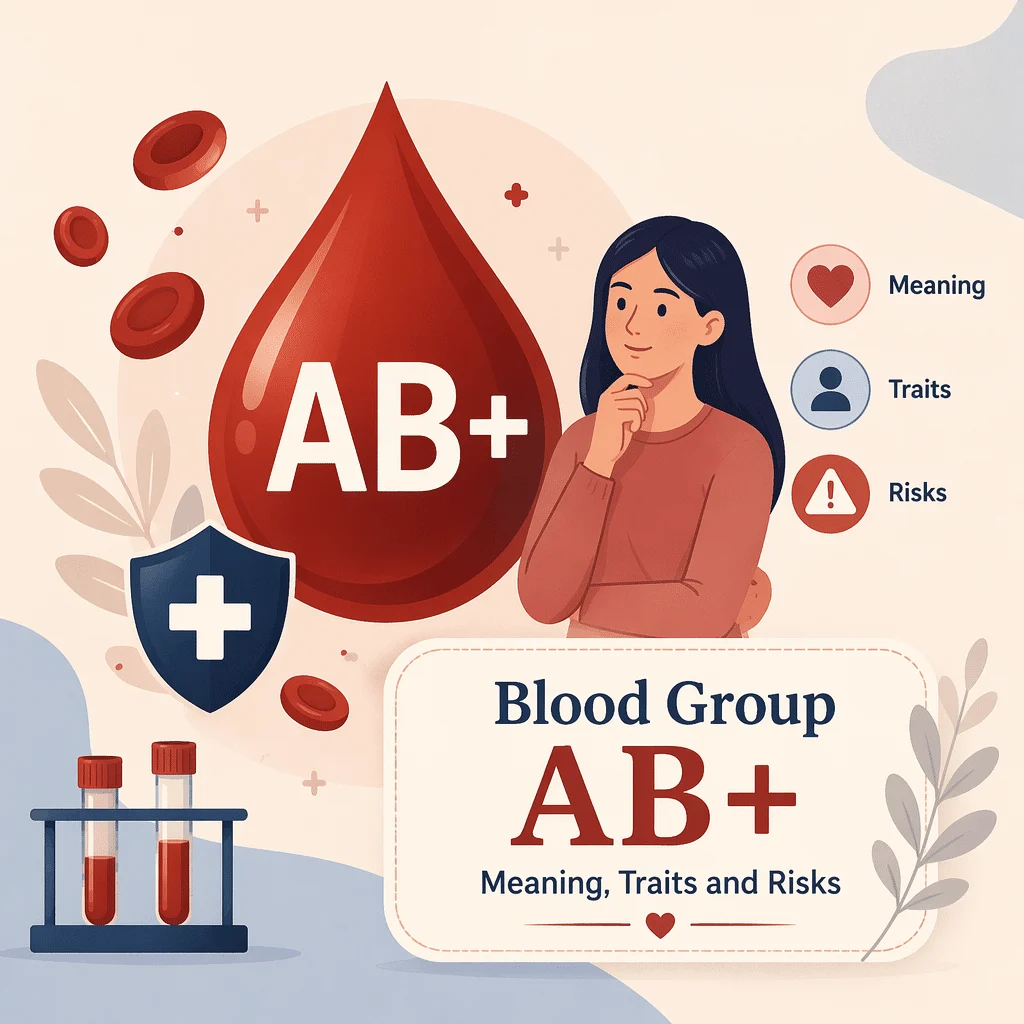
The AB positive blood type is best known for one striking trait: people who have it are universal red cell recipients, able to receive red blood cells from every other blood type. AB positive cells carry both the A and B markers and the Rh D protein, and the plasma usually carries no anti-A or anti-B antibodies. That combination gives AB positive patients the widest transfusion options of any blood type, shapes what their donations are best used for, and even simplifies part of pregnancy care. This guide focuses on what is specific to AB positive: what “universal recipient” really means and its limits, how common the type is, its donor profile, and its role in pregnancy and health. For the broader basics of AB blood, see our guide to blood type AB; for the Rh-negative version, see AB negative.
What does the AB positive blood type mean?
Your blood type combines two systems. The ABO system labels you A, B, AB, or O based on markers called antigens on your red blood cells, and the Rh system adds a positive or negative label based on one more marker, the Rh D antigen. You can see how these ABO and Rh blood group systems fit together across all eight types.
In the AB positive blood type, the AB part means your red cells carry both the A and the B antigen, and the positive part means they also carry the Rh D antigen. Because your cells already display A, B, and Rh D, your immune system has no reason to make anti-A or anti-B antibodies, and your plasma is free of them.
That single fact — antigens present, anti-A and anti-B antibodies absent — is what gives AB positive its two headline features: the widest red cell compatibility of any type, and plasma that is valuable to a broad range of patients. The next sections unpack both.
AB positive at a glance:
- Red cells carry the A, B, and Rh D antigens.
- Plasma usually contains no anti-A or anti-B antibodies.
- Universal red cell recipient: can receive red cells from all ABO and Rh types.
- The more common of the two AB types, but still uncommon overall.
- AB red cells can be donated only to other AB recipients; AB plasma suits any ABO type.
AB positive: the universal red cell recipient
The standout trait of the AB positive blood type is that it makes you a universal recipient for red blood cells. Here is why. On the ABO side, your cells already carry both A and B antigens, so your immune system does not attack A or B donor cells. On the Rh side, you are Rh positive, so you can accept either Rh positive or Rh negative red cells. Put those together and an AB positive patient can receive red blood cells from all eight common blood types: A+, A−, B+, B−, AB+, AB−, O+, and O−.
No other blood type can receive from every other type, which is why “universal recipient” is reserved for AB positive. In practice, it means you usually have the widest pool of compatible units available — a real advantage in trauma, surgery, or any situation where matching blood is in short supply.
The plasma rules run the opposite way. Because AB plasma lacks anti-A and anti-B antibodies, it can be given to recipients of any ABO type, which makes AB donors universal plasma donors. The contrast with blood type O is neat: O negative is the universal red cell donor, while AB is the universal plasma donor.
| Blood component | AB positive (AB+) can receive from | AB positive (AB+) can donate to |
|---|---|---|
| Red blood cells | All eight types: A+, A−, B+, B−, AB+, AB−, O+, O− | AB+ only |
| Plasma | AB plasma | Any ABO type (AB is the universal plasma donor) |
What “universal recipient” does not mean
Universal recipient is a useful headline, not a free pass, and a few limits matter every time.
First, hospitals still type your blood and run a crossmatch — a direct test that mixes a sample of donor and recipient blood — before a planned transfusion. Second, ABO and Rh are not the only markers on red cells; dozens of minor blood group antigens exist, and a previous transfusion or pregnancy can lead you to form antibodies against them. That is why a red blood cell antibody screen is part of pre-transfusion testing even for an AB positive patient. Third, the universal-recipient rule applies to red cells; plasma and platelet matching follow their own logic.
In short, being AB positive widens your options, but safe transfusion still depends on testing, not on the label alone.
How common is the AB positive blood type?
The AB positive blood type is uncommon, though it is the more common of the two AB types. In many populations it accounts for a low single-digit percentage of people — more than AB negative, which is usually under one percent, but less than the more frequent A, B, and O positive types. You can read about the rarer Rh-negative version in our guide to AB negative.
As with all blood types, the numbers shift with ancestry and geography. AB blood overall is more frequent in parts of East and South Asia than in many European and African populations, so the local share of AB positive varies from place to place. Blood centers track these patterns to keep balanced stocks and to know which units may run short.
For everyday life, being AB positive changes little. The type matters most in specific moments — needing a transfusion, donating, or planning a pregnancy — where its particular features come into play.
How is the AB positive blood type inherited?
You inherit the AB positive blood type from two separate gene systems. For ABO, you receive one allele from each parent. The A and B alleles are co-dominant, meaning both are expressed when present, so inheriting an A from one parent and a B from the other produces AB blood.
The positive part comes from the RHD gene, which carries the instructions for the Rh D antigen. Rh positive is dominant: inheriting just one working RHD copy, from either parent, makes you Rh positive. So to be AB positive, you generally inherit an A allele and a B allele for ABO, plus at least one Rh positive gene.
This is why AB positive can appear in families whose parents are not AB, and why an Rh positive child can be born to a parent who quietly carries an Rh negative gene. Family history offers clues, but only laboratory typing confirms a person’s actual ABO and Rh type. You can compare how the parent groups behave in our guides to blood group A and blood group B.
Being a donor with AB positive blood
There is an interesting mirror image to the universal-recipient story. While AB positive patients can receive red cells from anyone, AB positive donors can give red cells to very few people: only other AB positive recipients can accept them, because AB red cells carry both A and B antigens that other groups would react against. So as a red cell donor, AB positive is the most limited type.
Plasma is where AB donors shine. Because AB plasma has no anti-A or anti-B antibodies, it can be transfused to patients of any ABO type, often in emergencies before full typing is complete. For that reason, blood services frequently steer AB donors toward plasma, and AB plasma is in steady demand. AB plasma also helps stock the type used when patients need plasma before their own type is known.
If you have AB positive blood and want your donation to help the most people, ask your local blood service about plasma donation. Before any donation, your complete blood count and hemoglobin level are checked to confirm you are fit to give.
AB positive and pregnancy
Pregnancy is usually more straightforward for the AB positive blood type than for an Rh negative type, and the reason is the positive Rh status. Because you already carry the Rh D antigen, your body will not be sensitized by an Rh positive baby, so you generally do not need anti-D immune globulin (Rh immunoglobulin) for your own Rh status — the preventive injection that Rh negative mothers receive. The overview of the Rh system explains that contrast in more detail.
On the ABO side, AB mothers naturally lack anti-A and anti-B antibodies, so ABO-related hemolytic disease of the newborn — when a mother’s antibodies attack the baby’s red cells — rarely starts with an AB mother. ABO incompatibility is most often a concern when the mother is type O.
None of this removes the need for routine care. Every pregnancy includes blood typing and an antibody screen, usually early on, because a person can still carry other red cell antibodies from a past transfusion or pregnancy that could affect the baby. See how these fit into the schedule of blood tests during pregnancy, and always tell your prenatal team your blood type.
AB positive and your health
On its own, the AB positive blood type does not cause disease. Like other non-O groups, AB has been studied for small differences in disease risk. On average, non-O blood types — including AB — carry higher levels of certain clotting proteins, such as von Willebrand factor and factor VIII, which may slightly raise the tendency to form blood clots compared with type O. Findings on infection and specific cancers are mixed and modest.
These are population averages, not personal predictions, and the size of any added risk is small next to the factors you control. Staying active, not smoking, managing blood pressure, and keeping an eye on high cholesterol shape your long-term health far more than your blood type. If your doctor is assessing heart risk, a cardiac markers panel tells them much more than your ABO and Rh type alone.
Making the most of being AB positive
Knowing you have the AB positive blood type lets you turn its traits into a few simple, practical habits.
- Keep the reassurance in perspective. As a universal red cell recipient you have wide transfusion options, but your team will still type and crossmatch your blood, so keep your type on a health document or phone medical ID anyway.
- Donate where you help most. If you are eligible, consider plasma donation, since AB plasma can help patients of any type while AB positive red cells reach a smaller group.
- Plan pregnancy with less Rh worry. Being Rh positive means you generally will not need anti-D injections, but still attend prenatal visits for routine typing and antibody screening.
- Share your history. Tell your care team about any past transfusions, pregnancies, or known antibodies, since these can change how your blood is matched despite the universal-recipient label.
If you have a recent lab report and want to understand your blood type alongside the rest of your results, our guide on how to read your blood test results walks through it step by step. And contact your doctor promptly if you ever have a suspected transfusion reaction or are told an antibody screen came back positive.
Glossary
| Term | Definition |
|---|---|
| ABO blood group system | The main system that sorts blood into types A, B, AB, and O based on A and B antigens. |
| Antibody screen | A blood test that checks plasma for unexpected antibodies that could react against donor or fetal red cells. |
| Antigen | A marker on the red blood cell surface that the immune system uses to tell its own cells from foreign ones. |
| Crossmatch | A direct lab test that mixes donor and recipient blood to confirm they are compatible before a transfusion. |
| Hemolytic disease of the newborn (HDN) | A condition in which a mother’s antibodies cross the placenta and break down the baby’s red blood cells. |
| Rh D antigen | A protein on red blood cells that makes blood Rh positive when present and Rh negative when absent. |
| Rh immunoglobulin (anti-D) | A preventive injection given to Rh negative people, mainly in pregnancy, to stop them from forming anti-D antibodies. |
| Universal plasma donor | A person whose plasma lacks anti-A and anti-B antibodies, so it can be given to any ABO type; people with AB blood. |
| Universal recipient | A person who can receive red blood cells from every ABO and Rh type; people with AB positive blood. |
| von Willebrand factor | A blood clotting protein that tends to run higher in non-O blood types, including AB. |
Frequently asked questions
Is AB positive the universal recipient for everything?
Not for everything — the term applies to red blood cells. Because AB positive cells carry A, B, and Rh D antigens and the plasma lacks anti-A and anti-B antibodies, an AB positive patient can receive red cells from any ABO and Rh type. Plasma and platelet transfusions follow different matching rules, so “universal recipient” does not extend to every blood product. And even for red cells, your team still types your blood and runs a crossmatch, because minor antigens beyond ABO and Rh can occasionally cause reactions. The label widens your options; it does not replace testing.
Can AB positive blood receive O negative blood?
Yes. O negative red cells carry no A, B, or Rh D antigens, so they are compatible with every blood type, including AB positive. In fact, O negative is the emergency blood given before a patient’s type is confirmed. As an AB positive recipient you can also receive O positive, A, B, and AB units, whether Rh positive or Rh negative, which is what makes you a universal red cell recipient. Your care team still confirms each match with typing and a crossmatch when time allows.
Why can’t AB positive donate red cells to other blood types?
Because AB red cells carry both the A and the B antigen. A person with type A blood has anti-B antibodies, a person with type B has anti-A, and a person with type O has both, so their immune systems would attack AB red cells. That limits AB positive red cell donations to other AB positive recipients. It is the trade-off behind being a universal recipient: you can receive from everyone, but your red cells suit very few. Your plasma, on the other hand, can help patients of any ABO type.
Is AB positive a rare blood type?
AB positive is uncommon, but it is the more common of the two AB types. It usually appears in a low single-digit percentage of people — more often than AB negative, which is generally under one percent, but less often than the more frequent A, B, and O positive types. Exact figures vary by ancestry and region. So while AB positive is not among the most common blood types, it is far from the rarest. Knowing your exact type matters more for your care than where it ranks for rarity.
Does an AB positive mother need the anti-D (RhoGAM) shot in pregnancy?
Usually not for her own Rh status. Anti-D immune globulin (often called RhoGAM) is given to Rh negative mothers to prevent them from forming anti-D antibodies against an Rh positive baby. Because an AB positive mother is already Rh positive, that specific risk does not apply, so the routine anti-D injection is generally not needed. Even so, every pregnancy includes blood typing and an antibody screen, since other red cell antibodies can still be present. Your provider tailors monitoring to your situation.
Can AB positive donate blood to an AB negative person?
Not for red cells. AB positive red cells carry the Rh D antigen, and giving Rh positive cells to an Rh negative recipient can prompt them to form anti-D antibodies, so AB positive red cells go only to AB positive recipients. An AB negative person should receive Rh negative red cells. Plasma rules differ, since AB plasma lacks anti-A and anti-B antibodies and can be used broadly. As always, the transfusion service confirms compatibility with typing and a crossmatch before any transfusion.
Sources
- Johns Hopkins Medicine — Blood transfusions in adults
- Cleveland Clinic — Blood transfusion
- MedlinePlus (NIH) — Red blood cell antibody screen
Further reading
- Blood type AB: meaning, traits, and health risks
- AB negative blood type: meaning, rarity, and risks
- Understanding the Rh system
- Blood type O: meaning, risks, and benefits
- The four ABO blood groups explained
Understand your lab results with AI DiagMe
Your AB positive result is one line on a lab report that usually holds much more. AI DiagMe can read the rest of your results and explain them in plain language — from your blood typing and Rh status to an antibody screen, a complete blood count, or a lipid panel for heart-health risk. It turns dense abbreviations and numbers into clear, useful insights and suggests questions to raise with your clinician. AI DiagMe helps you understand your results; it does not diagnose conditions or replace your doctor. Upload your report to see what your results mean.
➡️ Get your results interpreted in minutes