
































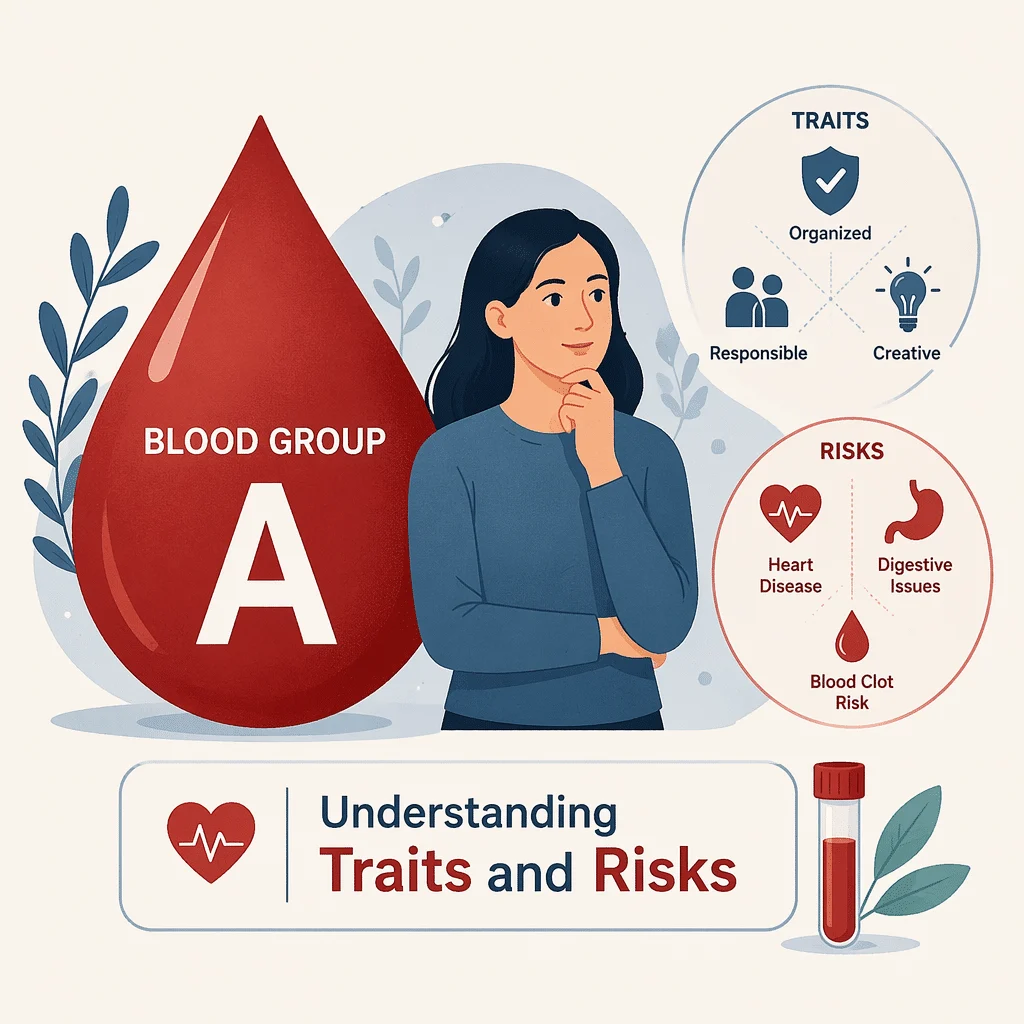
Blood group A is one of the four main ABO blood types, and it simply means your red blood cells carry a marker called the A antigen. If you have just learned your type, or you are curious about what it says about your health, this guide explains the essentials in plain language. You will learn how blood group A is defined, how you inherit it, how common it is, and what research really shows about its links to clotting, cancer, and infection. We also cover transfusion and pregnancy facts, how to confirm your type with a simple test, and when your blood type actually matters to your care. The goal throughout is clear, balanced information, not alarm: your blood type is one small piece of a much larger health picture.
What blood group A means
Blood group A describes blood whose red cells display the A antigen on their surface. An antigen is a molecule the immune system can recognize as “self” or “foreign.” Your blood type is part of the wider ABO system of four main blood groups, alongside B, AB, and O.
People with blood group A also carry anti-B antibodies in the liquid part of their blood (the plasma). These antibodies are described as naturally occurring, which means they are present without any prior transfusion. They form in early infancy and stand ready to attack any red cells that show the B antigen.
A antigen plus Rh factor make your full type
Your complete blood type combines two separate systems. The first is the ABO system (A, B, AB, or O). The second is the Rh factor, a protein that is either present (positive) or absent (negative).
When you put these together, blood group A splits into two everyday types: A positive (A+) and A negative (A−). So “blood group A” is the ABO half of the label, while the plus or minus sign records your Rh status.
How your immune system reads blood antigens
Your immune system constantly checks cell surfaces and tolerates the antigens it recognizes as your own. If it meets an unfamiliar antigen, it can mount a defense. This is exactly why blood typing matters before a transfusion.
If someone with blood group A received type B red cells, their anti-B antibodies would attack the donor cells and trigger a transfusion reaction, which can be serious. Matching donor and recipient prevents this, and it is the foundation of safe transfusion medicine.
Genetics: how you inherit blood group A
Your ABO type is set by a gene on chromosome 9, and you inherit one copy from each parent. The A version of the gene codes for an enzyme (a glycosyltransferase) that attaches the A-type sugar to red cells. The O version is inactive and adds no sugar, which is why O cells carry neither the A nor the B antigen.
In genetic terms, A is dominant over O. That means you are blood group A if you inherit either two A copies (genotype AA) or one A and one O copy (genotype AO). A and B are co-dominant, so inheriting one A and one B produces type AB.
This explains some family surprises. Two parents who are both blood group A but who each carry a hidden O copy can have a child with type O blood. They cannot, however, have a type B or AB child, because neither parent carries a B copy.
The A1 and A2 subtypes
Blood group A is not entirely uniform. Most people with type A belong to a subgroup called A1, while a smaller share belong to A2, which expresses the A antigen more weakly. For everyday life this distinction rarely matters, but blood banks occasionally take it into account during careful crossmatching, especially for repeat transfusions.
How common is blood group A?
The share of people with blood group A varies a great deal by region and ancestry. In the United States, type O is the most common group, with type A the next most common. Type A is also widespread across much of Europe, while other regions carry higher proportions of type B or O.
These patterns are not just trivia. Blood centers and hospitals track local blood-type distribution so they can keep the right mix of donations on the shelf. Because supply has to match demand, donors with common and rare types alike play an important role in a stable, balanced blood inventory.
Blood group A and your health: what the evidence shows
Researchers have studied blood type and disease for more than a century, and a handful of associations are now well documented. It is important to read these the right way. They are population-level statistical links, usually modest in size, and they never determine any one person’s fate.
For almost every condition below, factors such as age, family history, smoking, diet, blood pressure, and other lab markers matter far more than your ABO type. Blood group A is not a diagnosis, a screening test, or a reason for worry.
| Condition | What research suggests for blood group A | How strong is the link | What this means for you |
|---|---|---|---|
| Venous blood clots (DVT, PE) | A modestly higher relative risk than type O | Consistent across studies, but the effect is small | Mobility, surgery, hormones, and family history matter far more |
| Stomach (gastric) cancer | A small increase in risk | Long observed but modest | H. pylori infection and diet are the main drivers |
| Pancreatic cancer | A slightly higher risk than type O | Modest | Smoking and family history dominate the risk |
| COVID-19 and some infections | Possible small differences in susceptibility | Mixed and inconsistent | Standard prevention applies to everyone, regardless of type |
Clotting and the heart
The clearest link involves blood clotting. People with non-O blood groups, including A, tend to have higher levels of two clotting proteins, von Willebrand factor and factor VIII. On average this nudges up the risk of clots in the veins, such as deep vein thrombosis and pulmonary embolism.
The increase is real but modest, and the absolute risk for most people stays low. If you have a personal or family history of clots, your doctor may order a coagulation panel to look at how your blood clots, rather than focusing on your blood type alone.
Cancer associations
Since the early days of blood-type research, group A has been linked with a slightly higher risk of stomach cancer. The dominant cause of gastric cancer, however, is long-term infection with the bacterium Helicobacter pylori, not your ABO type.
Non-O groups, including A, also show a small increase in pancreatic cancer risk in large studies. Again, the effect is modest and is far outweighed by smoking, age, and family history. None of these associations changes routine screening recommendations for an average person.
Infections and immunity
Some studies have explored whether ABO type affects infection risk, including reports during the COVID-19 pandemic that type A might carry a slightly higher susceptibility and type O a slightly lower one. The findings have been mixed and inconsistent, and any effect appears small.
The practical takeaway is simple. Proven prevention, such as vaccination where appropriate and good hygiene, applies to everyone regardless of blood group A status. Your type does not earn you more or less protection in daily life.
Does the “blood group A diet” hold up?
You may have read that people should eat according to their blood type, with specific foods for group A. This idea, popularized in the 1990s, claims your ABO type dictates which foods you digest best.
Independent research has not supported it. No major medical or nutrition authority recommends changing your diet based on ABO type. Studies that found health benefits from these eating plans linked the benefits to the healthy foods themselves, not to anyone’s blood type.
A balanced diet, regular activity, and managing conditions such as high blood pressure or cholesterol are what reliably protect your health. Those principles are the same whether you are blood group A, B, AB, or O.
Donation and transfusion for blood group A
Blood typing is the backbone of safe transfusion. People with blood group A can give red cells to other A recipients and to AB recipients, as long as the Rh factor is compatible. They can receive red cells from group A and from group O.
The exact rules depend on your Rh status, as summarized below for red blood cells.
| Your blood type | Can receive red cells from | Can donate red cells to |
|---|---|---|
| A positive (A+) | A+, A−, O+, O− | A+, AB+ |
| A negative (A−) | A−, O− | A+, A−, AB+, AB− |
Two more points are worth knowing. First, plasma compatibility runs in the opposite direction to red cells, which is why type AB is the universal plasma donor, while the universal red cell donor is O negative. Second, before any transfusion, a laboratory performs a crossmatch and an antibody screen to confirm compatibility. The same type-and-screen testing is part of routine blood work before surgery. In a true emergency, when there is no time to confirm a type, O negative red cells can be given safely.
Blood group A in pregnancy and newborns
During pregnancy, prenatal care routinely checks both your ABO group and your Rh factor. These results are recorded early and help your care team plan for a safe delivery. You can see how this fits with other prenatal checks in our guide to blood tests during pregnancy.
Two different kinds of incompatibility can matter. Rh incompatibility occurs when an Rh-negative mother carries an Rh-positive baby. So a mother with blood group A negative may be monitored for this, and she can receive a protective injection (Rh immune globulin) to prevent her immune system from reacting in current and future pregnancies.
ABO incompatibility is a separate issue and is usually mild. It is most relevant when the mother is type O and the baby is A or B. When it does cause hemolytic disease of the newborn, the result is often limited to jaundice that resolves with simple treatment such as light therapy. Providers screen for these situations and manage newborns accordingly, so most babies are entirely unaffected.
How to find out your blood type, and when it matters
Knowing whether you are blood group A is easy, and the information can be genuinely useful in an emergency or during pregnancy.
The blood typing test
Your blood group is confirmed with a simple blood typing test at a clinic, hospital, or blood center. The laboratory checks your red cells for the A and B antigens and also checks your plasma for antibodies, then records your ABO and Rh result. You can read what a blood draw involves in our overview of the blood test process.
A few practical notes help. A routine complete blood count does not reveal your ABO type, because it counts cells rather than identifying antigens, so blood typing has to be requested specifically. Direct-to-consumer kits exist, but their accuracy varies, so it is wise to confirm any home result with a laboratory. Donating blood is another reliable way to learn your type. Whatever the route, keep a copy of your official result for your records.
When your blood type actually matters
For day-to-day life, being blood group A requires no special action, and there is nothing to “treat.” Your type becomes important mainly in specific situations: before a planned transfusion or surgery, during pregnancy, and if you are managing a personal or family history of blood clots.
Some symptoms always deserve prompt medical attention regardless of blood type. Sudden swelling or pain in one leg, sudden shortness of breath, or chest pain can signal a blood clot and should be treated as an emergency. Persistent digestive symptoms, unexplained weight loss, or any worrying change should be discussed with your doctor. The right response is never to change your health habits based on your blood type alone, but to focus on the proven risk factors that apply to everyone.
Glossary
| Term | Definition |
|---|---|
| A antigen | The surface marker on red blood cells that defines blood group A. |
| ABO blood group system | The main blood-typing system that sorts people into A, B, AB, or O. |
| Anti-B antibodies | Proteins in the plasma of group A blood that attack red cells carrying the B antigen. |
| Crossmatch | A laboratory test that mixes donor and recipient blood to confirm they are compatible. |
| Glycosyltransferase | The enzyme, coded by the A gene, that builds the A antigen on red cells. |
| Hemolytic disease of the newborn | A condition in which a mother’s antibodies attack a baby’s red cells; from ABO it is usually mild. |
| Rh factor | A separate antigen, recorded as positive or negative, that matters for transfusion and pregnancy. |
| Von Willebrand factor | A clotting protein that tends to run higher in non-O groups, including A. |
Frequently asked questions
Is blood group A the same as A positive?
Not exactly. “Blood group A” refers only to the ABO part of your type, meaning your red cells carry the A antigen. The “positive” or “negative” comes from a separate system, the Rh factor. So group A includes two everyday types: A positive (A+) and A negative (A−). Your full blood type combines both pieces of information, which is why a lab report shows something like A+ rather than just A. Both halves matter for safe transfusions and for pregnancy care.
Can two parents with blood group A have a child with a different type?
Yes, and this is a common source of confusion. If both parents are group A but each quietly carries an O copy of the gene (genotype AO), each pregnancy has about a one-in-four chance of producing a child with type O blood. What two group A parents cannot do is produce a type B or AB child, because neither parent carries a B copy to pass on. Inheritance follows the genes, not just the visible blood type, so a “surprise” type O child is perfectly normal.
Should I worry about the health risks linked to blood group A?
No. The associations between blood group A and conditions such as clotting or stomach cancer are real but modest, and they describe large groups, not individuals. Your everyday risk is shaped far more by age, family history, smoking, diet, activity, blood pressure, and other lab markers. Blood type is not a diagnosis or a screening tool, and there is nothing about being group A that you need to treat. The most useful step is to manage the proven risk factors that apply to everyone.
Can my blood type change over my lifetime?
For practical purposes, no. Your ABO type is fixed by your genes before birth and stays the same throughout life. Very rare medical events can change the type measured in a sample, the clearest example being a bone marrow or stem cell transplant, after which the recipient can take on the donor’s blood type. Certain illnesses can also cause temporary, weak changes in how antigens appear in the lab. Outside of these unusual situations, your blood group A result will not change.
Why do hospitals always ask for my blood type?
Because it is essential for safe care in several situations. If you ever need a transfusion, your blood must match to avoid a dangerous reaction, so hospitals confirm your ABO and Rh type with a crossmatch and antibody screen first. Your type is also checked before many surgeries and as a routine part of prenatal care. Even when you already know your group, the lab verifies it from a fresh sample rather than relying on memory, because the stakes of a mismatch are high.
Is the blood type A personality theory real?
No. The idea that blood group A is tied to a particular personality is popular in some cultures, but it has no scientific support. Careful studies have not found a reliable link between ABO type and traits, character, or temperament. Your blood type reflects antigens on your red cells, which has nothing to do with how you think or behave. It is a harmless belief, but it should not guide decisions about relationships, careers, or health.
Sources
- American Red Cross — Blood Types Explained: A, B, AB and O
- American Society of Hematology — Blood Safety and Matching
- StatPearls (NIH/NCBI Bookshelf) — ABO Blood Group System
Further reading
- Blood Groups Explained: Types, Risks, and Testing
- Understanding the Rh System: Causes and Risks
- Blood Type O: Meaning, Risks and Benefits
- Blood Group B: Meaning, Traits and Health Risks
- Blood Type AB: Meaning, Traits and Health Risks
Understand your lab results with AI DiagMe
Your blood type is just one line on a lab report, and the rest can feel just as puzzling. If your results list things like your ABO and Rh type, a complete blood count, an antibody screen, or a coagulation panel (clotting tests), AI DiagMe can translate them into plain language and clear next steps. The tool helps you understand what your numbers mean so you can have a more confident conversation with your doctor. It supports your understanding and does not replace your physician’s judgment or provide a diagnosis.
➡️ Get your results interpreted in minutes