









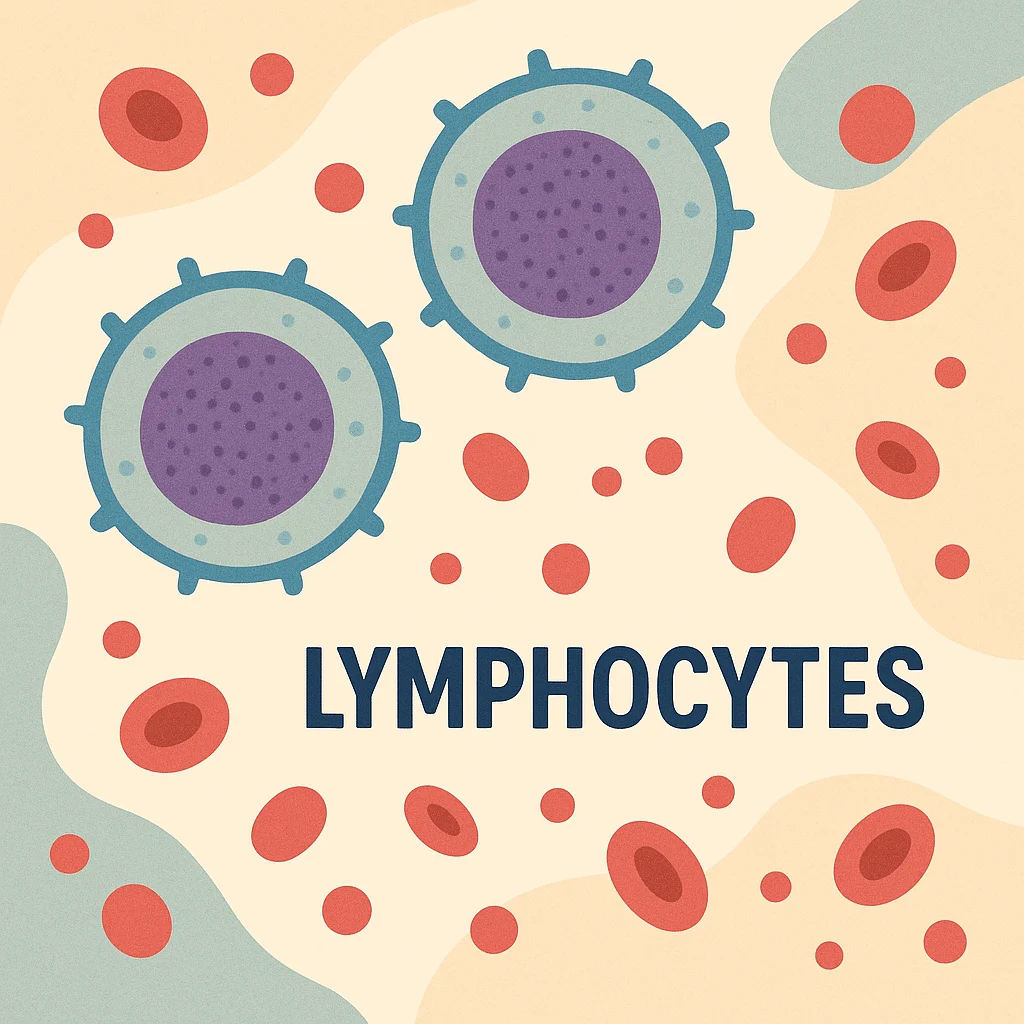
Los linfocitos son uno de los tipos de glóbulos blancos que se cuentan en un análisis de sangre de rutina, y ver un resultado marcado junto a esa palabra puede ser preocupante cuando no sabes qué significa. Esta guía explica qué son los linfocitos, por qué tu cuerpo los produce y cómo leer el conteo de linfocitos en tu reporte de laboratorio. En este artículo aprenderás cómo es un rango normal, qué puede indicar un resultado alto o bajo, y cuándo vale la pena llamar a tu médico. El objetivo es darte una explicación clara y objetiva que puedas usar junto con tu propio reporte, no un diagnóstico.
Los linfocitos que se encuentran dentro del tejido tumoral se cuentan de manera diferente y tienen un significado distinto, que abordamos en nuestra guía sobre linfocitos infiltrantes de tumor.
¿Qué son los linfocitos?
Los linfocitos son un tipo de glóbulo blanco que se produce en la médula ósea, el tejido blando que se encuentra dentro de tus huesos. Una vez maduros, circulan por tu sangre y tu sistema linfático, una red de vasos y pequeñas glándulas (ganglios linfáticos) que ayuda a drenar líquidos y combatir infecciones. Su función es reconocer todo aquello que no debería estar en tu cuerpo, como virus, bacterias y células anormales, y ayudar a eliminarlos.
Los linfocitos representan aproximadamente entre una quinta y dos quintas partes de tus glóbulos blancos totales. Se reportan como parte de una biometría hemática (BH) con diferencial, un estudio que clasifica los glóbulos blancos en cinco tipos, incluyendo neutrófilos, monocitos y su función en la eliminación de desechos y la coordinación de la defensa inmunológica, eosinófilos y basófilos. Los linfocitos lideran la respuesta más lenta pero duradera frente a los virus, y guardan memoria de los gérmenes con los que ya has tenido contacto.
Los tres tipos principales de linfocitos
No todos los linfocitos hacen el mismo trabajo. Tres tipos principales se dividen las funciones de tu sistema inmunológico adaptativo, la rama que aprende y recuerda amenazas específicas.
Linfocitos T (células T)
Las células T actúan como comandantes de campo y soldados a la vez. Algunas, llamadas células T asesinas, se adhieren directamente a células infectadas por un virus o que se han vuelto cancerosas, y las destruyen. Otras, llamadas células T colaboradoras, coordinan la respuesta inmunológica general, enviando señales a las células B y a otras células inmunitarias sobre cuándo y cómo actuar.
Linfocitos B (células B)
Las células B son tus fábricas de anticuerpos. Cuando una célula B encuentra un germen que reconoce, puede convertirse en una célula plasmática que produce anticuerpos, proteínas diseñadas para adherirse a ese invasor específico. Los anticuerpos no matan gérmenes directamente; los marcan para que otras células inmunitarias terminen el trabajo, y algunas células B se convierten en células de memoria que responden más rápido la próxima vez.
Células asesinas naturales (NK)
Las células NK forman parte de tu sistema inmunológico innato, la primera línea de defensa: más rápida pero menos específica. No necesitan haber enfrentado una amenaza antes para actuar. Las células NK patrullan constantemente la sangre y los tejidos, y pueden identificar y destruir células infectadas por virus y ciertos tipos de células tumorales en cuanto las detectan.
Por qué importa tu conteo de linfocitos
El conteo de linfocitos es una fotografía rápida de una parte de tu sistema inmunológico. Como los linfocitos son fundamentales para combatir infecciones, prevenir el cáncer y regular la inflamación, un cambio marcado en su número puede ser una señal temprana de que algo merece una revisión más detallada.
Un conteo bajo, llamado linfopenia (o linfocitopenia), puede dejarte algo más vulnerable a las infecciones. Un conteo persistentemente alto, llamado linfocitosis, generalmente refleja que el sistema inmunológico está respondiendo activamente a algo, aunque en ocasiones puede indicar una infección crónica o un trastorno sanguíneo que requiere más estudios. La mayoría de los resultados anormales aislados son temporales y benignos; es un patrón que persiste en análisis repetidos lo que suele motivar una investigación más profunda.
Factores no infecciosos también pueden hacer que el conteo de linfocitos suba o baje. El estrés físico o emocional intenso puede reducir temporalmente el conteo de linfocitos a través de hormonas del estrés como el cortisol. La alimentación también influye: una ingesta crónicamente baja de proteínas, vitamina D o zinc puede afectar la capacidad de tu cuerpo para mantener estas células. Por eso, los médicos interpretan un conteo individual junto con otros hallazgos, como un resultado de proteína C reactiva cuando se sospecha inflamación activa, y no de forma aislada.
Cómo leer el renglón de linfocitos en tu análisis de sangre
Los linfocitos se reportan dentro de una biometría hemática (BH) con diferencial, generalmente en la sección de glóbulos blancos de tu reporte. Esta guía explica cómo leer un reporte de biometría hemática en lenguaje sencillo. En el caso específico de los linfocitos, tu reporte normalmente incluye dos cifras relacionadas.
- Conteo absoluto de linfocitos: el número total de linfocitos en un volumen determinado de sangre, que generalmente se expresa como células por microlitro (células/µL) o como giga por litro (G/L), según el laboratorio. Este suele ser el valor más útil desde el punto de vista clínico.
- Porcentaje de linfocitos: la proporción de tus glóbulos blancos totales que corresponde a linfocitos, expresada como porcentaje.
El rango de referencia típico para adultos en el conteo absoluto es de aproximadamente 1,000 a 4,800 células por microlitro, lo que generalmente corresponde a entre el 20% y el 40% del total de glóbulos blancos. Los rangos de referencia varían ligeramente entre laboratorios según el equipo y la población utilizados para establecerlos, por lo que el rango impreso en tu propio reporte —no uno que encuentres en internet— es el que aplica para ti. Un resultado fuera de ese rango generalmente se señala con un asterisco, una flecha o un color, y simplemente indica que el valor está fuera de la banda típica, no que necesariamente haya algo malo.
De qué dependen los valores normales
Varios factores influyen en lo que se considera un nivel típico de linfocitos para cada persona, por eso los médicos interpretan un resultado en contexto y no comparándolo con un número fijo único.
- Edad: los niños, especialmente los menores de seis años, tienen de manera natural conteos de linfocitos más altos que los adultos. Un nivel que sería elevado en un adulto puede ser completamente normal en un niño pequeño.
- Embarazo: las reducciones leves en el conteo de linfocitos son frecuentes, sobre todo en el tercer trimestre, como parte de la adaptación inmunológica normal del cuerpo.
- Hora del día: el conteo de linfocitos sigue un ritmo circadiano: tiende a ser más bajo por la mañana y más alto a última hora de la tarde. Por eso los análisis de sangre suelen programarse en la mañana para que los resultados sean comparables.
- Método del laboratorio y población de referencia: distintos analizadores y poblaciones de referencia pueden modificar los valores límite exactos que utiliza cada laboratorio.
Valores de referencia de linfocitos de un vistazo
| Grupo | Rango absoluto típico | Porcentaje típico de glóbulos blancos |
|---|---|---|
| Adultos | Aproximadamente 1,000–4,800 células/µL | Aproximadamente 20%–40% |
| Niños pequeños (menores de 6 años) | Mayor que el rango adulto, con frecuencia hasta aproximadamente 7,000–9,500 células/µL | Con frecuencia 40%–60% o más |
| Embarazo (tercer trimestre) | Puede estar ligeramente por debajo del rango adulto estándar | Una reducción leve es frecuente |
Considera esta tabla como una guía general y no como una herramienta de diagnóstico. El rango de referencia de tu propio reporte, leído junto con tus síntomas e historial médico, es lo que tu médico tomará en cuenta.
Cuando los linfocitos están altos: linfocitosis
La linfocitosis describe un conteo absoluto de linfocitos por encima del rango de referencia para adultos, generalmente por encima de aproximadamente 4,000 a 4,800 células por microlitro, aunque el valor límite exacto varía según el laboratorio. Un resultado alto es frecuente y suele ser temporal.
Causas comunes, generalmente benignas
La mayoría de las veces, un conteo elevado de linfocitos es simplemente tu sistema inmunológico haciendo su trabajo. Un aumento impulsado principalmente por neutrófilos altos en lugar de linfocitos generalmente apunta hacia una causa bacteriana, ya que los médicos interpretan el diferencial completo y no un solo tipo de célula de forma aislada.
- Infecciones virales agudas: enfermedades como la mononucleosis infecciosa, la influenza y el COVID-19 frecuentemente elevan el conteo de linfocitos mientras el cuerpo intensifica su defensa.
- Ciertas infecciones bacterianas: enfermedades como la tos ferina (pertussis) y la tuberculosis también pueden elevar los linfocitos.
- Reacciones alérgicas: algunas respuestas alérgicas provocan un aumento leve y temporal.
- Vacunación reciente: un aumento pequeño y pasajero después de una vacuna es una señal normal de que tu sistema inmunológico está generando protección, no es motivo de preocupación.
Causas menos comunes que vale la pena investigar
Un conteo de linfocitos que se mantiene alto en análisis repetidos, especialmente junto con síntomas, merece una revisión más detallada.
- Trastornos linfoproliferativos: los cánceres de la sangre como la leucemia linfocítica crónica (LLC) o el linfoma implican un crecimiento descontrolado de linfocitos anormales y generalmente causan una elevación persistente, a menudo marcada.
- Enfermedades autoinmunes: condiciones como la artritis reumatoide o el lupus, en las que el sistema inmunológico ataca por error los propios tejidos del cuerpo, a veces se asocian con linfocitosis.
Un conteo elevado en una sola ocasión y sin síntomas rara vez es motivo de preocupación. Es la combinación de un aumento persistente, a menudo marcado, junto con señales como fiebre sin explicación, sudores nocturnos o ganglios inflamados lo que lleva a los médicos a investigar más a fondo. Los lectores que quieran más detalles pueden consultar una guía detallada causa por causa sobre los linfocitos altos y sus opciones de tratamiento.
Cuando los linfocitos están bajos: linfopenia
La linfopenia (también llamada linfocitopenia) describe un conteo absoluto por debajo de aproximadamente 1,000 células por microlitro en un adulto, con cierta variación entre laboratorios. Al igual que un conteo alto, uno bajo tiene una amplia variedad de posibles explicaciones, la mayoría de ellas temporales.
Causas frecuentes
- Estrés fisiológico severo: una cirugía mayor, un traumatismo físico o una infección aguda grave pueden reducir temporalmente los linfocitos en circulación.
- Desnutrición: las deficiencias de proteínas, zinc u otros nutrientes clave pueden afectar la producción de nuevos linfocitos.
- Medicamentos: los corticosteroides, los inmunosupresores y los medicamentos de quimioterapia son conocidos por reducir el conteo de linfocitos como parte de su mecanismo de acción.
Causas menos frecuentes
- Infecciones avanzadas: el VIH es un ejemplo clásico, ya que el virus ataca y destruye específicamente un subgrupo de linfocitos T con el tiempo.
- Trastornos de inmunodeficiencia primaria: condiciones hereditarias poco frecuentes pueden limitar la capacidad del cuerpo para producir cantidades normales de linfocitos.
- Cánceres relacionados con la médula ósea: la leucemia, el mieloma múltiple o los cánceres que se extienden a la médula ósea pueden desplazar la producción normal de células sanguíneas, incluidos los linfocitos.
Debido a que la linfopenia en sí rara vez causa síntomas directamente, generalmente se detecta solo a través de las infecciones que puede favorecer, o como un hallazgo incidental en estudios de laboratorio de rutina. Los lectores que quieran una visión más completa pueden consultar una guía más completa sobre las causas, síntomas y riesgos de los linfocitos bajos, incluyendo cuándo es apropiado referirte con un especialista.
Guía de decisión: a qué suele llevar un resultado anormal
El camino que sigue tu médico después de un resultado anormal de linfocitos depende en gran medida de si está alto o bajo, qué tan fuera del rango se encuentra y si persiste en un estudio repetido. La tabla a continuación resume los pasos siguientes más comunes, aunque tu médico adaptará esto a tu situación particular.
| Situación | Siguiente paso habitual |
|---|---|
| Levemente anormal, sin síntomas, primera vez que se detecta | Repetir la biometría hemática (BH) en unas semanas para ver si se normalizó |
| Infección reciente o vacunación, elevación leve | Por lo general no se requiere ninguna acción; solo repetir el estudio si persiste después de la recuperación |
| Anormalidad persistente en estudios repetidos | Estudios de sangre adicionales, como serología viral o inmunofenotipificación |
| Anormalidad marcada más síntomas (fiebre, sudoración nocturna, ganglios inflamados, pérdida de peso) | Evaluación urgente, posiblemente con estudios de imagen o referencia a un especialista |
Cuándo consultar a tu médico
La mayoría de las anomalías en los linfocitos son leves, temporales y se explican por una infección reciente u otro factor cotidiano. Aun así, ciertas situaciones requieren hablar con tu médico a tiempo, en lugar de esperar.
- Un conteo de linfocitos que sigue siendo anormal en un segundo o tercer análisis, en lugar de volver a la normalidad.
- Fiebre sin causa aparente, sudoraciones nocturnas abundantes o pérdida de peso involuntaria junto con un conteo anormal.
- Ganglios linfáticos persistentemente inflamados en el cuello, la axila o la ingle.
- Infecciones frecuentes, graves o inusualmente prolongadas, que pueden acompañar a un conteo bajo.
- Moretones fáciles, sangrado inusual o fatiga intensa, que requieren una evaluación pronta junto con cualquier anomalía en los estudios de laboratorio.
Si ninguna de estas situaciones aplica en tu caso y tu resultado está solo ligeramente fuera del rango sin presentar síntomas, sigue siendo razonable mencionarlo en tu próxima cita médica, pero generalmente no es una urgencia.
Avances científicos recientes
En los últimos años, la investigación sobre los linfocitos ha ido más allá del simple análisis de valores altos o bajos, y se enfoca en cómo cambian los conteos con el tiempo y en grupos específicos de pacientes. Aquí te presentamos algunos hallazgos destacados de los últimos años, explicados en lenguaje sencillo.
Los conteos de linfocitos pueden predecir resultados en pacientes gravemente enfermos, pero la relación no es lineal
Un estudio amplio con más de 37,000 adultos con sepsis (una respuesta grave del organismo a una infección) encontró que tanto los conteos de linfocitos muy bajos como los muy altos se asociaban con un mayor riesgo de morir en el hospital, generando lo que los investigadores llaman un patrón en forma de U: el riesgo era menor en las personas con valores intermedios y mayor en ambos extremos. Lo que esto significa para ti: en pacientes en estado crítico, los médicos cada vez más consideran el conteo de linfocitos como una señal importante a vigilar de cerca, en lugar de asumir que más alto siempre es mejor o que más bajo siempre es peor. Para alguien que revisa un análisis de sangre de rutina como paciente externo, este hallazgo refuerza principalmente que los valores extremos en cualquier dirección son los que tienden a tener relevancia clínica, más que una pequeña desviación del rango de referencia.
Los cambios en el conteo de linfocitos tras una lesión grave pueden ayudar a predecir la recuperación
Un estudio que siguió a 38 pacientes con lesiones traumáticas graves midió su conteo absoluto de linfocitos de forma repetida durante los primeros diez días tras la lesión y comparó los patrones con los de 38 voluntarios sanos. Los pacientes cuyos conteos de linfocitos se mantuvieron persistentemente bajos, o que bajaron rápidamente y no se recuperaron, tuvieron más probabilidades de tener una recuperación difícil, incluyendo una estancia más prolongada en la unidad de cuidados intensivos y un mayor riesgo de disfunción orgánica, en comparación con aquellos cuyos conteos se recuperaron de manera gradual. Lo que esto significa para ti: este es un hallazgo en etapa temprana obtenido de un grupo pequeño de pacientes con trauma, que aún debe confirmarse en estudios más amplios, pero apunta hacia el seguimiento de la tendencia del conteo de linfocitos a lo largo de varios días, en lugar de un valor único, como una herramienta potencialmente útil para los médicos que atienden a pacientes con lesiones graves.
Los conteos bajos de linfocitos se vuelven más frecuentes con la edad y varían según el estilo de vida
Un análisis de datos de encuestas nacionales de salud de más de 33,000 personas en Estados Unidos encontró que la linfopenia se vuelve progresivamente más común con la edad, alcanzando su tasa más alta, cercana al 7%, en adultos de 75 años o más. El mismo análisis encontró que la linfopenia era más frecuente en hombres que en mujeres, y que las personas con trastornos del sueño tenían una tasa más alta de linfopenia que quienes no los padecían. Lo que esto significa para ti: un conteo de linfocitos levemente bajo en un adulto mayor es común y, con frecuencia, refleja cambios normales relacionados con la edad en el sistema inmunológico, más que una enfermedad específica. Esto también es un recordatorio útil de que los buenos hábitos de sueño son uno de los pocos factores del estilo de vida relacionados con conteos de linfocitos más saludables, junto con los hábitos generales de apoyo al sistema inmunológico ya mencionados, como una nutrición equilibrada y el manejo del estrés.
La relación neutrófilo-linfocito se estudia como un marcador más amplio del envejecimiento saludable
Un estudio observacional de larga duración que ha seguido a adultos que viven en comunidad durante años, conocido como estudio de cohorte (un grupo de personas monitoreadas a lo largo del tiempo para ver cómo cambia su salud), analizó cómo cambian los conteos de neutrófilos y linfocitos con la edad en casi 1,800 participantes. Se encontró que la relación entre neutrófilos y linfocitos aumentaba con la edad y estaba vinculada a un mayor riesgo de muerte y de tener varias enfermedades crónicas al mismo tiempo, mientras que una relación más baja se asoció con menos enfermedades crónicas. Lo que esto significa para ti: los investigadores ven esta relación como un posible marcador del envejecimiento inmunológico, pero los propios autores del estudio señalan que aún falta demostrar si modificar esta relación mediante cambios en el estilo de vida o tratamiento realmente mejora los resultados de salud. Por ahora, es una herramienta de investigación y no algo con un plan de acción establecido para pacientes individuales.
Glosario
| Término | Definición |
|---|---|
| Linfocito | Un tipo de glóbulo blanco que ayuda al cuerpo a reconocer y combatir infecciones, y a recordar amenazas pasadas. |
| Linfocitosis | Un conteo de linfocitos por encima del rango de referencia normal. |
| Linfopenia (linfocitopenia) | Un conteo de linfocitos por debajo del rango de referencia normal. |
| Biometría hemática (BH) con diferencial | Un análisis de sangre que cuenta glóbulos rojos, glóbulos blancos y plaquetas, y desglosa los glóbulos blancos en sus cinco tipos principales. |
| Conteo absoluto | El número total de un tipo específico de célula en un volumen determinado de sangre, en lugar de un porcentaje. |
| Célula T (linfocito T) | Un linfocito que ataca directamente a las células infectadas o anormales y ayuda a dirigir la respuesta inmunológica general. |
| Célula B (linfocito B) | Un linfocito que produce anticuerpos, proteínas que atacan gérmenes específicos. |
| Célula natural killer (NK) | Un linfocito del sistema inmune innato que puede destruir células infectadas o anormales sin necesidad de haber tenido exposición previa. |
| Estudio de cohorte | Un estudio de investigación que sigue a un grupo de personas a lo largo del tiempo para observar cómo cambia su salud. |
| Inmunofenotipificación | Un análisis de laboratorio especializado que identifica y cuenta los diferentes subtipos de células inmunes presentes en una muestra de sangre. |
Preguntas frecuentes
¿Los niveles altos de linfocitos siempre significan que tengo una infección viral?
No. Las infecciones virales son la causa más común de un aumento temporal de linfocitos, pero no son la única. Las enfermedades autoinmunes, ciertas infecciones bacterianas y, con menos frecuencia, trastornos de la sangre también pueden elevar el conteo. Tu médico toma en cuenta tus síntomas, tu historial reciente y otros valores de tu biometría hemática en conjunto antes de sacar conclusiones a partir de un solo resultado.
¿Los niveles de linfocitos cambian a lo largo del día?
Sí. Los linfocitos siguen un ritmo circadiano: generalmente son más bajos por la mañana y aumentan hacia la tarde. Por eso los estudios de laboratorio de rutina suelen programarse en la mañana, ya que esto ayuda a que los resultados sean más comparables entre visitas y entre personas.
¿Los medicamentos pueden afectar mi conteo de linfocitos?
Sí. Los corticosteroides como la prednisona pueden reducir notablemente el conteo de linfocitos, mientras que la quimioterapia generalmente disminuye la mayoría de los tipos de glóbulos blancos, incluidos los linfocitos. Otros medicamentos pueden subir o bajar el conteo según su mecanismo de acción. Siempre dile a tu médico todos los medicamentos y suplementos que tomas para que pueda interpretar tus resultados correctamente.
¿Cuál es la relación entre los linfocitos y las vacunas?
Las vacunas funcionan al estimular a los linfocitos B y T para que generen una memoria inmunológica específica contra un germen determinado, sin provocar la enfermedad como tal. Un aumento pequeño y temporal de linfocitos en los días posteriores a una vacuna es una señal normal y esperada de que este proceso está en marcha, no es motivo de preocupación.
¿Es preocupante tener un conteo de linfocitos ligeramente bajo durante el embarazo?
La linfopenia leve es común durante el embarazo, especialmente en el tercer trimestre, y refleja la adaptación inmunológica normal del cuerpo para sostener el embarazo. Una reducción moderada por sí sola generalmente no es motivo de alarma, pero cualquier disminución significativa o sin explicación debe comentarse con tu médico obstetra.
¿Es normal que los niños tengan conteos de linfocitos más altos que los adultos?
Sí. Los niños, especialmente los menores de aproximadamente seis años, tienen de manera natural conteos de linfocitos más altos que los adultos, como parte del desarrollo normal del sistema inmune. Un conteo que en un adulto se marcaría como elevado puede ser completamente normal en un niño pequeño, por eso los rangos de referencia pediátricos son diferentes a los de los adultos.
El conteo de linfocitos rara vez cuenta toda la historia por sí solo. Por lo general se interpreta junto con otros valores de la biometría hemática (BH), como el conteo total de glóbulos blancos, los neutrófilos y la hemoglobina, así como marcadores de inflamación como la PCR cuando se sospecha una infección o una causa autoinmune. Entender varios valores a la vez, en el contexto de tus propios síntomas e historial médico, es exactamente donde un reporte claro y estructurado puede ayudarte. AI DiagMe está diseñado para ayudarte a entender qué pueden significar tus resultados en un lenguaje sencillo; no diagnostica enfermedades ni reemplaza el criterio de tu médico.
Entiende tus resultados de laboratorio con AI DiagMe
Obtén la lectura de tus resultados en minutos
Fuentes
- Linfocitos: función, definición, niveles y rangos — Cleveland Clinic
- Examen diferencial de sangre — MedlinePlus (Institutos Nacionales de Salud)
- Linfocitosis — StatPearls, NCBI Bookshelf (Biblioteca Nacional de Medicina)
- Zhang G, et al. — U-shaped correlation of lymphocyte count with all-cause hospital mortality in sepsis and septic shock patients: a MIMIC-IV and eICU-CRD database study — International Journal of Emergency Medicine, 2024 — ver estudio
- Reichardt L-M, et al. — Absolute lymphocyte count trajectory predicts clinical outcome in severely injured patients — European Journal of Trauma and Emergency Surgery, 2025 — ver estudio
- Xie W, et al. — Prevalence of lymphopenia in the American population: insights from demographic, BMI, and lifestyle factors — PLOS ONE, 2024 — ver estudio
- Pellegrino R, et al. — Neutrophil, lymphocyte count, and neutrophil to lymphocyte ratio predict multimorbidity and mortality: results from the Baltimore Longitudinal Study on Aging follow-up study — GeroScience, 2024 — ver estudio
Lecturas recomendadas
- Biometría hemática (BH): cómo leer tus resultados
- Linfocitos altos: causas, síntomas y tratamientos
- Linfocitos bajos: causas, síntomas y guía de riesgos
- Neutrófilos altos: qué revelan los valores elevados sobre tu salud
- Monocitos: guía para entender los resultados de tus análisis de sangre