



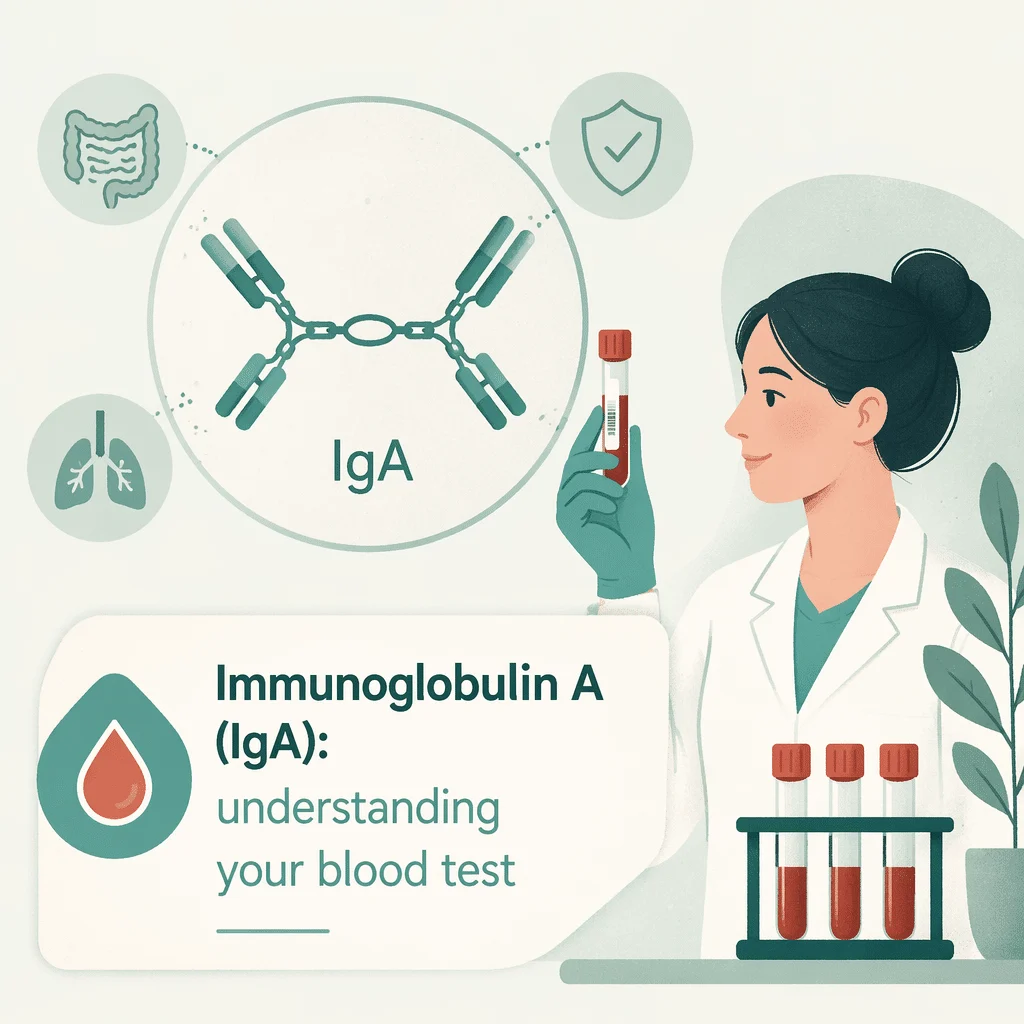
Un examen de IgA en sangre mide la inmunoglobulina A, el anticuerpo más abundante que protege las mucosas húmedas de tu intestino, vías respiratorias y otras superficies que están en contacto con el exterior. Como estas barreras son el primer punto de entrada de muchos gérmenes, el nivel de IgA ofrece una ventana muy útil para saber qué tan bien están funcionando tus defensas cotidianas.
Los médicos solicitan este estudio por muchas razones: infecciones frecuentes, problemas digestivos, sospecha de una enfermedad autoinmune o un resultado inesperado en otro análisis de sangre. Por sí solo, el valor de IgA rara vez lleva a un diagnóstico, pero al interpretarlo junto con tus síntomas y otros marcadores ayuda a orientar el camino.
En este artículo aprenderás qué hace la inmunoglobulina A, por qué se solicita este estudio y qué pueden significar los niveles altos, bajos y normales de IgA, además de los conocimientos más recientes sobre las enfermedades celíaca y renal relacionadas con este anticuerpo.
¿Qué es la inmunoglobulina A (IgA)?
La inmunoglobulina A, o IgA, es uno de los cinco tipos de anticuerpos que produce tu sistema inmunológico. Los anticuerpos son proteínas con forma de Y que reconocen gérmenes y otras amenazas, y los neutralizan directamente o los marcan para que sean eliminados. La IgA se distingue porque realiza la mayor parte de su trabajo en las superficies húmedas del cuerpo —las mucosas de la nariz, la garganta, los pulmones y el tracto digestivo— más que en el interior de la sangre.
Estas mucosas húmedas son el primer punto de contacto de una gran cantidad de virus y bacterias con tu cuerpo. La IgA las patrulla como un guardia en la puerta: se adhiere a los gérmenes y los atrapa en el moco para que sean expulsados antes de causar problemas. Los inmunólogos llaman a esto exclusión inmunitaria: mantener a los invasores fuera en lugar de combatirlos una vez que ya están adentro.
Dónde actúa la IgA
La IgA se encuentra en la saliva, las lágrimas, el sudor, la leche materna y los fluidos del intestino y las vías respiratorias, además de en la sangre. En la leche materna, la IgA que pasa de la madre al bebé ayuda a proteger el intestino del recién nacido antes de que su propio sistema inmunológico madure. Esta amplia presencia explica por qué la falta de IgA suele manifestarse como infecciones repetidas de los senos paranasales, el pecho o el intestino.
Dos formas: circulante y secretora
La IgA existe en dos formas principales. La IgA circulante viaja por el torrente sanguíneo, y es lo que mide un análisis de sangre estándar de IgA. La IgA secretora es una versión más resistente que se libera en la saliva, las lágrimas y los fluidos intestinales, diseñada para sobrevivir en entornos agresivos como el tracto digestivo. Una muestra de sangre capta la forma circulante, mientras que pruebas especializadas de saliva pueden medir la forma secretora cuando el médico lo necesita.
Qué mide el análisis de IgA en sangre y por qué lo piden los médicos
El análisis de IgA en sangre indica la cantidad de inmunoglobulina A que circula en tu sangre, generalmente en miligramos por decilitro (mg/dL). Es una extracción de sangre sencilla que suele realizarse junto con la inmunoglobulina G (IgG) y la inmunoglobulina M (IgM) como parte de un estudio inmunológico más completo. Los tres anticuerpos aportan información diferente, por eso con frecuencia se miden en conjunto.
Tu equipo médico puede pedir este análisis por varias razones:
- Tienes infecciones frecuentes o poco comunes, especialmente de los senos paranasales, los pulmones o el intestino.
- Tienes síntomas digestivos persistentes, como diarrea crónica, que podrían indicar enfermedad celíaca.
- Se sospecha una enfermedad autoinmune y tu médico quiere tener un panorama inmunológico más completo. En ese caso, también puede solicitar un panel de autoinmunidad.
- Otro estudio, como la medición de proteínas totales, dio un resultado inesperadamente alto o bajo y necesita explicación.
- Se está evaluando si existe un trastorno de células plasmáticas que pueda estar produciendo un solo anticuerpo en exceso.
Por lo general, no es necesario estar en ayuno para el análisis de IgA, aunque es posible que en tu visita se incluyan otros estudios que sí lo requieran.
Valores normales de IgA y cómo leer tus resultados
El nivel normal de IgA en adultos se encuentra aproximadamente entre 60 y 400 mg/dL, pero el rango de referencia exacto depende del laboratorio, tu edad y el método de análisis utilizado. Siempre compara tu resultado con el rango que aparece en tu propio reporte, no con un valor general. La IgA es naturalmente baja en los recién nacidos y va aumentando durante la infancia hasta la edad adulta, por lo que el valor normal en niños no es el mismo que en adultos.
Un valor aislado de IgA rara vez se interpreta solo. Los médicos lo evalúan junto con tus niveles de IgG e IgM, tus síntomas y, en ocasiones, una prueba de proteínas que separa las distintas familias de anticuerpos. Un valor marcado como alto o bajo es una señal para investigar más a fondo, no un diagnóstico en sí mismo, y con frecuencia factores cotidianos explican una pequeña variación.
Qué pueden indicar los niveles altos de IgA
Un nivel elevado de IgA puede presentarse en dos patrones muy distintos, y diferenciarlos es importante porque llevan a pasos a seguir diferentes.
Elevación generalizada (policlonal)
La mayoría de los resultados con IgA elevada son policlonales, lo que significa que muchas células inmunitarias diferentes están produciendo anticuerpos adicionales al mismo tiempo. Esta es la respuesta normal del cuerpo ante un desafío. Los desencadenantes más comunes incluyen infecciones crónicas o repetidas, inflamación prolongada y enfermedades hepáticas crónicas como la cirrosis, que pueden elevar la IgA. Esa relación con el hígado es una de las razones por las que los médicos suelen pedir también pruebas de función hepática. Varias enfermedades autoinmunes elevan la IgA de la misma manera general.
Un pico marcado (monoclonal)
Con menos frecuencia, la IgA sube porque un solo clon de células plasmáticas se multiplica y produce un único anticuerpo idéntico. Este patrón monoclonal puede indicar mieloma múltiple de tipo IgA o un estado precanceroso conocido como GMSI (gammapatía monoclonal de significado incierto). Un pico monoclonal generalmente se detecta mediante un estudio especializado. Para ver cómo aparece ese pico en un resultado de laboratorio, puedes leer nuestra guía sobre electroforesis de proteínas e inmunoglobulinas.
Qué significan los niveles bajos de IgA y la deficiencia selectiva de IgA
Un nivel de IgA bajo o indetectable es bastante común, y para muchas personas no causa ningún síntoma. La causa más frecuente es la deficiencia selectiva de IgA, en la que el cuerpo produce poca o ninguna IgA mientras que la IgG y la IgM se mantienen normales. Es la inmunodeficiencia primaria más común, y afecta aproximadamente a 1 de cada 300 a 1 de cada 700 personas de ascendencia europea; muchas nunca saben que la tienen.
Otras personas no tienen tanta suerte. Como la IgA protege las membranas mucosas, quienes tienen niveles bajos pueden presentar infecciones recurrentes en los senos paranasales, el pecho y el intestino. La deficiencia selectiva de IgA también está relacionada con una mayor frecuencia de alergias y enfermedades autoinmunes, incluyendo la enfermedad celíaca y la enfermedad inflamatoria intestinal. Dada esa relación con las alergias, algunas personas también leen nuestra guía sobre los estudios de sangre para alergias y la IgE. Un nivel de IgA muy bajo también puede reducir tus globulinas totales en un panel de rutina, y puedes leer nuestro artículo sobre niveles bajos de globulinas.
La nota sobre transfusiones
Un pequeño subgrupo de personas con deficiencia selectiva de IgA produce anticuerpos contra la propia IgA. Si reciben hemoderivados que contienen IgA, pueden tener, en casos raros, una reacción alérgica grave. Por eso vale la pena informar a tu equipo médico sobre una deficiencia de IgA conocida antes de cualquier transfusión o ciertos tratamientos. Es una precaución sensata, no un motivo para alarmarse.
Qué pueden indicar los niveles altos y bajos de IgA
La tabla a continuación resume las asociaciones más comunes. Lee cada fila como una posibilidad a explorar con un médico, no como un diagnóstico.
| Resultado de IgA | Lo que puede indicar |
|---|---|
| IgA alta, elevación amplia (policlonal) | Infecciones crónicas o recurrentes, inflamación prolongada, enfermedad hepática crónica como la cirrosis, y algunas enfermedades autoinmunes |
| IgA alta, pico pronunciado (monoclonal) | Proliferación de un solo clon de células plasmáticas, que se observa en el mieloma múltiple de tipo IgA o en el estado precanceroso GMSI |
| IgA baja o indetectable | Deficiencia selectiva de IgA, una deficiencia más amplia de anticuerpos, o un efecto secundario de ciertos medicamentos |
| IgA normal | Producción de anticuerpos dentro del rango esperado para tu edad; es posible que se necesiten otros estudios si los síntomas persisten |
En qué se diferencia la IgA de la IgG y la IgM
La IgA es más fácil de entender si la comparas con sus dos parientes más estudiados. Cada clase de anticuerpo tiene una función distinta y un lugar diferente en el cuerpo.
| Anticuerpo | Función principal | Dónde se encuentra |
|---|---|---|
| Inmunoglobulina A (IgA) | Protege las superficies mucosas y bloquea los gérmenes antes de que entren al cuerpo | Saliva, lágrimas, leche materna y el recubrimiento del intestino y las vías respiratorias |
| Inmunoglobulina G (IgG) | Proporciona inmunidad duradera y memoria después de una infección o vacunación | El anticuerpo más abundante en la sangre y el líquido tisular |
| Inmunoglobulina M (IgM) | Actúa como primera respuesta ante una infección nueva | Principalmente en sangre y linfa; se produce al inicio y luego cede el paso a la IgG |
Como las tres se relacionan entre sí, los médicos suelen analizarlas en conjunto. Por ejemplo, una IgA baja con IgG e IgM normales apunta hacia una deficiencia selectiva de IgA, mientras que niveles bajos en las tres sugieren un problema más amplio de anticuerpos.
Condiciones relacionadas con la IgA que debes conocer
Enfermedad celíaca y la prueba tTG-IgA
La enfermedad celíaca es una reacción autoinmune al gluten, y la IgA es clave en su diagnóstico. El principal análisis de sangre de tamizaje busca anticuerpos IgA contra la transglutaminasa tisular, conocido como tTG-IgA. Un resultado positivo es una señal importante, aunque un especialista confirma el diagnóstico antes de que cambies tu alimentación. Para entender la enfermedad en sí, puedes consultar nuestra guía sobre la enfermedad celíaca e intolerancia al gluten. Como la prueba depende de la IgA, una deficiencia oculta de IgA puede dar un resultado falsamente normal, que es exactamente por qué los laboratorios revisan tu IgA total al mismo tiempo.
Nefropatía por IgA (enfermedad de Berger)
En la nefropatía por IgA, también llamada enfermedad de Berger, la IgA se acumula en los pequeños filtros de los riñones, llamados glomérulos, y los daña de forma gradual. Con frecuencia se manifiesta como sangre o proteína en la orina, a veces justo después de un resfriado o dolor de garganta. Cuando se sospecha, los médicos suelen analizar la orina y solicitar un panel de función renal. También puedes leer nuestra guía sobre proteína en la orina. Un diagnóstico definitivo generalmente requiere una biopsia renal, ya que el nivel de IgA en sangre por sí solo no puede confirmarlo.
Vasculitis por IgA
La vasculitis por IgA, antes llamada púrpura de Henoch-Schönlein, es una enfermedad en la que depósitos inmunitarios que contienen IgA inflaman los vasos sanguíneos pequeños. Provoca un sarpullido morado elevado, dolor en las articulaciones, dolor de estómago y, en algunos casos, afectación renal. Es más frecuente en niños y suele resolverse sola, aunque requiere seguimiento. Al igual que con la enfermedad de Berger, un nivel de IgA en sangre apoya el cuadro clínico, pero no establece el diagnóstico por sí solo.
Cuándo consultar a tu médico
Un resultado de IgA es una señal de alerta, y los síntomas que lo acompañan son lo más importante. Considera consultar con un médico si notas:
- Infecciones frecuentes o difíciles de resolver en los senos paranasales, el pecho o el intestino.
- Síntomas digestivos persistentes como diarrea crónica, inflamación abdominal o pérdida de peso sin causa aparente.
- Sangre en la orina, orina de color té o espumosa de forma continua, lo que podría indicar un problema renal.
- Un sarpullido morado elevado acompañado de dolor en las articulaciones o el abdomen, especialmente en un niño.
- Antecedentes familiares de inmunodeficiencia, enfermedad celíaca o enfermedad renal, junto con tus propios síntomas.
Si ya sabes que tienes deficiencia selectiva de IgA, mencíonalo antes de cualquier transfusión, mantén al día las vacunas recomendadas y trata las infecciones a tiempo.
Avances científicos recientes en las pruebas y el tratamiento de la IgA
La investigación sobre la inmunoglobulina A ha avanzado rápidamente en los últimos años, especialmente en relación con la enfermedad celíaca y la enfermedad renal vinculada a la IgA. Esto es lo que sugieren las revisiones más recientes, en términos sencillos.
Las pruebas de celiaquía se apoyan más en la IgA y, en algunos casos, ya no requieren biopsia
El análisis de sangre para la enfermedad celíaca busca anticuerpos IgA contra una enzima intestinal llamada transglutaminasa tisular (tTG-IgA). En 2025, la Sociedad Europea para el Estudio de la Enfermedad Celíaca actualizó sus guías, y una revisión de 2026 publicada en el New England Journal of Medicine llegó a una conclusión similar: cuando la tTG-IgA es muy alta, alrededor de diez veces el límite superior normal, algunos adultos seleccionados pueden recibir el diagnóstico sin necesidad de una biopsia intestinal. Lo que esto significa para ti es que algunas personas podrían evitar un procedimiento invasivo, pero esta sigue siendo una decisión que toma un especialista, no algo que puedas interpretar por tu cuenta a partir de un resultado.
Un anticuerpo celíaco positivo es una señal importante, no un diagnóstico definitivo
Un amplio estudio de 2025 publicado en la revista Pediatrics analizó qué tan bien un nivel elevado de tTG-IgA predice la enfermedad celíaca. Un nivel muy alto fue correcto en la gran mayoría de los niños, pero un nivel levemente elevado resultó incorrecto con suficiente frecuencia como para que los autores recomendaran confirmar el diagnóstico antes de hacer cualquier cambio en la dieta. Lo que esto significa para ti: si tu tTG-IgA sale positiva, sigue consumiendo gluten hasta que un médico confirme el diagnóstico, porque eliminar el gluten demasiado pronto puede enmascarar la enfermedad y dificultar su confirmación.
Por qué el laboratorio mide primero tu IgA total
Aquí está el detalle que une todos estos puntos. Si tienes deficiencia selectiva de IgA, el análisis estándar de celiaquía basado en IgA puede aparecer falsamente normal, simplemente porque tu cuerpo no produce suficiente IgA. Una revisión de 2023 sobre serología celíaca confirmó que las pruebas basadas en IgG funcionan mejor en esta situación. Lo que esto significa para ti: los laboratorios ahora suelen medir tu IgA total al mismo tiempo que la tTG-IgA, para que una deficiencia oculta no lleve a un diagnóstico perdido.
Los nuevos tratamientos están cambiando la nefropatía por IgA
La nefropatía por IgA, en la que la IgA se acumula en los filtros del riñón, se manejaba principalmente con medicamentos para la presión arterial. Eso está cambiando rápidamente. Dos análisis de 2025 que reunieron múltiples ensayos clínicos encontraron que varias clases de medicamentos más nuevos, incluyendo terapias inmunes y del complemento dirigidas, reducen la proteína en la orina y frenan la pérdida de función renal. Lo que esto significa para ti: un resultado anormal de IgA o renal ahora abre la puerta a más opciones de tratamiento que hace unos años, aunque algunos de estos medicamentos son nuevos y sus resultados a largo plazo todavía se están recopilando.
Las alergias pueden indicar ocasionalmente una diferencia en el sistema inmune
Una revisión de 2025 sobre enfermedades alérgicas señaló que las alergias persistentes a veces coexisten con una condición inmunológica subyacente, incluida la deficiencia selectiva de IgA. Lo que esto significa para ti: cuando las alergias se presentan junto con infecciones frecuentes, el médico puede revisar tus niveles de inmunoglobulinas para tener un panorama más completo.
Glosario de términos sobre IgA
| Término | Definición |
|---|---|
| Inmunoglobulina A (IgA) | Un anticuerpo que protege las mucosas del intestino, las vías respiratorias y otras superficies del cuerpo frente a los gérmenes. |
| Anticuerpo | Una proteína que produce el sistema inmunológico para reconocer y neutralizar gérmenes. |
| Membranas mucosas | Las mucosas que recubren la boca, el intestino, las vías respiratorias y otros conductos que están en contacto con el exterior. |
| Deficiencia selectiva de IgA | Una condición inmunológica frecuente en la que el cuerpo produce muy poca IgA o ninguna, mientras que los demás anticuerpos se mantienen normales. |
| Aumento policlonal | Un aumento generalizado de anticuerpos provenientes de muchas células inmunitarias, que suele ser señal de infección o inflamación. |
| Aumento monoclonal | Un aumento producido por un solo clon idéntico de células plasmáticas, lo que requiere estudios adicionales. |
| IgA antitransglutaminasa tisular (tTG-IgA) | El principal análisis de sangre que se usa para detectar la enfermedad celíaca. |
| Nefropatía por IgA | Una enfermedad renal, también conocida como enfermedad de Berger, en la que la IgA se acumula en los filtros del riñón. |
| IgA secretora | La forma más resistente de IgA que se libera en la saliva, las lágrimas y los fluidos intestinales. |
| Células plasmáticas | Glóbulos blancos que producen anticuerpos. |
Preguntas frecuentes
¿Necesito estar en ayuno antes de un análisis de sangre de IgA?
No. El análisis de sangre de IgA no requiere ayuno, ya que los alimentos y bebidas no modifican de manera significativa los niveles de inmunoglobulina A en la sangre. Puedes comer y beber con normalidad antes de la toma. La excepción es cuando tu cita incluye otros estudios que sí requieren ayuno, como la glucosa o el perfil de lípidos. En ese caso, sigue la indicación más estricta que aparezca en tu orden de laboratorio. Si no estás seguro de qué aplica para tu visita, puedes leer nuestra guía sobre el ayuno antes de un análisis de sangre o preguntarle al laboratorio cuando hagas tu cita.
¿Cuál es el rango normal de IgA?
En la mayoría de los adultos, un nivel normal de IgA se encuentra aproximadamente entre 60 y 400 mg/dL, aunque cada laboratorio establece su propio rango de referencia según su equipo. La edad también influye: los bebés producen muy poca IgA, y los niveles aumentan durante la infancia hasta estabilizarse en la edad adulta. Por eso, el único rango que realmente aplica para ti es el que aparece junto a tu resultado. Un valor ligeramente fuera del rango es algo común y, por lo general, es una señal para buscar contexto, no para alarmarse.
¿Un nivel alto de IgA siempre indica algo grave?
Para nada. La mayoría de los resultados elevados de IgA se deben a la actividad inmunitaria cotidiana, como una infección que no termina de irse, una inflamación persistente o una enfermedad crónica del hígado. Este aumento amplio y policlonal es simplemente el cuerpo haciendo su trabajo. Con menos frecuencia, un pico pronunciado de un solo anticuerpo puede indicar un trastorno de células plasmáticas que requiere seguimiento. Tu médico distingue entre ambos casos con estudios adicionales, generalmente una electroforesis de proteínas. Un número alto por sí solo es una razón para investigar, no un diagnóstico, así que trata de no sacar conclusiones de un solo valor.
¿Se puede tratar la IgA baja o la deficiencia selectiva de IgA?
No existe ningún tratamiento que haga que el cuerpo produzca más IgA, y la mayoría de las personas con deficiencia selectiva de IgA no necesitan ningún tratamiento. El manejo se enfoca en los síntomas: tratar las infecciones a tiempo, mantener las vacunas al día y controlar cualquier condición asociada, como alergias, enfermedad celíaca o problemas autoinmunes. La terapia estándar de reemplazo de anticuerpos no sustituye la IgA y no se usa para la deficiencia aislada de IgA. Si las infecciones son frecuentes o graves, un inmunólogo puede ayudarte a diseñar un plan personalizado.
¿Por qué el laboratorio mide la IgA total antes de un estudio de celiaquía?
La prueba principal de detección de celiaquía busca anticuerpos IgA contra la transglutaminasa tisular (tTG-IgA). Si tienes IgA baja o ausente, ese estudio puede dar un resultado falsamente normal aunque la enfermedad celíaca esté presente, simplemente porque no produces suficiente IgA para que se detecte. Medir tu IgA total al mismo tiempo identifica esta situación, para que el laboratorio pueda cambiar a pruebas de celiaquía basadas en IgG cuando sea necesario. Es una medida de seguridad que ayuda a evitar un diagnóstico perdido en personas con deficiencia selectiva de IgA.
¿Los niños pueden hacerse un estudio de IgA y los valores son diferentes?
Sí, los niños pueden hacerse un análisis de sangre de IgA, y sus valores esperados son distintos a los de los adultos. Los bebés nacen con muy poca IgA propia y dependen de los anticuerpos de la leche materna en los primeros meses. La IgA va aumentando de forma gradual durante la infancia, por lo que los laboratorios pediátricos usan rangos de referencia según la edad. Una IgA baja en un niño pequeño no es necesariamente motivo de preocupación, ya que los niveles pueden alcanzar los valores normales con el tiempo. El pediatra interpreta el resultado considerando la edad del niño y su estado de salud general.
Fuentes
- MedlinePlus, Biblioteca Nacional de Medicina — Inmunoglobulinas (IgA, IgG, IgM) Análisis de sangre — medlineplus.gov
- Cleveland Clinic — Inmunoglobulina A (IgA): función, estudios y trastornos — my.clevelandclinic.org
- Mayo Clinic — Nefropatía por IgA (enfermedad de Berger), síntomas y causas — mayoclinic.org
- Al-Toma A, Zingone F, Branchi F, et al. — European Society for the Study of Coeliac Disease 2025 updated guidelines on the diagnosis and management of coeliac disease in adults, Part 1 — United European Gastroenterology Journal, 2025 — doi.org/10.1002/ueg2.70119
- Murray JA, Husby S — Celiac Disease — New England Journal of Medicine, 2026 — doi.org/10.1056/NEJMcp2415548
- Chang D, Wong M, Cardenas MC, et al. — Positive Predictive Value of Tissue Transglutaminase IgA for Celiac Disease — Pediatrics, 2025 — doi.org/10.1542/peds.2025-070897
- Volta U, Bai JC, De Giorgio R — El papel de la serología en el diagnóstico de la enfermedad celíaca — Gastroenterology and Hepatology from Bed to Bench, 2023 — doi.org/10.22037/ghfbb.v16i2.2713
- Kim D, Neuen BL, Perkovic V, Wong MG — Efectos de las terapias sobre la proteinuria y la TFGe en la nefropatía por IgA: metaanálisis de ensayos aleatorizados — Clinical Journal of the American Society of Nephrology, 2025 — doi.org/10.2215/CJN.0000000839
- Chen B, Zhu Y, Yang Y, Xu G — Eficacia y seguridad de los tratamientos para la nefropatía por IgA: un metaanálisis en red de ensayos clínicos aleatorizados y controlados — Frontiers in Medicine, 2025 — doi.org/10.3389/fmed.2025.1515723
- Alska E, Doligalska A, Napiorkowska-Baran K, et al. — Carga global de las alergias: mecanismos de desarrollo, retos en el diagnóstico y tratamiento — Life (Basel), 2025 — doi.org/10.3390/life15060878
Lecturas recomendadas
- Cómo leer tus resultados de análisis de sangre
- Valores normales en estudios de laboratorio
- Resultados anormales en estudios de laboratorio
- Biometría hemática (BH)
- Prueba de serología explicada
Entiende tus resultados de laboratorio con AI DiagMe
Tu nivel de IgA tiene más sentido cuando se ve como parte de un panorama más amplio. Leído junto con tus niveles de IgG e IgM, una electroforesis de proteínas o un panel renal, cuenta una historia más clara que cualquier número por sí solo. AI DiagMe te ayuda a entender estos resultados en un lenguaje sencillo, conectando los puntos entre marcadores como las inmunoglobulinas, las globulinas y los anticuerpos para celiaquía. Está diseñado para ayudarte a comprender tu reporte y preparar mejores preguntas para tu médico, no para diagnosticar ni reemplazar la atención médica.
Obtén la lectura de tus resultados en minutos