





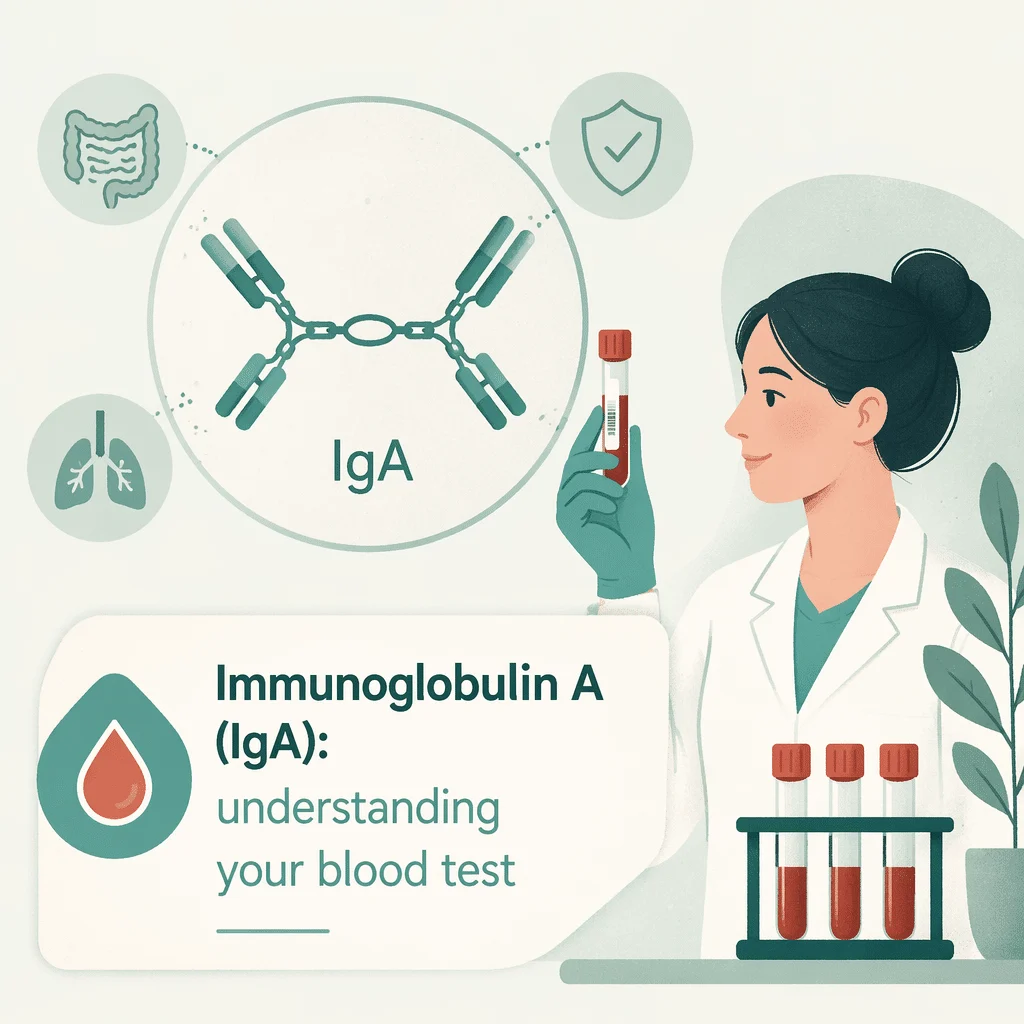
Een IgA-bloedtest meet immunoglobuline A, het meest voorkomende antilichaam dat de vochtige slijmvliezen van je darmen, luchtwegen en andere oppervlakken die in contact komen met de buitenwereld beschermt. Omdat deze barrières vaak de eerste plek zijn waar ziektekiemen proberen binnen te dringen, geeft je IgA-waarde een nuttig inzicht in hoe goed je dagelijkse afweer functioneert.
Artsen laten deze test om verschillende redenen uitvoeren: terugkerende infecties, spijsverteringsproblemen, een vermoedelijke auto-immuunziekte of een onverwachte uitslag bij een ander bloedonderzoek. Op zichzelf leidt een IgA-waarde zelden tot een diagnose, maar in combinatie met je klachten en andere markers helpt het de juiste richting aan te geven.
In dit artikel lees je wat immunoglobuline A doet, waarom de test wordt aangevraagd en wat hoge, lage en normale IgA-waarden kunnen betekenen, inclusief de nieuwste inzichten over de coeliakie- en nieraandoeningen die aan dit antilichaam zijn gekoppeld.
Wat is immunoglobuline A (IgA)?
Immunoglobuline A, of IgA, is een van de vijf soorten antilichamen die je immuunsysteem aanmaakt. Antilichamen zijn Y-vormige eiwitten die ziektekiemen en andere bedreigingen herkennen en ze ofwel direct onschadelijk maken ofwel markeren voor verwijdering. IgA onderscheidt zich doordat het het grootste deel van zijn werk verricht op de vochtige oppervlakken van het lichaam — de slijmvliezen van je neus, keel, longen en spijsverteringskanaal — en niet diep in het bloed.
Deze vochtige slijmvliezen zijn de plek waar een groot deel van de virussen en bacteriën voor het eerst contact met je maakt. IgA patrouillert daar als een bewaker bij de deur: het hecht zich aan ziektekiemen en vangt ze in slijm, zodat ze worden afgevoerd voordat ze problemen veroorzaken. Immunologen noemen dit immuunexclusie: indringers buiten houden in plaats van ze te bestrijden zodra ze eenmaal binnen zijn.
Waar IgA zijn werk doet
IgA is te vinden in speeksel, tranen, zweet, moedermelk en de vloeistoffen van je darmen en luchtwegen, maar ook in je bloed. In moedermelk helpt IgA dat van ouder op baby wordt overgedragen de darmen van een pasgeborene te beschermen voordat het eigen immuunsysteem van de baby volwassen is. Deze brede aanwezigheid is de reden waarom een tekort aan IgA zich vaak uit als terugkerende infecties van de sinussen, de borst of de darmen.
Twee vormen: circulerend en secretoir
IgA bestaat in twee hoofdvormen. Circulerend IgA bevindt zich in de bloedbaan, en dit is wat een standaard IgA-bloedtest meet. Secretoir IgA is een robuustere versie die wordt afgegeven in speeksel, tranen en darmvloeistoffen, en is bestand tegen ruwe omgevingen zoals het spijsverteringskanaal. Een bloedafname meet de circulerende vorm, terwijl gespecialiseerde speekseltests de secretoire vorm kunnen meten wanneer een arts dat nodig acht.
Wat een IgA-bloedtest meet en waarom artsen hem aanvragen
Een IgA-bloedtest geeft de hoeveelheid immunoglobuline A weer die in uw bloed circuleert, meestal uitgedrukt in milligram per deciliter (mg/dL). Het is een eenvoudige bloedafname die vaak samen wordt uitgevoerd met immunoglobuline G (IgG) en immunoglobuline M (IgM) als onderdeel van een breder immunologisch onderzoek. De drie antilichamen vertellen elk een ander deel van het verhaal, en daarom worden ze vaak als set gemeten.
Uw behandelend team kan de test om verschillende redenen aanvragen:
- U heeft vaak of ongewone infecties, met name van de sinussen, longen of darmen.
- U heeft aanhoudende spijsverteringsklachten, zoals chronische diarree, die kunnen wijzen op coeliakie.
- Er wordt een auto-immuunziekte vermoed en uw arts wil een vollediger beeld van uw immuunsysteem. In dat geval kunnen ze ook een auto-immuunpanel.
- Een andere test, zoals een meting van het totale eiwit, gaf een onverwacht hoge of lage uitslag en moet worden verklaard.
- Er wordt gecontroleerd op een plasmacelaandoening waarbij één enkel antilichaam overmatig kan worden aangemaakt.
Nuchter zijn is doorgaans niet vereist voor een IgA-test, hoewel uw afspraak mogelijk andere tests omvat waarvoor dat wel nodig is.
Normaalwaarden van IgA en hoe u uw uitslag kunt lezen
Een typische IgA-waarde bij volwassenen ligt ruwweg tussen 60 en 400 mg/dL, maar de exacte referentiewaarden zijn afhankelijk van het laboratorium, uw leeftijd en de gebruikte testmethode. Vergelijk uw uitslag altijd met de referentiewaarden op uw eigen rapport en niet met een algemeen getal. IgA is van nature laag bij pasgeborenen en stijgt gedurende de kindertijd tot in de volwassenheid, dus wat normaal is voor een kind verschilt van wat normaal is voor een volwassene.
Een enkele IgA-waarde staat zelden op zichzelf. Artsen interpreteren deze samen met uw IgG- en IgM-waarden, uw klachten en soms een eiwittest die de verschillende antilichaamfamilies van elkaar onderscheidt. Een waarde die als hoog of laag wordt gemarkeerd, is een aanleiding om nader te kijken, niet op zichzelf een diagnose, en alledaagse factoren verklaren vaak een kleine afwijking.
Wat een hoog IgA-gehalte kan betekenen
Een verhoogd IgA kan zich voordoen in twee heel verschillende patronen, en het onderscheid daartussen is belangrijk omdat ze tot verschillende vervolgstappen leiden.
Een brede stijging (polyclonaal)
De meeste hoge IgA-uitslagen zijn polyclonaal, wat betekent dat veel verschillende immuuncellen tegelijk extra antilichamen aanmaken. Dit is de normale reactie van het lichaam op een uitdaging. Veelvoorkomende oorzaken zijn chronische of terugkerende infecties, langdurige ontstekingen en chronische leverziekte zoals cirrose, die IgA kan verhogen. Die link met de lever is een van de redenen waarom artsen vaak ook leverfunctietestsaanvragen. Verschillende auto-immuunziekten verhogen IgA op dezelfde brede manier.
Een scherpe piek (monoklonaal)
Minder vaak stijgt IgA doordat één enkele kloon van plasmacellen zich vermenigvuldigt en steeds hetzelfde antilichaam aanmaakt. Dit monoklonale patroon kan wijzen op IgA-multipel myeloom of op een voorstadium van kanker dat bekend staat als MGUS (monoklonale gammopathie van onbepaalde betekenis). Een monoklonale piek wordt doorgaans opgespoord via een gespecialiseerde test. Om te zien hoe zo'n piek eruitziet op een laboratoriumuitslag, kunt u lezen onze gids over eiwitelectroforese en immunoglobulinen.
Wat lage IgA-waarden en selectieve IgA-deficiëntie betekenen
Een lage of niet-aantoonbare IgA-waarde komt vrij vaak voor, en bij veel mensen veroorzaakt dit helemaal geen klachten. De meest voorkomende oorzaak is selectieve IgA-deficiëntie, waarbij het lichaam weinig of geen IgA aanmaakt terwijl IgG en IgM normaal blijven. Het is de meest voorkomende primaire immuundeficiëntie, die bij ongeveer 1 op de 300 tot 1 op de 700 mensen van Europese afkomst voorkomt, en velen weten niet eens dat ze het hebben.
Anderen hebben minder geluk. Omdat IgA de slijmvliezen beschermt, kunnen mensen met een tekort hieraan te maken krijgen met terugkerende infecties van de sinussen, de luchtwegen en het maag-darmkanaal. Selectieve IgA-deficiëntie hangt ook samen met een hogere kans op allergieën en auto-immuunziekten, waaronder coeliakie en inflammatoire darmziekte. Vanwege de link met allergieën lezen sommige mensen ook onze gids over allergiebloeduitslagen en IgE. Een zeer lage IgA-waarde kan ook uw totale globulinen op een standaard bloedpanel verlagen, en u kunt lezen ons artikel over lage globulinewaarden.
De opmerking over bloedtransfusie
Een kleine groep mensen met selectieve IgA-deficiëntie maakt antilichamen aan tegen IgA zelf. Als zij bloedproducten ontvangen die IgA bevatten, kunnen zij in zeldzame gevallen een ernstige allergische reactie krijgen. Daarom is het verstandig om een bekende IgA-deficiëntie te melden aan uw zorgteam vóór een bloedtransfusie of bepaalde behandelingen. Het is een verstandige voorzorgsmaatregel, geen reden tot paniek.
Waar hoge en lage IgA-waarden op kunnen wijzen
De onderstaande tabel geeft een overzicht van de meest voorkomende verbanden. Lees elke rij als een mogelijkheid om samen met een arts te onderzoeken, niet als een diagnose.
| IgA-uitslag | Waar het op kan wijzen |
|---|---|
| Hoog IgA, brede stijging (polyklonaal) | Chronische of terugkerende infecties, langdurige ontsteking, chronische leverziekte zoals cirrose, en bepaalde auto-immuunziekten |
| Hoog IgA, scherpe piek (monoklonaal) | Overgroei van één plasmacellenklon, gezien bij IgA-multipel myeloom of het voorstadium MGUS |
| Laag of niet-aantoonbaar IgA | Selectieve IgA-deficiëntie, een bredere antilichaamdeficiëntie, of een bijwerking van bepaalde geneesmiddelen |
| Normaal IgA | Antilichaamproductie binnen het verwachte bereik voor uw leeftijd; andere tests kunnen nog steeds nodig zijn als klachten aanhouden |
Hoe IgA verschilt van IgG en IgM
IgA is het gemakkelijkst te begrijpen naast zijn twee meest gemeten verwanten. Elke antilichaamklasse heeft een andere taak en een andere plek in het lichaam.
| Antilichaam | Belangrijkste functie | Waar het wordt gevonden |
|---|---|---|
| Immunoglobuline A (IgA) | Bewaakt slijmvliesoppervlakken en blokkeert ziektekiemen voordat ze het lichaam binnendringen | Speeksel, tranen, moedermelk en de bekleding van de darmen en luchtwegen |
| Immunoglobuline G (IgG) | Zorgt voor langdurige immuniteit en geheugen na infectie of vaccinatie | Het meest voorkomende antilichaam in bloed en weefselvloeistof |
| Immunoglobuline M (IgM) | Treedt op als eerste responder bij een gloednieuwe infectie | Voornamelijk in bloed en lymfe, vroeg aangemaakt en daarna overgedragen aan IgG |
Omdat de drie elkaar overlappen, lezen artsen ze doorgaans samen. Een laag IgA met normaal IgG en IgM wijst bijvoorbeeld op een selectieve IgA-deficiëntie, terwijl lage waarden bij alle drie op een breder antilichaamprobleem duiden.
IgA-gerelateerde aandoeningen om te kennen
Coeliakie en de tTG-IgA-test
Coeliakie is een auto-immuunreactie op gluten, en IgA staat centraal in de diagnose ervan. De belangrijkste screeningsbloedtest zoekt naar IgA-antilichamen tegen weefseltransglutaminase, geschreven als tTG-IgA. Een positief resultaat is een sterk signaal, hoewel een specialist de diagnose bevestigt voordat u uw dieet aanpast. Voor meer informatie over de aandoening zelf kunt u onze uitleg over coeliakie en glutenintolerantiebekijken. Omdat de test op IgA vertrouwt, kan een verborgen IgA-deficiëntie een vals normaal resultaat opleveren — precies daarom controleren laboratoria tegelijkertijd uw totale IgA.
IgA-nefropathie (ziekte van Berger)
Bij IgA-nefropathie, ook wel de ziekte van Berger genoemd, hoopt IgA zich op in de kleine filters van de nieren, de glomeruli, en beschadigt deze langzaam. Het uit zich vaak als bloed of eiwit in de urine, soms direct na een verkoudheid of keelpijn. Wanneer dit vermoed wordt, onderzoeken artsen doorgaans de urine en vragen ze een nierfunctiepanelaan. U kunt ook onze gids over eiwit in de urinelezen. Voor een definitieve diagnose is gewoonlijk een nierbiopsie nodig, omdat het IgA-gehalte in het bloed alleen dit niet kan bevestigen.
IgA-vasculitis
IgA-vasculitis, vroeger Henoch-Schönlein-purpura genoemd, is een aandoening waarbij immuunafzettingen die IgA bevatten kleine bloedvaten ontsteken. Het veroorzaakt een verheven paarse huiduitslag, gewrichtspijn, buikpijn en soms nierbetrokkenheid. Het komt het meest voor bij kinderen en verdwijnt vaak vanzelf, maar vereist wel monitoring. Net als bij de ziekte van Berger ondersteunt een IgA-waarde in het bloed het klinische beeld, maar stelt het de diagnose niet op zichzelf.
Wanneer moet je een arts raadplegen?
Een IgA-uitslag is een wegwijzer, en de bijbehorende klachten zijn het belangrijkst. Overweeg een arts te raadplegen als u het volgende opmerkt:
- Frequente of hardnekkige infecties van de sinussen, borst of darmen.
- Aanhoudende spijsverteringsklachten zoals chronische diarree, een opgeblazen gevoel of onverklaarbaar gewichtsverlies.
- Bloed in de urine, theekleurige urine of aanhoudend schuimende urine die kan wijzen op nierproblemen.
- Een verhoogde paarse huiduitslag met gewrichts- of buikpijn, vooral bij een kind.
- Een familiegeschiedenis van immuundeficiëntie, coeliakie of nierziekte in combinatie met uw eigen klachten.
Als u al weet dat u een selectieve IgA-deficiëntie heeft, vermeld dit dan vóór elke bloedtransfusie, houd uw aanbevolen vaccinaties bij en behandel infecties snel.
Nieuwste wetenschappelijke ontwikkelingen op het gebied van IgA-testen en -behandeling
Het onderzoek naar immunoglobuline A heeft de afgelopen jaren een snelle ontwikkeling doorgemaakt, met name rond coeliakie en de nierziekte die verband houdt met IgA. Dit is wat de meest recente overzichten suggereren, in begrijpelijke taal.
Coeliakie-testen steunt steeds meer op IgA, en slaat soms de biopsie over
De bloedtest voor coeliakie zoekt naar IgA-antistoffen tegen een darmenzym dat weefsel-transglutaminase (tTG-IgA) wordt genoemd. In 2025 heeft de Europese Vereniging voor de Studie van Coeliakie haar richtlijnen bijgewerkt, en een overzichtsartikel uit 2026 in het New England Journal of Medicine kwam tot een vergelijkbare conclusie: wanneer tTG-IgA zeer hoog is — ongeveer tien keer de bovengrens van normaal — kunnen bepaalde volwassenen nu worden gediagnosticeerd zonder een darmbiopsie. Wat dit voor u betekent: sommige mensen kunnen een invasieve ingreep vermijden, maar dit blijft een beslissing die een specialist neemt, niet iets dat u zelf uit een uitslag kunt afleiden.
Een positieve coeliakie-antistof is een sterke aanwijzing, geen definitief oordeel
Een grote studie uit 2025 in het tijdschrift Pediatrics onderzocht hoe goed een verhoogd tTG-IgA coeliakie voorspelt. Een zeer hoog niveau was correct bij de grote meerderheid van de kinderen, maar een licht verhoogd niveau bleek vaak genoeg onjuist dat de auteurs aanraadden dit te bevestigen vóór elke dieetwijziging. Wat dit voor u betekent: als uw tTG-IgA positief uitvalt, blijf dan gluten eten totdat een arts de diagnose bevestigt, want te vroeg glutenvrij eten kan de ziekte maskeren en moeilijker te bevestigen maken.
Waarom het laboratorium eerst uw totale IgA controleert
Dit is het aandachtspunt dat alles met elkaar verbindt. Als u een selectieve IgA-deficiëntie heeft, kan de standaard IgA-gebaseerde coeliakie-test er vals normaal uitzien, simpelweg omdat u weinig IgA aanmaakt. Een overzichtsartikel uit 2023 over coeliakie-serologie bevestigde dat IgG-gebaseerde tests in deze situatie beter werken. Wat dit voor u betekent: laboratoria meten tegenwoordig vaak uw totale IgA tegelijk met tTG-IgA, zodat een verborgen deficiëntie niet leidt tot een gemiste diagnose.
Nieuwe behandelingen veranderen het beeld van IgA-nefropathie
IgA-nefropathie, waarbij IgA zich ophoopt in de filters van de nieren, werd lange tijd voornamelijk behandeld met bloeddrukverlagende middelen. Dat verandert snel. Twee analyses uit 2025 die meerdere klinische onderzoeken samenvoegden, toonden aan dat verschillende nieuwere geneesmiddelklassen — waaronder gerichte immuun- en complementtherapieën — de hoeveelheid eiwit in de urine verlagen en het verlies van nierfunctie vertragen. Wat dit voor u betekent: een afwijkend IgA- of nierresultaat opent nu de deur naar meer behandelingsmogelijkheden dan een paar jaar geleden, hoewel sommige van deze middelen nieuw zijn en de langetermijnresultaten nog worden verzameld.
Allergieën kunnen soms wijzen op een immuunverschil
Een overzichtsstudie uit 2025 over allergische aandoeningen merkte op dat hardnekkige allergieën soms samengaan met een onderliggende immuunaandoening, waaronder selectieve IgA-deficiëntie. Wat dit voor u betekent: wanneer allergieën gepaard gaan met frequente infecties, kan een arts uw immunoglobulinespiegels bekijken om een volledig beeld te krijgen.
Begrippenlijst IgA-termen
| Termijn | Definitie |
|---|---|
| Immunoglobuline A (IgA) | Een antilichaam dat de vochtige slijmvliezen van de darmen, luchtwegen en andere oppervlakken beschermt tegen ziekteverwekkers. |
| Antilichaam | Een eiwit dat door het immuunsysteem wordt aangemaakt om ziekteverwekkers te herkennen en te neutraliseren. |
| Slijmvliezen | De vochtige bekleding van de mond, darmen, luchtwegen en andere doorgangen die in contact staan met de buitenwereld. |
| Selectieve IgA-deficiëntie | Een veelvoorkomende immuunaandoening waarbij het lichaam weinig of geen IgA aanmaakt, terwijl andere antilichamen normaal blijven. |
| Polyclonale stijging | Een brede stijging van antilichamen afkomstig van veel immuuncellen, meestal een teken van infectie of ontsteking. |
| Monoklonale stijging | Een stijging veroorzaakt door één identieke kloon van plasmacellen, waarvoor verder onderzoek nodig is. |
| Weefsel-transglutaminase IgA (tTG-IgA) | De belangrijkste bloedtest die wordt gebruikt om coeliakie op te sporen. |
| IgA-nefropathie | Een nieraandoening, ook wel de ziekte van Berger genoemd, waarbij IgA zich ophoopt in de filters van de nieren. |
| Secretoir IgA | De robuuste vorm van IgA die vrijkomt in speeksel, tranen en darmvloeistoffen. |
| Plasmacellen | Witte bloedcellen die antilichamen produceren. |
Veelgestelde vragen
Moet ik nuchter zijn voor een IgA-bloedtest?
Nee. Voor een IgA-bloedtest hoeft u niet nuchter te zijn, omdat eten en drinken uw circulerende immunoglobuline A niet noemenswaardig beïnvloeden. U kunt vooraf gewoon eten en drinken. De uitzondering is wanneer uw afspraak ook andere tests omvat waarvoor u wel nuchter moet zijn, zoals glucose of een lipidenonderzoek. Volg in dat geval de strengste instructie op uw labformulier. Als u niet zeker weet wat voor uw afspraak geldt, kunt u onze gids over nuchter zijn voor een bloedtest lezen of het laboratorium vragen wanneer u een afspraak maakt.
Wat is een normale IgA-waarde?
Voor de meeste volwassenen ligt een normaal IgA-gehalte ruwweg tussen 60 en 400 mg/dL, maar elk laboratorium stelt zijn eigen referentiewaarden vast op basis van zijn eigen apparatuur. Leeftijd speelt ook een rol: baby's maken zeer weinig IgA aan, en de waarden stijgen tijdens de kindertijd voordat ze op volwassen leeftijd stabiliseren. Daarom is het enige bereik dat echt op jou van toepassing is, het bereik dat naast jouw uitslag staat vermeld. Een waarde die iets buiten het bereik valt, is gebruikelijk en is doorgaans een aanleiding voor meer context, niet voor ongerustheid.
Betekent een hoog IgA-gehalte altijd iets ernstigs?
Zeker niet. De meeste hoge IgA-uitslagen zijn het gevolg van gewone immuunactiviteit, zoals een aanslepende infectie, aanhoudende ontsteking of een chronische leveraandoening. Deze brede, polyclonale stijging is het lichaam dat zijn werk doet. Minder vaak kan een scherpe piek van één enkel antilichaam wijzen op een plasmacelaandoening die verdere opvolging vereist. Jouw arts maakt het onderscheid met aanvullend onderzoek, vaak een eiwitelectroforese. Een hoog getal op zich is een reden om verder te onderzoeken, geen diagnose — probeer dus niet te veel conclusies te trekken uit één waarde.
Kan een laag IgA-gehalte of selectieve IgA-deficiëntie worden behandeld?
Er bestaat geen behandeling die het lichaam ertoe aanzet meer IgA aan te maken, en de meeste mensen met selectieve IgA-deficiëntie hebben helemaal geen behandeling nodig. De zorg richt zich op de klachten: infecties snel behandelen, vaccinaties bijhouden en eventuele bijkomende aandoeningen zoals allergieën, coeliakie of auto-immuunproblemen aanpakken. Standaard antilichaamvervangingstherapie vervangt IgA niet en wordt niet gebruikt bij geïsoleerde IgA-deficiëntie. Als infecties frequent of ernstig zijn, kan een immunoloog helpen een plan op maat te maken.
Waarom meet het laboratorium het totale IgA vóór een coeliakie-test?
De belangrijkste screeningstest voor coeliakie zoekt naar IgA-antilichamen tegen weefseltransglutaminase (tTG-IgA). Als je toevallig een laag of afwezig IgA-gehalte hebt, kan die test vals normaal uitvallen, zelfs als coeliakie aanwezig is — simpelweg omdat je niet genoeg IgA aanmaakt om te worden geregistreerd. Door tegelijkertijd het totale IgA te meten, wordt deze situatie gesignaleerd, zodat het laboratorium indien nodig kan overstappen op IgG-gebaseerde coeliakie-tests. Het is een veiligheidsmaatregel die helpt een gemiste diagnose te voorkomen bij mensen met selectieve IgA-deficiëntie.
Kunnen kinderen een IgA-test ondergaan, en zijn de waarden anders?
Ja, kinderen kunnen een IgA-bloedtest ondergaan, en hun verwachte waarden verschillen van die van volwassenen. Baby's worden geboren met zeer weinig eigen IgA en zijn in de vroege periode afhankelijk van antistoffen uit moedermelk. IgA stijgt daarna geleidelijk tijdens de kindertijd, waardoor kinderartslaboratoria leeftijdsgebonden referentiewaarden hanteren. Een laag IgA bij een jong kind is niet automatisch een reden tot bezorgdheid, omdat de waarden mogelijk gewoon nog inhalen met de tijd. Een kinderarts beoordeelt de uitslag in relatie tot de leeftijd en de algehele gezondheid van het kind.
Bronnen
- MedlinePlus, National Library of Medicine — Immunoglobulins (IgA, IgG, IgM) Blood Test — medlineplus.gov
- Cleveland Clinic — Immunoglobulin A (IgA): Function, Tests and Disorders — my.clevelandclinic.org
- Mayo Clinic — IgA nephropathy (Berger disease), Symptoms and causes — mayoclinic.org
- Al-Toma A, Zingone F, Branchi F, et al. — European Society for the Study of Coeliac Disease 2025 updated guidelines on the diagnosis and management of coeliac disease in adults, Part 1 — United European Gastroenterology Journal, 2025 — doi.org/10.1002/ueg2.70119
- Murray JA, Husby S — Celiac Disease — New England Journal of Medicine, 2026 — doi.org/10.1056/NEJMcp2415548
- Chang D, Wong M, Cardenas MC, et al. — Positive Predictive Value of Tissue Transglutaminase IgA for Celiac Disease — Pediatrics, 2025 — doi.org/10.1542/peds.2025-070897
- Volta U, Bai JC, De Giorgio R — The role of serology in the diagnosis of coeliac disease — Gastroenterology and Hepatology from Bed to Bench, 2023 — doi.org/10.22037/ghfbb.v16i2.2713
- Kim D, Neuen BL, Perkovic V, Wong MG — Effects of Therapies on Proteinuria and eGFR in IgA Nephropathy: Meta-Analysis of Randomized Trials — Clinical Journal of the American Society of Nephrology, 2025 — doi.org/10.2215/CJN.0000000839
- Chen B, Zhu Y, Yang Y, Xu G — Efficacy and safety of agents for IgA nephropathy: a network meta-analysis of randomized controlled trials — Frontiers in Medicine, 2025 — doi.org/10.3389/fmed.2025.1515723
- Alska E, Doligalska A, Napiorkowska-Baran K, et al. — Global Burden of Allergies: Mechanisms of Development, Challenges in Diagnosis, and Treatment — Life (Basel), 2025 — doi.org/10.3390/life15060878
Verder lezen
- Hoe lees je de resultaten van je bloedonderzoek?
- Normale waarden bloedonderzoek
- Afwijkende uitslagen bloedonderzoek
- Volledig bloedbeeld (CBC)
- Serologietest uitgelegd
Begrijp uw laboratoriumresultaten met AI DiagMe.
Uw IgA-waarde heeft de meeste betekenis als onderdeel van het grotere geheel. Samen met uw IgG en IgM, een eiwitelectroforese of een nierpanel vertelt het een duidelijker verhaal dan één enkel getal. AI DiagMe helpt u deze uitslagen in begrijpelijke taal te doorgronden, door de verbanden te leggen tussen markers zoals immunoglobulinen, globulinen en coeliakie-antistoffen. Het is bedoeld om u te helpen uw uitslag te begrijpen en betere vragen voor te bereiden voor uw arts — niet om een diagnose te stellen of medische zorg te vervangen.
Ontvang binnen enkele minuten een interpretatie van uw resultaten.