




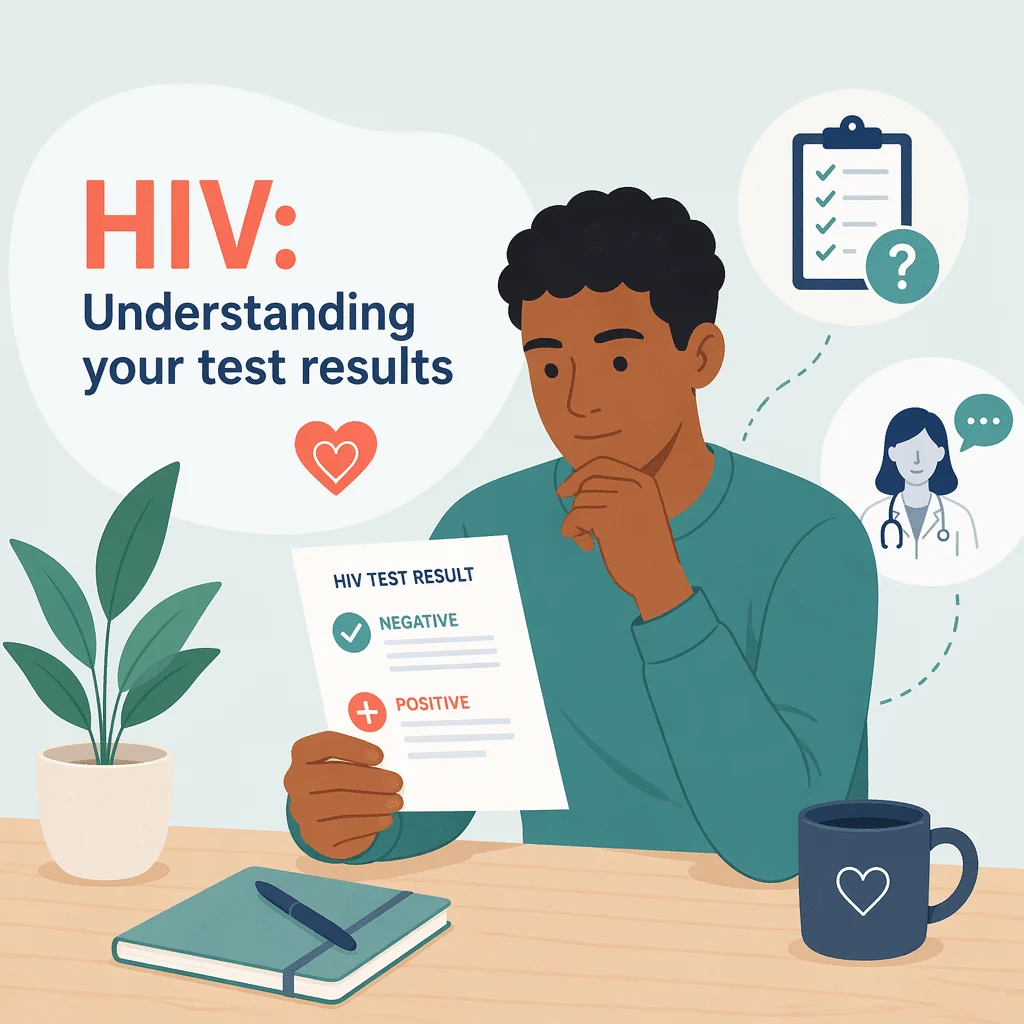
Un análisis de sangre para VIH busca rastros del virus en una pequeña muestra de sangre, y la versión que se usa hoy en la mayoría de los laboratorios los detecta antes de lo que mucha gente espera. Si estás leyendo esto con un resultado en la mano, o contando los días desde una posible exposición, lo más importante es esto: un resultado reactivo en el tamizaje no es un diagnóstico. Las pruebas de tamizaje están diseñadas para no pasar nada por alto, por lo que a veces reaccionan en personas que no tienen VIH. La confirmación es un paso normal y esperado. Hacerse la prueba es atención médica de rutina, recomendada al menos una vez para casi todos los adultos.
En este artículo aprenderás qué mide realmente la prueba, cómo funciona el período de ventana, qué descarta y qué no descarta un resultado negativo, qué sucede después de un tamizaje reactivo y qué significa hoy un resultado positivo confirmado.
Qué mide realmente un análisis de sangre para VIH
El VIH no es una sustancia que produce tu cuerpo, como el colesterol o el hierro. Es un virus. Por eso, un análisis de sangre para VIH no reporta un nivel alto o bajo. Busca dos rastros específicos del virus y te indica si los encontró.
El antígeno p24
Un antígeno es una sustancia extraña que activa tu sistema inmunológico. El antígeno p24 es una proteína del núcleo interno del propio VIH. Si el virus se está replicando, el p24 aparece en la sangre aproximadamente dos o tres semanas después, antes de que la respuesta inmunológica esté completamente formada. Eso lo convierte en el marcador más temprano que puede detectar un análisis de laboratorio de rutina.
Anticuerpos contra VIH-1 y VIH-2
Los anticuerpos son proteínas que produce tu sistema inmunológico cuando entra en contacto con algo que reconoce como extraño. Los anticuerpos anti-VIH tardan más en aparecer que el p24, pero una vez que lo hacen, permanecen. Las pruebas estándar buscan anticuerpos tanto contra el VIH-1, el tipo responsable de la mayoría de las infecciones en el mundo, como contra el VIH-2, que se encuentra principalmente en África Occidental, porque ambos se manejan de manera diferente.
Por qué se llama prueba de cuarta generación
La prueba que la mayoría de los laboratorios en EE. UU. utilizan actualmente es un inmunoensayo combinado de antígeno/anticuerpo de cuarta generación. «Combinado» significa que detecta el antígeno p24 y los anticuerpos en una sola prueba. «Cuarta generación» simplemente describe cómo evolucionó la tecnología: las pruebas anteriores solo podían detectar anticuerpos, por lo que no identificaban las primeras semanas de infección. Agregar el p24 redujo considerablemente esa brecha. Los CDC recomiendan las pruebas de antígeno/anticuerpo para el diagnóstico en laboratorio, y son las más comunes para detectar el VIH en Estados Unidos.
Tu reporte puede nombrarlo de varias formas: «HIV Ag/Ab combo», «antígeno y anticuerpo VIH-1/2, cuarta generación» o simplemente «tamiz de VIH». Todas describen la misma prueba. El resultado generalmente se reporta como no reactivo o reactivo, en lugar de negativo o positivo, y esa terminología es intencional. Una prueba de tamizaje reacciona; no diagnostica. Si el formato de tu reporte te resulta desconocido, también puedes consultar nuestra guía sobre cómo leer los resultados de tus análisis de sangre.
Por qué y cuándo hacerse la prueba
Hacerse la prueba del VIH es parte de la atención médica de rutina. No es una acusación ni implica nada sobre el estilo de vida de nadie.
Los CDC recomiendan que todas las personas de 13 a 64 años se hagan la prueba del VIH al menos una vez como parte de su atención médica de rutina. El Grupo de Trabajo de Servicios Preventivos de EE. UU. otorga una recomendación de grado A al tamizaje del VIH en adolescentes y adultos de 15 a 65 años, su categoría más alta, reservada para servicios con alta certeza de beneficio sustancial. El Grupo de Trabajo también otorga grado A al tamizaje de todas las personas embarazadas, incluidas aquellas cuyo estado serológico frente al VIH se desconoce al momento del parto.
Por eso la prueba del VIH suele aparecer en un panel que no solicitaste específicamente: un chequeo general, un examen médico para seguro, una revisión de salud sexual o un panel prenatal. Los estudios de laboratorio que se realizan durante el embarazo lo incluyen de forma rutinaria, porque el tratamiento durante el embarazo es muy eficaz para prevenir la transmisión al bebé.
Los CDC también recomiendan hacerse la prueba al menos una vez al año en ciertas situaciones: cualquier persona que haya tenido una nueva pareja desde su última prueba, cualquier persona a quien le hayan diagnosticado otra infección de transmisión sexual, hepatitis o tuberculosis, y cualquier persona que haya compartido equipo de inyección. El VIH se revisa con frecuencia junto con otras infecciones de transmisión sexual y transmitidas por sangre, por lo que es posible que lo veas agrupado en un panel de serología para ITS, o junto a la prueba del antígeno de superficie de la hepatitis B, la prueba de anticuerpos contra hepatitis C y el prueba RPR para sífilis.
La razón para hacerse la prueba es práctica, no moral: la única forma de conocer tu estado serológico frente al VIH es mediante una prueba. Saberlo te da opciones útiles en cualquier caso.
El período de ventana: por qué el momento en que te haces la prueba influye en lo que puede detectar
Ninguna prueba de VIH puede detectar el virus de inmediato después de una exposición. El período entre la exposición y el momento en que una prueba puede detectar el VIH de forma confiable se llama período de ventana, y es la principal fuente de confusión y de preocupación innecesaria.
Durante el período de ventana, el virus puede estar presente mientras que el marcador que busca la prueba aún no ha alcanzado un nivel detectable. Por eso, un resultado negativo obtenido demasiado pronto no descarta la infección.
La duración del período de ventana depende del tipo de prueba que te realizaste. Los CDC indican los siguientes rangos.
| Tipo de prueba | Qué busca | Período de ventana (CDC) | Lugar habitual de realización |
|---|---|---|---|
| Prueba de ácidos nucleicos (NAT) | El material genético del propio virus | 10 a 33 días | Sangre de una vena; se usa después de una exposición conocida o para aclarar resultados dudosos |
| Prueba de laboratorio de antígeno/anticuerpo (cuarta generación) | Antígeno p24 más anticuerpos contra VIH-1 y VIH-2 | 18 a 45 días | Sangre de una vena; la prueba de laboratorio estándar en EE. UU. |
| Prueba rápida de antígeno/anticuerpo | Antígeno p24 más anticuerpos contra VIH-1 y VIH-2 | 18 a 90 días | Sangre de punción en el dedo; clínicas y centros de detección comunitaria |
| Prueba de anticuerpos (rápida o de autodiagnóstico) | Solo anticuerpos contra VIH-1 y VIH-2 | 23 a 90 días | Sangre de punción en el dedo o fluido oral; la mayoría de las autopruebas |
De esa tabla se desprenden dos conclusiones. Primero, el tipo de muestra importa: la sangre extraída de una vena detecta el VIH antes que una punción en el dedo o una muestra de fluido oral. Segundo, estos son rangos, no plazos definitivos. El sistema inmunológico responde a distintas velocidades, por lo que la misma prueba puede dar positivo al día 18 en una persona y al día 44 en otra.
Si te hiciste la prueba dentro del período de ventana, la respuesta no es buscar tranquilidad razonando. Lo que debes hacer es repetir la prueba una vez que el período de ventana para tu tipo de prueba haya cerrado.
Qué significa un resultado negativo en la prueba de sangre para VIH
Un resultado no reactivo, o negativo, significa que la prueba no encontró antígeno p24 ni anticuerpos contra el VIH en tu muestra.
Lo que eso te indica depende completamente del momento en que te hiciste la prueba.
- Si tu última posible exposición ocurrió hace más tiempo que el período de ventana de la prueba que te realizaste, y no ha habido ninguna exposición desde entonces, un resultado negativo significa que no tienes VIH. Esa es una respuesta real y confiable.
- Si tu última posible exposición ocurrió dentro del período de ventana, un resultado negativo es información incompleta. No descarta la infección. Repite la prueba una vez que el período de ventana haya cerrado.
Vale la pena ser claro al respecto. Una prueba de laboratorio de cuarta generación realizada 10 días después de una exposición te dice muy poco. La misma prueba a los 45 días te dice mucho.
Un detalle que suele pasarse por alto: un panel de sangre de rutina no incluye el VIH a menos que se haya solicitado específicamente. Una biometría hemática (BH), por ejemplo, cuenta tus células sanguíneas y no puede detectar el virus. Si quieres saber tu estatus, el estudio debe pedirse por nombre.
Si crees que pudiste haber estado expuesto en las últimas 72 horas, comunícate de inmediato con un profesional de salud o un servicio de urgencias en lugar de esperar a hacerte la prueba. Existe un tratamiento preventivo de emergencia llamado PEP que debe iniciarse dentro de los tres días para ser efectivo.
Qué significa un resultado reactivo y la confirmación que sigue
Un resultado reactivo en la prueba de tamizaje significa que el estudio detectó algo. No significa que tengas VIH.
Eso no es un simple tecnicismo ni algo para tranquilizarse sin razón. Los inmunoensayos de tamizaje están diseñados deliberadamente para ser muy sensibles: su objetivo es no pasar por alto ninguna infección real, y el costo de ese diseño es que a veces reaccionan en personas que no tienen VIH. Otros anticuerpos que circulan en la sangre, una vacuna reciente, el embarazo y algunas enfermedades autoinmunes pueden desencadenar una reacción. Por eso ningún laboratorio emite un diagnóstico basándose únicamente en el resultado del tamizaje, y por eso un tamizaje reactivo siempre va seguido de más pruebas.
El algoritmo de pruebas de laboratorio de los CDC
Cuando el tamizaje de laboratorio es reactivo, el laboratorio generalmente realiza las pruebas de seguimiento con la misma muestra de sangre, por lo que muchas veces no es necesaria una segunda visita. El algoritmo tiene tres etapas.
- Tamizaje. La prueba de antígeno/anticuerpo de cuarta generación. Si es no reactiva, el proceso termina aquí. Si es reactiva, la muestra pasa al segundo paso.
- Diferenciación. Un inmunoensayo de diferenciación de anticuerpos VIH-1/VIH-2. Este cumple dos funciones a la vez: verifica si realmente hay anticuerpos presentes e identifica cuál virus. Si es reactivo y coincide con el tamizaje, el resultado se considera un positivo confirmado.
- Resolución. Si el ensayo de diferenciación es negativo o indeterminado, es decir, no coincide con el tamizaje, el laboratorio realiza una prueba de ácido nucleico (NAT) para VIH-1, que busca directamente el material genético del virus. Una NAT positiva generalmente indica una infección muy temprana, detectada antes de que se desarrollaran los anticuerpos. Una NAT negativa tras un tamizaje reactivo indica que el tamizaje fue un falso positivo.
El Western blot, que era la prueba más antigua, ya no forma parte del algoritmo recomendado en Estados Unidos. Fue reemplazado porque era más lento y tenía menor capacidad para detectar infecciones en etapas tempranas.
| Tu resultado | Qué significa | Qué sigue después |
|---|---|---|
| No reactivo, fuera del período de ventana | No se detectó VIH; resultado confiable | No se requiere nada más para esta exposición; continúa con las pruebas de rutina o anuales según se recomiende |
| No reactivo, dentro del período de ventana | Información incompleta; no se descarta la infección | Repite la prueba una vez que haya pasado el período de ventana para el tipo de prueba que te realizaste |
| Tamizaje de laboratorio reactivo | Se detectó algo; no es un diagnóstico | El laboratorio realiza la prueba de diferenciación de anticuerpos, generalmente con la misma muestra |
| Tamizaje reactivo con seguimiento discordante o indeterminado | Las dos pruebas no coinciden; resultado no resuelto | Una prueba NAT para VIH-1 lo confirma: ya sea que detecte una infección muy temprana o que descarte un falso positivo |
| Autotest reactivo o prueba rápida comunitaria | Solo una señal preliminar | Consulta a un proveedor de salud para confirmación en laboratorio |
| Positivo confirmado | Tienes VIH | Vinculación a atención por VIH e inicio de tratamiento; seguimiento con conteo de CD4 y carga viral |
Sobre la espera
La confirmación en la misma muestra suele ser rápida, pero «rápida» es relativo cuando eres tú quien está esperando. Si un autotest o una prueba rápida comunitaria resultó reactiva, necesitarás ver a un proveedor de salud para seguimiento en laboratorio, y eso puede sentirse más lento. Es completamente razonable preguntar al servicio de pruebas cuándo se esperan los resultados, y pedir apoyo mientras tanto.
Qué significa hoy un resultado positivo confirmado
Si los estudios de confirmación muestran que tienes VIH, lo que sigue es muy diferente a la imagen que la mayoría de las personas tiene en mente, que suele estar varias décadas desactualizada.
Una condición crónica tratable
El tratamiento es la terapia antirretroviral: con frecuencia consiste en una sola pastilla al día y, en algunos casos, en una inyección de acción prolongada. Se inicia lo antes posible después del diagnóstico, sin importar cómo te sientas. Los CDC señalan que la mayoría de las personas logran controlar el VIH en los primeros seis meses de tratamiento. VIH y SIDA no son lo mismo. El SIDA es la etapa más avanzada de la infección por VIH sin tratamiento, y con un tratamiento eficaz la mayoría de las personas con VIH nunca llegan a esa etapa.
Indetectable = Intransmisible
El tratamiento puede reducir la cantidad de virus en la sangre a tal punto que las pruebas ya no pueden detectarlo, lo que se conoce como carga viral indetectable. Según los CDC, si tienes una carga viral indetectable, no transmitirás el VIH a través de relaciones sexuales. Esto se conoce como Indetectable = Intransmisible, o I=I. La supresión viral sostenida también previene la transmisión durante el embarazo, el trabajo de parto y el parto.
Este es uno de los hallazgos mejor respaldados de la medicina moderna, y ha cambiado lo que significa un diagnóstico para las relaciones personales y la vida cotidiana.
Las pruebas que vienen después
Dos análisis de sangre permiten el seguimiento continuo.
- El conteo de CD4 mide un tipo de glóbulo blanco que el VIH ataca, y refleja cómo está respondiendo tu sistema inmunológico. Los CDC señalan que los médicos suelen revisarlo cada 3 a 6 meses.
- La carga viral mide cuánto VIH hay en tu sangre y, por lo tanto, qué tan bien está funcionando el tratamiento. Por lo general se revisa cada 4 a 6 meses, y de nuevo entre 2 y 8 semanas después de iniciar o cambiar el medicamento.
Las células CD4 son un subgrupo de linfocitos; para más información sobre lo que hacen estas células, también puedes leer nuestra guía sobre los linfocitos y su función en el sistema inmunológico.
Si tu resultado es negativo y quieres que siga así
La PrEP, o profilaxis preexposición, es un medicamento que se toma antes de una posible exposición y que reduce considerablemente el riesgo de adquirir el VIH. La prescribe y supervisa un proveedor de salud; si es adecuada para ti es algo que debes hablar con él o ella.
Dónde hacerte la prueba y cuándo consultar a un médico
Dónde hacerte la prueba
Las pruebas de VIH están ampliamente disponibles y con frecuencia son gratuitas. En Estados Unidos puedes hacerte la prueba en el consultorio de tu médico, en centros de salud comunitarios, en clínicas de salud sexual, en muchas farmacias y en casa con un kit de autotest. Los CDC tienen un localizador de sitios de prueba en gettested.cdc.gov. Las pruebas de VIH están cubiertas por el seguro médico sin copago, y la prueba puede ser anónima: es posible que te asignen un número en lugar de tu nombre.
Cuándo consultar a tu médico
- De inmediato, si pudiste haber estado expuesto al VIH en las últimas 72 horas, ya que el tratamiento preventivo de emergencia (PEP) debe iniciarse dentro de los tres días.
- Lo antes posible, si un autotest o una prueba rápida resultó reactiva, para poder coordinar la confirmación en laboratorio.
- Si tienes algún resultado que no entiendes, incluyendo uno indeterminado o discordante.
- Si tuviste una posible exposición, ahora tienes síntomas parecidos a los de la gripe como fiebre, dolor de garganta, ganglios inflamados, sarpullido o sudoración nocturna, y una prueba de anticuerpos salió negativa, ya que una NAT puede ser lo más adecuado.
- Si tu resultado fue negativo dentro del período de ventana y no estás seguro/a de cuándo volver a hacerte la prueba.
- Si la espera de un resultado está afectando tu sueño, tu estado de ánimo o tu capacidad para seguir con tu día a día. Es algo completamente válido para comentarle a un médico.
Últimos avances científicos en las pruebas de VIH
La investigación de los últimos años se ha enfocado menos en crear nuevas pruebas y más en responder las preguntas que la gente realmente tiene: qué significa un diagnóstico para la vida de una persona y si hacerse la prueba fuera de una clínica realmente conecta a las personas con la atención médica.
Un gran análisis colaborativo de cohortes europeas y norteamericanas, encabezado por Adam Trickey y publicado en The Lancet HIV en 2023, dio seguimiento a más de 200,000 adultos con VIH que habían estado en tratamiento antirretroviral durante al menos un año. Un estudio de cohorte simplemente sigue a un grupo definido de personas a lo largo del tiempo. Para quienes tenían el sistema inmunológico en buen estado al inicio del seguimiento, la esperanza de vida restante a los 40 años era solo unos pocos años menor que la de la población general. Para las personas cuyo sistema inmunológico ya estaba muy deteriorado al comenzar, el panorama era considerablemente peor. Lo que esto significa para ti: con tratamiento, tener una esperanza de vida normal o casi normal es una expectativa realista, y hacerse la prueba cuanto antes es lo que protege ese resultado.
El mismo grupo publicó un análisis complementario en The Lancet HIV en 2024, en el que se rastreó de qué murieron realmente las personas con VIH en tratamiento entre 1996 y 2020. Las muertes relacionadas con el SIDA bajaron de aproximadamente la mitad de todas las muertes a finales de los años 90 a una pequeña minoría a finales de la década de 2010, y las tasas de mortalidad general disminuyeron de forma constante. Lo que esto significa para ti: los riesgos que dominan la atención moderna del VIH son cada vez más los riesgos comunes del envejecimiento, como las enfermedades del corazón y el cáncer, razón por la cual el seguimiento de rutina es tan importante como el propio tratamiento para el VIH.
Una revisión sistemática y metaanálisis liderada por Ying Zhang, publicada en el Journal of the International AIDS Society en 2024, analizó 173 estudios sobre lo que ocurre después de que alguien se realiza una autoprueba de VIH. Una revisión sistemática reúne todos los estudios disponibles sobre una pregunta y los analiza en conjunto. Entre las personas cuya autoprueba dio reactiva, la gran mayoría se realizó pruebas confirmatorias, y la mayoría de los recién diagnosticados comenzó tratamiento. Lo que esto significa para ti: una autoprueba es un punto de partida válido y la mayoría de las personas sí da seguimiento, pero es solo el primer paso y no una respuesta definitiva. Una autoprueba reactiva requiere confirmación en laboratorio.
Una revisión sistemática global liderada por Sanele Ngcobo, publicada en el Journal of the International AIDS Society en 2025, analizó 47 estudios sobre el uso de aprendizaje automático en la atención del VIH. Los programas que leen fotografías de tiras reactivas rápidas y de autoprueba las interpretaron con mayor consistencia que las personas, y los chatbots aumentaron el número de personas que se realizaron autopruebas. Lo que esto significa para ti: estas herramientas siguen siendo de investigación y no de uso rutinario, y ninguna reemplaza el algoritmo de laboratorio.
Leídos en conjunto, estos estudios dicen algo que vale la pena recordar: el valor de un análisis de sangre para VIH radica casi por completo en lo que ocurre después, y lo que ocurre después es ahora alentador.
Glosario
| Término | Definición |
|---|---|
| Antígeno | Una sustancia extraña que desencadena una respuesta de tu sistema inmunológico. En las pruebas de VIH, el antígeno que se busca es una parte del virus. |
| Anticuerpo | Una proteína que tu sistema inmunológico produce en respuesta a algo que reconoce como extraño. Los anticuerpos anti-VIH tardan semanas en aparecer, pero una vez que surgen persisten. |
| Antígeno p24 | Una proteína del núcleo del VIH. Aparece en la sangre antes que los anticuerpos, lo que permite que las pruebas modernas detecten la infección más temprano. |
| Prueba de cuarta generación | Un inmunoensayo de laboratorio que busca el antígeno p24 y los anticuerpos contra el VIH-1 y el VIH-2 en una sola prueba. Es la prueba de detección estándar en Estados Unidos. |
| Reactiva | El término que usan los laboratorios cuando una prueba de tamizaje detecta algo. Indica que se necesitan pruebas confirmatorias, no que se haya hecho un diagnóstico. |
| Período de ventana | El tiempo entre la exposición y el momento en que una prueba determinada puede detectar el VIH de forma confiable. Un resultado negativo dentro de este período no descarta la infección. |
| Prueba de ácidos nucleicos (NAT) | Una prueba que busca directamente el material genético del VIH. Detecta la infección en la etapa más temprana y se usa para aclarar resultados dudosos o medir la carga viral. |
| Prueba de diferenciación de anticuerpos | El segundo paso después de una prueba de tamizaje reactiva. Confirma si realmente hay anticuerpos contra el VIH y distingue el VIH-1 del VIH-2. |
| Conteo de CD4 | Una medida de los glóbulos blancos que el VIH ataca. Indica qué tan bien está funcionando el sistema inmunológico y se monitorea después del diagnóstico. |
| Carga viral | La cantidad de VIH en la sangre. El tratamiento eficaz la reduce hasta que las pruebas ya no pueden detectarla, lo que se conoce como carga viral indetectable. |
Preguntas frecuentes
¿Puedo confiar en un resultado negativo de la prueba de VIH a las cuatro semanas?
Cuatro semanas son 28 días, lo que cae dentro del período de 18 a 45 días que los CDC establecen para una prueba de laboratorio de cuarta generación. Por eso, un resultado negativo en ese momento es alentador, pero no definitivo: muchas personas ya darían positivo para entonces, pero algunas todavía no. La respuesta más clara es hacerte otra prueba una vez que hayan pasado 45 días desde la exposición que tienes en mente. Si usaste una prueba rápida o una autoprueba en lugar de una prueba de laboratorio, el período de espera es aún más largo, hasta 90 días. Esperar es incómodo, pero una segunda prueba es lo único que convierte un "tal vez" en una respuesta.
¿Cuánto tardan en llegar los resultados de la prueba de VIH?
Depende del tipo de prueba. Una prueba rápida de anticuerpos o una prueba rápida de antígeno/anticuerpo, incluidas las autopruebas para usar en casa, da un resultado en 30 minutos o menos. Una prueba de laboratorio de antígeno/anticuerpo o una NAT requiere que la muestra se envíe a analizar, y los resultados suelen tardar varios días. Si el resultado de la prueba de laboratorio es reactivo, la prueba confirmatoria generalmente se realiza con la misma muestra de sangre, por lo que normalmente no implica otra extracción ni otra espera igual de larga. El servicio donde te hagas la prueba puede decirte qué esperar.
¿Son confiables las autopruebas de VIH?
Las autopruebas son una forma realmente útil de conocer tu estado de manera privada, y están aprobadas para ese fin. Vale la pena conocer dos limitaciones. La autoprueba aprobada por la FDA es una prueba de anticuerpos, por lo que su período de ventana puede ser de hasta 90 días, considerablemente más largo que el de una prueba de laboratorio. Además, un resultado reactivo en una autoprueba es un resultado preliminar que siempre necesita confirmación en un laboratorio. Sigue las instrucciones del fabricante al pie de la letra, y si el resultado sale inválido, simplemente significa que la prueba no funcionó y necesitarás hacer otra o acudir a una clínica.
¿Qué puede causar un resultado falso positivo en una prueba de VIH?
Las pruebas de tamizaje están diseñadas deliberadamente para detectar el mayor número posible de infecciones reales, y esa característica hace que a veces reaccionen cuando el VIH no está presente. Se han descrito como causas otros anticuerpos en la sangre, una vacunación reciente, el embarazo y ciertas enfermedades autoinmunes. Esto no es un defecto en tu muestra ni un error del laboratorio. Es la razón por la que existe el algoritmo de confirmación, y por eso una prueba de tamizaje reactiva por sí sola nunca se reporta como diagnóstico. El ensayo de diferenciación y, si es necesario, una prueba NAT son los que resuelven esto.
¿Un análisis de sangre de rutina detecta el VIH?
No. El VIH solo se detecta cuando se solicita específicamente. Un panel general mide otras cosas: conteo de células, marcadores de riñón e hígado, colesterol, entre otros. Ninguno de ellos puede detectar el VIH. Del mismo modo, el VIH no puede inferirse a partir de un conteo bajo de linfocitos ni de ningún otro hallazgo indirecto, sin importar lo que diga internet. Si quieres saber tu estatus de VIH, la prueba debe pedirse por nombre, y puedes solicitarla directamente.
Si el tratamiento funciona, ¿mi prueba de VIH volverá a ser negativa?
No, y esto confunde a mucha gente. El tratamiento antirretroviral no elimina los anticuerpos que produjo tu sistema inmunológico, por lo que una prueba de anticuerpos se mantiene positiva de por vida. Lo que cambia con el tratamiento es la carga viral: la cantidad de virus en la sangre puede bajar hasta niveles indetectables. Carga viral indetectable y prueba de VIH negativa son cosas distintas. Una persona con carga viral sostenidamente indetectable sigue teniendo VIH, sigue tomando tratamiento y, según los CDC, no transmitirá el VIH a través de relaciones sexuales.
Fuentes
- Centros para el Control y la Prevención de Enfermedades (CDC) — Hacerse la prueba del VIH
- MedlinePlus, Biblioteca Nacional de Medicina de EE. UU. — Prueba de tamizaje del VIH
- Grupo de Trabajo de Servicios Preventivos de EE. UU. — Infección por el Virus de Inmunodeficiencia Humana (VIH): Tamizaje
- Centros para el Control y la Prevención de Enfermedades (CDC) — Tratamiento del VIH
- Trickey A, Sabin CA, Burkholder G, et al. — Life expectancy after 2015 of adults with HIV on long-term antiretroviral therapy in Europe and North America: a collaborative analysis of cohort studies — The Lancet HIV, 2023 — https://doi.org/10.1016/S2352-3018(23)00028-0
- Trickey A, McGinnis K, Gill MJ, et al. — Longitudinal trends in causes of death among adults with HIV on antiretroviral therapy in Europe and North America from 1996 to 2020: a collaboration of cohort studies — The Lancet HIV, 2024 — https://doi.org/10.1016/S2352-3018(23)00272-2
- Zhang Y, Goh SM, Tapa J, et al. — Linkage to care and prevention after HIV self-testing: a systematic review and meta-analysis — Journal of the International AIDS Society, 2024 — https://doi.org/10.1002/jia2.26388
- Ngcobo S, Mntla EM, Shock J, et al. — Artificial intelligence for HIV care: a global systematic review of current studies and emerging trends — Journal of the International AIDS Society, 2025 — https://doi.org/10.1002/jia2.70045
Lecturas recomendadas
- Resultados anormales en análisis de sangre: qué significan
- Linfocitos bajos: causas, síntomas y riesgos
- Prueba de PCR en sangre: cómo leer tus resultados de inflamación
- Toxoplasmosis IgG e IgM: cómo entender los resultados de tu análisis de sangre
- Glosario de marcadores en sangre: términos clave explicados
Entiende tus resultados de laboratorio con AI DiagMe
Los reportes que mencionan una prueba de antígeno/anticuerpo del VIH, un conteo de CD4, una carga viral o una biometría hemática (BH) están redactados para médicos, no para la persona que los tiene en mano. AI DiagMe convierte ese lenguaje técnico en palabras sencillas, para que llegues a tu consulta sabiendo qué se midió y qué preguntar. Te ayuda a entender tus resultados; no te diagnostica, no descarta ninguna condición ni reemplaza a tu médico.
Obtén la lectura de tus resultados en minutos