
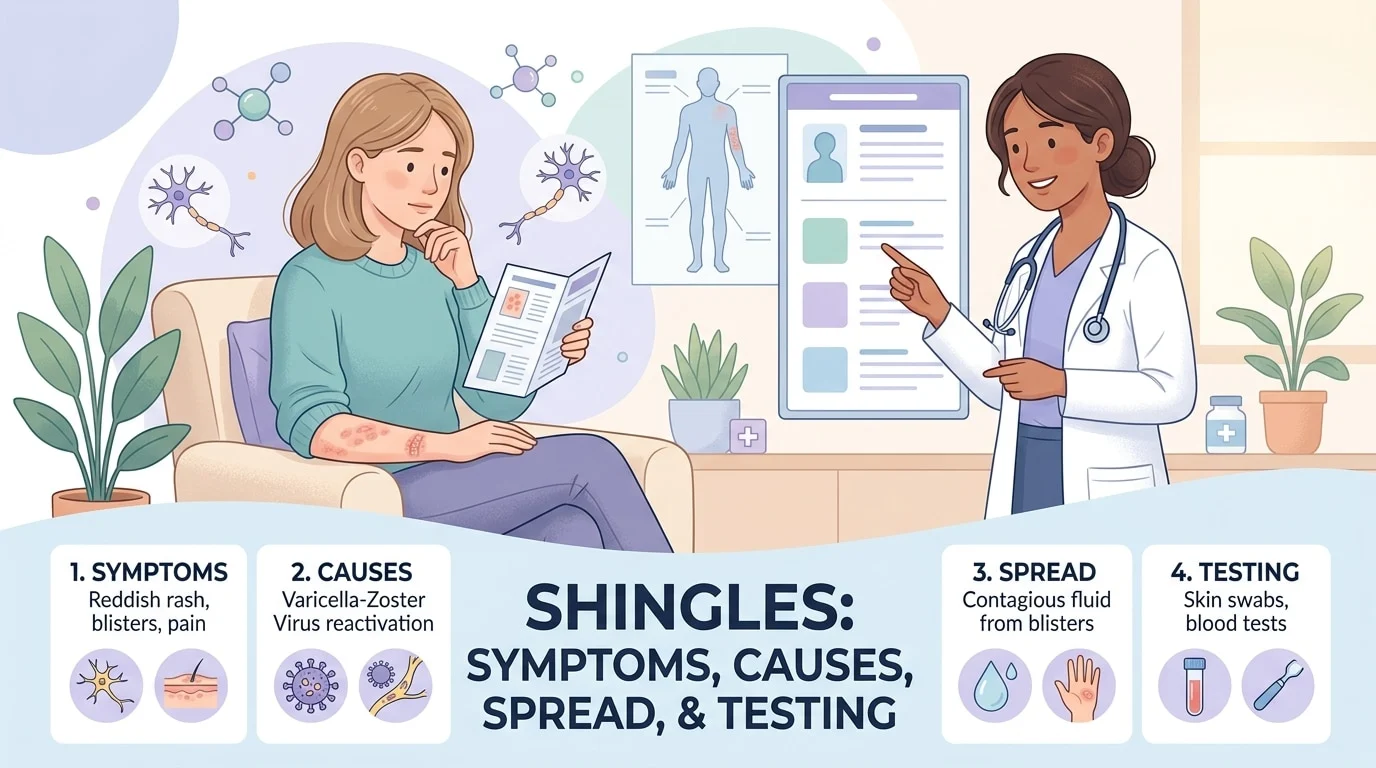
Los síntomas del herpes zóster suelen comenzar con una sensación de ardor, hormigueo o picor en un lado del cuerpo, uno o dos días antes de que aparezca cualquier erupción. El herpes zóster es una enfermedad dolorosa de la piel y los nervios causada por la reactivación del virus varicela-zóster, el mismo virus responsable de la varicela, que se reactiva años después de la primera infección. La mayoría de las personas quieren respuestas rápidas a las mismas preguntas: cómo es la erupción, si es contagioso, cuánto dura y cuándo es necesario hacerse pruebas. Esta guía responde a esas preguntas en un lenguaje sencillo y explica qué papel tienen los análisis de laboratorio, ya que el herpes zóster se diagnostica principalmente por su aspecto, aunque a veces se confirma en el laboratorio. En este artículo aprenderás a reconocer los síntomas y las fases del herpes zóster, cómo se contagia el virus, quiénes tienen más riesgo, cómo lo diagnostican y tratan los médicos, y cómo la vacuna reduce tu riesgo.
Qué es el herpes zóster y cómo se presenta
El herpes zóster, también conocido como culebrilla, es una reactivación del virus varicela-zóster (VVZ). Después de recuperarte de la varicela, el virus no desaparece de tu cuerpo. Permanece latente en el tejido nervioso cerca de la médula espinal y el cerebro, a veces durante décadas. Cuando se reactiva, viaja de nuevo a través de un nervio hasta la piel, lo que explica por qué la erupción sigue un trayecto en banda en un lado del cuerpo. Según los Centros para el Control y la Prevención de Enfermedades, aproximadamente 1 de cada 3 personas en Estados Unidos desarrollará herpes zóster a lo largo de su vida, y se estima que cada año se producen alrededor de 1 millón de casos en ese país.
El aspecto característico es una franja de piel enrojecida con pequeñas ampollas llenas de líquido que rodea un lado del tronco, aunque también puede aparecer en un lado de la cara, el cuello o alrededor de un ojo. La erupción suele ser dolorosa y puede picar u hormiguear. Las ampollas se abren, luego se secan y forman costras, generalmente en un plazo de 7 a 10 días, y la piel se recupera en dos a cuatro semanas. Como la erupción respeta la línea media y rara vez cruza al otro lado, su patrón unilateral es una de las señales visuales más claras. Nuestro equipo también explica el panorama más amplio de una erupción cutánea con sus múltiples posibles causas.
Síntomas y fases del herpes zóster
Los síntomas del herpes zóster tienden a desarrollarse en una secuencia predecible, lo que explica por qué la erupción a veces pasa desapercibida al principio.
La fase inicial (prodrómica)
Entre uno y cinco días antes de que aparezca el sarpullido, muchas personas sienten dolor, ardor, hormigueo, entumecimiento o picor en una franja concreta de piel. Algunas describen una sensibilidad exagerada, en la que incluso la ropa ligera resulta molesta. También pueden aparecer síntomas generales como fiebre, dolor de cabeza, cansancio y malestar estomacal. Como este dolor inicial no tiene una causa visible, a veces se confunde con un problema cardíaco, pulmonar o renal, según la zona donde se localice.
La fase del sarpullido y las ampollas
A continuación, aparece un sarpullido rojizo en la misma zona, seguido de grupos de ampollas llenas de líquido. Las ampollas se llenan, se rompen, supuran y luego forman costras. El dolor suele alcanzar su punto máximo en esta etapa. Todo el episodio dura habitualmente entre tres y cinco semanas, desde los primeros síntomas hasta la curación de la piel.
Cuando el dolor persiste después del sarpullido
En algunas personas, el dolor nervioso continúa después de que la piel haya cicatrizado. Esta es la complicación más frecuente y se aborda en el apartado sobre la neuralgia postherpética que encontrarás más adelante. Mayo Clinic señala que algunas personas experimentan el dolor del herpes zóster sin llegar a desarrollar un sarpullido visible, un patrón denominado zoster sine herpete que puede dificultar el diagnóstico.
¿Es el herpes zóster contagioso y cómo se transmite?
Esta es la pregunta que más hacen los pacientes, y la respuesta es tranquilizadora, aunque matizada. No puedes contagiarte el herpes zóster de otra persona. El herpes zóster solo aparece cuando el propio virus latente se reactiva. Sin embargo, el líquido de las ampollas del herpes zóster contiene el virus varicela-zóster activo, por lo que una persona con herpes zóster puede transmitir el virus a alguien que nunca haya tenido varicela ni la vacuna correspondiente. Esa persona desarrollaría varicela, no herpes zóster, y podría llegar a desarrollar herpes zóster mucho más adelante en su vida.
El virus se transmite por contacto directo con el líquido de las ampollas y, en ocasiones, al inhalar partículas víricas procedentes de ellas. Una persona con herpes zóster solo es contagiosa una vez que han aparecido las ampollas, y deja de serlo cuando el sarpullido ha formado costras por completo. Mantener el sarpullido cubierto reduce considerablemente el riesgo para los demás. Los CDC recomiendan a las personas con herpes zóster que cubran el sarpullido, eviten tocarlo o rascarlo, se laven las manos con frecuencia y eviten el contacto con personas embarazadas que nunca hayan tenido varicela, con bebés prematuros o de bajo peso al nacer, y con cualquier persona con el sistema inmunitario debilitado, hasta que el sarpullido forme costras. Cabe destacar que las personas con varicela transmiten el virus con más facilidad que las que tienen herpes zóster.
Qué causa el herpes zóster y quién tiene más riesgo
La causa directa es la reactivación del virus de la varicela-zóster. Por qué exactamente se reactiva en una persona y no en otra no se comprende del todo, pero el factor más determinante es el descenso natural de la inmunidad. El mayor factor de riesgo es la edad: el herpes zóster se vuelve mucho más frecuente a partir de los 50 años, y las personas mayores de 60 tienen más probabilidades de sufrir complicaciones graves.
Otros factores de riesgo reconocidos son un sistema inmunitario debilitado por enfermedades como el VIH o ciertos tipos de cáncer como la leucemia y el linfoma; tratamientos que suprimen la inmunidad, como la quimioterapia, los corticoides a largo plazo como la prednisona y los fármacos antirechazo tras un trasplante de órgano; y el estrés físico o emocional intenso. Dado que más del 99 % de los adultos que tuvieron varicela de niños ya portan el virus en estado latente, la gran mayoría de las personas mayores lo llevan consigo aunque no recuerden haber pasado la enfermedad. Cuando la inmunidad baja, el nervio inflamado puede provocar un dolor nervioso persistente, tema que abordamos en nuestra guía sobre el dolor nervioso conocido como neuralgia.
Cómo se diagnostica el herpes zóster, incluidas las pruebas de laboratorio
En la mayoría de los casos, el médico diagnostica el herpes zóster observando el sarpullido y preguntando sobre los síntomas y los antecedentes del paciente. Como los síntomas del herpes zóster siguen un patrón reconocible, la combinación de dolor en un solo lado seguido de una banda de ampollas a lo largo de una zona nerviosa concreta suele ser suficientemente característica como para no necesitar ninguna prueba de laboratorio. El antecedente de varicela refuerza el diagnóstico. Por eso se dice que el herpes zóster es un diagnóstico clínico, principalmente visual.
Las pruebas de laboratorio resultan útiles cuando el cuadro es atípico, cuando no hay sarpullido o cuando se sospechan complicaciones. Es en este punto donde entender tus resultados de laboratorio cobra importancia, y vale la pena saber qué prueba sirve para qué.
Qué prueba se usa para el herpes zóster, cuándo y qué indica
Un frotis del líquido de una ampolla reciente analizado mediante reacción en cadena de la polimerasa (PCR) es el método más preciso para confirmar el virus cuando hay erupción cutánea. El análisis de anticuerpos en sangre frente al VZV, midiendo IgM e IgG, puede ser útil en casos atípicos o sin erupción, aunque es menos concluyente. Cuando existe preocupación por complicaciones como una infección bacteriana grave, puede solicitarse un hemograma completo y marcadores de inflamación. Nuestro equipo explica cómo leer un análisis de sangre completo, qué significa El resultado del anticuerpo IgM en un informe de laboratorio qué significa y cómo interpretar el marcador de anticuerpos IgG para exposición previa, y qué indica marcador de inflamación PCR refleja cuándo se sospecha una infección. Para una visión más amplia del cribado de anticuerpos, consulta nuestra guía sobre el análisis de serología utilizado en un panel de infecciones.
| Prueba | Mejor indicado cuando | Lo que muestra |
|---|---|---|
| PCR en muestra de lesión | Hay erupción cutánea o ampollas presentes | Confirmación más precisa del virus de la varicela-zóster activo |
| Prueba de anticuerpos VZV (IgM / IgG) | Presentación atípica o ausencia de sarpullido | Respuesta inmunitaria reciente (IgM) frente a pasada o establecida (IgG); orientativa, no definitiva |
| Cultivo viral | Hay erupción cutánea y la PCR no está disponible | Confirma el virus, pero es más lento y menos sensible que la PCR |
| Hemograma completo y PCR | Se sospecha una complicación como una infección bacteriana | Signos generales de infección o inflamación, no específicos del herpes zóster |
Tratamiento y aspectos básicos de la recuperación
No existe ningún tratamiento que elimine el virus del organismo, pero los antivirales pueden acortar la enfermedad y reducir su gravedad. Según MedlinePlus, los tres antivirales utilizados son el aciclovir, el valaciclovir y el famciclovir, y funcionan mejor cuando se inician en los tres primeros días tras la aparición del sarpullido. Empezar pronto también puede reducir el riesgo de que quede un dolor nervioso persistente. Por eso es tan importante consultar a un médico rápidamente si sospechas que tienes herpes zóster.
Junto con los antivirales, el tratamiento se centra en el bienestar y en aliviar los síntomas del herpes zóster mientras la piel se cura. Los analgésicos de venta libre o con receta pueden ayudar, y las compresas húmedas frías, la loción de calamina y los baños de avena pueden aliviar el picor. Mantener la erupción limpia, seca y cubierta reduce el riesgo de una infección bacteriana secundaria de la piel. La mayoría de las personas sanas se recuperan por completo en pocas semanas. Busca atención médica urgente si la erupción está cerca de un ojo, si es extensa, o si tienes más de 50 años o el sistema inmunitario debilitado, ya que un tratamiento más temprano reduce el riesgo de complicaciones.
Complicaciones y prevención
Neuralgia posherpética y otras complicaciones
La complicación más frecuente es la neuralgia posherpética (NPH), un dolor nervioso que persiste en la zona del sarpullido una vez que la piel ha cicatrizado. Por lo general remite en semanas o meses, pero puede durar años e interferir en la vida cotidiana. El herpes zóster que afecta a un ojo puede comprometer la visión, y el que aparece en el oído o cerca de él puede causar problemas de audición, de equilibrio y debilidad facial. En casos raros puede derivar en neumonía, inflamación cerebral o incluso la muerte. Estos riesgos aumentan con la edad y cuando el sistema inmunitario está debilitado.
La vacuna contra el herpes zóster
La forma más eficaz de reducir el riesgo de padecer herpes zóster es la vacunación. Los CDC recomiendan dos dosis de la vacuna recombinante contra el zóster (Shingrix) para adultos de 50 años en adelante, y para adultos de 19 años en adelante con el sistema inmunitario debilitado por una enfermedad o su tratamiento. La vacuna reduce considerablemente la probabilidad de desarrollar herpes zóster y de sufrir NPH en caso de que aparezca. No trata un episodio activo, y un estilo de vida saludable por sí solo no puede sustituirla, aunque dormir bien, gestionar el estrés y controlar las enfermedades crónicas contribuyen a mantener el sistema inmunitario en buen estado.
Cuándo acudir al médico: señales de alarma
| Situación | Por qué es importante |
|---|---|
| Sarpullido o dolor cerca de un ojo | Puede causar daño ocular permanente; requiere atención urgente |
| Tienes 50 años o más | Mayor riesgo de complicaciones; el tratamiento precoz ayuda |
| Sistema inmunitario debilitado | Mayor riesgo de enfermedad grave o extendida |
| Sarpullido generalizado o que se extiende rápidamente | Puede indicar un curso más grave |
| Debilidad facial repentina, problemas de audición o de equilibrio | Posible afectación nerviosa que requiere valoración urgente |
| Dolor intenso o que empeora, fiebre alta o signos de infección cutánea | Puede indicar una complicación |
Últimos avances científicos
Las investigaciones de los últimos tres años han reforzado dos aspectos especialmente relevantes para entender tu propia salud: la duración de la protección que ofrece la vacuna y la relación del herpes zóster con otros riesgos para la salud. Estos hallazgos aportan contexto y deben interpretarse como evidencia en evolución, no como consejo médico personalizado.
En cuanto a la durabilidad, el análisis final del estudio de seguimiento ZOE-LTFU indicó que la protección ofrecida por la vacuna recombinante contra el herpes zóster se mantuvo elevada hasta 11 años después de la vacunación. En adultos vacunados a partir de los 50 años, la eficacia frente al herpes zóster, medida desde un mes después de la segunda dosis, se situó en torno al 88% durante todo el periodo y seguía siendo de aproximadamente el 82% en el undécimo año, con una protección de alrededor del 88% frente a la neuralgia posherpética (Strezova et al., EClinicalMedicine, 2025). Una revisión sistemática independiente que agrupó 12 ensayos aleatorizados y 5 estudios de cohortes encontró una eficacia vacunal de aproximadamente el 92% y una efectividad en el mundo real de alrededor del 70%, señalando además que la eficacia disminuye de forma gradual, pasando de un 97,7% inicial a un 73,2% en el décimo año (Byrne et al., International Journal of Technology Assessment in Health Care, 2024).
En cuanto a la relación entre el herpes zóster y la salud cardiovascular, un amplio estudio de cohortes retrospectivo realizado con una base de datos estadounidense analizó a adultos con diabetes y observó que quienes habían recibido la vacuna contra el herpes zóster presentaban un menor riesgo de eventos cardiovasculares adversos graves —incluidos el ictus y la enfermedad coronaria— en comparación con los pacientes no vacunados (Kornelius et al., BMJ Open, 2025). Al tratarse de un estudio observacional, muestra una asociación y no una relación de causalidad demostrada, y los autores reclaman estudios prospectivos que lo confirmen. La investigación también se está ampliando hacia otros posibles beneficios: actualmente se está reclutando participantes para un amplio ensayo aleatorizado de fase IV con el objetivo de evaluar si la vacuna recombinante contra el herpes zóster influye en la tasa de nuevos diagnósticos de demencia en adultos mayores (GSK, ClinicalTrials.gov NCT07502560). En conjunto, estos estudios apuntan a una protección duradera y significativa gracias a la vacunación, aunque quedan preguntas abiertas sobre efectos más amplios que futuros ensayos podrían resolver.
Glosario
| Término | Definición |
|---|---|
| Virus varicela-zóster (VVZ) | El virus responsable de la varicela y, cuando se reactiva, del herpes zóster. |
| Herpes zóster | El nombre médico del herpes zóster (culebrilla). |
| Dermatoma | La franja de piel inervada por un único nervio, que es la que suele seguir la erupción. |
| Fase prodrómica | La fase inicial de dolor, hormigueo o picor que aparece antes de que surja la erupción. |
| Neuralgia posherpética (NPH) | Dolor nervioso que persiste después de que la erupción del herpes zóster haya cicatrizado. |
| PCR (reacción en cadena de la polimerasa) | Método de laboratorio que detecta el material genético del virus en una muestra. |
| IgM e IgG | Tipos de anticuerpos; la IgM indica una respuesta reciente, mientras que la IgG señala una infección pasada o ya establecida. |
| Vacuna recombinante contra el herpes zóster | La vacuna no viva contra el herpes zóster (Shingrix), que se administra en dos dosis. |
| Inmunodeprimido | Con el sistema inmunitario debilitado a causa de una enfermedad o de un tratamiento. |
Preguntas frecuentes
¿El herpes zóster se contagia a otras personas?
El herpes zóster en sí no se contagia de persona a persona. No puedes transmitirle el herpes zóster a alguien. Sin embargo, el líquido de las ampollas contiene el virus de la varicela-zóster, por lo que alguien que nunca haya tenido varicela ni la vacuna correspondiente podría contagiarse del virus por contacto directo y desarrollar varicela, no herpes zóster. El riesgo es mayor mientras las ampollas están abiertas y supurando, y desaparece una vez que el sarpullido forma costras. Mantener el sarpullido cubierto, lavarte las manos y evitar el contacto cercano con personas embarazadas, recién nacidos y personas inmunodeprimidas hasta que se formen las costras reduce considerablemente el riesgo de transmitir el virus.
¿Cuánto dura el herpes zóster?
En la mayoría de los casos, un episodio de herpes zóster dura entre tres y cinco semanas, desde el primer hormigueo hasta la curación completa de la piel. Las ampollas suelen formar costras en un plazo de 7 a 10 días. Comenzar el tratamiento antiviral en los tres primeros días tras la aparición del sarpullido puede acortar la enfermedad y reducir su gravedad. En algunas personas, el dolor nervioso conocido como neuralgia postherpética persiste después de que el sarpullido desaparece y puede durar semanas, meses o, en ocasiones, años; esto es más frecuente en personas de mayor edad.
¿Se puede tener herpes zóster más de una vez?
Sí. Muchas personas lo tienen solo una vez, pero es posible que vuelva a aparecer, y las recurrencias son más frecuentes en personas con el sistema inmunitario debilitado. Haber tenido herpes zóster no es motivo para no vacunarse; los CDC recomiendan la vacuna incluso a quienes ya han pasado un episodio, porque reduce el riesgo de que se repita.
¿Puedes tener herpes zóster si nunca has tenido varicela?
El herpes zóster solo se desarrolla en personas que ya tienen el virus de la varicela-zóster en su organismo, adquirido a través de la varicela o, con menos frecuencia, de la vacuna contra la varicela. Si realmente nunca has estado expuesto al virus, no puedes desarrollar herpes zóster. Ten en cuenta que más del 99 % de los estadounidenses nacidos antes de 1980 tuvieron varicela, muchas veces sin recordarlo, por lo que la mayoría de los adultos mayores sí llevan el virus latente aunque no recuerden haber tenido ninguna enfermedad en la infancia.
¿El herpes zóster pica o solo duele?
Ambas cosas son frecuentes. Muchas personas sienten picor, hormigueo o quemazón en la zona de piel afectada, a veces incluso antes de que aparezca el sarpullido, junto con un dolor que puede ir de leve a intenso. Las compresas frías, la loción de calamina y los baños de avena pueden aliviar el picor, mientras que el tratamiento del dolor lo orienta tu médico. Si el picor lleva a rascarse y abrir las ampollas, aumenta el riesgo de infección cutánea secundaria, por lo que mantener la zona limpia y cubierta es importante.
¿Existe algún análisis de sangre para detectar el herpes zóster?
Existe, pero no es la forma principal de diagnosticar el herpes zóster. La mayoría de los casos se identifican únicamente por el sarpullido y los síntomas. Cuando se necesitan pruebas, un frotis del líquido de las ampollas analizado mediante PCR es la opción más precisa mientras el sarpullido está presente. Los análisis de sangre para detectar anticuerpos frente al VZV (IgM e IgG) se reservan principalmente para casos atípicos o sin sarpullido, y son de apoyo diagnóstico más que definitivos. Tu médico decide si está justificada alguna prueba según tu situación.
Fuentes
- Información sobre el herpes zóster — Centros para el Control y la Prevención de Enfermedades
- Herpes zóster — MedlinePlus, Biblioteca Nacional de Medicina de EE. UU.
- Herpes zóster: síntomas y causas — Mayo Clinic
- Strezova A, et al. Final analysis of the ZOE-LTFU trial to 11 years post-vaccination — EClinicalMedicine, 2025
- Kornelius E, et al. Herpes zoster vaccination and cardiovascular risk in patients with diabetes — BMJ Open, 2025
- Byrne D, et al. A systematic review of the clinical effectiveness of recombinant zoster vaccine — International Journal of Technology Assessment in Health Care, 2024
- GSK. Effect of recombinant zoster vaccine on incident dementia diagnosis (Phase IV trial) — ClinicalTrials.gov, NCT07502560
Lecturas adicionales
- nuestra guía detallada sobre las causas y los tratamientos del herpes zóster
- nuestra explicación sobre el dolor nervioso llamado neuralgia
- nuestra guía sobre la prueba de serología en un panel de infecciones
- nuestra guía para entender los resultados de un análisis de sangre
- nuestra comparativa entre la foliculitis y otras afecciones similares al herpes
Comprenda los resultados de su laboratorio con AI DiagMe.
Obtén la interpretación de tus resultados en minutos.
Cuando el herpes zóster es atípico o se sospecha una complicación, es posible que acabes con resultados de laboratorio que necesitas entender, como una prueba de anticuerpos frente al VZV con IgM e IgG, un hemograma completo o un marcador de inflamación como la PCR. AI DiagMe convierte esos valores en explicaciones claras y en un lenguaje sencillo para que llegues a tu consulta mejor informado. Está diseñado para ayudarte a entender tus resultados, no para diagnosticarte, y no sustituye a tu médico.