



























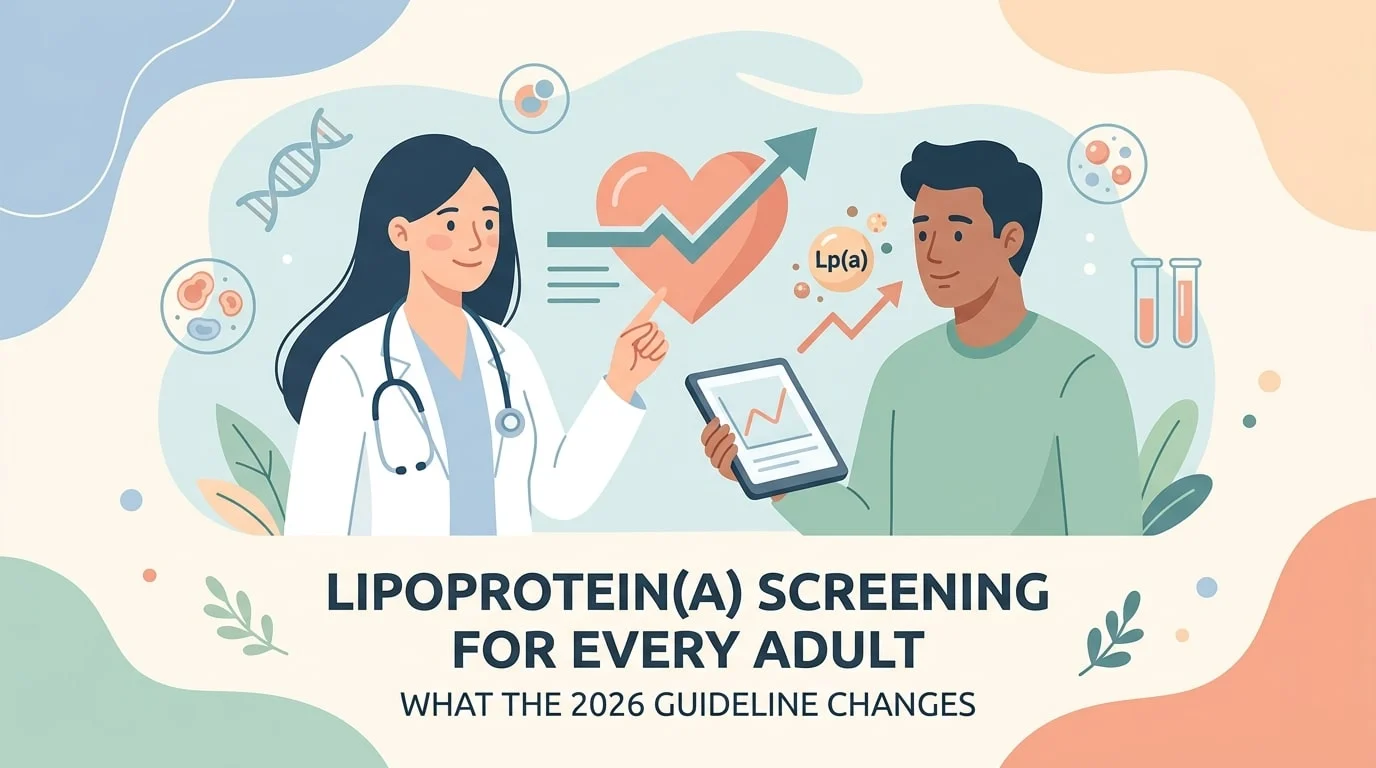
El cribado de lipoproteína(a) ha pasado a primer plano. En marzo de 2026, una importante guía clínica de Estados Unidos empezó a recomendar que todos los adultos se midan la lipoproteína(a) al menos una vez en la vida. Esto supone un cambio claro respecto al enfoque anterior, que reservaba la prueba para personas con un riesgo evidente. La lipoproteína(a), o Lp(a), es una partícula de origen principalmente genético que aumenta el riesgo de infarto, ictus y estenosis de la válvula aórtica, de forma independiente al colesterol habitual. En este artículo descubrirás qué cambió en 2026, qué mide la prueba, cómo leer tu resultado, qué hacer si tienes el nivel alto y qué apunta la investigación más reciente.
¿Qué cambió en 2026?
El 13 de marzo de 2026 se publicó la nueva Guía 2026 ACC/AHA/Multisociety sobre Dislipidemia que sustituye a la guía de colesterol de 2018. Por primera vez en una guía estadounidense, se recomienda el cribado universal de adultos para detectar niveles elevados de lipoproteína(a), con consideraciones especiales para la realización de la prueba en niños. También recupera los objetivos de tratamiento de lipoproteínas de baja densidad (LDL) basados en el riesgo y promueve el control lipídico a lo largo de toda la vida.
Esto es relevante porque las recomendaciones anteriores consideraban la prueba opcional. Los recursos nacionales para pacientes siguen describiendo la lipoproteína(a) como una prueba que se solicita habitualmente solo a personas de alto riesgo, y no como un cribado rutinario. La actualización de 2026 redefine una única medición de Lp(a) como información útil para casi todo el mundo, ya que el resultado apenas varía a lo largo de la vida y puede revelar un riesgo oculto que un perfil lipídico estándar no detecta.
Qué mide el cribado de lipoproteína(a)
La lipoproteína(a) es una partícula similar al LDL a la que se une una proteína adicional, la apolipoproteína(a). Esa estructura la hace propensa tanto a formar placas en las arterias como a favorecer la formación de coágulos. Tu nivel está determinado principalmente por la genética, por lo que se mantiene bastante estable desde la infancia. Para una explicación más detallada, consulta nuestra guía sobre la lipoproteína(a) como marcador de riesgo cardiovascular.
La prueba en sí consiste en una simple extracción de sangre, que a menudo se incluye en un análisis lipídico más completo. Nuestro artículo explica el perfil lipídico estándar, que mide el colesterol total, el LDL, el HDL y los triglicéridos. La Lp(a) no forma parte de ese panel básico, por eso es importante solicitarla específicamente. A diferencia de un análisis de colesterol rutinario, la prueba de lipoproteína(a) normalmente no requiere ayuno previo.
Cómo interpretar tu resultado de lipoproteína(a)
La Lp(a) se expresa en una de estas dos unidades: miligramos por decilitro (mg/dL) o nanomoles por litro (nmol/L). Estas unidades no se convierten con un factor simple, así que comprueba siempre cuál ha utilizado tu laboratorio. La tabla siguiente muestra los valores de referencia más habituales.
| Nivel de lipoproteína(a) | En mg/dL | En nmol/L | Interpretación habitual |
|---|---|---|---|
| Deseable | Por debajo de 30 | Por debajo de 75 | Riesgo bajo relacionado con la Lp(a) |
| Límite | 30 a 50 | 75 a 125 | Optimizar los demás factores de riesgo |
| Alto | Por encima de 50 | Por encima de 125 | Riesgo cardiovascular elevado |
Un solo número nunca cuenta toda la historia. El médico interpreta tu resultado junto con la edad, el sexo, la tensión arterial, el tabaquismo, la diabetes y el resto de tus lípidos. Aproximadamente una de cada cinco personas tiene un nivel alto, muchas veces sin saberlo, porque la aterosclerosis se desarrolla en silencio durante años.
Qué significa un resultado alto y qué hacer
Una lipoproteína(a) alta no provoca síntomas por sí sola, y aún no existe ningún medicamento aprobado específicamente para reducirla. Por eso, el objetivo práctico es reducir todos los demás factores de riesgo que sí puedes modificar: controlar el colesterol LDL, la tensión arterial, el azúcar en sangre y el peso, y dejar de fumar, ya que el tabaco multiplica considerablemente el peligro de tener la Lp(a) alta.
La dieta y el ejercicio apenas modifican el valor de la Lp(a) en sí, pero sí reducen tu riesgo cardiovascular global, que es lo que realmente importa. Algunas personas se benefician de un análisis más detallado de la carga de partículas: nuestro artículo explica el análisis de ApoB en sangre, y nuestra guía general cubre el perfil lipídico avanzado. Para actuar sobre los factores modificables, nuestra guía detalla los niveles saludables de colesterol LDL y nuestro recurso explica cómo prevenir el colesterol alto.
Quién se beneficia más del cribado de lipoproteína(a)
La guía de 2026 recomienda realizar la prueba al menos una vez a todos los adultos, aunque algunos grupos son los que más se benefician de obtener un resultado temprano. La tabla compara el enfoque anterior, más selectivo, con el nuevo, de carácter universal.
| Enfoque | A quién se analizaba | Limitación |
|---|---|---|
| Selectivo (antes de 2026) | Antecedentes familiares de enfermedad cardíaca precoz, LDL muy alto o eventos cardiovasculares previos | Dejaba sin detectar a muchas personas con riesgo hereditario silencioso |
| Universal (2026) | Todos los adultos, al menos una vez; normas especiales para niños | Requiere mayor concienciación y acceso |
Las pruebas son especialmente útiles si un familiar cercano sufrió un infarto o un ictus a edad temprana, si tienes hipercolesterolemia familiar o si sigues teniendo eventos cardiovasculares a pesar de tener el LDL bien controlado. Como la Lp(a) es hereditaria, un resultado elevado en una persona es una señal para hablar de hacer la prueba a sus familiares de primer grado.
Cuándo buscar atención médica
Una Lp(a) alta es un marcador de riesgo a largo plazo, no una urgencia. Aun así, algunos síntomas requieren atención inmediata: dolor en el pecho, dificultad repentina para respirar o señales de alarma de ictus como caída de un lado de la cara, debilidad en un brazo o dificultad para hablar. En esas situaciones, llama a los servicios de emergencias de inmediato, sin esperar a ningún análisis de sangre.
Últimos avances científicos
Según la literatura reciente indexada en PubMed, los argumentos a favor de medir la Lp(a) son cada vez más sólidos, aunque un hallazgo reciente no equivale a una práctica consolidada. Una revisión de 2024 publicada en The Lancet concluyó que aproximadamente una de cada cinco personas tiene la lipoproteína(a) elevada y que las personas con riesgo deberían medírsela al menos una vez en la vida (DOI).
Un amplio análisis de 30 años en mujeres inicialmente sanas, publicado en el New England Journal of Medicine en 2024, demostró que una única medición combinada de PCR de alta sensibilidad, colesterol LDL y lipoproteína(a) predijo eventos cardiovasculares décadas después, lo que respalda una evaluación del riesgo más temprana (DOI). A partir de la misma cohorte, un estudio de 2026 publicado en JAMA Cardiology analizó los umbrales clínicos y concluyó que el cribado de Lp(a) elevada en la población general podría estar justificado (DOI). Estos son hallazgos observacionales y de cohortes; describen el riesgo, no un tratamiento que lo reduzca.
Glosario
| Término | Definición |
|---|---|
| Lipoproteína(a) / Lp(a) | Una partícula sanguínea similar al LDL, en gran medida hereditaria, que aumenta el riesgo cardiovascular. |
| Apolipoproteína(a) | La proteína adicional unida a la Lp(a) que potencia su efecto protrombótico. |
| aterosclerosis | La acumulación gradual de placa grasa que estrecha y endurece las arterias. |
| Estenosis de la válvula aórtica | Estrechamiento de la válvula aórtica del corazón, que la Lp(a) puede favorecer con el tiempo. |
| ASCVD | Enfermedad cardiovascular aterosclerótica, que incluye el infarto de miocardio y el ictus. |
| nmol/L frente a mg/dL | Dos unidades de laboratorio para la Lp(a) que no se convierten con un factor simple. |
| PCR-as | Proteína C reactiva de alta sensibilidad, un marcador de inflamación de bajo grado. |
| Prevención primaria | Medidas adoptadas antes de un primer infarto o ictus para reducir el riesgo. |
Preguntas frecuentes
¿El cribado de lipoproteína(a) es ya una prueba rutinaria?
La guía estadounidense de 2026 recomienda medir la Lp(a) al menos una vez en todos los adultos, lo que la acerca al uso rutinario. En la práctica, la disponibilidad y la cobertura local siguen variando, así que consulta con tu médico si la prueba tiene sentido para ti y cuándo realizarla. Como el resultado es estable de por vida, una sola medición suele ser suficiente.
¿Necesito ayunar antes del examen?
Normalmente no. Los niveles de lipoproteína(a) son estables y no se ven muy afectados por una comida reciente, por lo que la muestra puede tomarse habitualmente sin ayuno previo. Si la Lp(a) se extrae junto con un perfil lipídico completo, tu médico puede darte instrucciones específicas, así que sigue las indicaciones que te facilite el laboratorio.
¿Con qué frecuencia hay que medir la lipoproteína(a)?
Para la mayoría de las personas, una sola vez es suficiente, ya que el nivel está determinado genéticamente y cambia poco a lo largo de la vida. En ocasiones se considera repetir la prueba tras la menopausia o si el primer resultado quedó cerca de un umbral de decisión. Tu médico decidirá en función de tu perfil de riesgo global.
¿Puedo reducir una lipoproteína(a) alta?
Actualmente no existe ningún medicamento aprobado que actúe directamente sobre la Lp(a), y los cambios en el estilo de vida tienen poco efecto sobre el valor en sí. La estrategia demostrada consiste en reducir todos los demás factores de riesgo: el colesterol LDL, la tensión arterial, el azúcar en sangre, el peso y el tabaquismo. Varios fármacos reductores de la Lp(a) se encuentran en ensayos en fase avanzada, pero aún no están disponibles en la práctica clínica habitual.
¿Un resultado alto significa que voy a tener un infarto?
No. Una Lp(a) alta aumenta el riesgo a lo largo del tiempo, pero es uno más entre muchos factores, y muchas personas con niveles elevados nunca sufren ningún evento cardiovascular. El objetivo del cribado es identificar un riesgo oculto de forma temprana para que tú y tu médico podáis actuar sobre lo que sí es modificable.
Fuentes
- Prueba de lipoproteína(a) en sangre — MedlinePlus (Biblioteca Nacional de Medicina de EE. UU.)
- Lipoproteína(a): niveles y análisis — Cleveland Clinic
- Publicada la guía ACC/AHA/Multisociedad 2026 sobre dislipidemia — National Lipid Association
Lecturas adicionales
- Lipoproteína(a): cómo entender este marcador de riesgo cardiovascular
- Análisis del perfil lipídico: colesterol, LDL, HDL y triglicéridos.
- Análisis de ApoB en sangre: una visión más clara del riesgo cardíaco
- Niveles normales de LDL: guía de valores saludables
- Perfil lipídico avanzado: ApoB, Lp(a) y análisis más exhaustivo del riesgo cardíaco.
Comprenda los resultados de su laboratorio con AI DiagMe.
La lipoproteína(a) rara vez tiene sentido analizarla de forma aislada. Se interpreta mejor junto con tu perfil lipídico completo, el colesterol LDL y HDL, los triglicéridos y, en ocasiones, la ApoB o la PCR de alta sensibilidad. Ante todos esos valores y unidades, no siempre es fácil saber en qué punto te encuentras. AI DiagMe te ayuda a entender tus resultados de laboratorio en un lenguaje claro, para que puedas preparar mejor la conversación con tu médico. No diagnostica ni sustituye a tu médico; simplemente hace que tus resultados sean más fáciles de leer.
Obtén la interpretación de tus resultados en minutos.