









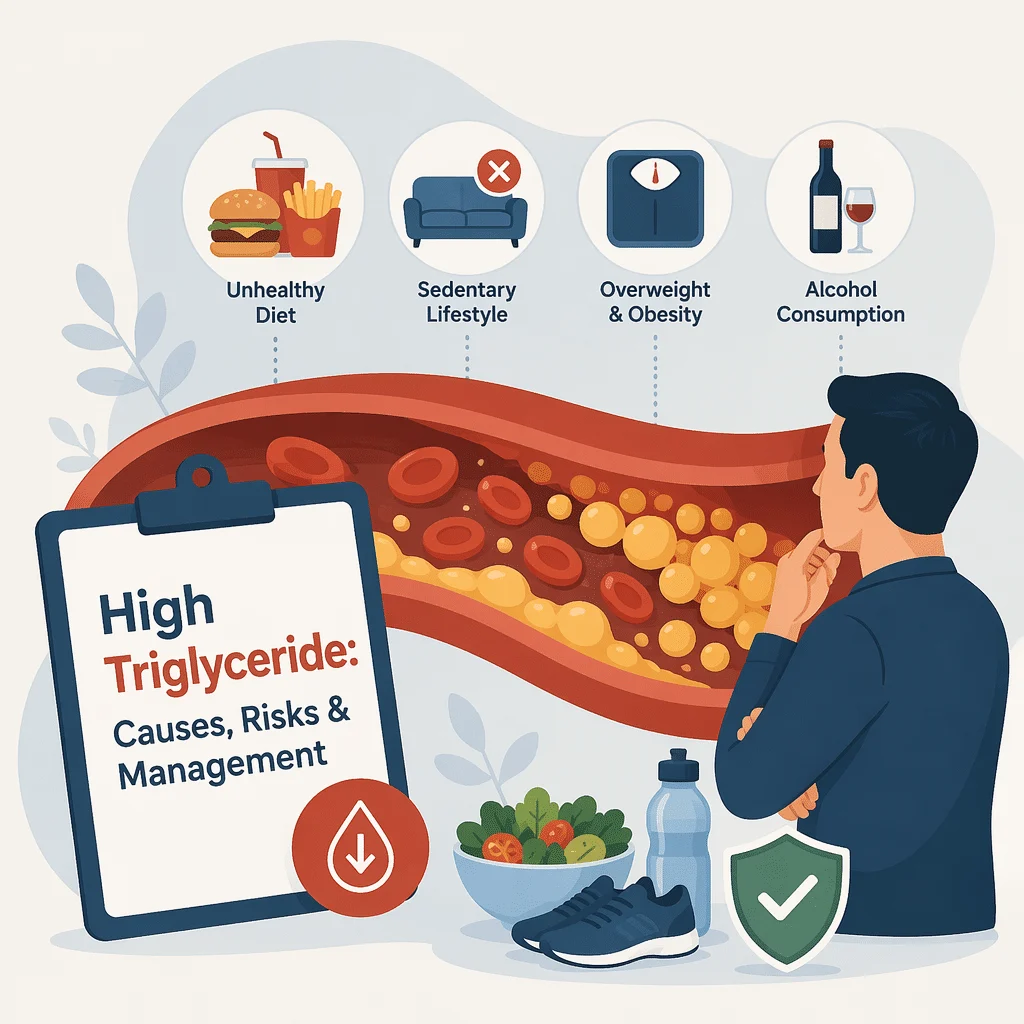
High triglycerides are one of the most common findings on a routine blood test, yet they often slip by unnoticed because they rarely cause obvious symptoms. Triglycerides are the body’s main storage form of fat, and when their level in the blood climbs too far, the reading can flag trouble with how you handle food, sugar, and alcohol. Very high values carry their own danger, from heart disease to a painful pancreas condition. This guide explains what high triglycerides mean on a blood test, what pushes them up, why they matter for your health, and the lifestyle steps and medicines that bring them down. You will also find the standard result bands, a plain-language look at recent research, and answers to the questions people ask most.
What are triglycerides, and what counts as high?
Triglycerides are fat molecules that circulate in your blood. After a meal, your body turns calories it does not need right away into triglycerides and stores them in fat cells, then releases them for energy between meals. This system is normal and useful. The problem starts when there are consistently too many of them in circulation, a state doctors call hypertriglyceridaemia.
Triglycerides almost never appear on their own. They are one of four numbers on the standard lipid panel, alongside total cholesterol, LDL cholesterol, and HDL cholesterol. Because triglycerides ride through the bloodstream inside fat-carrying particles, a high reading also hints at how many triglyceride-rich particles, measured as VLDL cholesterol, your blood is carrying. Reading the four numbers together tells a fuller story than any single figure.
Triglycerides versus cholesterol
People often blur triglycerides and cholesterol together, but they are different fats with different jobs. Cholesterol helps build cells and hormones, while triglycerides mainly store energy from the calories you eat. Both travel in the blood on protein-wrapped particles, and both can harm the arteries when they run high, which is why a lipid panel measures them side by side. Knowing the difference helps explain why you can have a healthy cholesterol reading and a raised triglyceride number at the same time.
The standard result bands
Most laboratories in the UK report triglycerides using the ranges explained by the National Library of Medicine and echoed by the British Heart Foundation. The bands below apply to a fasting sample, meaning you had nothing but water for 9 to 12 hours before the draw.
| Category | Fasting triglycerides (mg/dL) | What it usually means |
|---|---|---|
| Normal | Below 150 | Considered a healthy range for most adults |
| Borderline high | 150 to 199 | A signal to review diet, weight, and activity |
| High | 200 to 499 | Often linked to cardiovascular risk and metabolic problems |
| Very high | 500 and above | Raises the risk of acute pancreatitis and needs prompt care |
Some labs report triglycerides in millimoles per litre (mmol/L) instead of milligrams per decilitre (mg/dL); to convert, multiply the mmol/L figure by about 89. A non-fasting sample can read higher than a fasting one, so the bands above are meant for a fasting test. If your result lands just over a cutoff, that single point matters less than where your number sits overall and how it changes on a repeat test.
If your value sits at the low end instead, the causes and meaning are different, and a separate guide covers low triglyceride levels. A dedicated article also explains normal triglyceride ranges in more detail if you want the healthy targets by situation.
What causes high triglycerides?
High triglycerides usually come from a mix of daily habits and underlying health conditions rather than a single cause. Sorting out which factors apply to you is the first step your doctor takes, because several of them can be changed.
Everyday and lifestyle causes
- Diets heavy in refined carbohydrates, sugary drinks, and added sugars, which the body quickly converts into triglycerides.
- Regular or heavy alcohol use, one of the fastest ways to push a reading upward.
- Excess body weight, especially around the waist, and a mostly sedentary routine.
- Large, fatty meals shortly before a non-fasting blood draw, which can inflate the number temporarily.
Medical causes and medicines
- Poorly controlled type 2 diabetes and insulin resistance, which loosen the body’s grip on blood fats.
- An underactive thyroid, known as hypothyroidism, along with some kidney and liver conditions.
- Certain medicines, including some steroids, beta-blockers, oestrogen pills, and specific diuretics.
- Inherited lipid disorders that raise triglycerides strongly and often run in families.
One pattern confuses many people: high triglycerides with normal cholesterol. This is common and usually points to diet, weight, alcohol, or blood-sugar control rather than a classic cholesterol problem. It still deserves attention, because triglyceride-rich particles contribute to artery damage on their own.
Doctors also separate secondary causes, which come from another condition or medicine and can often be reversed, from primary causes, which are written into your genes. Pinpointing the secondary drivers matters, because treating an underactive thyroid, tightening blood-sugar control, or adjusting a medicine can lower the reading without adding a new lipid drug. When a strongly raised level runs in the family, an inherited disorder is more likely and may call for specialist care.
Why high triglycerides matter for your health
For most people, the main concern with high triglycerides is long-term damage to the arteries and heart. For a smaller group with very high levels, the immediate worry shifts to the pancreas.
Heart and blood vessel disease
Triglyceride-rich particles can slip into artery walls and add to the fatty buildup that narrows blood vessels, a process called atherosclerosis. Over years, this raises the risk of coronary artery disease, heart attack, and stroke, particularly when high triglycerides travel with low HDL cholesterol or high LDL cholesterol. That is why doctors weigh the whole lipid picture, and sometimes order an advanced lipid panel, rather than reacting to one number.
Part of the concern comes from remnant particles, the leftover fragments of triglyceride-rich lipoproteins. These remnants can lodge in the artery wall and stir up inflammation, adding to cardiovascular risk beyond what LDL cholesterol alone explains. This is one reason a raised triglyceride reading is taken seriously even when the classic cholesterol numbers look reassuring.
Acute pancreatitis when levels are very high
Once triglycerides climb past roughly 500 mg/dL, and especially above 1,000 mg/dL, they can inflame the pancreas and set off acute pancreatitis, a medical emergency marked by severe upper-abdominal pain, nausea, and vomiting. This risk is the reason very high readings are treated quickly and aggressively.
Fatty liver and metabolic syndrome
Elevated triglycerides frequently travel with a fatty liver and with metabolic syndrome, the cluster of high blood sugar, high blood pressure, extra waist fat, and unfavourable cholesterol. Because these conditions feed one another, doctors often order liver function tests and blood-sugar checks when triglycerides are high.
Do high triglycerides cause symptoms?
In most cases, high triglycerides cause no symptoms at all, which is exactly why they are usually found on a routine blood test rather than because a person feels unwell. This silent nature is one reason regular screening matters.
When levels become extremely high, a few visible clues can appear: small yellowish fatty bumps under the skin, called xanthomas, or a pale ring around the cornea of the eye. Severe cases can also bring on the abdominal pain of pancreatitis.
When to see a doctor
- Your fasting triglycerides come back at 200 mg/dL or higher on a lab report.
- You have diabetes, a strong family history of early heart disease, or several cardiovascular risk factors together.
- You develop sudden, severe pain in the upper abdomen with nausea or vomiting, which needs urgent care.
- You notice new fatty skin bumps or other unexplained changes after a high result.
How to lower high triglycerides
The good news is that elevated triglycerides respond well to change. Triglycerides are among the most diet-sensitive numbers on a lab report, so everyday habits often move them substantially before any medicine is needed.
Lifestyle changes come first
- Cut back on sugary drinks, refined carbohydrates, and added sugars, and favour vegetables, whole grains, beans, and fish.
- Limit alcohol, or stop for a while, since even moderate amounts can raise triglycerides sharply in sensitive people.
- Aim for at least 150 minutes of moderate activity a week, such as brisk walking, and lose excess weight gradually.
- Keep blood sugar in range if you have diabetes, which often brings triglycerides down at the same time.
- Choose unsaturated fats and oily fish over fried foods, and replace some starches with fibre-rich choices.
Medicines your doctor may consider
When lifestyle changes are not enough, or when levels are very high, a doctor may add medicine, guided by your overall heart risk rather than the triglyceride number alone.
- Statins, which lower cardiovascular risk and modestly reduce triglycerides, are often the first drug considered.
- Fibrates, which target triglycerides directly and help protect the pancreas at very high levels.
- Prescription omega-3 fatty acids, including the purified form icosapent ethyl, used for selected people at higher risk.
- Better control of contributing conditions, such as thyroid or blood-sugar problems, and a review of any medicine that may be raising your level.
Over-the-counter fish-oil capsules are not the same as prescription omega-3 products, and doses differ widely, so any supplement is worth discussing with your clinician first.
Combining several small changes usually works better than relying on any single one. Cutting back on sugary drinks, walking most days, and easing off alcohol together can move a reading further than one change alone. Give the plan a fair trial, then confirm progress with a repeat fasting test, so you and your doctor can see what is working before deciding on medication.
How to read your triglyceride result
A single number is a snapshot, not a verdict. Triglycerides swing with your last meal, recent alcohol, illness, and even the time of day, so one high reading is best confirmed with a repeat fasting test before you draw firm conclusions.
Context is everything. The same value carries a different weight for a person with diabetes and low HDL than for an otherwise healthy adult. Compare your result against the standard bands, look at it alongside your cholesterol numbers, and track the trend over time rather than fixating on one day. If your reading is high, the triglycerides blood test explainer walks through what the figure represents and how it fits with the rest of the panel.
Small differences between labs and between blood draws are normal, so do not read too much into a modest shift from one test to the next. What matters more is the direction of travel over months and how your number sits next to your cholesterol, blood sugar, and personal risk factors. Bring your report to your clinician, who can place the value in the context of your health rather than treating it as an isolated score.
Latest scientific advances
Research on high triglycerides has shifted in an important way: the goal is no longer just to make the number smaller, but to lower the actual risk of heart attacks and strokes. Here is what recent reviews and trials suggest, in plain terms.
Lowering the number is not automatically enough. In one large trial, a triglyceride-lowering drug called pemafibrate (a type of fibrate) clearly reduced triglycerides but did not reduce heart attacks or strokes. What this means for you is that the aim is your overall cardiovascular risk, not the lab figure alone, and that shapes which treatment a doctor chooses.
One prescription omega-3 stands out from the rest. A purified form of an omega-3 fatty acid called icosapent ethyl (a concentrated version of EPA, one of the fats found in fish) lowered the risk of cardiovascular events by roughly a quarter in people who were already taking a statin but still had elevated triglycerides. What this means for you is that this is a specific prescription medicine, not the same as an over-the-counter fish-oil capsule, and only a doctor can judge whether it fits your case.
Newer, more targeted medicines are on the way. Scientists are testing drugs that switch off specific proteins the body uses to handle blood fats, such as ApoC-III and ANGPTL3, with experimental names like olezarsen and plozasiran. Early studies show they can lower triglycerides substantially, which is promising for very high or inherited cases. What this means for you is that these are encouraging but still preliminary; whether they prevent heart attacks is being studied now, and the results are not final.
Everyday habits remain the foundation. Recent guideline summaries and primary-care reviews still place diet, physical activity, weight, alcohol reduction, and blood-sugar control at the base of care, with statins guided by a person’s overall heart risk. What this means for you is that lifestyle steps keep working alongside any medicine, and they are the reliable starting point at every level of risk.
Glossary of key terms
| Term | Definition |
|---|---|
| Triglycerides | The most common type of fat in the blood, used by the body to store and supply energy. |
| Lipid panel | A blood test that measures triglycerides along with total, LDL, and HDL cholesterol. |
| Hypertriglyceridaemia | The medical term for a higher-than-normal triglyceride level in the blood. |
| VLDL | Very low-density lipoprotein, the particle that carries most triglycerides through the bloodstream. |
| Pancreatitis | Painful inflammation of the pancreas that very high triglycerides can trigger. |
| Metabolic syndrome | A cluster of findings, including high triglycerides, that together raise heart and diabetes risk. |
| Statin | A common cholesterol-lowering medicine that also lowers cardiovascular risk. |
| Fibrate | A prescription medicine used mainly to bring down high triglyceride levels. |
| Icosapent ethyl | A purified prescription omega-3 (concentrated EPA) studied for lowering cardiovascular risk. |
Frequently asked questions
What triglyceride level is considered dangerous?
Triglycerides in the high band run from 200 to 499 mg/dL, and readings of 500 mg/dL or more are labelled very high. The very high range is the one doctors treat most urgently, because it can inflame the pancreas. Any high result is worth acting on, but the exact level of concern also depends on your other heart-risk factors, so your clinician interprets it in context rather than by the number alone.
What causes high triglycerides when cholesterol is normal?
This common pattern usually points to diet, alcohol, excess weight, or blood-sugar control rather than a classic cholesterol problem. Refined carbohydrates and sugary drinks are frequent culprits, and so is regular alcohol. It still deserves attention, because the triglyceride-rich particles involved can affect your arteries even when your cholesterol numbers look fine.
How quickly can triglycerides come down?
Triglycerides are among the most responsive numbers on a lab report. With steady changes to diet, alcohol, activity, and weight, many people see a meaningful drop within a few weeks to a couple of months. Your doctor will usually recheck a fasting sample after a set period to confirm the trend before deciding whether medicine is needed.
Do high triglycerides always mean I need medication?
Not always. For borderline and many high readings, lifestyle changes are the first and often sufficient step. Medicine becomes more likely when levels are very high, when you already have heart disease or diabetes, or when several risk factors stack up together. The decision rests on your whole health picture, not the triglyceride figure by itself.
How often should triglycerides be checked?
Many adults have triglycerides measured as part of a lipid panel every four to six years, but people with diabetes, prior high results, heart disease, or other risk factors are usually tested more often. If you are working to lower a high result, your doctor may recheck within a few months to see whether your changes are working.
Can high triglycerides be a warning sign of diabetes?
They can be a clue. High triglycerides often accompany insulin resistance and type 2 diabetes, so an elevated reading may prompt your doctor to check your blood sugar, sometimes with the A1C blood test. Finding and treating a blood-sugar problem early frequently helps bring triglycerides down as well.
Sources
- National Library of Medicine (MedlinePlus) – Triglycerides, 2025 – medlineplus.gov/triglycerides.html
- Mayo Clinic – Triglycerides: Why do they matter? 2024 – mayoclinic.org
- Centers for Disease Control and Prevention – About Cholesterol, 2024 – cdc.gov/cholesterol/about
- Hussain A, et al. – What is really new in triglyceride guidelines? Current Opinion in Endocrinology, Diabetes and Obesity, 2023 – doi.org/10.1097/MED.0000000000000802
- Chukwurah MI, Miller M. – Fibrates, Hypertriglyceridaemia, and CVD Risk after PROMINENT. Current Cardiology Reports, 2023 – doi.org/10.1007/s11886-023-01926-2
- Kaur G, et al. – Omega-3 fatty acids for cardiovascular event lowering. European Journal of Preventive Cardiology, 2024 – doi.org/10.1093/eurjpc/zwae003
- Diaz-Diaz JL. – Evidence on cardiovascular prevention with icosapent ethyl. Clinica e Investigacion en Arteriosclerosis, 2025 – doi.org/10.1016/j.arteri.2025.500818
- Lan NSR, et al. – Hypertriglyceridaemia: a practical approach for primary care. Australian Journal of General Practice, 2025 – doi.org/10.31128/AJGP-01-25-7535
- Maiorca C, et al. – Targeting triglycerides for cardiovascular risk reduction. Internal and Emergency Medicine, 2026 – doi.org/10.1007/s11739-026-04383-1
Further reading
- Total cholesterol test: a complete guide to your results
- Cholesterol ratio explained: meaning and risks
- High cholesterol: understand, prevent, and act
- Fasting blood glucose: a complete guide to interpretation
- Understanding lipase levels: causes and risks
Understand your lab results with AI DiagMe
High triglycerides rarely travel alone, and the fuller picture usually lives in the rest of your blood work. AI DiagMe reads your uploaded results and explains tests like your lipid panel, fasting glucose, HbA1c, and liver enzymes in clear, everyday language, so you can see how the numbers fit together before your next appointment. It helps you understand what your results suggest and what to ask about; it does not diagnose conditions and does not replace your doctor.
Get your results interpreted in minutes