






































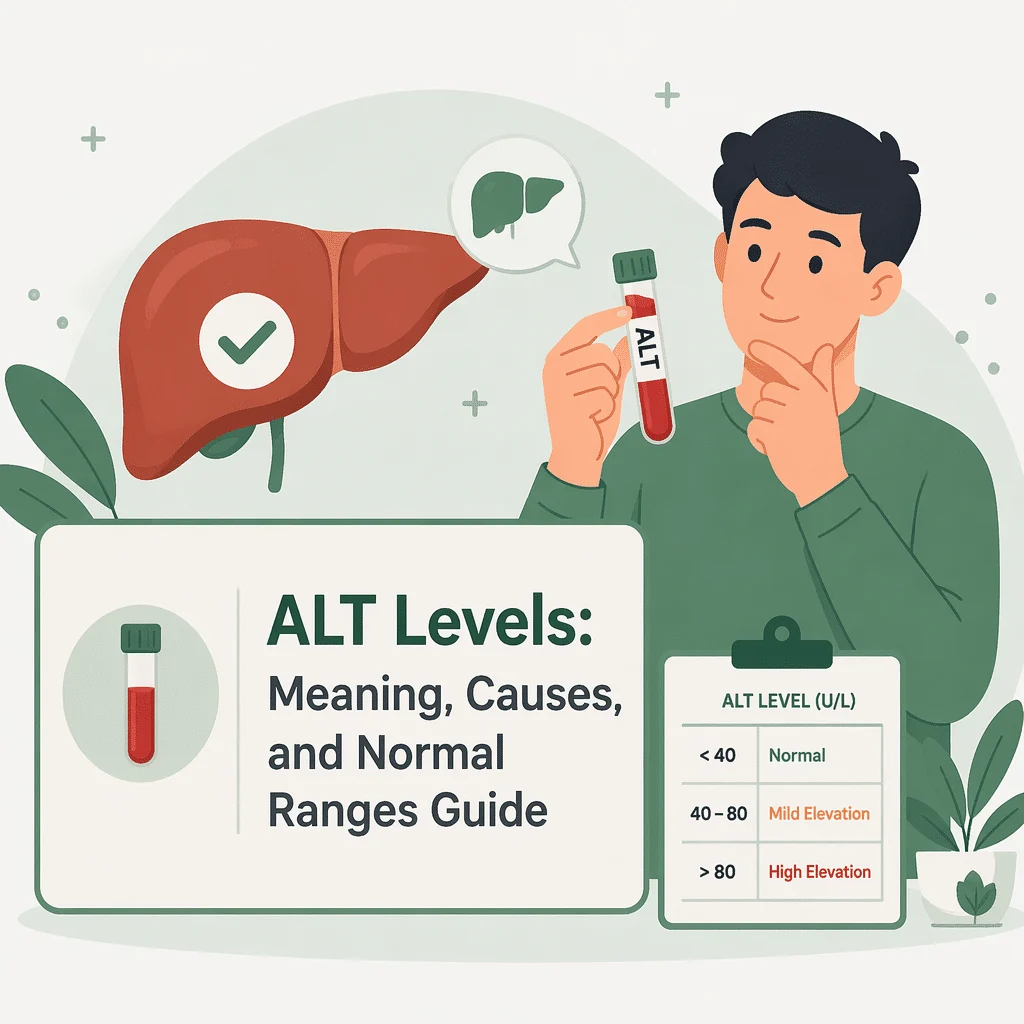
Your ALT levels are one of the most common numbers to appear on a liver blood test, and seeing them flagged as high can be unsettling. ALT, short for alanine aminotransferase, is an enzyme that lives mostly inside liver cells, so the amount in your blood offers a useful window into how your liver is doing. The reassuring news is that a mildly raised result is common and is usually followed up calmly rather than treated as an emergency. In this article you will learn what ALT is, what counts as a normal range, what a high or low reading can mean, how ALT compares with AST, and what sensible next steps look like if your result comes back elevated.
What ALT levels measure
The enzyme behind the number
Alanine aminotransferase is an enzyme, a protein that speeds up a specific chemical reaction. Inside liver cells, ALT helps turn a building block of protein into energy the liver can use. Because this enzyme is concentrated in the liver, doctors treat it as one of the more liver-specific markers on a blood panel. Smaller amounts also exist in the kidneys and muscles, but the liver is where most of your ALT is stored.
Why ALT leaks into the blood
When liver cells are healthy, only a little ALT escapes into the bloodstream, so blood levels stay low. When those cells are stressed, inflamed, or damaged, they release more ALT, and the level in your blood rises. That is why a high result is read as a sign of possible liver cell injury rather than a diagnosis on its own. For a plain-language overview of the test, the U.S. National Library of Medicine explains the ALT blood test.
Normal ALT ranges and why they vary
Most laboratories report a reference range for ALT of roughly 7 to 55 units per litre (U/L), according to the Mayo Clinic, although some labs use an upper limit closer to 45 U/L. The exact cut-off depends on the equipment and methods each laboratory uses, so the figure printed on your own report is the one that matters most. Always compare your result with the reference range shown on that lab sheet rather than a number from elsewhere.
How sex, age, and body size shift the number
ALT is not identical for everyone. On average, men tend to have slightly higher readings than women, and results can drift with age and body size. Some experts argue that the traditional cut-offs are too generous and that a truly healthy upper limit sits lower, around 30 U/L for men and about 19 U/L for women. Because AST usually appears right beside ALT on the panel, it also helps to understand the AST reference range.
It also helps to remember that any ALT result is a snapshot in time. A single reading reflects the day it was taken, so a brief rise after a hard workout, a weekend of heavier drinking, or a passing infection can fade on a repeat test. This is one reason doctors pay more attention to a trend across several results than to any isolated value, and why they rarely act on one borderline figure without checking it again.
What a high ALT means and its common causes
A high ALT tells you that liver cells are releasing more enzyme than usual, but it does not, by itself, reveal the cause. Doctors interpret the size of the rise, the pattern of other liver markers, your symptoms, and your history together. The table below shows how clinicians often think about different ranges. Treat it as a general guide rather than a self-diagnosis tool, because thresholds vary between laboratories.
| ALT result | What it often reflects | Typical next step |
|---|---|---|
| Within the reference range (about 7 to 55 U/L) | Little enzyme leaking from the liver; usually no active liver stress | Often no action; periodic checks if you have risk factors |
| Mildly high (up to about 3 times the upper limit) | Commonly fatty liver (MASLD), alcohol, medicines, or a recent infection | Repeat the test; review alcohol, medicines, and metabolic health |
| Moderately to markedly high (about 3 to 10 times) | Active inflammation such as viral, drug-induced, or autoimmune hepatitis | Prompt medical review with further blood tests or imaging |
| Very high (more than 10 times, into the hundreds or thousands) | Acute liver injury from viruses, toxins, some drug overdoses, or reduced blood flow | Urgent medical assessment, sometimes the same day |
Metabolic dysfunction-associated steatotic liver disease (MASLD)
The most common reason for a mildly raised ALT in many countries is fatty liver, now called metabolic dysfunction-associated steatotic liver disease, or MASLD. This is the current name for what used to be called non-alcoholic fatty liver disease (NAFLD), renamed in 2023 to reflect its close link with metabolic health. Extra fat stored in liver cells can keep ALT gently elevated for years, often without any symptoms. It is strongly tied to excess weight, type 2 diabetes, and abnormal cholesterol. Fatty liver is common: health authorities estimate that it affects roughly one in four adults in the United Kingdom, which is part of why a mildly high ALT is such a frequent finding on routine blood tests.
Viral hepatitis B and C
Infection with the hepatitis B or hepatitis C virus inflames the liver and can push ALT up, sometimes for years before symptoms appear. Screening blood tests can identify these infections early, when treatment works best. To check for one common viral cause, physicians order the hepatitis B surface antigen test, and to look for the other they use the hepatitis C antibody test.
Alcohol, medicines, and muscle injury
Regular heavy drinking irritates the liver and raises its enzymes. Several medicines can do the same, including some cholesterol drugs, certain antibiotics, anti-seizure medicines, and higher doses of paracetamol. Because ALT also exists in muscle, intense exercise or a muscle injury can nudge it upward without any liver problem at all. Your doctor will usually review your prescriptions, supplements, and recent activity before ordering more tests.
Iron overload and other causes
Less common causes include haemochromatosis, an inherited condition in which the body absorbs and stores too much iron, along with autoimmune hepatitis and bile duct problems. When iron overload is suspected, it is worth understanding haemochromatosis and its treatment. Your care team may also order iron blood tests to see how much iron your body is storing.
What a low ALT can mean
A low ALT is rarely a cause for concern. Very low readings can simply reflect normal variation, older age, or low levels of vitamin B6, which the enzyme needs in order to work. Some research links a persistently low ALT with frailty and reduced muscle mass in older adults, but this remains an area of ongoing study rather than a reason for alarm. If your ALT is low and you feel well, it usually needs no specific action beyond routine follow-up with your doctor. As with a high result, a low ALT is read in the context of the rest of your panel, because the goal is always the overall pattern rather than a single enzyme. In practice, medical decisions almost never hinge on a low ALT on its own.
ALT vs AST and the AST/ALT ratio
ALT is often reported alongside a related enzyme, aspartate aminotransferase (AST). Both rise when liver cells are injured, but AST is less specific because it also comes from the heart and muscles. Comparing the two can point towards a cause, which is why clinicians often weigh the AST/ALT ratio and its interpretation. The table below summarises how the two enzymes differ and what their pattern can suggest.
| Feature | ALT | AST |
|---|---|---|
| Main source in the body | Mostly liver cells | Liver, plus heart and skeletal muscle |
| How liver-specific it is | Fairly specific to the liver | Less specific; also rises with muscle or heart injury |
| Usual pattern in fatty liver (MASLD) | Often higher than AST | Usually lower than ALT |
| Usual pattern in alcohol-related injury | Lower than AST | Often about twice ALT or more |
| How they are used together | Anchors the liver panel | Combined with ALT to form the AST/ALT (De Ritis) ratio |
When ALT is tested and how to read it in context
ALT is almost never measured on its own. It belongs to a liver panel, a group of blood tests that are read together to build a fuller picture. Because a single marker can mislead, this panel also measures AST, alkaline phosphatase, bilirubin, and albumin, and our companion guide explains the full liver function panel.
Reading these markers together helps separate a harmless blip from a meaningful trend. A one-off mild rise is often simply rechecked in a few weeks, while a stable pattern across several markers guides what should come next. Your doctor also weighs your symptoms, medicines, and personal history alongside the numbers.
How the ALT test is done
Measuring ALT needs only a routine blood sample, usually drawn from a vein in your arm during standard bloodwork. Most people do not need to fast specifically for the ALT test itself, although the wider panel it belongs to may carry its own instructions, so follow whatever your clinic advises. Results are typically ready within a day or two. Your doctor then reads them together with the rest of the panel, rather than in isolation, before explaining what the pattern means for you and whether any repeat testing is worthwhile.
Next steps if your ALT is elevated
A single mildly high ALT is common and is usually managed with patience, not panic. The most useful first move is often to repeat the test after a few weeks, because levels naturally fluctuate. Your doctor may review your alcohol intake, medicines, and metabolic health, and may suggest gradual weight loss and more activity if fatty liver looks likely. If lifestyle is the driver, our companion guide covers practical ways to lower ALT levels.
Keeping copies of your results helps as well. A record of your ALT over months lets you and your doctor see whether the number is stable, improving, or slowly climbing, which often matters more than any single test. Bring that history, along with a list of your medicines and supplements, to your next appointment.
When to see a doctor
Contact a healthcare professional promptly if a high ALT comes with any of the following:
- Yellowing of the skin or eyes (jaundice)
- Dark urine or pale stools
- Pain or swelling in the upper right side of the abdomen
- Unexplained nausea, vomiting, or loss of appetite
- Easy bruising, confusion, or severe tiredness
- A known overdose of a medicine such as paracetamol, which is a medical emergency
These features suggest the liver may need urgent attention, and they should not wait for a routine appointment.
Latest scientific advances
Research on ALT keeps refining how doctors read the number. The findings below come from recent peer-reviewed studies indexed in PubMed and are shared here in plain language, with the full references listed in the Sources section.
Rethinking what “normal” means
A 2024 review in the World Journal of Gastroenterology argued that a result sitting at the high end of the normal band, if it stays there over time, can be an early clue to fatty liver (MASLD, the current name for fat-related liver disease). The authors note that the healthiest upper limit may be lower than the classic cutoff, closer to 30 U/L for men and 19 U/L for women. What this means for you: a value labelled normal but near the top may still be worth rechecking, especially if you carry metabolic risk factors such as extra weight or raised blood sugar.
Reading ALT and AST together
A 2024 United States study that analysed a large national health survey found that when ALT is high relative to AST, the pattern is linked to a greater chance and severity of fatty liver. What this means for you: the balance between the two enzymes can be more informative than either number alone, which is one reason doctors rarely judge ALT in isolation.
How lifestyle moves the number
A 2025 systematic review and meta-analysis (a study that pools the results of many trials) in BMC Medicine reported that a Mediterranean-style diet and regular exercise modestly lower ALT in people with fatty liver. What this means for you: everyday habits, kept up over time, can nudge ALT in the right direction alongside any medical care your doctor advises.
A note of caution on supplements
A 2024 Cochrane review, a type of high-quality evidence summary, found that vitamin E likely lowers ALT and AST a little in fatty liver, but it remains unclear whether that leads to fewer serious liver problems later on. What this means for you: a lower ALT number is reassuring, yet the underlying cause still matters most, and any supplement is best discussed with your doctor rather than started on your own.
Glossary of key terms
| Term | Definition |
|---|---|
| Alanine aminotransferase (ALT) | A liver enzyme that leaks into the blood when liver cells are stressed or damaged, making it a key marker of liver health. |
| Aspartate aminotransferase (AST) | A related enzyme found in the liver, heart, and muscles; read together with ALT on a liver panel. |
| Liver function tests (LFTs) | A group of blood tests, including ALT and AST, that together show how the liver is working. |
| Metabolic dysfunction-associated steatotic liver disease (MASLD) | The current name for fatty liver linked to metabolic health, formerly called non-alcoholic fatty liver disease (NAFLD). |
| Steatosis | The medical term for a build-up of fat inside cells, such as the fat stored in the liver in MASLD. |
| Cirrhosis | Advanced scarring of the liver that can follow long-term inflammation or damage. |
| Upper limit of normal (ULN) | The highest value a laboratory counts as normal for a test; results above it are flagged as high. |
| De Ritis ratio | The ratio of AST to ALT, used to help point towards the cause of a liver injury. |
| Hepatocyte | A liver cell; hepatocytes hold most of the body’s ALT. |
| Haemochromatosis | An inherited condition in which the body stores too much iron, which can injure the liver over time. |
Frequently asked questions
When should I worry about my ALT levels?
A mildly high ALT, up to about two or three times the upper limit of normal, is common and is usually rechecked rather than treated as an emergency. It becomes more concerning when the level is very high, when it keeps rising on repeat tests, or when it appears alongside jaundice, dark urine, abdominal pain, or severe fatigue. Context matters too: risk factors such as heavy drinking, viral hepatitis, or metabolic conditions raise the priority. Your doctor weighs the number, the trend, and your symptoms together before deciding what to do.
Is an ALT of 70 or 80 high?
Compared with a typical upper limit of roughly 45 to 55 U/L, readings of 70 or 80 U/L are mildly elevated. On their own, values in this range are common and often trace back to fatty liver, a recent viral infection, alcohol, medicines, or even vigorous exercise. They rarely signal an emergency. The usual approach is to repeat the test after a few weeks and to look at AST and other liver markers at the same time. If the level keeps climbing or symptoms appear, your doctor will investigate further.
Do normal ALT levels change with age and sex?
Yes, to a degree. Men generally have slightly higher ALT than women, and readings can shift with age and body size. That is one reason laboratories publish a reference range rather than a single ideal figure, and why some experts suggest lower healthy cutoffs for women than for men. When you review your result, compare it with the range printed on your own report, and ask your doctor how your age, sex, and health history affect what counts as normal for you.
Which medicines can raise ALT levels?
Several everyday medicines can lift ALT, usually mildly and reversibly. Common examples include some statins used for cholesterol, certain antibiotics, anti-seizure drugs, some anti-inflammatory painkillers, and higher doses of paracetamol. A few herbal products and bodybuilding supplements can stress the liver too. This does not mean you should stop a prescribed medicine on your own. Instead, tell your doctor about everything you take, including supplements, so they can judge whether a medicine is the likely cause and whether any change or monitoring is needed.
Can ALT be high without liver disease?
Yes. Because small amounts of ALT exist in muscle, intense exercise, a muscle injury, or an intramuscular injection can raise the level temporarily without any liver problem. Recent illness, certain medicines, and normal day-to-day variation can also nudge it up. This is exactly why a single high reading is usually repeated before any conclusion is drawn. If the follow-up test is normal and you feel well, a brief rise often needs no further action beyond routine monitoring.
Can lifestyle changes lower a high ALT?
Often, yes, when the cause is fatty liver or alcohol. Gradual weight loss, more physical activity, a balanced Mediterranean-style diet, and cutting back on alcohol can lower ALT over months. Reviewing medicines and supplements with your doctor helps too. Crash diets are not the goal; steady, sustained habits work better and are safer for the liver. Because a high ALT can have several causes, pair lifestyle changes with medical advice so the underlying reason is properly identified and addressed.
Sources
- MedlinePlus, U.S. National Library of Medicine — ALT Blood Test, 2024 — medlineplus.gov
- Mayo Clinic — Liver function tests, 2023 — mayoclinic.org
- Cleveland Clinic — Liver Function Tests, 2022 — my.clevelandclinic.org
- National Institute of Diabetes and Digestive and Kidney Diseases (NIH) — Definition and Facts of NAFLD and NASH, 2021 — niddk.nih.gov
- Moyana TN — Metabolic dysfunction-associated steatotic liver disease: the question of long-term high-normal alanine aminotransferase as a screening test — World Journal of Gastroenterology, 2024 — doi.org/10.3748/wjg.v30.i42.4576
- Xuan Y, Wu D, Zhang Q, et al. — Elevated ALT/AST ratio as a marker for NAFLD risk and severity: a cross-sectional analysis in the United States — Frontiers in Endocrinology, 2024 — doi.org/10.3389/fendo.2024.1457598
- Artola Arita V, Castro Cabezas M, Beigrezaei S, et al. — Mediterranean diet, exercise, and their combination on body composition and liver outcomes in MASLD: a systematic review and meta-analysis of randomised controlled trials — BMC Medicine, 2025 — doi.org/10.1186/s12916-025-04320-7
- Wen H, Deng H, Yang L, et al. — Vitamin E for people with non-alcoholic fatty liver disease — Cochrane Database of Systematic Reviews, 2024 — doi.org/10.1002/14651858.CD015033.pub2
Further reading
- How to read your blood test results
- Low AST: causes, symptoms, and meaning
- Understanding the iron studies panel
- Normal albumin levels explained
- High ferritin: causes, symptoms, and risks
Understand your lab results with AI DiagMe
ALT is just one line on a liver panel, and a single value rarely tells the whole story. AI DiagMe helps you make sense of results such as ALT, AST, GGT, and bilirubin by turning them into clear, plain-language explanations you can bring to your next appointment. It is designed to help you understand your numbers and ask better questions; it does not diagnose conditions and does not replace your doctor.
Get your results interpreted in minutes