




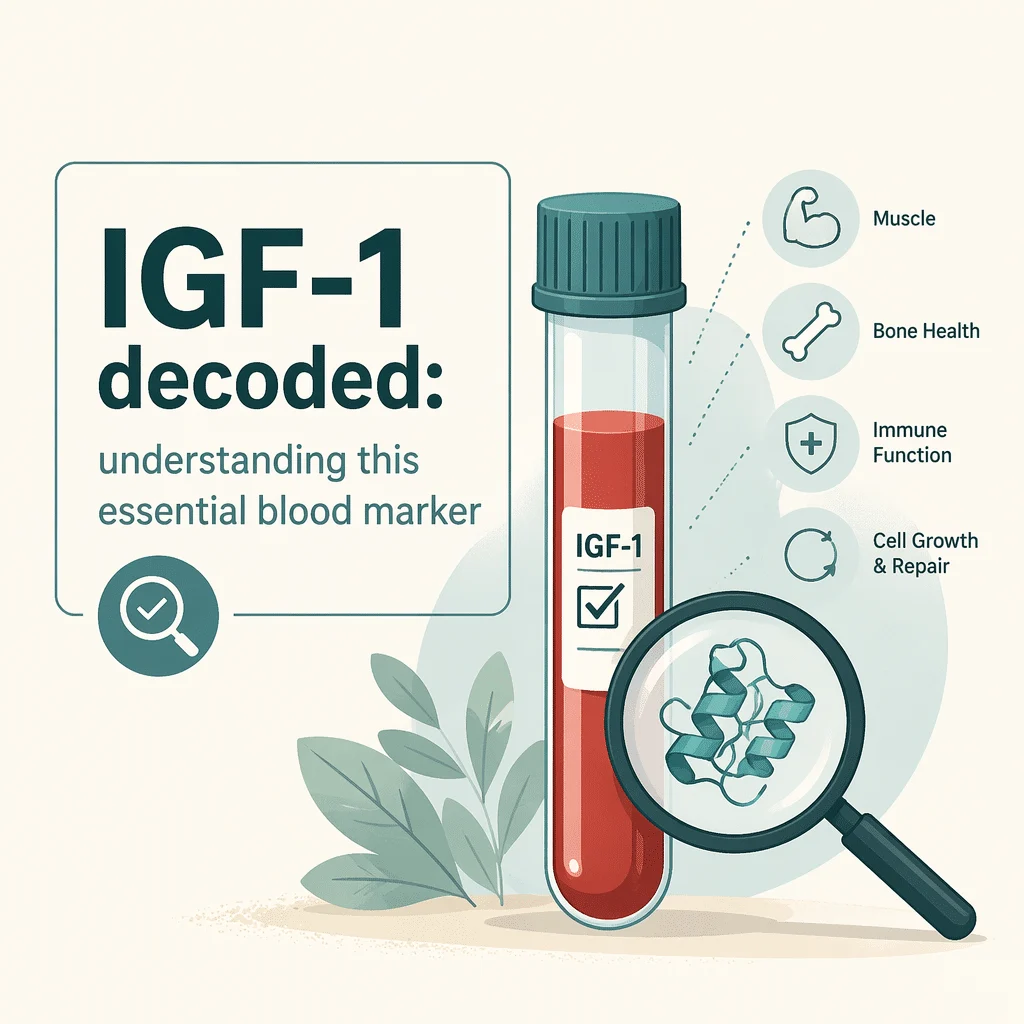
An IGF-1 blood test measures the amount of insulin-like growth factor 1 in your blood, a hormone that mirrors how much growth hormone your body is making. Because IGF-1 stays steady through the day, it gives your doctor a reliable snapshot of growth hormone activity over several days rather than a single moment. Finding a value outside the printed range can feel unsettling, yet an abnormal number is a reason for questions, not a diagnosis on its own.
In this article you will learn what IGF-1 is, how the growth hormone axis works, why doctors order the test, how age and sex shape the normal range, and what high or low results can point to, so you can walk into your appointment ready to ask the right questions.
What IGF-1 is, and how the GH–IGF-1 axis works
IGF-1 (insulin-like growth factor 1) is a protein hormone that acts as the main messenger for growth hormone (GH). Your pituitary gland, a pea-sized gland at the base of the brain, releases GH in bursts. GH then travels to the liver and other tissues, which respond by producing IGF-1.
IGF-1 carries out many of growth hormone’s day-to-day effects. It signals cells to grow, divide and repair, and it helps manage how your body handles sugar, builds bone and maintains muscle. This chain, from the brain to the pituitary to the liver, is often called the GH–IGF-1 axis or the somatotropic axis.
Most IGF-1 does not float freely. It travels bound to carrier proteins, chiefly one called IGFBP-3, which protects it and controls how much reaches your cells. Because the two move together, doctors sometimes measure both; you can read our IGFBP-3 blood marker analysis for a closer look at that partner protein.
Why doctors order an IGF-1 blood test
The single biggest reason to measure IGF-1 is that it is a stable stand-in for growth hormone. GH itself rises and falls in pulses through the day and night, so one GH reading tells you little. IGF-1 changes slowly, so it reflects your average GH output and is far easier to interpret.
Your doctor may order an IGF-1 blood test to:
- Investigate a child who is growing too slowly or unusually fast
- Look into signs of too much growth hormone in adults, such as enlarging hands, feet or facial features
- Explore possible growth hormone deficiency, which can cause fatigue and changes in muscle and fat
- Monitor treatment once a growth hormone disorder has been diagnosed
The pituitary makes several hormones at once, so a pituitary problem rarely affects IGF-1 alone. That is why related tests are common; for example, you can see our guide to the ACTH hormone blood test, which reflects a different pituitary pathway.
How the IGF-1 blood test is measured and read
The test itself is simple. A healthcare professional draws a small blood sample from a vein in your arm, and the laboratory measures IGF-1, usually in nanograms per millilitre (ng/mL). No special preparation is normally needed, and strict fasting is not usually required.
Reading your results sheet
Your report shows your value next to a reference range, and often a flag such as “H” for high or “L” for low. A result just outside the range is read very differently from one far outside it, and a single value is always weighed against your symptoms and history.
Why age and sex change the normal range
There is no single normal IGF-1 level for everyone. Levels are naturally low in early childhood, climb to a peak around puberty, then decline steadily through adult life. Values also differ between men and women. For this reason, every laboratory reports IGF-1 against a range matched to your age and sex, and you should always compare your number with that specific range rather than a figure from the internet. The U.S. National Library of Medicine’s MedlinePlus guide to the IGF-1 test explains this age pattern in plain terms.
What high IGF-1 results can mean
A raised IGF-1, especially when it sits well above the range for your age, usually points to too much growth hormone. The best-known cause is acromegaly, a rare condition in which a benign (non-cancerous) tumour of the pituitary gland releases excess GH. That surplus drives the liver to make too much IGF-1.
Acromegaly develops slowly, with gradual enlargement of the hands, feet and facial features, along with joint aches, sweating and, sometimes, raised blood sugar. In children whose growth plates have not yet closed, the same excess causes gigantism. When results are high, doctors confirm the picture with further tests, as Mayo Clinic describes in its overview of acromegaly diagnosis and treatment, typically an oral glucose tolerance test and an MRI of the pituitary.
Because excess growth hormone can push blood sugar upward, a high IGF-1 is sometimes found alongside metabolic changes; you can explore our guide to blood glucose levels to see how that fits together. Less common causes of a high reading include precocious puberty and certain states of high insulin.
What low IGF-1 results can mean
A low IGF-1 has several possible explanations, and many are not primarily about the pituitary at all.
- Growth hormone deficiency, present from birth or acquired after a tumour, surgery, head injury or radiation. In children it slows growth; in adults it can bring fatigue, less muscle and more body fat.
- Undernutrition or very low-calorie diets, because the liver needs enough protein and energy to make IGF-1.
- Liver disease, since the liver is the main production site; doctors may pair the result with liver function tests to check this.
- An underactive thyroid, which can lower IGF-1; our guide to normal thyroid levels covers that link.
Adult growth hormone deficiency often overlaps with other hormone shifts, such as low testosterone, so results are read together rather than in isolation; you can read our testosterone blood marker guide for that connection. A low IGF-1 rarely stands alone, which is why doctors add other tests before drawing conclusions.
IGF-1 versus growth hormone: why both matter
People often ask whether IGF-1 and growth hormone are the same test. They are closely linked but not interchangeable. Growth hormone is the signal from the pituitary; IGF-1 is the downstream response, mostly from the liver.
Because GH is released in short pulses, a random GH level is hard to interpret, whilst IGF-1 offers a steadier average. That is why IGF-1 is usually the first-line screen. To confirm a diagnosis, though, doctors often add dynamic tests, such as a GH stimulation test for suspected deficiency or a glucose suppression test for suspected excess.
Several everyday factors nudge IGF-1 as well. Sleep, exercise and good nutrition support the axis, whilst long-term steroid medicines and high cortisol tend to lower it; you can understand the cortisol blood test to see how those stress hormones interact.
High versus low IGF-1 at a glance
The table below summarises the common patterns. It is a general guide, not a personal diagnosis, and your doctor interprets your result within your full clinical picture.
| IGF-1 pattern | Common causes | What your doctor may consider next |
|---|---|---|
| Higher than your age and sex range | Acromegaly (usually a benign pituitary tumour), gigantism in children, precocious puberty, occasionally high-insulin states | An oral glucose tolerance test and an MRI of the pituitary gland |
| Lower than your age and sex range | Growth hormone deficiency, undernutrition or very low-calorie diets, liver disease, an underactive thyroid, poorly controlled diabetes | Growth hormone stimulation testing, plus a review of nutrition, liver and other pituitary hormones |
When to see a doctor
Most IGF-1 abnormalities are not emergencies, and your doctor will set the pace of any follow-up. Still, some situations deserve a prompt appointment rather than waiting.
| See a doctor promptly if you notice |
|---|
| Gradual enlargement of your hands, feet, jaw or facial features |
| Persistent headaches or changes in your vision |
| In a child, growth that is much slower or faster than peers of the same age |
| Ongoing fatigue with loss of muscle or a gain in body fat |
| An IGF-1 result far outside your range, or one that keeps drifting on repeat tests |
A slight, isolated variation with no symptoms is often simply rechecked later. A result far from the range, a value that keeps drifting over repeat tests, or symptoms of a hormone disorder are the signals that usually prompt a referral to an endocrinologist, a doctor who specialises in hormones.
The pituitary can affect several hormones at once, so if a tumour is suspected your doctor may check related markers too; our guide to high prolactin levels explains one that is often assessed alongside it.
Latest scientific advances in IGF-1 testing
Research from the last few years has sharpened how IGF-1 is measured and interpreted. Here is what recent work found and what it means for you.
Clearer thresholds for diagnosing acromegaly
An international expert consensus led by Giustina and colleagues (Pituitary, 2023) reaffirmed that, in someone with typical features, an IGF-1 clearly above the upper limit of normal for their age confirms acromegaly, and that a single well-timed growth hormone reading is not needed to make the diagnosis. What this means for you: the age-matched IGF-1 result carries real weight, and if a first result is borderline, repeating it with the same laboratory method is the recommended next step rather than jumping straight to more invasive tests.
How IGF-1 helps detect growth hormone deficiency
A consensus survey of specialists by Arlien-Søborg and colleagues (Pituitary, 2025) agreed that a low IGF-1 is diagnostic of growth hormone deficiency when someone already has several pituitary hormone deficiencies, a state called panhypopituitarism. What this means for you: a below-range IGF-1 is most telling when the clinical context already points to a pituitary problem, and in less clear-cut cases doctors still rely on stimulation tests, where the body’s growth hormone response is measured after a trigger.
Why the same sample can read differently between labs
A detailed review by Huang and colleagues (Critical Reviews in Clinical Laboratory Sciences, 2024) explained that IGF-1’s long half-life makes it more stable and specific than growth hormone, but that binding proteins can interfere with older immunoassays (antibody-based tests), and that reference ranges still differ between laboratories. Newer mass spectrometry methods, which identify the molecule by its precise mass, are improving accuracy. What this means for you: it is normal for an IGF-1 result to look slightly different depending on the lab, which is exactly why you compare your value with your own report’s range and keep to the same lab when tracking changes over time.
Using IGF-1 to steer growth hormone treatment
In a three-year trial in children with growth hormone deficiency, Miller and colleagues (European Journal of Endocrinology, 2025) reported that a once-weekly growth hormone kept average IGF-1 within the normal range whilst growth stayed on track. What this means for you: when someone is treated with growth hormone, IGF-1 is the marker doctors watch to keep the dose both effective and safe, rather than too high.
Reading IGF-1 across different ages
A global review by Yuen and colleagues (Endocrine Connections, 2023) stressed that a random growth hormone level is unreliable for diagnosing deficiency because the hormone is released in pulses, so IGF-1 and, when needed, stimulation testing do the heavy lifting, with careful attention to age and the assay used. What this means for you: the reason your doctor relies on IGF-1 rather than a one-off growth hormone number is that IGF-1 gives a steadier, more interpretable signal.
Glossary
| Term | Definition |
|---|---|
| IGF-1 | Insulin-like growth factor 1, a hormone that carries out most of the effects of growth hormone and remains stable throughout the day. |
| Growth hormone (GH) | A hormone released in pulses by the pituitary gland that drives growth and prompts the liver to produce IGF-1. |
| Pituitary gland | A small gland at the base of the brain that controls many hormones, including growth hormone. |
| GH–IGF-1 axis | The signalling chain from brain to pituitary to liver that regulates growth, also called the somatotropic axis. |
| Acromegaly | A rare condition of excess growth hormone in adults, usually from a benign pituitary tumour, that raises IGF-1. |
| Growth hormone deficiency (GHD) | A shortage of growth hormone that can lower IGF-1 and, in children, slow growth. |
| IGFBP-3 | Insulin-like growth factor binding protein 3, the main carrier that transports IGF-1 in the blood. |
| Reference range | The set of values a laboratory considers normal, which for IGF-1 depends on age and sex. |
| Oral glucose tolerance test (OGTT) | A test that measures how growth hormone responds after a sugary drink, used to confirm acromegaly. |
| Standard deviation score (SDS) | A way of expressing how far a result sits from the average for a person’s age and sex. |
Frequently asked questions
Do I need to fast for an IGF-1 blood test?
In most cases, no. IGF-1 stays relatively stable and is not greatly affected by a recent meal, which is one reason it is easier to interpret than growth hormone. Your sample can usually be taken at any time of day. Sometimes an IGF-1 test is taken alongside others, such as glucose or a lipid panel, that do need fasting, so always follow the specific instructions on your test request. If you are unsure, ask the clinic or laboratory before your appointment.
What is a normal IGF-1 blood test range?
There is no universal normal value. IGF-1 is naturally high in the teenage years and falls steadily through adult life, and it differs between men and women, so results are always reported against an age-matched and sex-matched range. A value inside your laboratory’s range is generally reassuring, whilst one outside it is a prompt for your doctor to look at the wider picture. Always read your number against the range printed on your own report rather than comparing it to someone else’s.
How long does an IGF-1 blood test take, and when will I get results?
The blood draw itself takes only a few minutes, usually with a small needle in a vein in your arm. You may feel a brief sting, and most people return to their normal activities straight away. The laboratory analysis takes longer, and results commonly reach your doctor within a few days, though this varies by laboratory and whether the sample is sent to a specialist centre. Your doctor will explain what the numbers mean in the context of your symptoms and history.
How much does an IGF-1 blood test cost?
The price varies widely depending on your country, your insurance and whether the test is ordered by a doctor or bought directly. When a healthcare professional requests it to investigate a growth hormone disorder, it is often covered like other diagnostic blood tests. If you are paying yourself, ask the laboratory for the price in advance, and remember that interpreting the result with a clinician matters more than the number alone. Cost should not stop you seeking advice about worrying symptoms.
Can I lower my IGF-1 level before a blood test?
It is best not to try. The purpose of the test is to capture your true, everyday IGF-1 level so your doctor can interpret it correctly, and deliberately changing it, for example through extreme dieting or fasting, can distort the result and delay a proper answer. Undernutrition genuinely lowers IGF-1, but that masks the real picture rather than helping. The most useful thing you can do is keep your usual routine and tell your doctor about any medicines or supplements you take.
Do any medications affect IGF-1 results?
Yes. Long-term high-dose corticosteroids, sometimes used for inflammation, tend to lower IGF-1, whilst some oral contraceptives containing oestrogen can shift it. Growth hormone treatment naturally raises IGF-1, which is why it is used to monitor that therapy. Because several everyday medicines can nudge the result, it helps to bring a complete list of your prescriptions, over-the-counter products and supplements to your appointment. Your doctor factors these in when deciding whether a value is genuinely abnormal.
Sources
- MedlinePlus (U.S. National Library of Medicine): IGF-1 (Insulin-like Growth Factor 1) Test
- Cleveland Clinic: Acromegaly
- Mayo Clinic: Acromegaly — Diagnosis and treatment
- Giustina A, et al. — Consensus on criteria for acromegaly diagnosis and remission — Pituitary, 2023 — https://doi.org/10.1007/s11102-023-01360-1
- Arlien-Søborg MC, et al. — Consensus and controversies about diagnosing GH deficiency: a Delphi survey by the GH Research Society — Pituitary, 2025 — https://doi.org/10.1007/s11102-025-01526-z
- Huang R, et al. — Challenges of insulin-like growth factor-1 testing — Critical Reviews in Clinical Laboratory Sciences, 2024 — https://doi.org/10.1080/10408363.2024.2306804
- Miller BS, et al. — Efficacy, safety, and insulin-like growth factor I of weekly somapacitan in children with growth hormone deficiency: 3-year results from REAL4 — European Journal of Endocrinology, 2025 — https://doi.org/10.1093/ejendo/lvaf096
- Yuen KCJ, et al. — Diagnosis and testing for growth hormone deficiency across the ages — Endocrine Connections, 2023 — https://doi.org/10.1530/EC-22-0504
Further reading
- IGFBP-3 blood marker analysis
- ACTH hormone blood test
- Cortisol blood test
- Liver function tests
- Normal thyroid levels
Understand your lab results with AI DiagMe
Reading an IGF-1 result means joining it up with your age, your symptoms and sometimes related tests such as growth hormone and IGFBP-3, which is hard to do alone with a printout. AI DiagMe puts each value in plain language and in context, so you can understand what your numbers suggest and prepare sharper questions for your appointment. It is built to help you understand your results, not to give a diagnosis or replace your doctor.
Get your results interpreted in minutes