








An IGFBP-3 blood test measures insulin-like growth factor binding protein 3, the main carrier protein for a growth factor called IGF-1. If your laboratory report mentions IGFBP-3, this guide explains, in plain language, what the marker does, why doctors order it, and how to read a high, low, or normal value. IGFBP-3 is usually checked alongside IGF-1 and growth hormone to see how your body grows, repairs tissue, and uses energy. A single figure outside the reference range is rarely a diagnosis on its own, because your doctor reads it together with your symptoms, your age, and your other results.
In this article you’ll learn what IGFBP-3 is, when it is tested, how it is measured, what different levels can mean, the conditions it is linked to, what recent research shows, and when it makes sense to speak with a healthcare professional.
What is IGFBP-3?
IGFBP-3 (insulin-like growth factor binding protein 3) is the most abundant of the proteins that carry insulin-like growth factors in the blood. The liver produces most of it, and its production is driven largely by growth hormone (GH), the hormone released by the pituitary gland at the base of the brain.
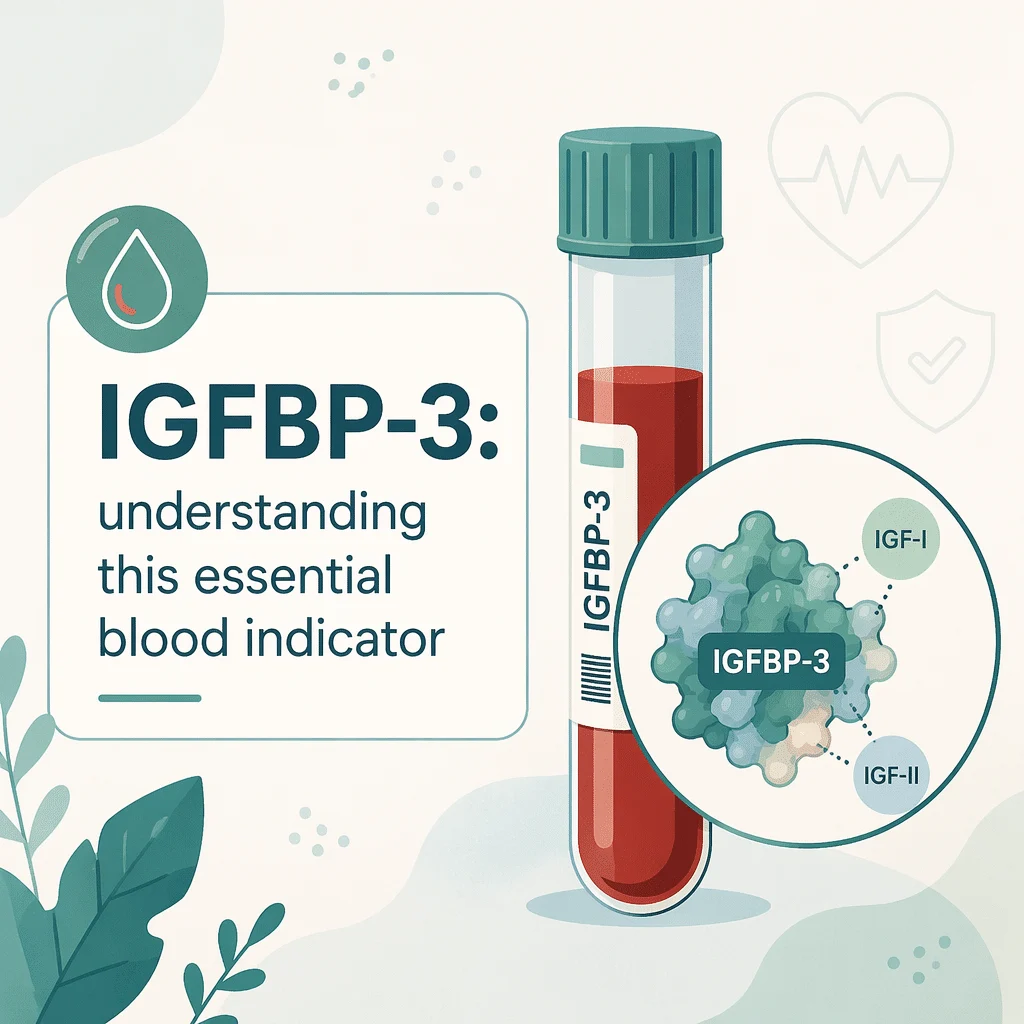
Its main job is to transport and regulate IGF-1, a hormone that helps cells grow, divide, and renew tissue. By binding to IGF-1, IGFBP-3 keeps it stable in the circulation, controls how much reaches your cells, and prevents it from acting too quickly. In practice, IGFBP-3 works like a reservoir that stores IGF-1 and releases it in a measured way.
How IGFBP-3 carries IGF-1
Most IGF-1 does not float freely. It travels inside a three-part package called a ternary complex, made of IGF-1, IGFBP-3, and a helper protein called the acid-labile subunit (ALS). This package extends the working life of IGF-1 from minutes to hours. Because growth hormone stimulates the whole system, IGFBP-3 levels also give an indirect picture of growth hormone activity. If you want to understand the hormone it carries, you can read our IGF-1 blood marker guide.
Why doctors order an IGFBP-3 blood test
An IGFBP-3 blood test is rarely ordered on its own. Doctors usually request it together with IGF-1, and sometimes with growth hormone testing, to assess the somatotropic axis. This is the chain of signals linking the hypothalamus, the pituitary gland, and the liver that controls growth and tissue repair.
Common reasons for testing include:
- Investigating slow growth or short stature in children, or unusually fast growth.
- Looking into a suspected growth hormone deficiency in children or adults.
- Helping to detect growth hormone excess, as seen in acromegaly.
- Monitoring growth hormone treatment to check that the dose is working safely.
- Adding information about nutritional status or liver function.
Because IGFBP-3 is more stable across the day than growth hormone, it gives doctors a steady reading that is easier to interpret than a single growth hormone measurement, which naturally rises and falls in bursts.
How the IGFBP-3 blood test is measured
The test needs a simple blood sample, usually taken from a vein in the arm. Unlike growth hormone, IGFBP-3 stays fairly constant throughout the day, so the timing of the draw matters less. Many laboratories still collect the sample in the morning to keep conditions consistent, and your care team will tell you whether fasting is needed.
Reading the result depends heavily on age and sex. IGFBP-3 is naturally higher during childhood and puberty, peaks in the teenage years, and then declines slowly through adulthood. For this reason, laboratories compare your value against an age-matched and sex-matched reference range rather than a single fixed number. Results are often reported both as a concentration (for example, in mg/L) and as a standard deviation score (SDS or z-score), which shows how far your value sits from the average for your age. To see how reference ranges work more broadly, you can consult our normal blood test ranges guide.
One practical point: different laboratories use different testing kits, so values are not always directly comparable between labs. If you are tracking IGFBP-3 over time, try to use the same laboratory each time.
What high IGFBP-3 levels can mean
A higher-than-expected IGFBP-3 is not a disease by itself. It is a signal that your doctor interprets alongside IGF-1 and your clinical picture. Possible explanations include:
- Acromegaly or gigantism, where a benign pituitary tumour produces too much growth hormone, which in turn raises IGF-1 and IGFBP-3.
- Precocious (early) puberty, when the growth axis switches on ahead of time in children.
- Reduced clearance from the body, for example in chronic kidney disease, where the protein is removed more slowly.
Because acromegaly develops gradually, its signs can be easy to miss. They may include larger hands and feet, changes in facial features, joint aches, headaches, excessive sweating, and sometimes high blood sugar or high blood pressure. If growth hormone excess is suspected, the workup often includes a full hormone assessment and imaging such as a pituitary MRI.
What low IGFBP-3 levels can mean
A lower-than-expected IGFBP-3 usually points to less growth hormone activity, or to a problem with the organs that make or support the protein. Common possibilities include:
- Growth hormone deficiency, because IGFBP-3 production depends on growth hormone. In children this can slow growth, whilst in adults it may bring fatigue, reduced muscle mass, and more body fat.
- Undernutrition or a catabolic state, when severe illness or low protein and calorie intake pushes the body to cut back on non-essential proteins.
- Liver disease, since the liver is the main site of IGFBP-3 production. To understand liver markers, you can review our liver function tests guide.
Because poor nutrition can lower these values, doctors sometimes look at related proteins that reflect nutritional status. You may find it helpful to see our prealbumin blood test guide and to consult our albumin blood test guide.
Lower versus higher IGFBP-3 at a glance
| Lower IGFBP-3 may be linked to | Higher IGFBP-3 may be linked to |
|---|---|
| Growth hormone deficiency | Growth hormone excess (acromegaly, gigantism) |
| Undernutrition or severe illness | Early (precocious) puberty in children |
| Liver disease | Reduced clearance in chronic kidney disease |
| Poorly controlled diabetes | Normal childhood and puberty (age-related peak) |
| Certain medicines, such as corticosteroids | Growth hormone treatment that is set too high |
Reading IGFBP-3 and IGF-1 together
IGFBP-3 becomes far more useful when it is read alongside IGF-1, because the two proteins are made and released together. In most people their levels move in parallel. Doctors sometimes calculate an IGF-1 to IGFBP-3 ratio, which can sharpen the picture of how much active growth factor is available. The table below shows common patterns and how a clinician might approach them. It is a general guide, not a diagnosis.
| Pattern | What it may suggest | Typical next step |
|---|---|---|
| Low IGF-1 and low IGFBP-3 | Possible growth hormone deficiency, undernutrition, or liver problem | Growth hormone stimulation tests and a nutritional and liver review |
| High IGF-1 and high IGFBP-3 | Possible growth hormone excess (acromegaly) | Confirmatory hormone testing and pituitary imaging |
| Low IGF-1 with a more normal IGFBP-3 | A more complex or partial signalling issue | Closer specialist assessment of the growth axis |
| Both within range, with symptoms | Growth axis is likely a normal contributor | Look for other explanations for the symptoms |
Conditions linked to IGFBP-3
Because it sits at the heart of the growth axis, IGFBP-3 touches several areas of health. It plays a part in the assessment of growth hormone deficiency and acromegaly, in the follow-up of growth disorders in children, and in tracking nutritional and liver status during serious illness. Its close ties to insulin and blood sugar mean it can also feature in metabolic assessments; to understand that link, you can explore our insulin blood test guide.
Hormones rarely act alone, so IGFBP-3 is often interpreted within a wider endocrine picture. Stress hormones, for example, can influence the growth axis, and you can read our cortisol blood test guide to see how. When a pituitary problem is suspected, doctors may also assess other pituitary signals, and you can see our ACTH hormone blood test guide for a related example.
When to see a doctor
An out-of-range IGFBP-3 is a reason to talk with your doctor, not a reason to panic. Only a clinician can combine the result with your history and examination to reach a conclusion. The following situations deserve prompt medical attention.
| See a doctor if you notice |
|---|
| A child growing much slower or faster than peers, or crossing growth chart lines |
| Gradual enlargement of the hands, feet, or facial features in an adult |
| Persistent fatigue, loss of muscle, or unexplained weight changes |
| Ongoing headaches or changes in vision alongside abnormal results |
| Any IGFBP-3 or IGF-1 result flagged as clearly outside the reference range |
Everyday factors that influence IGFBP-3
Several everyday factors gently shape the growth axis. They do not replace medical treatment, but they help explain why values differ between people and over time.
- Nutrition: enough quality protein and calories supports normal IGFBP-3 production, whilst restrictive dieting can lower it.
- Physical activity: resistance and higher-intensity exercise are natural stimulators of growth hormone.
- Sleep: most growth hormone is released at night, so restorative sleep matters.
- Medicines: corticosteroids tend to lower IGFBP-3, and some hormonal treatments can shift it, so tell your doctor about everything you take.
- Age: levels fall steadily with age, which is a normal part of getting older rather than a sign of illness. Our biological versus chronological age explainer explores this idea further.
Latest scientific advances in IGFBP-3 testing
Research on IGFBP-3 is active, and recent work helps explain how the marker is best used and measured. According to studies indexed in PubMed and other scientific databases, several themes stand out. None of these findings changes the basic message that IGFBP-3 should be read in context, but together they refine how clinicians interpret it.
A 2024 review in Nature Reviews Endocrinology examined the acid-labile subunit, the helper protein that locks IGF-1 and IGFBP-3 into their stable circulating package. What it found is that this package acts as a controlled reservoir of growth factors and closely reflects growth hormone activity. What this means for you is that IGFBP-3 is a useful, steady mirror of the growth axis, which is why it is often preferred to a single growth hormone reading.
A 2023 commentary in The Journal of Clinical Endocrinology and Metabolism highlighted the IGF-1 to IGFBP-3 ratio as a robust way to judge growth hormone deficiency and to guide growth hormone therapy. What it found is that combining the two markers can describe growth factor exposure more reliably than either one alone. What this means for you is that your doctor may look at the pair, or their ratio, rather than a single value.
A 2025 study in Clinical Chemistry and Laboratory Medicine tested a modern laboratory method, called targeted proteomics, that weighs individual proteins directly using mass spectrometry. What it found is that this approach agreed well with standard tests for IGF-1 but less closely for IGFBP-3, meaning IGFBP-3 measurements still vary by method. What this means for you is a practical reminder to compare results from the same laboratory whenever possible.
A 2024 study in Heliyon built age and sex reference curves for IGF-1 and IGFBP-3 in healthy children using three different testing systems. What it found is that healthy ranges shift with age and sex and differ noticeably between testing kits. What this means for you is that a value should always be judged against the right reference range, not a single universal number.
Finally, a 2025 study in Frontiers in Endocrinology looked at IGF-1 and IGFBP-3 in children and adolescents. What it found is that higher levels of both were linked with a lower chance of metabolic problems, and that IGFBP-3 tends to rise steadily with age during childhood. What this means for you is that these markers reflect general growth and metabolic health, whilst any interpretation still belongs with your care team.
Glossary
| Term | Definition |
|---|---|
| IGFBP-3 | Insulin-like growth factor binding protein 3, the main carrier protein for IGF-1 in the blood. |
| IGF-1 | Insulin-like growth factor 1, a hormone that drives cell growth and tissue repair. |
| Growth hormone (GH) | A pituitary hormone that stimulates the liver to make IGF-1 and IGFBP-3. |
| Somatotropic axis | The signalling chain linking the brain, pituitary gland, and liver that controls growth. |
| Acid-labile subunit (ALS) | A helper protein that stabilises the IGF-1 and IGFBP-3 package in the circulation. |
| Ternary complex | The three-part unit of IGF-1, IGFBP-3, and ALS that carries growth factor safely. |
| Acromegaly | A condition of growth hormone excess, usually from a benign pituitary tumour. |
| Growth hormone deficiency | A shortage of growth hormone that can lower IGF-1 and IGFBP-3. |
| Reference range | The age-matched and sex-matched span of values considered typical for a test. |
Frequently asked questions
What does a low IGF-1 with a normal IGFBP-3 mean?
This pattern is less common than both markers moving together, and it usually prompts a closer look. It can happen when IGF-1 production is affected whilst IGFBP-3 stays relatively steady, which may point to a partial signalling problem, an early or mild issue, or, rarely, a genetic difference in the growth axis. On its own it is not a diagnosis. Your doctor will weigh it against your age, growth pattern, symptoms, and often repeat or additional tests before drawing any conclusion.
Can I raise my IGFBP-3 level naturally?
Healthy habits support the growth axis, though they cannot correct a medical deficiency. Eating enough quality protein and calories, doing regular resistance or higher-intensity exercise, and getting restorative sleep all help the body produce IGF-1 and IGFBP-3 at a normal level. Avoiding very restrictive diets is important, because undernutrition lowers these proteins. If your IGFBP-3 is low because of an underlying condition, lifestyle steps are helpful support but not a substitute for the treatment your doctor recommends.
Do I need to fast before an IGFBP-3 blood test?
IGFBP-3 is stable across the day, so strict timing is less critical than for growth hormone. Even so, many laboratories collect the sample in the morning and may ask you to fast, mainly to keep testing conditions consistent and because other markers are often measured at the same time. The simplest approach is to follow the specific instructions from your doctor or laboratory. If you are unsure whether to fast, contact them before your appointment.
What is the IGF-1/IGFBP-3 ratio used for?
Because IGF-1 and IGFBP-3 are made and released together, comparing them as a ratio can give a clearer sense of how much active growth factor is available. Some clinicians use this ratio to help judge growth hormone deficiency or to guide growth hormone treatment. It is a supportive tool rather than a stand-alone test, and it is always interpreted with your age, symptoms, and other results. Your laboratory report may or may not show it, depending on local practice.
Can medications change my IGFBP-3 results?
Yes. Corticosteroids such as prednisone tend to lower IGFBP-3, and some hormonal treatments, including certain oral contraceptives, can shift it in either direction. Growth hormone therapy raises it, which is one reason the marker is used to monitor treatment. Because many medicines and supplements can nudge the result, it is important to give your doctor a full and current list before testing. That way, your levels can be read accurately and any change can be explained.
Does IGFBP-3 fall as I get older?
Yes, and this is normal. IGFBP-3 is highest during childhood and puberty, then declines gradually through adult life, mirroring the natural fall in growth hormone. A lower value in an older adult is not automatically a problem, which is exactly why laboratories compare your result with an age-matched reference range. Researchers continue to study how the growth axis relates to healthy ageing, but a single age-related decline, without symptoms, is usually part of ordinary biology.
Understand your lab results with AI DiagMe
Markers like IGFBP-3, IGF-1, and growth hormone are easier to follow when they are explained in everyday language. AI DiagMe turns these blood test results into a clear, readable summary so you can see what each value points to and prepare better questions for your appointment. It is designed to help you understand your results, not to diagnose you, and it never replaces your doctor.
Get your results interpreted in minutes
Sources
- MedlinePlus, National Library of Medicine (NIH) — Growth hormone test — https://medlineplus.gov/ency/article/003706.htm
- National Institute of Diabetes and Digestive and Kidney Diseases (NIDDK) — Acromegaly — https://www.niddk.nih.gov/health-information/endocrine-diseases/acromegaly
- Endocrine Society — Acromegaly — https://www.hormone.org/diseases-and-conditions/acromegaly
- Baxter RC — Endocrine and cellular physiology and pathology of the insulin-like growth factor acid-labile subunit — Nature Reviews Endocrinology, 2024 — https://doi.org/10.1038/s41574-024-00970-4
- Lambrecht N — IGF-1/IGFBP-3 serum ratio as a robust measure to determine GH deficiency and guide human recombinant GH therapy — The Journal of Clinical Endocrinology and Metabolism, 2023 — https://doi.org/10.1210/clinem/dgac687
- Albrethsen J, et al. — Targeted proteomics of serum IGF-I, -II, IGFBP-2, -3, -4, -5, -6 and ALS — Clinical Chemistry and Laboratory Medicine, 2025 — https://doi.org/10.1515/cclm-2024-1428
- Zhao Z, et al. — Association of IGF-1 and IGFBP-3 with metabolic abnormalities among children and adolescents — Frontiers in Endocrinology, 2025 — https://doi.org/10.3389/fendo.2025.1579107
- Jo Y, et al. — Establishment of IGF-1 and IGFBP-3 continuous reference percentiles from data of healthy children using three kinds of immunoassay systems — Heliyon, 2024 — https://consensus.app/papers/details/346d42186a1a52bd96c1a04f42a438bf/
Further reading
- IGF-1 blood marker guide
- Liver function tests guide
- Prealbumin blood test guide
- Cortisol blood test guide
- Blood test results reading guide