




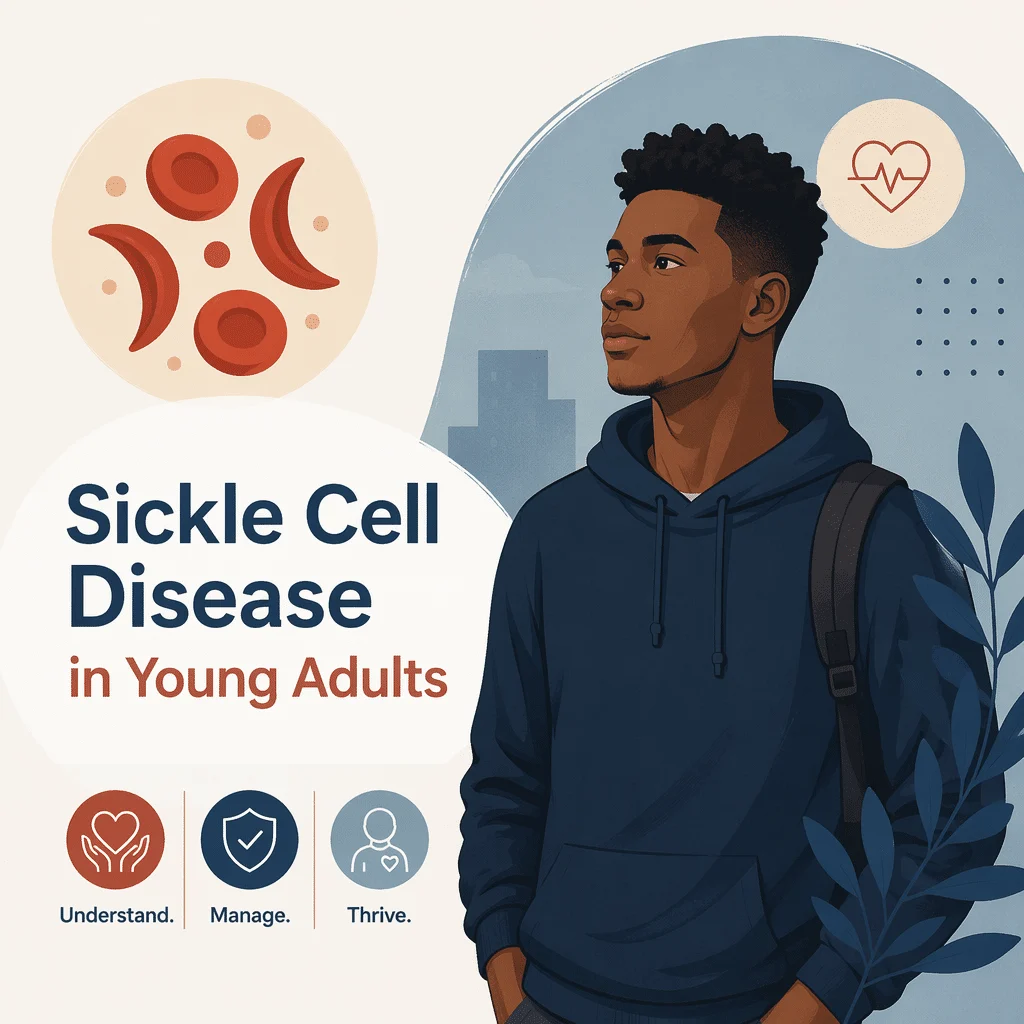
Sickle cell disease in young adults is a turning point that many families do not see coming. In childhood, care is tightly organised around paediatric specialists. As teenagers become adults, the disease often grows more demanding at the very moment they move into adult health services. A 2023 research review looked closely at this stage of life, and its findings help explain why the years between 15 and 25 can be some of the hardest.
This article reviews that study in plain language: what sickle cell disease does to the body, what the research found about complications and care in young adults, and how routine blood tests help track the condition over time. In this article you will learn what the results mean for everyday care, and where the science is heading next.
What sickle cell disease is
Sickle cell disease is a group of inherited red blood cell disorders. A change in the gene for haemoglobin, the protein that carries oxygen, makes red cells stiff and curved, shaped a little like a crescent or a farming sickle. These rigid cells break apart early and can clog small blood vessels.
Two problems follow. First, red cells are destroyed faster than the body can replace them, which produces a lifelong form of anaemia. Second, when sickled cells block a vessel, the tissue downstream is starved of oxygen and pain flares up. Doctors call these episodes pain crises, or vaso-occlusive crises.
Care teams follow the blood picture over time with a complete blood count. Because the condition is present from birth and confirmed on a simple blood test, most people in the United Kingdom are identified as newborns through routine screening.
What the study examined
The review centres on a study titled Burden of Aging: Health Outcomes Among Adolescents and Young Adults With Sickle Cell Disease, published in the journal HemaSphere in 2023. The researchers drew on a large United States patient registry built by the Sickle Cell Disease Implementation Consortium, a network of eight academic sickle cell centres.
The analysis focused on 996 participants between 15 and 25 years old, with baseline information collected from 2016 to 2019. That age band matters. It spans the handoff from paediatric to adult care, a transition that research repeatedly links to gaps in treatment. By concentrating on this window, the authors set out to describe how the weight of the disease shifts as patients grow up, rather than treating sickle cell disease as one unchanging condition across a lifetime.
What the research found in young adults
The first theme is pain. Pain crises remain the most common reason young adults with sickle cell disease seek urgent care, and many also live with pain that lingers between crises. Repeated episodes can wear down quality of life and disrupt school, work, and relationships during years that are supposed to be about building independence.
The second theme is accumulating organ damage. Years of blocked vessels and low oxygen quietly stress the spleen, kidneys, lungs, eyes, and brain. Blocked vessels in the brain can even trigger a stroke, sometimes surprisingly early in life. This is why clinicians watch several organ systems at once, not just the blood.
The third theme is mental and emotional health. Depression and anxiety are common in this age group, and emotional strain can make pain harder to bear and daily self-care harder to keep up. The authors treat mental health as part of the disease burden, not a side issue.
The fourth theme is care itself. A companion survey from the same consortium reported that young patients were often less satisfied with emergency-department care than with their regular sickle cell clinic, especially when severe pain was met with delays or doubt. As young adults leave paediatric teams, these care gaps can widen, and the study frames the transition to adult care as a period of real vulnerability.
Complications to watch for in young adulthood
The table below groups the complications that most often concern clinicians caring for young adults, along with the body system involved and the kind of monitoring that may help. It is a general guide for understanding, not a personal risk assessment.
| Body system | What can happen | How it is often monitored |
|---|---|---|
| Blood | Chronic anaemia with sudden drops during a crisis | Full blood count and reticulocyte count |
| Brain | Overt or silent strokes that can affect learning | Symptom checks and specialist imaging |
| Kidneys | Protein in the urine and declining filtration | Kidney function panel and urine tests |
| Lungs | Acute chest syndrome and breathlessness | Oxygen levels and chest imaging |
| Spleen | Weakened defence against infection | Vaccinations and prompt review of any fever |
| Whole body, from transfusions | Iron overload affecting the heart and liver | Ferritin and iron studies |
What the findings mean for patients and families
The core message is practical: the years around the move to adult care deserve extra attention, not less. Staying connected to a sickle cell specialist, keeping vaccinations up to date, and treating pain promptly all help stop small problems from becoming emergencies.
Reproductive health is part of this picture, because young adulthood is when many people start families. A 2024 consortium analysis of pregnancies in women with sickle cell disease found that roughly three in four reported pregnancies involved at least one complication, most often a pain crisis or a need for transfusion. That is not a reason to avoid pregnancy; it is a reason to plan it early with a specialist team.
Everyday monitoring leans heavily on blood work. Because red cells break down quickly, doctors track markers of that breakdown, and because repeated transfusions add iron, they keep a close eye on iron stores too.
How blood tests help track sickle cell disease
No single test captures sickle cell disease, but several read together tell a useful story. A full blood count shows how severe the anaemia is and how hard the bone marrow is working to keep up. When red cells rupture, they release an enzyme that clinicians measure with the lactate dehydrogenase blood test, a marker of how much breakdown is happening.
Iron deserves special attention. People who receive many transfusions can slowly build up excess iron, which doctors flag through high ferritin levels. To see the fuller picture, doctors confirm iron overload with an iron studies panel. Left unchecked, too much iron can harm the heart and liver, so monitoring it is part of routine follow-up.
The kidneys are vulnerable in sickle cell disease, so care teams also request a kidney function panel to catch early changes. Read in context by a clinician, these results guide decisions about hydroxyurea, transfusions, and when to step up care.
Latest scientific advances
Treatment is changing quickly, and that is genuinely hopeful news for young adults facing decades of disease. Here is what the newest research means in plain terms.
Gene-based therapies
In December 2023, the United States Food and Drug Administration approved two one-time, cell-based therapies for people 12 and older with sickle cell disease: Casgevy (exagamglogene autotemcel, or exa-cel) and Lyfgenia (lovotibeglogene autotemcel). Both work by re-engineering a patient’s own blood stem cells so the body makes healthier red cells.
In a 2024 trial published in the New England Journal of Medicine, exa-cel, which uses CRISPR gene editing to switch fetal haemoglobin back on, helped the great majority of treated patients go at least a full year with no severe pain crises. What this means for you: for some young adults with severe disease, a functional cure is now on the table. It remains an intensive option, though. It is not yet widely available, and it involves chemotherapy to prepare the body before treatment.
Medicines and transfusions
For most people, day-to-day care still rests on proven tools. Hydroxyurea, a daily medicine, reduces pain crises for many patients and remains a cornerstone of treatment. Regular or exchange transfusions can lower stroke risk and help in specific situations. One newer drug, voxelotor (Oxbryta), was withdrawn from the market by its manufacturer in 2024 after additional data raised safety concerns, a reminder that treatment guidance keeps evolving and should always come from your own care team.
What this means for you: options are broader than they were even five years ago, but the right choice depends on your genotype, your history, and access to a specialist centre. These are conversations to have with a haematologist, not decisions to make from a headline.
When to seek medical care
Sickle cell disease can turn serious fast. A fever needs urgent review, because it can signal a dangerous infection when the spleen no longer protects the body well. Get emergency help for sudden trouble breathing or chest pain, severe pain that home measures do not control, sudden weakness or trouble speaking that could signal a stroke, or a painful erection lasting more than a few hours. Sudden paleness, extreme tiredness, or a swollen, painful abdomen also need same-day attention.
Your own clinician knows your history best, so treat these signs as a prompt to get help quickly rather than to wait and see.
Glossary
| Term | Definition |
|---|---|
| Sickle cell disease | A group of inherited disorders in which abnormal haemoglobin makes red blood cells stiff and crescent-shaped. |
| Haemoglobin | The protein inside red blood cells that carries oxygen from the lungs to the rest of the body. |
| Vaso-occlusive crisis | A pain crisis caused when sickled cells block a blood vessel and cut off oxygen to nearby tissue. |
| Anaemia | A shortage of healthy red blood cells or haemoglobin, which leaves the body short of oxygen and often tired. |
| Haemolysis | The early breakdown of red blood cells, which happens faster than normal in sickle cell disease. |
| Reticulocytes | Young red blood cells; a high count shows the marrow is working hard to replace lost cells. |
| Hydroxyurea | A daily medicine that raises protective foetal haemoglobin and reduces pain crises for many patients. |
| Transition of care | The move from paediatric to adult health services, a period linked to gaps in sickle cell treatment. |
Frequently asked questions
Is sickle cell disease the same as sickle cell anaemia?
They are closely related but not identical. Sickle cell disease is the umbrella term for all inherited forms of the condition. Sickle cell anaemia usually refers to the most common and often most severe type, in which a person inherits two copies of the sickle haemoglobin gene. Other forms combine the sickle gene with a different haemoglobin change, and they can vary in severity. A blood test identifies the exact type, which helps guide treatment.
What complications are most common in young adults with sickle cell disease?
Pain crises are the most frequent problem, and many young adults also cope with lingering everyday pain. Over time, the condition can affect the kidneys, lungs, eyes, brain, and spleen, and repeated transfusions can lead to iron overload. Mental health matters too, since depression and anxiety are common. Regular follow-up with a specialist helps catch these issues early, before they become emergencies.
Can sickle cell disease be cured?
For some people, yes. A stem cell transplant from a matched donor can cure sickle cell disease, and since December 2023 two one-time gene-based therapies have been approved in the United States for eligible patients aged 12 and older. These options are intensive and not yet widely available, so most people still manage the condition with medicines such as hydroxyurea, transfusions, and careful monitoring. A haematologist can explain which paths fit an individual case.
Which blood tests are used to monitor sickle cell disease?
A full blood count and a reticulocyte count show how severe the anaemia is and how the marrow is responding. Lactate dehydrogenase reflects how fast red cells are breaking down. Ferritin and iron studies track iron overload from transfusions, and a kidney function panel watches for early kidney strain. A clinician reads these together, along with your history, rather than judging any one number alone.
Does sickle cell trait cause the same problems as sickle cell disease?
No. Sickle cell trait means a person carries one sickle gene and one normal gene. Most people with the trait have no symptoms and live normal lives, although rare problems can appear in extreme conditions such as severe dehydration or very low oxygen. The trait is not the same as the disease, but it can be passed to children, which is why genetic counselling is helpful for families planning a pregnancy.
Sources
- National Heart, Lung, and Blood Institute (NHLBI) — Sickle Cell Disease. nhlbi.nih.gov
- Centers for Disease Control and Prevention (CDC) — About Sickle Cell Disease. cdc.gov
- MedlinePlus, U.S. National Library of Medicine — Sickle Cell Disease. medlineplus.gov
- Howell KE, Pugh N, Longoria J, et al. — Burden of Ageing: Health Outcomes Among Adolescents and Young Adults With Sickle Cell Disease — HemaSphere, 2023. doi.org/10.1097/HS9.0000000000000930
- Kanter J, Gibson R, Lawrence RH, et al. — Perceptions of US Adolescents and Adults With Sickle Cell Disease on Their Quality of Care — JAMA Network Open, 2020. doi.org/10.1001/jamanetworkopen.2020.6016
- Mathias JG, Masese RV, King AA, et al. — Patient-reported pregnancy loss and maternal complications: Insights from the Sickle Cell Disease Implementation Consortium — International Journal of Gynaecology and Obstetrics, 2024. doi.org/10.1002/ijgo.15974
- Frangoul H, Locatelli F, Sharma A, et al. — Exagamglogene Autotemcel for Severe Sickle Cell Disease — New England Journal of Medicine, 2024. doi.org/10.1056/NEJMoa2309676
- Parums DV — Editorial: First Regulatory Approvals for CRISPR-Cas9 Therapeutic Gene Editing for Sickle Cell Disease and Transfusion-Dependent Beta-Thalassemia — Medical Science Monitor, 2024. doi.org/10.12659/MSM.944204
Further reading
- Folate deficiency: symptoms, causes, and treatments
- A complete blood work guide: what a full blood panel includes
- Understanding high MCV levels: causes and symptoms
- The BUN to creatinine ratio: meaning and levels
- Low vitamin B12: symptoms, causes, and treatments
Understand your lab results with AI DiagMe
Living with sickle cell disease means a lifetime of blood work, from complete blood counts and reticulocytes to haemoglobin, lactate dehydrogenase, ferritin, and kidney markers. AI DiagMe helps you read those results in plain language, so you can walk into each appointment already understanding your trends. It is built to help you understand your labs, not to diagnose, and it never replaces your own doctor.
Get your results interpreted in minutes