










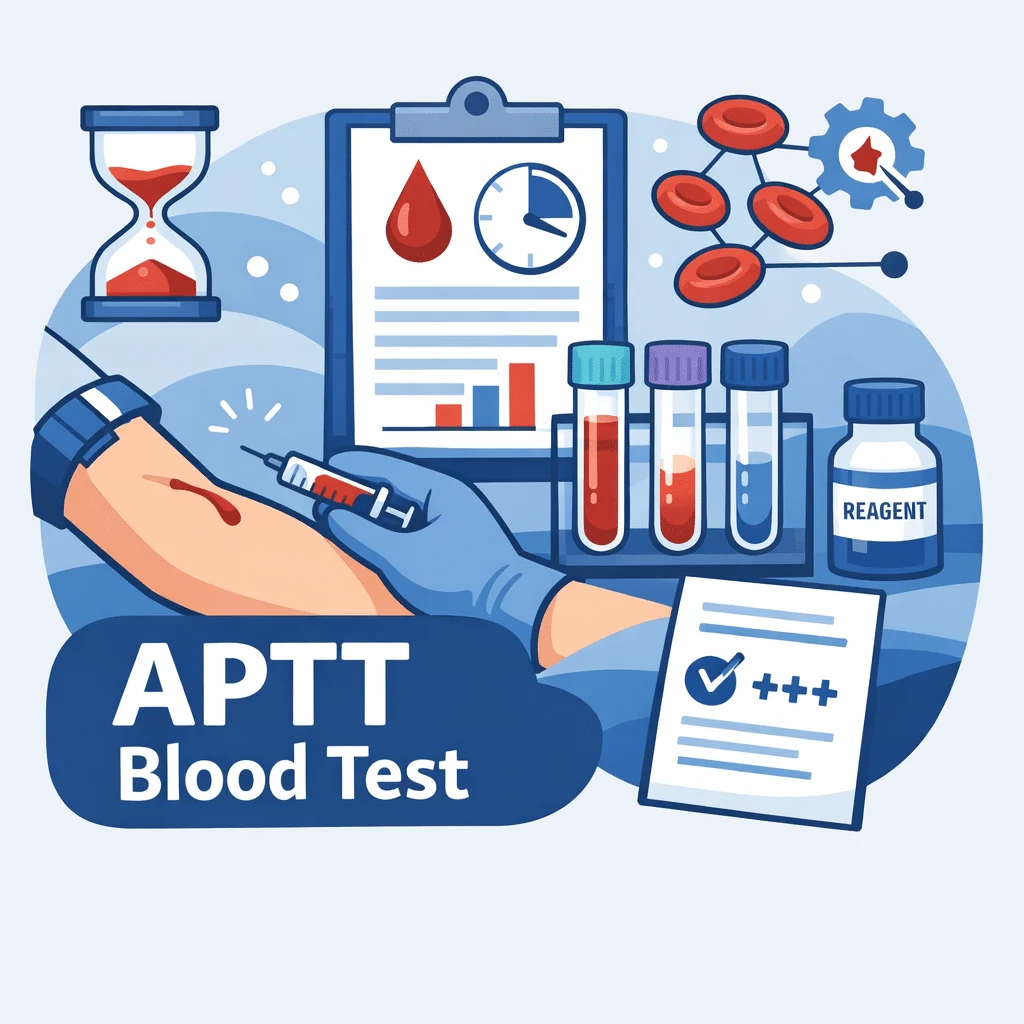
An aPTT blood test measures how long it takes a sample of your blood to form a clot through part of the coagulation system called the intrinsic pathway. Doctors order it most often to monitor heparin, an injectable blood thinner, and to investigate unexplained bleeding, bruising, or clotting. This guide explains what the test checks, how to read your result against the lab’s reference range, what a prolonged or shortened value can mean, and when a result deserves a conversation with your doctor.
What the aPTT blood test measures
Activated partial thromboplastin time, usually shortened to aPTT, is a laboratory test that times how many seconds it takes plasma to clot after a lab technician adds specific chemicals to the sample. It focuses on the intrinsic pathway, one of two routes your body uses to form a clot, plus the shared final steps both pathways rely on.
Coagulation depends on a series of proteins called clotting factors, made mainly by the liver and normally inactive in the bloodstream. An injury to a blood vessel sets off a chain reaction that activates these factors in sequence, ending in a stable clot. The aPTT checks whether the factors in the intrinsic pathway, including factors VIII, IX, XI, and XII, are present in normal amounts and working correctly.
In the laboratory, a technician draws your blood into a tube containing an anticoagulant, then separates out the plasma. They add a surface-activating substance and calcium to trigger the clotting reaction, and an automated instrument times how long the sample takes to form a visible clot. The whole process typically takes only a few minutes once the sample reaches the lab, though full turnaround including transport and reporting can take longer.
How the test differs from the PT test
A related test, prothrombin time (PT), checks the extrinsic pathway and is reported alongside the international normalised ratio, or INR. The PT and aPTT examine different groups of clotting factors, so doctors frequently order both together. Comparing which one is abnormal helps narrow down where in the clotting process a problem may lie. If your report lists several clotting values together, it helps to review the full coagulation panel.
Why doctors order an aPTT test
The aPTT test serves several distinct clinical purposes, and the reason it was ordered shapes how the result should be read.
Monitoring heparin therapy
Unfractionated heparin is a fast-acting, injectable anticoagulant commonly used in hospitals for conditions such as deep vein thrombosis, pulmonary embolism, or during certain heart and vascular procedures. Because heparin has a narrow therapeutic window, clinicians recheck the aPTT regularly to keep the dose in a safe range, one that prevents dangerous clotting without raising the risk of bleeding. In practice, a care team often takes a baseline aPTT before starting an infusion, then rechecks the value roughly every six hours until the dose stabilises in the target range, after which testing can space out further.
Newer, low-molecular-weight heparins and direct oral anticoagulants have reduced how often unfractionated heparin is used outside hospital, but it remains the preferred choice in specific situations, including severe kidney impairment, a high bleeding risk that may require rapid reversal, and certain surgical or intensive-care settings where a short-acting, easily adjustable medication is valuable.
Investigating unexplained bleeding or bruising
If you experience frequent nosebleeds, easy bruising, heavy menstrual periods, or prolonged bleeding after a minor cut, a doctor may order an aPTT alongside other coagulation tests to look for an underlying bleeding disorder.
Screening before surgery in select patients
Not everyone needs coagulation testing before an operation. Current practice reserves it for people with a personal or family history of bleeding, known liver disease, or those taking anticoagulant medication, rather than testing every patient routinely. Anyone with an upcoming procedure can review what to expect from typical blood tests before surgery.
Detecting factor deficiencies and inhibitors
A markedly prolonged aPTT can point towards a deficiency in one of the intrinsic pathway factors, a pattern that most classically produces haemophilia A or B, or towards an acquired inhibitor that blocks a clotting factor’s activity. The test can also flag lupus anticoagulant, an antibody that paradoxically increases someone’s odds of developing a pulmonary embolism, even though it prolongs the aPTT result in the lab.
Reading your aPTT result
Your lab report will list your aPTT result in seconds next to a reference range set by that specific laboratory. The same haemostasis section of your report typically groups the PT/INR result, and a full printout usually defines dozens of other common blood markers. Some reports also include a patient-to-control ratio, which compares your result to a normal control sample. If you are on heparin, your report may also list a separate target range specific to your treatment rather than the general population reference range.
A typical adult reference range falls between about 25 and 35 seconds, though the exact numbers vary depending on the reagents and equipment your lab uses. For this reason, always compare your result to the range printed on your own report rather than a number found online or on a different lab’s form. Labs commonly flag abnormal values with an “H” or “L,” an asterisk, or coloured text; a broader walkthrough can help you read blood test results with more confidence.
| What your report shows | General meaning |
|---|---|
| Result within the lab’s reference range | Intrinsic pathway appears to be functioning at a normal speed |
| Result above the reference range (prolonged) | Clotting is slower than expected; several causes are possible, see below |
| Result below the reference range (shortened) | Clotting is faster than expected; less common, also has several causes |
| Patient/control ratio outside 0.8 to 1.2 | Suggests a meaningful deviation from a healthy control sample |
Causes of a prolonged aPTT
A prolonged aPTT means your blood took longer than the reference range to clot in the test tube. Several distinct conditions can produce this pattern, and your doctor will weigh your symptoms, medications, and other tests to identify the cause.
Heparin and other anticoagulants
Unfractionated heparin is by far the most common reason for an intentionally prolonged aPTT, since the medication works by slowing the intrinsic pathway. Among direct oral anticoagulants, dabigatran reliably prolongs the aPTT, while factor Xa inhibitors like rivaroxaban and apixaban have a more variable effect and are not typically monitored with this test.
Inherited bleeding disorders
Haemophilia A results from a deficiency in factor VIII, and haemophilia B from a deficiency in factor IX; both can cause a significantly prolonged aPTT along with joint bleeding and easy bruising. A more common inherited condition affecting a protein that helps platelets stick together can also prolong the test; clinicians managing pregnant patients pay particular attention when they diagnose von Willebrand disease.
Lupus anticoagulant and antiphospholipid syndrome
This is one of the more counterintuitive findings in coagulation testing. Antiphospholipid antibodies interfere with the chemical reagents used in the aPTT test itself, which prolongs the result in the lab, even though the underlying condition raises a person’s real-world risk of blood clots rather than bleeding. Specialised follow-up testing, often combining the aPTT with a second method based on different reagents, is usually needed to confirm this finding.
Liver disease
Because the liver manufactures most clotting factors and the natural anticoagulant proteins that balance them, significant liver dysfunction can reduce their production and prolong both the aPTT and the PT. Severe liver disease can also lower antithrombin III levels, further complicating the clotting picture.
Causes of a shortened aPTT
A shortened aPTT is less common than a prolonged one and is generally considered less clinically significant on its own, though it can occasionally point towards an increased tendency to clot.
Acute inflammation or recent blood loss
During an active inflammatory response or shortly after significant bleeding, the body can temporarily raise the levels of certain clotting factors as part of a protective response, which can shorten the aPTT. This pattern is usually incidental, found alongside other markers of inflammation or recent injury, rather than a finding that leads to its own separate workup.
Early-stage disseminated intravascular coagulation
Disseminated intravascular coagulation, or DIC, is a serious condition involving widespread clotting activity throughout the body. In its earliest phase, this excess clotting can shorten the aPTT before the condition progresses to consume clotting factors and cause bleeding instead.
Certain cancers
Some advanced cancers, including certain gynaecological and gastrointestinal tumours, can release substances that activate the clotting system and shorten the aPTT as part of a broader hypercoagulable state.
Factor V Leiden
This inherited mutation causes resistance to activated protein C, a natural anticoagulant, and is associated with a modestly shortened aPTT along with an increased risk of venous clots, particularly during pregnancy or after surgery. When investigating an unexplained clot, doctors will often order a D-dimer test.
Latest scientific advances
Recent research continues to refine how clinicians use and interpret the aPTT test, especially in complex clinical situations. According to PubMed, a 2025 systematic review and meta-analysis found that people with preeclampsia, a pregnancy complication involving high blood pressure, tend to have a longer prothrombin time and aPTT than pregnant women without the condition (Alemayehu et al., BMC Pregnancy and Childbirth, 2024; DOI). What this means for you: if you are pregnant and your coagulation panel looks different from a typical reference range, your doctor may consider this alongside blood pressure and other findings; this is an early pattern still being confirmed across larger, longer studies rather than a stand-alone diagnostic test.
A separate meta-analysis looking at adults on veno-arterial ECMO, a form of life support that oxygenates blood outside the body, compared outcomes between patients managed with lower versus higher aPTT treatment targets for heparin dosing. The pooled data found broadly similar rates of bleeding and clotting complications between the two target ranges (Mazzeffi et al., Perfusion, 2023; DOI). What this means for you: for the relatively small group of critically ill patients on ECMO, this suggests there may be more flexibility in aPTT targets than previously assumed, though the authors note a properly randomised trial is still needed before guidelines change.
Research on lupus anticoagulant testing has also progressed. A 2025 review of laboratory practice noted that current international guidance recommends testing for lupus anticoagulant using at least two different methods, typically the aPTT alongside a separate test called the dilute Russell viper venom time, because relying on a single method risks false results, particularly in people taking newer oral anticoagulants (Favaloro et al., Journal of Clinical Medicine, 2025). What this means for you: if your doctor suspects lupus anticoagulant based on a prolonged aPTT, expect additional, more specific testing before a diagnosis is confirmed, rather than a conclusion from one result alone.
Separately, a 2024 meta-analysis examined whether prothrombin time and aPTT differ between people with diabetes and healthy individuals across studies conducted in Africa. Overall, the analysis did not find a statistically significant difference for the group as a whole, though a signal emerged specifically in people with type 1 diabetes (Getu et al., Frontiers in Medicine, 2024; DOI"). What this means for you: this is a preliminary, population-level finding rather than a reason for routine coagulation screening in diabetes, and researchers describe it as worth monitoring rather than acting on directly.
When to see a doctor
Most abnormal aPTT results are best discussed at a routine follow-up appointment rather than treated as an emergency, since a single flagged value often reflects a mild, harmless variation. A few situations call for more prompt attention.
Seek urgent medical care if a prolonged aPTT is accompanied by any of the following signs of active bleeding:
- Frequent or hard-to-stop nosebleeds.
- Large, unexplained bruises or blood blisters.
- Blood in your urine or stool, or unusually heavy menstrual bleeding.
- Swollen, painful joints, which can indicate internal bleeding.
- Any bleeding that does not stop with firm pressure after several minutes.
Contact your doctor promptly, though not necessarily as an emergency, if you notice sudden leg swelling, pain, or warmth, or if you develop unexplained shortness of breath or chest pain, since these can suggest a clot rather than a bleeding problem. If you take heparin or another blood thinner and your aPTT result comes back well outside your target range, your care team will typically adjust your dose and recheck the level rather than change your treatment based on a single number.
Understand your lab results with AI DiagMe
Reviewing an aPTT result alongside other clotting values like PT/INR, D-dimer, or a platelet count can feel overwhelming without context. AI DiagMe helps you understand what these numbers mean in plain language, so you can walk into your next appointment with clearer questions. It is built to help you understand your lab results, not to diagnose you or replace the advice of your doctor.
Get your results interpreted in minutes
Glossary
| Term | Definition |
|---|---|
| aPTT (activated partial thromboplastin time) | A blood test that measures how many seconds it takes plasma to clot through the intrinsic and common coagulation pathways. |
| Coagulation cascade | The step-by-step chain of clotting factor activation that leads to a stable blood clot. |
| Factor VIII | A clotting factor in the intrinsic pathway; a deficiency causes haemophilia A. |
| Factor V Leiden | A common inherited gene change that makes clotting factor V resist a natural anticoagulant, raising clot risk. |
| Haemophilia | An inherited bleeding disorder caused by a deficiency in a specific clotting factor, most often factor VIII or IX. |
| Heparin | A fast-acting, injectable anticoagulant medication often monitored using the aPTT test. |
| Intrinsic pathway | One of two routes in the coagulation cascade, evaluated by the aPTT test. |
| Lupus anticoagulant | An antibody that prolongs the aPTT in the lab but is associated with a higher real-world risk of blood clots. |
| PT/INR | A related coagulation test that checks the extrinsic pathway and is used to monitor warfarin. |
| Reference range | The span of results considered typical for a healthy population, set individually by each laboratory. |
Frequently asked questions
What does a low aPTT result mean?
A low, or shortened, aPTT means your blood clotted faster than the lab’s reference range in the test tube. This is less common than a prolonged result and is often not clinically significant on its own. Possible causes include recent blood loss, acute inflammation, certain cancers, or an inherited clotting tendency such as Factor V Leiden. Your doctor will typically interpret a shortened aPTT alongside your symptoms and other coagulation tests rather than treating the number in isolation.
What is the normal range for an aPTT test?
Most laboratories report a normal adult range of roughly 25 to 35 seconds, though this varies based on the specific reagents and equipment each lab uses. Always compare your result to the reference range printed on your own report, since ranges can differ meaningfully between laboratories. If you are being monitored on heparin, your target range will usually be wider and set individually by your care team based on the medication dose.
What does aPTT stand for, and how is it different from PTT?
aPTT stands for activated partial thromboplastin time. The “activated” refers to a chemical activator the lab adds to speed up and standardise the clotting reaction, which makes results more consistent between tests. PTT and aPTT are generally used to refer to the same test in modern practice, since nearly all labs now use the activated method rather than the older, non-activated version.
Can high aPTT levels be treated?
Treatment depends entirely on the cause. If heparin is responsible, your care team will adjust the dose. If a factor deficiency such as haemophilia is found, treatment may involve replacing the missing clotting factor. If lupus anticoagulant or another autoimmune cause is identified, management focuses on the underlying condition and reducing clot risk rather than correcting the aPTT number itself. A prolonged aPTT is a signal that guides further testing, not a condition treated directly.
Does a normal aPTT rule out a bleeding disorder?
No. A normal aPTT confirms that the intrinsic pathway is working as expected, but it does not check every aspect of your clotting system. Problems with the extrinsic pathway, evaluated separately by the PT/INR test, platelet function, or specific factor deficiencies such as factor XIII, can exist even with a normal aPTT. If you have symptoms of a bleeding disorder despite normal results, your doctor may order additional, more targeted tests.
Do I need to fast before an aPTT blood test?
No special preparation, including fasting, is typically needed before an aPTT test. It uses a standard blood draw from a vein in your arm, generally collected into a tube containing an anticoagulant to keep the sample from clotting before it reaches the lab. Tell the person drawing your blood about any medications, including blood thinners and supplements, since several can influence your result.
Sources
- Partial Thromboplastin Time (PTT) Test — MedlinePlus, U.S. National Library of Medicine
- Partial Thromboplastin Time — Cleveland Clinic
- Haemophilia: Symptoms and Causes — Mayo Clinic
- Alemayehu et al., Association of prothrombin time, thrombin time and activated partial thromboplastin time levels with preeclampsia: a systematic review and meta-analysis — BMC Pregnancy and Childbirth, 2024 (PubMed, PMC11092070)
- Mazzeffi et al., Outcomes of heparinised adult veno-arterial extracorporeal membrane oxygenation patients managed with low and high activated partial thromboplastin time targets: A systematic review and meta-analysis — Perfusion, 2023 (PubMed)
- Getu et al., The evaluation of prothrombin time and activated partial thromboplastin time among diabetic and healthy controls in Africa: systematic review and meta-analysis — Frontiers in Medicine, 2024 (PubMed, PMC11658991)
- Favaloro et al., Lupus Anticoagulant Testing for Diagnosis of Antiphospholipid Syndrome: A Perspective Informed by Local Practice — Journal of Clinical Medicine, 2025 (via Consensus)
Further reading
- Coagulation panel: PT, PTT, INR, and D-dimer
- D-dimer blood test: a comprehensive guide to your results
- Antithrombin III test: understanding your levels
- Vitamin K blood test and PT/INR results
- How to read your blood test results