




An antithrombin III test measures a natural anticoagulant protein that keeps your blood from clotting too easily. Doctors usually order this test after an unexplained or recurrent blood clot, or before starting certain treatments, to check whether your body’s built-in clotting brake is working normally. This article explains what antithrombin III does, how to read your result against the reference range, what a low or high level can mean, and when the finding calls for a specialist. You will also find a plain-language look at how antithrombin relates to heparin treatment in hospital, a glossary of the terms used here, and answers to common patient questions.
What is antithrombin III?
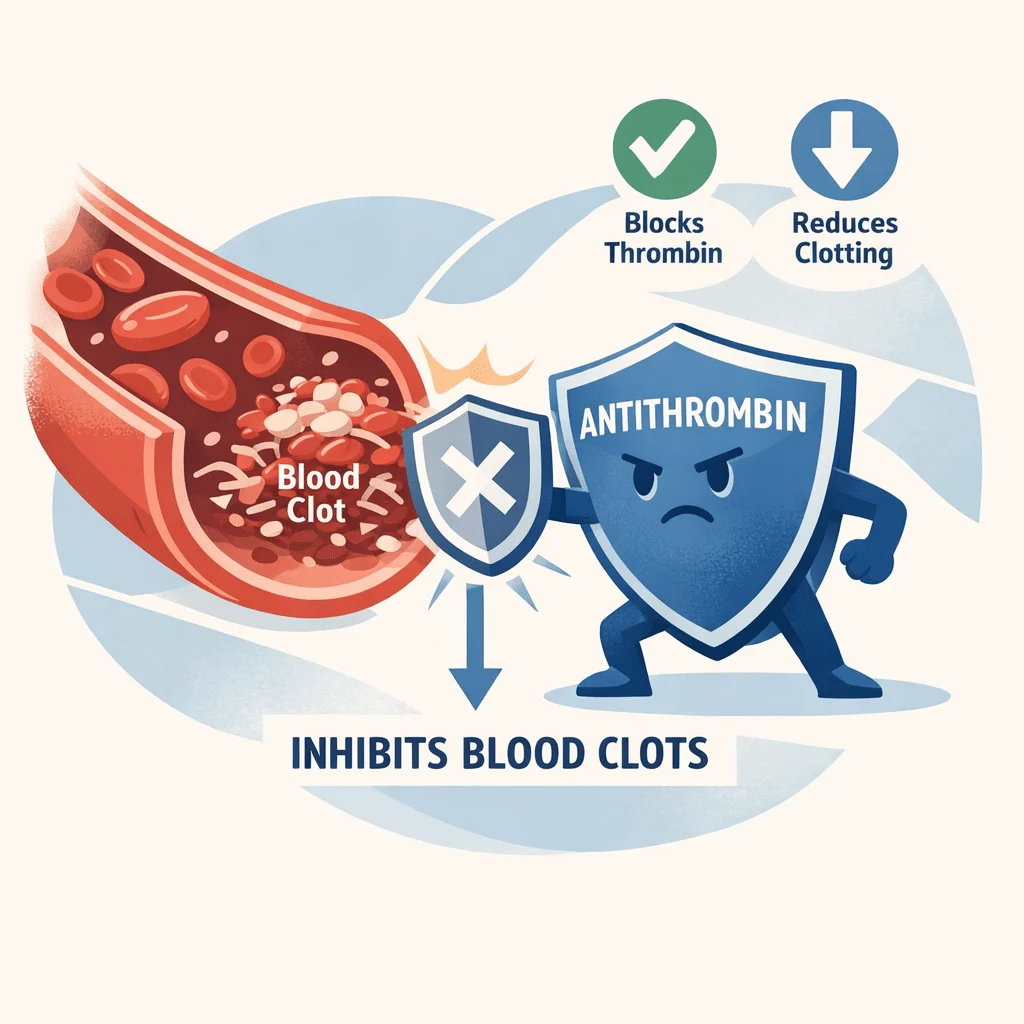
Antithrombin III, usually just called antithrombin, is a protein made mainly by your liver and released into the bloodstream. Its job is to act as a brake on clotting. Blood needs to clot to stop bleeding after an injury, but that process has to switch off again once the job is done — otherwise clots could keep growing inside healthy blood vessels.
Antithrombin does this by binding to and inactivating two key clotting enzymes, thrombin and factor Xa. Once antithrombin latches onto them, they can no longer drive the clotting cascade forward. This is a continuous, low-level process that keeps your blood flowing smoothly through normal, undamaged vessels.
Why antithrombin matters for heparin therapy
Antithrombin has a second, clinically important role: it is the target of heparin, a fast-acting blood-thinning medicine used in hospitals for surgery, dialysis, and treating existing clots. Heparin does not directly block clotting factors; instead, it binds antithrombin and speeds up its action by roughly a thousandfold. This means heparin can only work as well as the antithrombin available in your blood. If antithrombin levels are very low, heparin may not thin the blood as expected, a situation clinicians call heparin resistance.
Why your doctor may order this test
An antithrombin test is not part of routine blood tests. It is typically requested when there is a specific reason to suspect a clotting-balance problem.
Common reasons include an unprovoked deep vein thrombosis or pulmonary embolism, especially in someone under 45; a strong family history of blood clots; recurrent clots despite standard risk factors being ruled out; unexplained pregnancy loss; or in a hospital setting, when a patient needs unusually high doses of heparin to reach a safe level of anticoagulation. The test is one part of a broader thrombophilia workup, which usually also checks protein C, protein S levels, and genetic clotting mutations.
Timing also matters. Because pregnancy, acute clotting events, and certain medications can all temporarily shift antithrombin levels, doctors often prefer to test outside of these situations where possible, or to interpret a result obtained during them with extra caution. If your first test happens during an acute illness or shortly after a new clot, your doctor may recommend a repeat measurement later, once the acute period has passed, to see your more typical baseline level.
How to read your antithrombin III test result
Your lab report will show your result as a percentage of normal activity, sometimes alongside a separate antigen (protein quantity) measurement. A typical adult reference range for antithrombin activity is about 80% to 120%, though the exact cutoffs vary slightly by laboratory and testing method.
| Result category | Approximate range | General meaning |
|---|---|---|
| Normal | About 80–120% | Anticoagulant function is within the expected range |
| Mildly low | Roughly 60–80% | Can reflect a partial deficiency or a temporary acquired cause |
| Moderately to severely low | Below 60% | More consistent with a significant deficiency, often warranting specialist follow-up |
| High | Above 120% | Usually a temporary finding of limited clinical concern |
Always compare your number to the reference range printed on your own report rather than a general figure, since methods differ between laboratories. A single abnormal value is a starting point for discussion with your doctor, not a diagnosis on its own.
Activity versus antigen testing
Some labs report two separate antithrombin values: activity and antigen. The activity test measures how well the protein actually functions, whilst the antigen test measures how much protein is present, regardless of whether it works correctly. Comparing the two helps distinguish a quantity problem from a quality problem, which matters for identifying the underlying cause.
Understanding low antithrombin III: causes and types
A below-range result is far more common than an elevated one, and doctors separate the causes into inherited and acquired categories.
Hereditary antithrombin deficiency
Hereditary antithrombin deficiency is caused by a mutation in the SERPINC1 gene and is estimated to affect roughly 1 in 2,000 to 3,000 people. It follows an autosomal dominant inheritance pattern, meaning a child of an affected parent has about a 50% chance of inheriting the mutation. Type I deficiency involves lower amounts of a structurally normal protein, whilst Type II deficiency produces a normal amount of protein that does not function properly. Either way, the net anticoagulant capacity of the blood is reduced, which raises the lifetime risk of a first blood clot, often a deep vein thrombosis or pulmonary embolism appearing before the age of 45.
Acquired antithrombin deficiency
Acquired deficiency develops later in life due to another medical condition rather than a gene change. Common drivers include liver disease, kidney protein loss, and consumption during acute illness, summarised below.
| Cause | Why antithrombin falls |
|---|---|
| Severe liver disease | The liver makes antithrombin, so advanced disease reduces production; related markers are covered in our liver function tests guide |
| Nephrotic syndrome | This kidney condition causes the body to lose antithrombin directly into the urine, a topic covered in our kidney function panel overview |
| Disseminated intravascular coagulation (DIC) | Widespread clotting activation rapidly consumes antithrombin along with other clotting factors |
| Prolonged heparin therapy | Extended heparin use can gradually lower antithrombin through increased consumption |
| Major surgery or acute illness | Critical illness and large operations can transiently reduce levels |
High antithrombin III levels: what an elevated result means
An above-range antithrombin level is uncommon and generally carries far less clinical significance than a deficiency. It can appear during oestrogen-containing hormone therapy, in the early phase of acute liver inflammation, or during the first trimester of pregnancy. These elevations are usually temporary and typically resolve without specific treatment once the underlying cause passes.
Antithrombin III, heparin resistance, and hospital care
Because heparin depends on antithrombin to work, low antithrombin levels can make standard heparin doses less effective, particularly during cardiac surgery involving a heart-lung bypass machine or in critically ill patients on prolonged heparin infusions. When a patient needs unusually large heparin doses to reach a safe clotting time, the care team may check antithrombin activity as part of the workup, alongside other possible explanations. Management options can include a higher heparin dose, antithrombin replacement, fresh frozen plasma, or switching to an anticoagulant that does not depend on antithrombin, such as a direct thrombin inhibitor.
A decision guide: what typically happens after your result
| Your situation | Common next step |
|---|---|
| Normal result, no symptoms | No specific follow-up needed for this marker alone |
| Mildly low, no prior clot, no family history | Often monitored; precautions considered around surgery, pregnancy, or immobility |
| Low result with a personal history of a blood clot | Referral to a haematologist for a full thrombophilia evaluation |
| Low result found through family screening | Genetic counselling and individualised risk discussion, often without automatic anticoagulant therapy |
| Low result during a hospital stay, on heparin | Reassessed by the treating team, since acute illness can transiently lower levels |
When to see a doctor
Contact your healthcare provider promptly if you have an abnormal antithrombin result along with any of the following, since these can be signs of an active blood clot:
- Sudden swelling, pain, warmth, or redness in one leg, which can suggest a deep vein thrombosis or related clotting event
- Unexplained shortness of breath, chest pain that worsens with breathing, or coughing up blood
- A family member recently diagnosed with a hereditary clotting disorder
- Plans for surgery, pregnancy, or starting hormonal contraception with a known or suspected deficiency
These symptoms need urgent medical evaluation regardless of when your last blood test was done, since a laboratory result only reflects a single point in time.
Living with an antithrombin deficiency: practical steps
If you have a confirmed deficiency, your care plan will depend on its severity and your personal history. General measures that support healthy circulation include staying well hydrated, avoiding long periods of immobility during travel or after surgery, maintaining a healthy weight, and not smoking, since tobacco use promotes clot formation. Anyone with a known deficiency should tell every new healthcare provider about the diagnosis before a procedure, since perioperative planning may need adjustment. None of these lifestyle steps replace anticoagulant therapy when it is prescribed; they work alongside your doctor’s plan, not instead of it.
Pregnancy deserves special mention, since it is one of the highest-risk periods for someone with a known deficiency. Pregnancy itself naturally shifts the body towards more clotting to prepare for delivery, and this effect can compound an existing deficiency. Many women with a confirmed hereditary deficiency receive preventive blood-thinning injections during pregnancy and for several weeks after delivery, with the exact plan set by a haematologist working alongside an obstetrician. If you know you have a deficiency and are planning a pregnancy, raising this early, ideally before conception, gives your care team time to prepare a monitoring and prevention plan.
Family members are also part of the picture. Because hereditary deficiency follows a predictable inheritance pattern, first-degree relatives, meaning parents, siblings, and children, of someone diagnosed with the condition may be offered testing themselves, particularly if they are considering surgery, pregnancy, or hormonal contraception. A relative who tests positive but has never had a clot is not automatically started on long-term anticoagulant therapy; instead, the focus is usually on targeted prevention during known higher-risk periods.
Latest scientific advances
According to PubMed, the American Society of Hematology published updated evidence-based guidelines in 2023 on thrombophilia testing, including antithrombin, protein C, and protein S deficiency (Middeldorp et al., Blood Advances, 2023; DOI). The panel found that broad population screening before starting birth control is not helpful, but recommended targeted testing in specific situations, such as a family history of antithrombin deficiency when someone is weighing hormone therapy or thromboprophylaxis. In plain terms, this confirms that antithrombin testing works best when aimed at people with a real reason for suspicion, rather than as a general screening tool.
A 2024 systematic review and meta-analysis pooled data from more than 107,000 people to quantify how much hereditary thrombophilia types actually raise clotting risk (Alnor et al., Annals of Hematology, 2024; DOI). It found that antithrombin deficiency carries an intermediate level of risk compared with other inherited clotting disorders — meaningfully elevated, but somewhat lower than earlier, smaller studies had suggested. For readers, this is a reassuring nuance: a deficiency raises risk, but the size of that risk may be more modest than older estimates implied, which is one reason your doctor weighs your personal and family history alongside the lab result rather than treating every deficiency identically.
A 2025 systematic review conducted for the CDC examined thrombosis risk when women with an inherited clotting tendency, including antithrombin deficiency, use hormonal contraception (Tepper et al., Contraception, 2025; DOI). It found that oestrogen-containing contraception appeared to further raise clotting risk in women who already have a thrombophilia, whilst evidence on progestogen-only methods remained more limited. What this means for you: if you carry a known deficiency and are considering contraception, this is a conversation worth having with your doctor, since non-oestrogen options are generally considered safer in this context — though the certainty of the underlying evidence is still described as low, meaning more research is expected to refine this guidance.
On the hospital side, a 2025 study of 605 cardiac surgery patients directly tested whether low antithrombin activity explains heparin resistance during bypass surgery (Kim et al., Journal of Cardiothoracic and Vascular Anesthesia, 2025; DOI). Surprisingly, preoperative antithrombin activity was not significantly associated with heparin resistance in this group; active infection and aortic surgery were the stronger risk factors instead. This is an early but well-designed finding that nuances a longstanding assumption — it suggests that in some surgical settings, low antithrombin may be a less important explanation for heparin resistance than previously believed, and that routinely giving antithrombin concentrate to prevent it may not always be necessary. This remains a single study, and practice may continue to vary between hospitals as more research accumulates.
Separately, a 2023 study from Johns Hopkins looked at acquired antithrombin deficiency in children supported on extracorporeal membrane oxygenation (ECMO), a heart-lung support machine (Procaccini et al., British Journal of Clinical Pharmacology, 2023; DOI). Deficiency was common in this critically ill population, and about a third of measurements stayed low even after antithrombin replacement. For families of children on ECMO, this underscores that antithrombin monitoring in intensive care is an evolving area, with dosing strategies still being refined rather than fully standardised.
Glossary
| Term | Definition |
|---|---|
| Antithrombin (antithrombin III) | A liver-made protein that inhibits thrombin and factor Xa to prevent excessive blood clotting |
| Thrombophilia | An increased tendency of the blood to form clots, whether inherited or acquired |
| Thrombin | A central clotting enzyme that converts fibrinogen into fibrin, the mesh that forms a clot |
| Factor Xa | A clotting enzyme that helps activate thrombin; a key target of antithrombin and some anticoagulant drugs |
| Heparin resistance | A reduced response to standard heparin doses, sometimes linked to low antithrombin activity |
| SERPINC1 gene | The gene that provides instructions for producing antithrombin; mutations here cause hereditary deficiency |
| Disseminated intravascular coagulation (DIC) | A serious condition where widespread clotting activation consumes clotting factors, sometimes causing bleeding and clotting together |
| Nephrotic syndrome | A kidney disorder causing significant protein loss in the urine, which can include antithrombin |
| Autosomal dominant inheritance | A genetic pattern where one copy of a mutated gene from either parent is enough to potentially cause the condition |
Frequently asked questions
What is a dangerously low antithrombin III level?
There is no single universal cutoff for “dangerous,” because risk depends on the whole clinical picture, not just the number. That said, activity levels below roughly 60% are generally taken more seriously by clinicians, especially alongside a personal or family history of clotting. Severe deficiency, along with acute triggers such as surgery or pregnancy, raises concern further. Your haematologist interprets your specific value together with your symptoms and history rather than applying one fixed threshold to everyone.
Can antithrombin III levels be improved naturally?
Diet and lifestyle cannot correct a genetic deficiency, since the underlying gene mutation remains unchanged. However, general habits that support healthy circulation, such as staying active, avoiding prolonged immobility, not smoking, and maintaining a healthy weight, can help reduce your overall clotting risk. If a low level is caused by an acquired condition like liver disease, treating that underlying condition may allow antithrombin levels to recover over time.
Is antithrombin III the same as antithrombin?
Yes. The protein was originally named antithrombin III when several numbered antithrombin activities were described decades ago, but “antithrombin” is now the standard scientific name for the same protein. You may see either term used interchangeably on lab reports, in medical literature, and by your doctor.
Does antithrombin III deficiency cause symptoms on its own?
Typically, no. Most people with a deficiency have no symptoms until a blood clot actually forms, which is why the condition is often discovered only after a first thrombosis or through family screening once a relative is diagnosed. This is an important reason doctors take an unexplained clot in a younger person seriously enough to investigate underlying causes.
How often should antithrombin III be retested?
There is no universal schedule, since retesting depends on why the test was ordered in the first place. A single mildly abnormal result in someone without symptoms may simply be discussed at a future appointment, while a confirmed deficiency with a history of clotting often prompts more structured, periodic monitoring by a haematologist. Your doctor will set a personalised follow-up plan based on your situation.
Can medications affect my antithrombin III test result?
Yes. Heparin use, especially prolonged use, can lower measured antithrombin activity due to increased consumption, whilst oestrogen-containing medications can raise it. Because of this, it is important to tell the laboratory and your doctor about every medication you are taking, including hormonal contraception, so your result can be interpreted in the right context rather than assumed to reflect your baseline level.
Antithrombin III sits at the centre of your body’s natural clot-control system, working alongside markers like aPTT, protein C, and D-dimer to give doctors a fuller picture of your coagulation health. Understanding what these values mean can help you follow a preventive plan more confidently and ask more focused questions at your next appointment. AI DiagMe is built to help you make sense of results like these — it explains what your numbers show in plain language, without diagnosing you or replacing the care of your doctor.
Understand your lab results with AI DiagMe
Get your results interpreted in minutes
Sources
- Antithrombin III Injection — Cleveland Clinic
- Hereditary Antithrombin Deficiency — MedlinePlus Genetics, U.S. National Library of Medicine (NIH)
- Deep Vein Thrombosis (DVT): Symptoms & Causes — Mayo Clinic
- Middeldorp et al., American Society of Hematology 2023 Guidelines for Management of Venous Thromboembolism: Thrombophilia Testing — Blood Advances, 2023 (PubMed)
- Alnor et al., Venous Thromboembolism Risk in Adults with Hereditary Thrombophilia: A Systematic Review and Meta-Analysis — Annals of Hematology, 2024 (PubMed)
- Tepper et al., Thrombosis Risk with the Use of Hormonal Contraception Among Women with Thrombophilia: An Updated Systematic Review — Contraception, 2025 (PubMed)
- Kim et al., Analysis of Risk Factors for Heparin Resistance During Cardiac Surgery: Does Antithrombin Deficiency Cause Heparin Resistance? — Journal of Cardiothoracic and Vascular Anesthesia, 2025 (PubMed)
- Procaccini et al., Evaluation of Acquired Antithrombin Deficiency in Paediatric Patients Supported on Extracorporeal Membrane Oxygenation — British Journal of Clinical Pharmacology, 2023 (PubMed)
Further reading
- Coagulation panel explained: PT, PTT, INR, and D-dimer
- Protein C: A complete guide to understanding your blood test
- Protein S test results: Understanding your levels and their significance
- Vitamin K: Understand and act on your results
- Blood tests before surgery: What tests are done and why