Most of us have been told the same thing for years: no food after dinner, nothing but water in the morning, and arrive hungry. A large study published in JAMA Internal Medicine on September 28, 2026 now asks a fair question: do all blood tests really need that? The researchers looked at nearly ten million routine lab results and found that fasting changes only a handful of them in a meaningful way. This article explains what the study found, what it does not change, and how to prepare for your next blood draw.
If you want the practical rules first, our guide to Fasten vor einer Blutuntersuchung covers timing, drinks, and medications. This news article focuses on the new evidence.
What the new study actually did
A very large hospital dataset
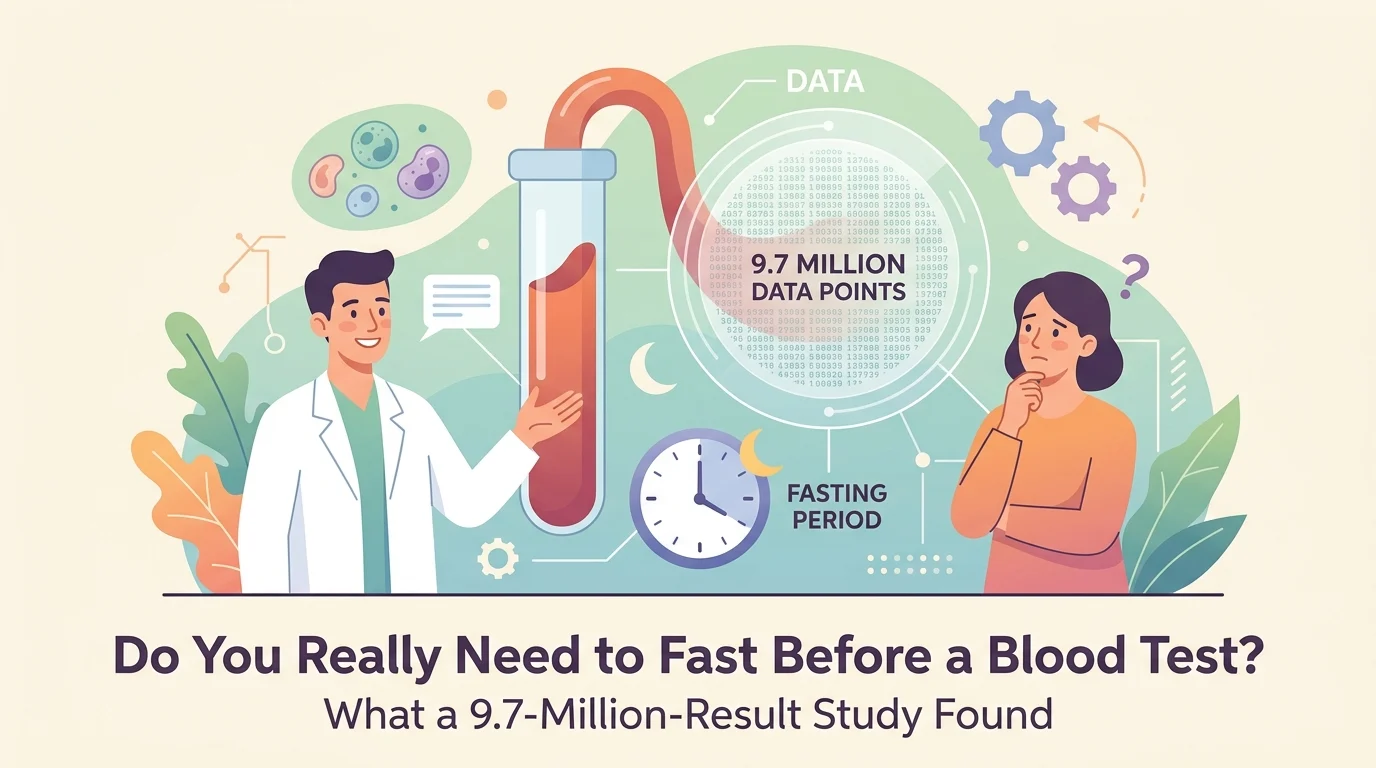
A team in South Korea reviewed laboratory records from one 670-bed university hospital near Seoul, collected between February 2021 and December 2023. The dataset covered 9,755,547 test results from 101,148 adult outpatients across 372 test items. Each result was linked to how long the patient had gone without eating: less than 8 hours, 8 to 12 hours, or more than 12 hours.
Comparing results with a quality yardstick
The team did not only ask whether numbers differed. They asked whether the difference was larger than the amount of variation laboratories already accept for each test, based on European laboratory medicine standards. They also compared the same patients with themselves across different visits, which helps remove the effect of people simply being different from each other.
What the results showed
At first glance, 27 tests looked different between fasting groups. Once the researchers compared people with themselves, only 10 of those differences held up, which suggests much of the first signal came from other factors. The clearest effects appeared when people had fasted for less than 8 hours.
| Prüfen | Result after less than 8 hours without food | Was das für Sie bedeutet |
|---|---|---|
| Glucose | Higher (about 11% in the study) | A short fast can make blood sugar look higher than it is at rest |
| Triglyceride | Higher (about 20%) | The blood fat most affected by recent meals |
| Gamma-Glutamyltransferase (GGT) | Higher (about 15%) | A liver enzyme that can look slightly raised after eating |
| Lipase | Higher (about 36%) | A digestive enzyme linked to the pancreas |
Just as important, no test exceeded the accepted variation when the 8 to 12 hour group was compared with the more-than-12-hour group. In other words, fasting overnight for 8 to 12 hours looked as good as fasting for longer. Fasting for 14 or 16 hours did not appear to buy extra accuracy.
What the study does not change
This was a retrospective study from a single hospital, and it described associations in routine data rather than testing a new rule in a trial. The authors themselves conclude that the findings support test-by-test fasting instructions rather than one uniform rule. They do not say that fasting is pointless.
In practice, your lab or clinician still decides whether you should fast, because they know which tests are on your order and why. Major health resources keep the same practical advice: MedlinePlus describes fasting as usually 8 to 12 hours with plain water only, and also notes that fasting is needed only for some tests. If your order includes glucose or a lipid panel, follow the instructions you were given.
Why the cholesterol question is still debated
The lipid panel is where the fasting debate is liveliest. Triglycerides rise after a meal, while LDL and total cholesterol move much less. A 2024 review reported that guidelines in Europe, the United States, Canada, Brazil, Japan, India, and Australia now endorse non-fasting lipid profiles for some or all patients, partly because it is more convenient and avoids the risk of low blood sugar for people who take diabetes medicines.
Not every analysis agrees. A 2024 meta-analysis of eight studies and about 245,000 healthy participants found measurable differences between fasting and non-fasting samples and concluded that fasting remains a reasonable conservative choice because it reduces variability. The honest summary is that non-fasting lipid results are widely accepted for estimating heart risk, while a fasting sample can still be preferred when triglycerides are high or when your clinician wants the most comparable number. To see how these markers fit together, read how a lipid panel explained in plain language works.
How to prepare for your next blood test
A simple approach
- Check the instructions that came with your order, or ask the lab which of your tests need fasting.
- If fasting is requested, plan for 8 to 12 hours without food and drink only plain water.
- Keep taking your regular medicines unless your clinician told you otherwise.
- If you ate by mistake, say so at the draw. Your clinician can interpret the result in context or repeat it.
- Do not fast longer than asked. More hours did not improve accuracy in this study, and long fasts can be unpleasant or risky for some people.
For individual results, it helps to know what each marker measures. You can explore how triglycerides respond to meals und was ein fasting blood glucose result shows.
Neueste wissenschaftliche Fortschritte
Three pieces of research frame the topic. The new JAMA Internal Medicine analysis suggests that fasting instructions could become more specific to each test instead of applying to every blood draw. A 2024 review of worldwide practice shows that many countries already allow non-fasting cholesterol testing, because everyday meals change most lipid measurements only modestly. And a 2024 meta-analysis reminds us that small differences between fasting and non-fasting samples do exist, so the choice should stay with your care team.
What this changes for you: you may soon be told that you do not need to fast for some of your tests, which can make early-morning appointments easier. What it does not change: you should still follow the instructions on your own order today. All three studies describe groups of people, not what would happen to your individual numbers.
Wann Sie mit Ihrem Arzt sprechen sollten
Contact your clinician or lab before the appointment if you have diabetes, take insulin or other glucose-lowering medicines, are pregnant, or feel faint when you skip meals, since fasting can be unsafe in some situations. Ask for a repeat test if a result is unexpected and you were not able to follow the preparation. Never change a medicine because of a single lab value.
Glossar
- Fasten: going without food and caloric drinks for a set time before a blood draw, usually 8 to 12 hours.
- Analyt: a substance measured in a laboratory test, such as glucose or a liver enzyme.
- Gamma-Glutamyltransferase (GGT): an enzyme made mainly in the liver and bile ducts.
- Lipase: an enzyme released by the pancreas that helps digest fat.
- Querschnittsstudie: research that looks at data at one point in time and cannot prove cause and effect.
Häufig gestellte Fragen
Do I still need to fast for a blood test?
If your clinician or lab asked you to fast, yes. The new study suggests that only some tests, mainly glucose, triglycerides, GGT, and lipase, are clearly affected, but the instruction on your order still applies.
How long should I fast before a blood test?
Mayo Clinic describes about 9 to 12 hours for a cholesterol test and Cleveland Clinic suggests 10 to 12 hours. The new study found no meaningful difference between 8 to 12 hours and more than 12 hours.
Can I drink water while fasting?
Yes, plain water is allowed and often encouraged. Coffee, juice, and sugary or flavored drinks are generally avoided.
What if I ate before a fasting blood test?
Tell the person taking your sample. Normal results are usually reassuring, while unexpected results may be repeated after a proper fast.
Do all cholesterol tests require fasting?
Not always. Mayo Clinic notes that some cholesterol tests do not require fasting, so follow your own instructions.
Quellen
- Shin S, et al. Fasting Duration and Differences Across Routine Laboratory Tests. JAMA Internal Medicine, 2026
- Langsted A, Nordestgaard BG. Worldwide Increasing Use of Nonfasting Rather Than Fasting Lipid Profiles. Clinical Chemistry, 2024
- Zaid AB, et al. Fasting and nonfasting lipid testing in a normal population: systematic review and meta-analysis. Lipids in Health and Disease, 2024
- MedlinePlus (NIH): Fasting for a Blood Test
- Mayo Clinic: Cholesterol Test
- Cleveland Clinic: Fasting Before a Blood Test
Weitere Artikel
- Fasten vor einer Blutabnahme: Regeln, Zeitpunkt und was erlaubt ist
- Triglyzeride-Test: Was Ihre Werte bedeuten
- Nüchternblutzucker: Was Ihre Werte bedeuten
- Leberfunktionstests: Wie man die Ergebnisse interpretiert
Verstehen Sie Ihre eigenen Blutuntersuchungsergebnisse mit AI DiagMe
Once your results arrive, numbers like glucose, triglycerides, or GGT can be hard to put in context. Verstehen Sie Ihre Laborergebnisse mit AI DiagMe, an AI interpretation reviewed by a committee of physicians, with data hosted in France.