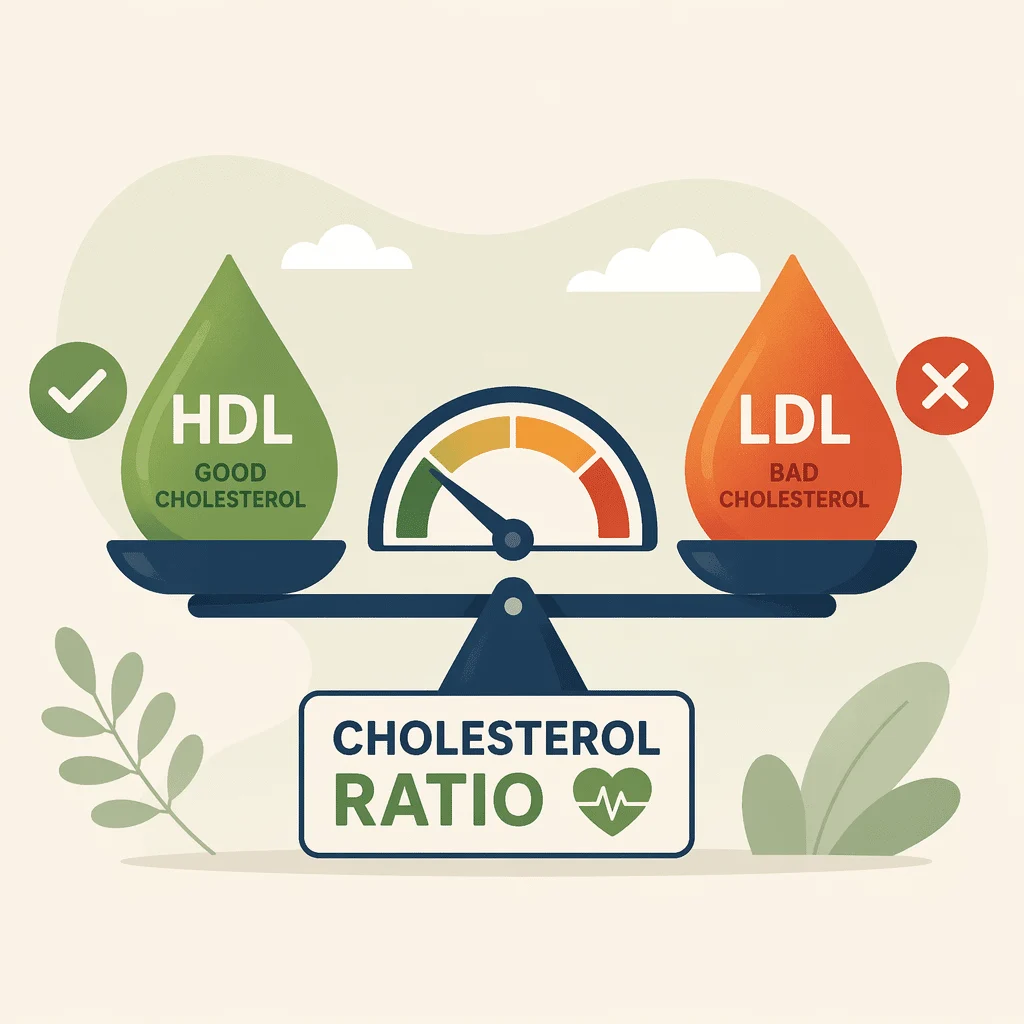
Dit kolesterolforhold er ét tal på din laboratorieprøve divideret med et andet, og det er sandsynligvis den mindst nyttige oplysning på siden. Det er en forkortelse, og moderne kolesterolvejledning er i vid udstrækning gået videre fra det: behandlingsbeslutninger i USA bygger på absolutte kolesteroltal og en estimeret kardiovaskulær risiko – ikke på et forhold.
I denne artikel lærer du, hvilke tre forhold du kan støde på, og hvad hvert af dem dividerer med hvad, hvorfor et beroligende forhold kan skjule et højt LDL, hvad amerikanske retningslinjer bruger i stedet, hvordan du beregner dit ikke-HDL-kolesterol ud fra din egen prøve, hvad apolipoprotein B og lipoprotein(a) tilføjer, hvorfor et højt HDL ikke er den sikkerhedsmargin, det ser ud til at være, og hvilke resultater der kræver akut behandling.
Hvad et kolesterolforhold er, og de tre du kan se
En lipidprofil måler totalkolesterol, HDL, LDL og triglycerider. Et forhold tager to af disse tal og dividerer det ene med det andet. Der måles intet nyt; regnestykket komprimerer to oplysninger til én. Tre versioner cirkulerer, og laboratorier rapporterer dem inkonsekvent.
Totalkolesterol i forhold til HDL
Dette er totalkolesterol divideret med HDL-kolesterol. Hvis dit totalkolesterol er 200 mg/dL, og dit HDL er 50 mg/dL, er forholdet 4,0. Det er den version, der oftest udskrives på amerikanske prøvesvar, nogle gange betegnet CHOL/HDL.
LDL i forhold til HDL
Dette er LDL-kolesterol divideret med HDL-kolesterol. Det udelader det kolesterol, der transporteres i triglyceridrige partikler, og beskriver derfor et smallere udsnit af billedet end total-til-HDL-versionen.
Triglycerid i forhold til HDL
Dette dividerer triglycerider med HDL-kolesterol. Det bruges mindre som et kolesterolmål end som et groft signal om insulinresistens, og det er det forhold, der er mest påvirket af, hvad du spiste i går, fordi triglyceridniveauer og deres normalværdier ændrer sig hurtigt med måltider og alkohol.
I alle tilfælde er meningen med et lavere forhold, at en mindre andel af dit kolesterol befinder sig i partikler, der aflejres i arteriernes vægge, i forhold til dem, der transporterer det væk. Et højere forhold signalerer det modsatte. Det er hele idéen – og det er her, problemerne begynder.
Hvorfor et godt kolesterolforhold kan skjule et højt LDL
Et forhold er en brøk, og HDL befinder sig i nævneren. Alt, der hæver HDL, trækker derfor forholdet ned og får det til at se bedre ud – selv når det kolesterol, der faktisk driver arteriel plak, slet ikke har ændret sig.
Forestil dig to personer, der er testet på det samme laboratorium samme morgen. Den første har et total-kolesterol på 240 mg/dL, et HDL på 80 mg/dL og et LDL på 145 mg/dL: total divideret med HDL giver 3,0, hvilket de fleste tabeller betegner som beroligende. Den anden har et total-kolesterol på 190 mg/dL, et HDL på 40 mg/dL og et LDL på 130 mg/dL: total divideret med HDL giver 4,75, hvilket de samme tabeller markerer som bekymrende.
Den første person har det højeste LDL, 145 mod 130. Den første person har også det højeste non-HDL-kolesterol, 160 mod 150. På de to tal, der afspejler de partikler, som opbygger plak, bærer personen med det fordelagtige forhold faktisk mere – ikke mindre. Det høje HDL sminker simpelthen brøken.
Det er vigtigt, fordi forholdet ikke er det, nogen behandler ud fra. Beslutninger hviler på den absolutte LDL-værdi og din samlede estimerede risiko; hvad der regnes som et sundt LDL-resultat gennemgås i vores guide til normale LDL-niveauer og sunde referenceværdier. Pointen her er mere snæver: et forhold kan bevæge sig i den beroligende retning, uden at noget, der reelt betyder noget, er blevet bedre.
Hvad retningslinjerne faktisk bruger til at træffe beslutninger
I mange år var amerikansk kolesterolbehandling baseret på AHA/ACC's multisociety-retningslinje for blodkolesterol fra 2018, som kombinerede en absolut LDL-kolesterolværdi med en 10-årig risikovurdering fra Pooled Cohort Equations, offentliggjort i 2013.
I slutningen af 2023 offentliggjorde American Heart Association PREVENT-ligningerne, en forkortelse for Predicting Risk of cardiovascular disease EVENTs. De er kønsspecifikke, racefrie, gælder for aldersgruppen 30 til 79 år og estimerer 10-årig og 30-årig risiko for samlet hjerte-kar-sygdom – det vil sige aterosklerotiske hændelser plus hjertesvigt. Afgørende er det, at nyrefunktion – målt som estimeret glomerulær filtrationshastighed – nu indgår sammen med alder, blodtryk, rygning, diabetes og kolesterol. Hvis du har undret dig over, hvorfor en kardiolog interesserer sig for dine BUN- og kreatininværdier, er det derfor.
I marts 2026 offentliggjorde ACC, AHA og ni partnerselskaber en retningslinje for behandling af dyslipidæmi, der formelt erstatter og afløser 2018-retningslinjen for blodkolesterol. Risikovurdering foretages nu med PREVENT-ASCVD-scoren, som giver 10-årig risiko og – for voksne i alderen 30 til 59 år – 30-årig risiko; Pooled Cohort Equations er ikke længere referenceværktøjet. Retningslinjen anbefaler desuden måling af lipoprotein(a) mindst én gang i løbet af livet, støtter selektiv apolipoprotein B-testning og genindføjer behandlingsmål udtrykt som LDL-kolesterol, non-HDL-kolesterol og apolipoprotein B i udvalgte tilfælde.
Bemærk, hvad der mangler. Intet forhold optræder noget sted i den ramme. HDL indgår som sit eget tal, side om side med det samlede kolesterol, ikke som en nævner. Dit glukoseniveau, blodtryk, rygestatus og nyrefunktion vejer alle tungt på en måde, intet forhold kan udtrykke.
Hvad der i høj grad har erstattet forholdstallene: non-HDL, apoB og Lp(a)
Hvis forholdet er et groft redskab, har tre bedre tal taget dets plads. To er måske allerede med i dit lipidpanel; ét kan du selv beregne.
Non-HDL-kolesterol – det tal, du selv kan udregne
Non-HDL-kolesterol er det samlede kolesterol minus HDL-kolesterol. Det er hele formlen, og National Heart, Lung, and Blood Institute nævner det som et af de nyttige ekstratal, et lipoproteinpanel giver.
Det, der gør det bedre end et forholdtal, er, hvad det fanger. Når man trækker HDL fra, er det kolesterolet i alle de partikler, der kan sætte sig i en arterievæg, der er tilbage: LDL, men også very-low-density- og intermediate-density-lipoprotein, restpartikler og lipoprotein(a). Det er en sum, ikke en brøk, så et højt HDL kan ikke skjule det, og det kræver ikke faste.
NHLBI beskriver en sund lipidprofil som havende non-HDL-kolesterol under 130 mg/dL, med HDL på mindst 40 mg/dL hos mænd og 50 mg/dL hos kvinder. Dit eget mål afhænger af din samlede risiko og fastsættes sammen med din læge – det kan ikke aflæses fra en tabel.
Apolipoprotein B – partikelantallet
Hver aterogen partikel bærer præcis ét apolipoprotein B-molekyle på sin overflade. At måle apolipoprotein B tæller derfor partikler frem for at veje kolesterolet inde i dem.
Det har betydning, fordi partikler varierer i, hvor meget kolesterol de indeholder. En person kan have en beskeden LDL-værdi fordelt på et stort antal små, kolesterolfattige partikler: LDL-tallet ser acceptabelt ud, men partikelantallet gør det ikke. Denne uoverensstemmelse kaldes diskordans, og den er hyppigere, når triglycerider er forhøjede eller ved metabolisk syndrom – præcis der, hvor LDL-kolesterol undervurderer risikoen.
Lipoprotein(a) – det du arver
Lipoprotein(a) er en LDL-lignende partikel med et ekstra protein tilknyttet. Dit niveau bestemmes næsten udelukkende af de gener, du arver. NHLBI bemærker, at det næppe ændrer sig meget fra barndom til alderdom, og det er grunden til, at kost, motion og vægttab ikke meningsfuldt påvirker det.
Da niveauet er stabilt hele livet, afklarer én enkelt måling som regel spørgsmålet – det er logikken bag 2026-anbefalingen om at måle lipoprotein(a) én gang i voksenlivet. NHLBI bemærker, at en læge kan bestille den, hvis du har en familiehistorie med slagtilfælde eller tidlig hjertesygdom, eller ikke kender din familiehistorie.
Hvorfor HDL ikke blot er det gode kolesterol
The good cholesterol label is the most persistent piece of outdated lipid folklore, and it is exactly what a flattering ratio reinforces.
The relationship between HDL and outcomes is not a straight line. It is U-shaped. Low HDL is associated with worse outcomes, as expected. But very high HDL is also associated with higher all-cause and cardiovascular mortality, not lower. The association turns unfavourable at the top of the range as well as at the bottom.
Two further lines of evidence point the same way. Drugs designed to raise HDL, including niacin preparations and cholesteryl ester transfer protein inhibitors, largely failed to reduce cardiovascular events despite raising the number. And Mendelian randomization studies, which test whether genetically higher HDL translates into fewer events, have not supported a causal protective effect.
None of this means HDL is meaningless. It means the reasoning “my HDL is high, so I am fine” does not hold, and a good-looking ratio is one of the main things that encourages it.
How to read your own lipid report sensibly
Before reading anything into a single panel, three practical points are worth knowing.
Fasting is no longer a routine requirement. A non-fasting sample is acceptable for most screening, and non-HDL cholesterol can be measured either fasting or not. Some clinics still ask for an 8 to 12 hour fast, and a fasting sample is preferred when triglycerides are high, so ask what applies to you.
Results also vary between draws. Biological variation, recent illness, weight change, alcohol and the time of day all move lipid values, so a single abnormal panel is usually repeated before any decision is made.
Finally, lipids do not exist in isolation. Untreated hypothyroidism raises LDL, which is why a TSH test often accompanies a lipid panel, along with liver function tests. Chronic inflammation, tracked with high CRP levels, clusters with metabolic problems, as do gout and, in some men, raised testosterone. The table below translates the patterns people actually see.
| What your report shows | What it actually means | What to ask your doctor |
|---|---|---|
| A good-looking ratio, but LDL is high | A generous HDL in the denominator is flattering the fraction. The particle load that builds plaque has not changed. | What are my LDL and non-HDL in absolute numbers, and what does my estimated risk look like? |
| A poor ratio driven mainly by high triglycerides | Triglycerides push total cholesterol up and often travel with a low HDL, so the ratio worsens for reasons that are not only about LDL. | Are my triglycerides driving this, and should the sample be repeated fasting? |
| A good ratio with a very high HDL | Very high HDL is not a bonus. The association with mortality is U-shaped, and the top of the range is not protective. | Does my high HDL change anything about how you read the rest of my panel? |
| Normal LDL with high apoB or high triglycerides | Classic discordance. The number of atherogenic particles can be higher than the cholesterol value suggests. | Would measuring apolipoprotein B add anything useful in my case? |
| A high lipoprotein(a) | Largely inherited and stable across life. It is not modified by diet, exercise or weight change. | Does this change my overall risk assessment, and should my relatives be screened? |
Supplements, red yeast rice and what the evidence shows
Red yeast rice deserves a sober, factual description rather than a recommendation either way.
It is produced by fermenting a mould, usually Monascus purpureus, on rice. Depending on the strain and fermentation conditions, it can contain substances called monacolins. One of them, monacolin K, is structurally identical to the prescription statin lovastatin. A red yeast rice capsule containing meaningful monacolin K is, chemically, a statin.
The problem is that nobody knows the dose. The National Center for Complementary and Integrative Health reports a 2017 analysis of 28 red yeast rice brands from mainstream US retailers: none listed the monacolin K content on the label, two contained none at all, and among the 26 that did the amount varied more than 60-fold, from 0.09 to 5.48 mg per 1,200 mg of product. NCCIH adds that products with significant monacolin K carry the same muscle, kidney and liver effects and drug interactions as statin medicines, and that some are contaminated with citrinin, a kidney toxin. The FDA holds that red yeast rice with enhanced or added lovastatin cannot legally be marketed as a dietary supplement.
Put plainly: it is a statin at an unknown dose, without prescription or monitoring. That is a description, not advice.
Other supplement claims deserve the same sobriety. Plant sterols and stanols and soluble fibre have modest, measurable effects on cholesterol. Omega-3 preparations act mainly on triglycerides, and the evidence differs sharply between prescription formulations and over-the-counter fish oil. Our overview of cholesterol supplements, benefits and risks goes through the individual claims. Tell whoever prescribes for you about any supplement you take, because the interactions are real.
When to get checked, and when to seek urgent care
High cholesterol produces no symptoms, so the only way to know your numbers is to have them measured. The CDC advises most healthy adults to check every four to six years, more often with heart disease, diabetes or a family history.
Some situations are not routine. If a lipid result arrives alongside symptoms, the symptoms come first: cardiac markers such as troponin are what a hospital measures when the concern is an event happening now, not a risk over the next decade.
Seek emergency or urgent care, not a repeat blood test, if any of the following applies.
- Chest pain or pressure, especially with breathlessness, sweating, nausea, or pain spreading to the jaw or arm. Call 911.
- Sudden weakness on one side, facial droop, or difficulty speaking or understanding speech. Call 911.
- Cramping calf pain that comes on when you walk and eases when you rest. Arrange prompt medical assessment.
- A very high triglyceride result together with abdominal pain, because of the risk of pancreatitis. Seek urgent care.
Separately, a family history of heart attack or stroke at an unusually young age, or thickened tendons at the Achilles or over the knuckles (tendon xanthomas), can point to familial hypercholesterolemia, an inherited condition. Both warrant assessment, and relatives may need screening.
Latest scientific advances in cholesterol testing
Five findings from the past three years stand out.
A new US guideline replaced the old framework. In March 2026 the ACC, the AHA and nine partner societies published a Guideline on the Management of Dyslipidemia retiring the 2018 blood cholesterol guideline. Risk is now estimated with the PREVENT-ASCVD score rather than the Pooled Cohort Equations, lipoprotein(a) is recommended at least once in a lifetime, and apolipoprotein B testing is endorsed selectively. What this means for you: the framework your clinician works from contains absolute values and a risk score, and no cholesterol ratio anywhere in it.
Two people with identical LDL numbers are not carrying identical risk. A UK Biobank analysis of nearly 294,000 adults without cardiovascular disease, followed for a median of eleven years, found that at any given LDL, non-HDL or triglyceride value, apolipoprotein B varied widely between individuals, and those with more of it had more cardiovascular events. None of the three, the authors concluded, is an adequate substitute for apolipoprotein B. What this means for you: your LDL number describes cholesterol weight, not how many particles carry it.
A systematic review settled the comparison. Across fifteen discordance studies covering more than 590,000 treated and untreated participants, apolipoprotein B was a more accurate marker of atherosclerotic risk than LDL cholesterol in every direct comparison, and more accurate than non-HDL cholesterol in most. What this means for you: if a clinician suggests apolipoprotein B, that is real added information, not an extra test for its own sake.
Very high HDL is not a bonus. An analysis of nearly 430,000 UK Biobank participants, followed for a median of almost fourteen years, set HDL cholesterol against the ten leading causes of death. The associations were U-shaped for several, including ischaemic heart disease, diabetes and kidney disease, and extremely high HDL was linked to a higher risk of death from several causes. How HDL functions, the authors argued, matters more than how much of it there is. What this means for you: a high HDL is not a safety margin, and a ratio that looks good because of it is not reassurance.
Lipoprotein(a) still adds something when the risk score looks fine. A study combining the Multi-Ethnic Study of Atherosclerosis and the UK Biobank, more than 314,000 people, found the PREVENT equations performed well overall, including in those with raised lipoprotein(a). But raised lipoprotein(a) remained independently associated with higher event rates and modestly improved prediction, particularly at the lower and borderline end of calculated risk. What this means for you: a reassuring risk estimate does not rule out an inherited risk a one-off test can identify.
Ofte stillede spørgsmål
What is a good cholesterol ratio?
There is no ratio value that determines your care, which is why this question has no satisfying answer. Figures such as “below 4” or “below 3.5” circulate widely on charts, but they are not treatment thresholds in current US guidance, and the 2026 dyslipidemia guideline does not use a ratio at all. The direction is also easy to misread: because HDL sits underneath, a high HDL improves the ratio without changing the particle load that builds plaque. If you want one number to watch, watch your non-HDL cholesterol, and discuss your absolute LDL and your estimated risk with your clinician.
Is a high HDL always good?
No. The relationship between HDL and outcomes is U-shaped, not linear. Low HDL is associated with worse outcomes, but so is very high HDL, which has been linked in large cohorts to higher all-cause and cardiovascular mortality. Medicines that successfully raised HDL largely failed to reduce cardiovascular events, and genetic studies have not supported a causal protective effect. HDL is a useful marker, but it is not a shield, and “my HDL is high, so I am fine” is not sound reasoning.
Do I need to fast for a cholesterol test?
Usually not. A non-fasting sample is acceptable for routine screening, and non-HDL cholesterol can be measured whether you have eaten or not. Some clinics still ask for an 8 to 12 hour fast, and a fasting sample is generally preferred when triglycerides are high or when a calculated LDL value needs to be as accurate as possible. The practical answer is to ask your clinic what they want before you go, because turning up in the wrong state usually means going back.
How do I work out my non-HDL cholesterol?
Take your total cholesterol and subtract your HDL cholesterol. Both are on the panel, both are in the same units, and the result is your non-HDL cholesterol. If total cholesterol is 210 mg/dL and HDL is 55 mg/dL, non-HDL is 155 mg/dL. That single subtraction captures the cholesterol in every particle capable of lodging in an artery wall, including remnants and lipoprotein(a), which is more than either LDL alone or any ratio tells you.
My ratio changed between two tests. Does that mean something?
Often not much. Lipid values vary between draws for ordinary reasons: recent illness, alcohol, a change in weight, the time of day, even how long you were seated before the draw. Because a ratio combines two variable numbers, it swings more than either one alone, which makes it look more dramatic than it is. A single change is rarely acted on. Clinicians usually repeat a panel before drawing conclusions, and they look at the absolute values rather than the ratio.
Should I ask for an apoB or lipoprotein(a) test?
They are reasonable things to raise, and the 2026 US guideline supports lipoprotein(a) measurement at least once in adulthood and selective apolipoprotein B testing. Apolipoprotein B is most informative when triglycerides are raised, in metabolic syndrome, or when an LDL result looks acceptable but something in the picture does not fit. Lipoprotein(a) is worth knowing once because it is inherited and stable. Whether either changes anything in your case is a conversation for your clinician, not a decision to make from a chart.
Glossary of key terms
| Term | Definition |
|---|---|
| Cholesterol ratio | One lipid value divided by another, most often total cholesterol divided by HDL cholesterol. A summary, not a measurement. |
| Atherogenic | Capable of contributing to plaque formation in artery walls. Used to describe LDL and other particles that carry apolipoprotein B. |
| Non-HDL cholesterol | Total cholesterol minus HDL cholesterol. Captures the cholesterol in every atherogenic particle and needs no fasting. |
| Apolipoprotein B (apoB) | A protein carried once by each atherogenic particle, so measuring it counts particles rather than weighing their cholesterol. |
| Lipoprotein(a) | An LDL-like particle whose level is largely inherited and stable through life, and which lifestyle changes do not meaningfully alter. |
| Discordance | A mismatch between two lipid markers, such as an acceptable LDL cholesterol alongside a high apolipoprotein B. |
| PREVENT equations | American Heart Association risk equations released in 2023 that estimate 10-year and 30-year cardiovascular risk and include kidney function. |
| Pooled Cohort Equations | The 2013 risk equations used by the 2018 US cholesterol guideline, now superseded by PREVENT in the 2026 dyslipidemia guideline. |
| Monacolin K | A compound found in some red yeast rice products that is structurally identical to the prescription statin lovastatin. |
| Familial hypercholesterolemia | An inherited condition causing very high cholesterol from birth, sometimes signalled by early heart disease in the family or tendon xanthomas. |
Kilder
- National Heart, Lung, and Blood Institute. Blood Cholesterol: Diagnosis
- Centers for Disease Control and Prevention. Testing for Cholesterol
- National Center for Complementary and Integrative Health. Red Yeast Rice: What You Need To Know
- American Heart Association. The AHA PREVENT Online Calculator
- Blumenthal RS, Morris PB, et al. 2026 ACC/AHA/AACVPR/ABC/ACPM/ADA/AGS/APhA/ASPC/NLA/PCNA Guideline on the Management of Dyslipidemia. Circulation. 2026
- Abramov D, Minhas AMK, Shapiro MD, et al. Primary Prevention of Dyslipidemia: 10 Practice-Changing Takeaways from the 2026 ACC/AHA Multisociety Guideline. Current Atherosclerosis Reports. 2026
- Khan SS, Matsushita K, Sang Y, et al. Development and Validation of the American Heart Association’s PREVENT Equations. Circulation. 2024
- Sniderman AD, Dufresne L, Pencina KM, et al. Discordance among apoB, non-high-density lipoprotein cholesterol, and triglycerides: implications for cardiovascular prevention. European Heart Journal. 2024
- Sehayek D, Cole J, Bjornson E, et al. ApoB, LDL-C, and non-HDL-C as markers of cardiovascular risk. Journal of Clinical Lipidology. 2025
- Soffer DE, Marston NA, Maki KC, et al. Role of apolipoprotein B in the clinical management of cardiovascular risk in adults: an Expert Clinical Consensus from the National Lipid Association. Journal of Clinical Lipidology. 2024
- Shi S, Lin Z, Song Y, et al. Association of High-Density Lipoprotein Cholesterol with the Top 10 Causes of Death. European Journal of Preventive Cardiology. 2025
- Bhatia HS, Ambrosio M, Razavi AC, et al. AHA PREVENT Equations and Lipoprotein(a) for Cardiovascular Disease Risk: Insights From MESA and the UK Biobank. JAMA Cardiology. 2025
- Razavi AC, Mehta A, Jain V, et al. High-Density Lipoprotein Cholesterol in Atherosclerotic Cardiovascular Disease Risk Assessment: Exploring and Explaining the U-Shaped Curve. Current Cardiology Reports. 2023
- Endo Y, Fujita M, Ikewaki K. HDL Functions: Current Status and Future Perspectives. Biomolecules. 2023
Further reading
- Total cholesterol test: a complete guide to understanding results
- HDL cholesterol test and what good cholesterol really means
- Understanding low HDL cholesterol, causes and risks
- Advanced lipid panel, apoB and heart risk
- High cholesterol: understand it, prevent it, act on it
Forstå dine laboratoriesvar med AI DiagMe
A lipid report lists total cholesterol, LDL, HDL, triglycerides and often non-HDL cholesterol, in units and abbreviations that rarely explain themselves. AI DiagMe turns those lines into plain language so you can see what was measured and arrive at your appointment with better questions. It does not diagnose, it does not assess your cardiovascular risk, and it does not replace your doctor.
Get your results interpreted in minutes