Low BUN levels — a blood urea nitrogen result below your laboratory’s reference range — are among the more reassuring “abnormal” findings you can see on a blood test. In most people, a low BUN reflects something ordinary: a lower-protein diet, drinking plenty of fluids, or the normal physiology of pregnancy. Only occasionally does it point to something that needs attention, such as advanced liver disease or malnutrition.
This guide explains what a low blood urea nitrogen result actually means, the most common causes, when it matters, and how clinicians interpret it alongside your other markers. It reflects current laboratory medicine and recent research and is reviewed by our medical team. It is educational information — not a substitute for advice from the clinician who knows your history.
What Is BUN, and What Counts as “Low”?
Blood urea nitrogen measures the nitrogen in your blood that comes from urea, a waste product your liver makes when it breaks down protein. Urea travels through the bloodstream to the kidneys, which filter most of it into urine. A BUN test therefore captures several processes at once: how much protein you eat and break down, how well your liver produces urea, how effectively your kidneys clear it, and how diluted or concentrated your blood is.
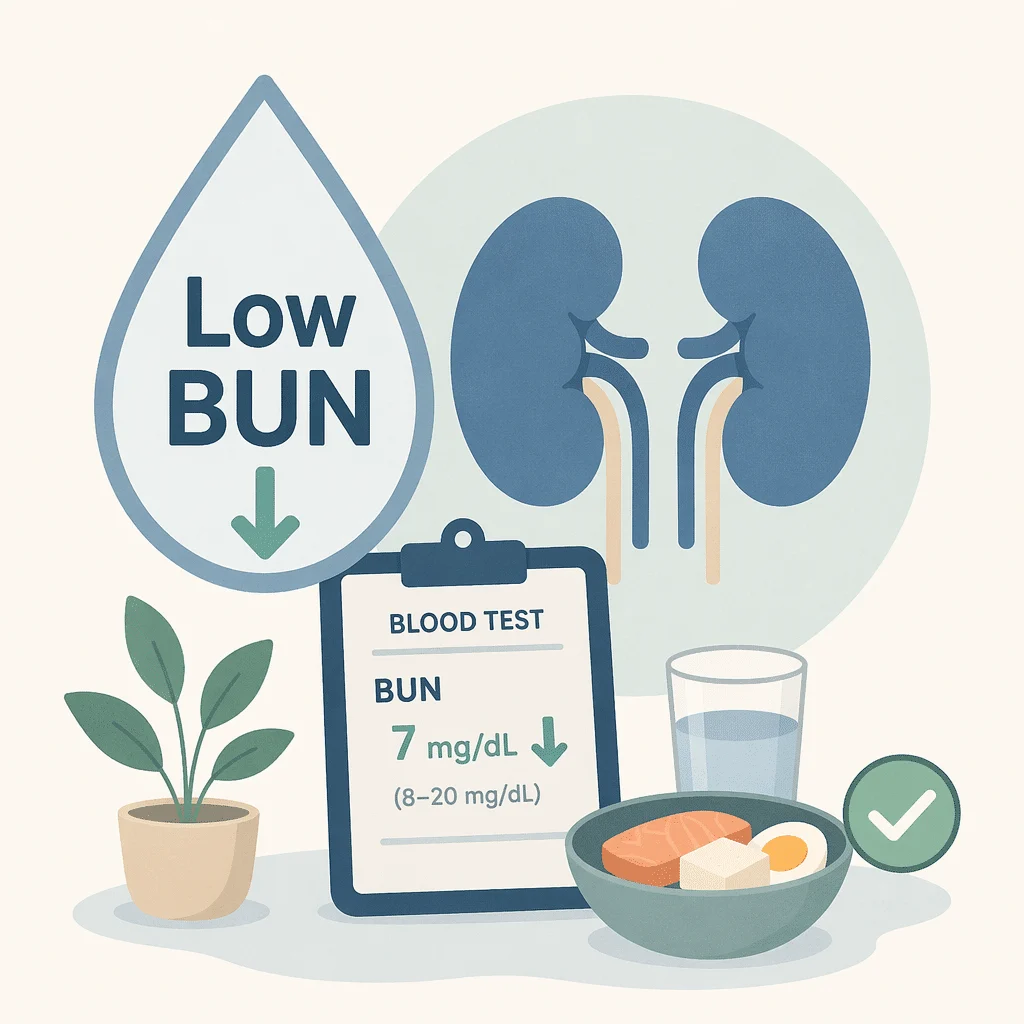
Reference ranges differ slightly between labs, but a typical adult range is about 7–20 mg/dL (2.5–7.1 mmol/L). Results below roughly 6–8 mg/dL are usually flagged as low. Because “normal” depends on the testing method and the population, always compare your number against the range printed on your own report rather than a generic figure.
| BUN status | Approx. value (mg/dL) | Approx. value (mmol/L) |
|---|---|---|
| Low | Below ~6–8 | Below ~2.1–2.9 |
| Typical adult range | 7–20 | 2.5–7.1 |
| Elevated | Above 20 | Above 7.1 |
Outside the United States, laboratories often report “urea” rather than “BUN.” It is the same molecule measured a little differently: BUN in mg/dL is roughly urea in mmol/L multiplied by 2.8. If your report lists urea, the low-versus-normal logic below still applies.
What a Low BUN Level Means for Your Body
Because BUN sits at the crossroads of diet, the liver, the kidneys, and hydration, a low value is best read as a clue rather than a diagnosis on its own. A genuinely low BUN usually means your body is generating less urea — less dietary protein, less protein breakdown, or a liver producing less urea — or that the urea you do make is being diluted by extra body water. This is the key contrast with a high BUN: whereas elevated values often raise questions about the kidneys or dehydration, a low BUN is almost never caused by the kidneys themselves.
Common Causes of Low BUN Levels
Most low readings trace back to one of a handful of everyday explanations. Your clinician will weigh these against your diet, medications, fluid status, and the rest of your blood work.
Low protein intake or malnutrition
This is the single most common reason for a low BUN. If you eat relatively little protein — through a very low-protein or plant-forward diet, appetite loss, an eating disorder, or the reduced intake that often accompanies aging or serious illness — your liver has less protein to convert into urea. Because poor protein status shows up in more than one marker, clinicians frequently look for a low albumin result alongside a low BUN as corroborating evidence of undernutrition.
Overhydration and fluid overload
Urea is dissolved in your blood, so anything that adds water dilutes it. Drinking very large volumes of fluid, receiving intravenous fluids in the hospital, or conditions that make the body retain water — such as the syndrome of inappropriate antidiuretic hormone secretion (SIADH) — can all push BUN down. In these cases the low number reflects dilution, not a lack of urea production.
Liver disease
The liver is the body’s urea factory. In advanced liver disease or cirrhosis, the damaged liver manufactures less urea, so BUN can fall even as other waste products, such as ammonia, build up. A low BUN combined with abnormal liver function tests is a clinically meaningful pairing that warrants a closer look at liver health.
Pregnancy
Normal pregnancy expands blood volume and increases the rate at which the kidneys filter blood. Both effects lower BUN — and creatinine — so a below-range result is expected and usually reassuring during pregnancy rather than a sign of trouble.
Anabolic and growth states
When the body is actively building tissue rather than breaking it down — during childhood growth, recovery from illness, or with certain hormone therapies — nitrogen is channeled into making new protein instead of being excreted as urea. The net effect can be a modestly lower BUN.
Low muscle mass
People with less muscle tend to generate less urea and less creatinine, so both can read low. This pattern is common in frailty and in age-related muscle loss, which is one reason a low BUN in an older adult prompts a look at overall nutrition and physical function rather than reassurance alone.
Less common causes
Some medications and, rarely, inherited urea cycle disorders can produce low urea. Urea cycle disorders typically appear in newborns or infants and combine a low BUN with a high ammonia level and neurological symptoms — a medical emergency that looks quite different from the mild, incidental low BUN seen in healthy adults.
Signs and Symptoms of Low BUN
A low BUN by itself produces no symptoms — there is no set of complaints that “low urea” causes. Any symptoms you notice come from the underlying cause. Inadequate protein or malnutrition may bring fatigue, muscle wasting, poor wound healing, or hair thinning; liver disease may cause jaundice, swelling, or easy bruising; overhydration from SIADH can cause nausea, headache, or confusion because of the accompanying low sodium. This is why clinicians treat a low BUN as a prompt to ask why, not as a condition to treat in isolation.
How Doctors Diagnose and Interpret Low BUN
A single BUN value rarely stands alone. It almost always arrives as part of a basic or comprehensive metabolic panel, and it is interpreted together with the rest of your kidney function panel — creatinine, estimated glomerular filtration rate (eGFR), and electrolytes. To make sense of a low result, a clinician will typically confirm it is not a one-off, review your diet, medications, and fluid intake, and compare it with related markers: albumin and total protein for nutrition, liver enzymes for hepatic function, and sodium for dilution. The pattern across these tests usually points to the cause far more clearly than the BUN number by itself.
The BUN-to-Creatinine Ratio: Why Context Matters
Clinicians often divide BUN by creatinine to sharpen the picture. A normal ratio runs roughly 10:1 to 20:1. A low ratio — where BUN is low relative to creatinine — tends to accompany low protein intake, liver disease, overhydration, or the dilution seen in SIADH; it can also appear when creatinine is disproportionately high, as in muscle injury (rhabdomyolysis). A high ratio more often reflects dehydration or gastrointestinal bleeding. Reading BUN and creatinine as a pair helps separate a harmless low BUN from one that deserves follow-up.
Low BUN in Pregnancy and Childhood
Context is everything in these groups. As noted above, pregnancy naturally lowers BUN through increased blood volume and kidney filtration, so a below-range value is part of normal physiology. Children also tend to have somewhat lower reference ranges than adults, and healthy, fast-growing children commonly sit at the lower end. In both cases, an isolated low BUN with no other abnormal findings is usually nothing to worry about — but it should still be read against age-appropriate ranges and the child’s growth and nutrition.
When a Low BUN Signals a Problem
Most low BUN results are benign. The value becomes more meaningful when it travels with other findings. Warning combinations worth prompt medical review include a low BUN with signs of liver disease (jaundice, abdominal swelling, confusion), a low BUN with a low albumin and unintended weight loss (suggesting malnutrition), or a low BUN with a low sodium and new confusion or headache (suggesting water overload). In these situations it is the underlying condition — not the BUN itself — that needs treatment.
How to Raise Low BUN Levels (When It’s Needed)
There is no reason to “chase the number” if you feel well and the rest of your panel is normal — a low BUN is not a disease to be corrected. When a low value does reflect a real problem, the fix is to treat the cause. That usually means ensuring adequate, good-quality protein intake if diet is the issue, correcting fluid balance if overhydration is to blame, and managing liver disease or another underlying condition with your medical team. For most people, a balanced diet with enough protein and sensible hydration keeps BUN comfortably within range without any special effort.
Latest Scientific Advances
Research on BUN has shifted over the past three years, and the newer thinking helps explain why a low value is treated as a clue rather than a clean bill of health. Historically, most studies focused on elevated BUN as a warning sign. A 2023 systematic review and meta-analysis in Frontiers in Cardiovascular Medicine confirmed that higher BUN independently predicts worse outcomes in heart failure, reinforcing that BUN carries information well beyond simple kidney filtration (DOI: 10.3389/fcvm.2023.1189884).
More recent work reframes BUN as an integrated marker of nutrition, kidney function, inflammation, and fluid balance all at once. Studies of the BUN-to-albumin ratio — including a 2024 meta-analysis in BMC Cardiovascular Disorders (DOI: 10.1186/s12872-024-04244-9) — treat urea and protein status together precisely because the two are biologically linked, which is the same reason a low BUN and a low albumin so often appear side by side in undernutrition. A 2025 umbrella review in Nutrition Reviews underscored how strongly dietary protein patterns drive urea generation and kidney health (DOI: 10.1093/nutrit/nuaf208), and mechanistic work published in 2025 in Sub-cellular Biochemistry described how the body actively conserves urea and recycles nitrogen when protein supply is low (DOI: 10.1007/978-981-96-6898-4_10) — the physiology that sits behind a diet-related low BUN.
Perhaps most importantly for interpretation, large database analyses now model BUN and mortality as a nonlinear relationship rather than a simple “higher is worse” line. A 2024 analysis of the U.S. NHANES cohort (1999–2018) used restricted cubic spline modeling to map the BUN–mortality curve across the population rather than assuming a straight line (DOI: 10.1186/s12944-024-02158-1). Related 2025 work in Renal Failure tied everyday factors such as prolonged sitting to higher mortality partly through kidney markers including BUN, reinforcing that urea behaves as an integrated signal of overall health rather than a stand-alone kidney test (DOI: 10.1080/0886022X.2025.2486568). The practical message is consistent with everything above: a lower BUN is not automatically “better,” and the healthiest interpretation weighs the value against your protein intake, liver function, muscle mass, and hydration. As always, statistical associations across large groups describe populations, not individuals — your own result is best interpreted by your clinician.
Frequently Asked Questions
What causes low BUN levels?
The most common causes are a lower-protein diet or malnutrition, overhydration, and pregnancy. Less often, low BUN reflects advanced liver disease, low muscle mass, or certain medications. It is very rarely caused by the kidneys themselves.
Is a low BUN level dangerous?
Usually not. On its own, a low BUN causes no symptoms and is often incidental. It becomes concerning mainly when it appears alongside other abnormal findings — such as a low albumin with weight loss, abnormal liver tests, or a low sodium with confusion.
What is a concerning low BUN level?
There is no universal cutoff. Many labs flag values below about 6–8 mg/dL, but a low number matters far more when paired with other clues than as a stand-alone figure. Read it against your own report’s range and the rest of your panel.
Can low BUN levels occur with normal creatinine?
Yes, and this is common. A low BUN with a normal creatinine typically points toward diet, overhydration, or liver-related causes rather than a kidney problem, because creatinine reflects muscle and kidney function more than protein intake.
How can I raise my BUN naturally?
If a low BUN is diet-related, eating enough good-quality protein and maintaining balanced (not excessive) hydration usually restores it over days to weeks. If liver disease, malnutrition, or another condition is responsible, treating that cause is what matters — not the number itself.
Does low BUN mean liver disease?
Not by itself. The liver makes urea, so severe liver disease can lower BUN — but so can many harmless factors. A low BUN raises the possibility of liver involvement mainly when liver enzymes or other liver markers are also abnormal.
Can autoimmune conditions like lupus cause a low BUN?
Autoimmune diseases do not directly lower BUN, but the reduced appetite, weight loss, or altered fluid balance that can accompany a flare may do so indirectly. As always, the BUN is interpreted in the context of your broader clinical picture.
Key Terms at a Glance
Blood urea nitrogen (BUN): the nitrogen in blood that comes from urea, a protein-breakdown waste product. Urea: the waste molecule the liver makes from ammonia; “urea” and “BUN” describe the same thing in different units. BUN-to-creatinine ratio: BUN divided by creatinine, used to distinguish causes of abnormal results. eGFR: estimated glomerular filtration rate, a measure of kidney filtering capacity. Albumin: the main protein in blood, often low in malnutrition or liver disease. SIADH: a condition of excess water retention that dilutes blood tests, including BUN.
Understand Your Lab Test Results with AI DiagMe
A single marker like BUN rarely tells the whole story — its meaning comes from the pattern across your entire panel. AI DiagMe reads your results in context and explains them in plain language, with medical validation built in, so you know which numbers are reassuring and which deserve a conversation with your clinician.
Scientific references
Evidence in the “Latest scientific advances” section is drawn from peer-reviewed literature indexed in PubMed: “Predictive value of blood urea nitrogen in heart failure: a systematic review and meta-analysis,” Frontiers in Cardiovascular Medicine (2023), DOI 10.3389/fcvm.2023.1189884; “Prognostic value of albumin-based indices for mortality after heart failure: a systematic review and meta-analysis,” BMC Cardiovascular Disorders (2024), DOI 10.1186/s12872-024-04244-9; “Dietary Patterns and Kidney Health: An Umbrella Review of Systematic Reviews and Meta-Analyses,” Nutrition Reviews (2025), DOI 10.1093/nutrit/nuaf208; “Energy-Dependent Urea Transports in Mammals and their Functional Consequences,” Sub-cellular Biochemistry (2025), DOI 10.1007/978-981-96-6898-4_10; “Association of blood urea nitrogen with all-cause and cardiovascular mortality in hyperlipidemia: NHANES 1999–2018,” Lipids in Health and Disease (2024), DOI 10.1186/s12944-024-02158-1; “Prolonged sitting time and all-cause mortality: the mediating and predictive role of kidney function markers,” Renal Failure (2025), DOI 10.1080/0886022X.2025.2486568. This article is for education and does not replace personalized medical advice.