





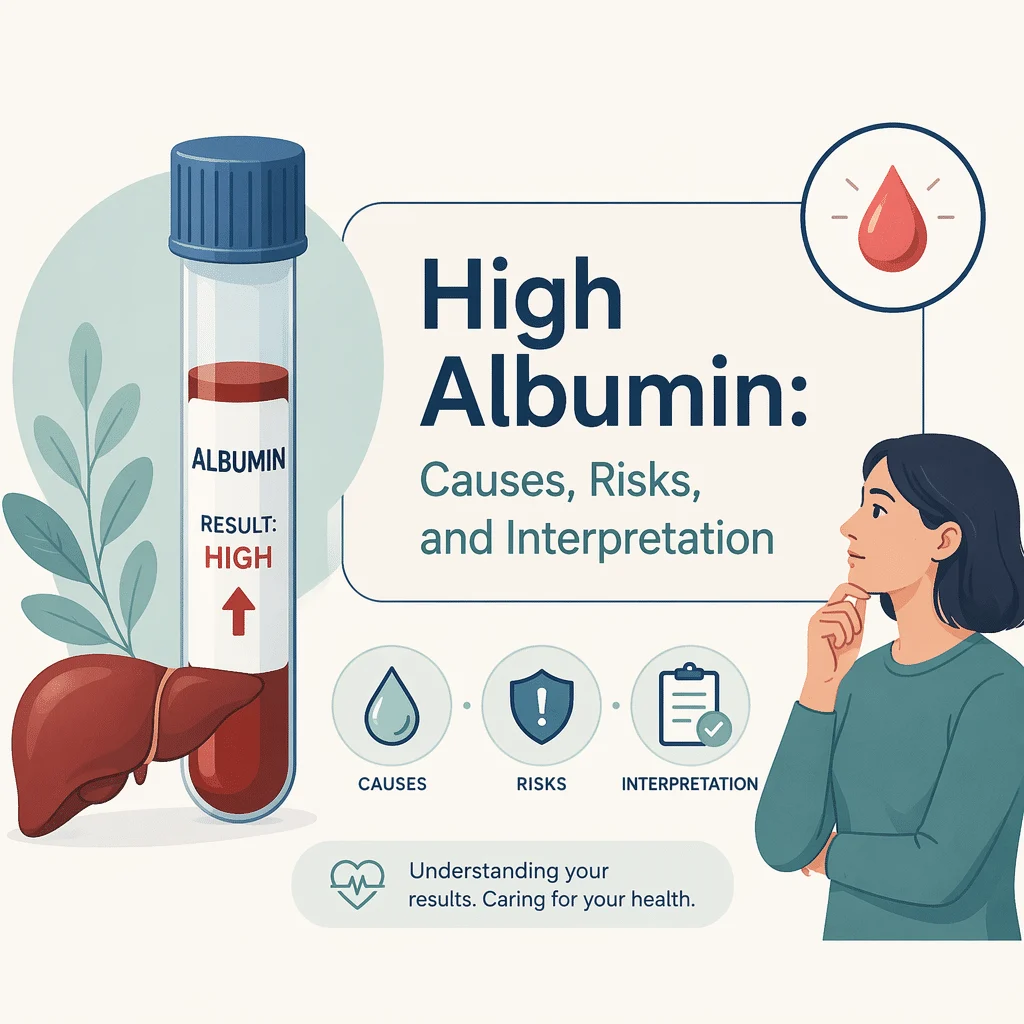
A high albumin result on a blood test is one of the most reassuring “abnormal” findings you can receive, because it is almost never caused by disease. Albumin is the most abundant protein in your blood, and when a laboratory flags it as high, the reading usually reflects concentrated blood from mild dehydration rather than a condition that makes your body produce too much protein. In the vast majority of cases, drinking more fluids and repeating the test resolves the finding. This article explains what a high albumin level means, why dehydration and simple testing quirks are the main causes, how doctors interpret the number alongside the rest of your panel, and the practical steps to take next. You will also learn why a low albumin reading, not a high one, is the direction that carries real clinical weight.
What does a high albumin result mean?
Albumin is a protein your liver makes and releases into your bloodstream, where it becomes the single most plentiful protein in your plasma. It performs two everyday jobs: it holds fluid inside your blood vessels so the right amount of water stays in circulation, and it acts as a shuttle, carrying hormones, vitamins, calcium, and many medications to where they are needed. Because albumin is measured as a concentration, the amount of protein per volume of blood, anything that reduces the water portion of your blood can push that concentration up.
A high albumin result simply means the concentration measured in your sample sits above your laboratory’s upper reference limit. Crucially, this is different from your body suddenly manufacturing extra protein. There is no common disease that switches on albumin overproduction, which is why a high albumin reading rarely points to a serious diagnosis. Most often it is a signal about the water in your blood, not the protein itself. For an authoritative overview of what the result indicates, see the National Library of Medicine’s page on the albumin blood test.
High albumin is a concentration story, not a production story
Think of albumin like sugar dissolved in a glass of water. If some of the water evaporates, each sip tastes sweeter even though the amount of sugar never changed. When you are even mildly dehydrated, the liquid part of your blood shrinks, so the albumin already present becomes more concentrated. The laboratory then reports a higher number. This everyday chemistry, called hemoconcentration, explains most high albumin results and is the reason the finding is usually harmless.
Normal albumin ranges: where does “high” start?
Most laboratories consider an albumin level of roughly 3.5 to 5.5 grams per deciliter (g/dL) to be normal for adults, although the exact cutoffs vary from one lab to another and shift slightly with age. A result is labeled high when it rises above your specific lab’s upper limit, often somewhere around 5.0 to 5.5 g/dL. Because the boundaries differ, the “high” flag on your report is always relative to the range printed next to your result.
Small movements above the top of the range are common and rarely meaningful on their own. If you want to see how the full spectrum is defined, you can consult our detailed guide to normal albumin levels, which walks through the typical figures and how they change across the lifespan. Reading your own number in the context of that range matters far more than the single word “high.”
What causes high albumin?
The list of genuine causes is short, and dehydration sits at the top by a wide margin. Understanding the handful of explanations makes it easier to see why a high albumin level is treated as a prompt to recheck rather than a reason to worry.
Dehydration and concentrated blood
Not drinking enough fluid, heavy sweating, vomiting, diarrhea, or a fever can all reduce your blood’s water content and raise your albumin concentration. This is the single most frequent reason a high albumin result appears, and it is why the finding so often travels with other clues of dehydration, such as a raised hematocrit or a slightly elevated sodium level. Because dehydration is common and easily corrected, it explains most flagged results in otherwise healthy people. The Mayo Clinic’s overview of dehydration lists many of the everyday triggers behind a concentrated sample.
A tight tourniquet and other testing artifacts
Sometimes the number is high because of how the sample was collected rather than anything happening inside your body. Leaving the tourniquet, the elastic band tied around your arm, in place too long during a blood draw can concentrate the plasma at the needle site and nudge the albumin reading upward. Clenching your fist repeatedly or a difficult draw can have a similar effect. These collection quirks are a recognized cause of a spuriously high albumin level, and they resolve completely on a properly performed repeat test.
Infused fluids, medications, and rare exceptions
Occasionally, receiving intravenous albumin during hospital care, certain medications such as anabolic steroids, or the effect of water pills that remove fluid can raise the measured concentration. Unlike the causes of a low reading, there is no everyday disease that drives the liver to overproduce albumin. This is the core reassurance of the topic: a high albumin result is a story about fluid balance and sampling, not about a hidden illness making too much protein.
Does a high albumin level cause symptoms?
Albumin itself does not usually cause symptoms when it is high. When people do feel unwell alongside the result, the symptoms almost always come from the dehydration that concentrated the blood in the first place, not from the protein. Thirst, a dry mouth, darker urine, tiredness, lightheadedness, or a mild headache are the body’s signals that it needs more water. Correcting the fluid deficit typically relieves these feelings and brings the albumin concentration back down.
This distinction matters. A patient searching for high albumin symptoms is usually experiencing dehydration symptoms, and treating the thirst and fluid loss treats the underlying situation, so the blood number follows. If you feel well and simply saw a high flag on a routine panel, there is very often nothing to feel at all.
Reading high albumin within your metabolic and liver panel
Albumin never travels alone on a lab report. It appears inside larger groups of tests, and doctors read it in the company of the values printed around it. Seeing which neighbors are also abnormal is what turns a high albumin result from a puzzle into a clear picture.
Albumin is one of the components of the comprehensive metabolic panel, the common bundle that also checks kidney markers, electrolytes, blood sugar, and liver values. It is also reported as part of liver function tests, because the liver is where albumin is made. When albumin is high from dehydration, the total protein on the panel often rises in parallel, and the balance between albumin and the other proteins can be examined through the albumin-to-globulin ratio.
Doctors also glance at hydration-sensitive neighbors. A raised hematocrit, a climbing sodium level, or changes across the kidney function panel all point toward concentrated blood as the shared explanation. If total protein is high but albumin is normal, attention shifts instead to the other protein fraction, which we cover in our article on high globulin levels. Learning to read these values together is the heart of making sense of your blood test results.
Albumin result at a glance
| Albumin result | What it usually points to | Common next step |
|---|---|---|
| Low (below the lab range) | Liver disease, kidney disease, poor nutrition, inflammation, or a long illness, the direction doctors watch most closely | Further tests to find the underlying cause |
| Normal (about 3.5 to 5.5 g/dL) | Balanced hydration and steady protein production by the liver | No action needed |
| High (above the lab range) | Almost always dehydration or a blood-draw artifact, not a disease that overproduces albumin | Rehydrate and repeat the test |
Why low albumin matters more than high albumin
Here is the point that reframes the entire topic: for albumin, the clinically meaningful direction is down, not up. A high albumin result is usually a temporary reflection of hydration, but a low albumin result can be an early signal of liver disease, kidney disease, poor nutrition, inflammation, or a long-standing illness. Decades of medical research treat albumin as a barometer of general health, and in that research it is a falling number, not a rising one, that draws concern.
That is why your care team may repeat a high reading and move on, yet investigate a low one thoroughly. If your result went the other way, our explainer on low albumin causes and symptoms describes what a downward trend can mean and how it is evaluated. Keeping this asymmetry in mind is the single most useful thing to remember about interpreting an albumin value.
What to do about a high albumin result
For most people, the response to a high albumin level is simple and undramatic. The first step is to restore normal hydration by drinking water steadily over the following day or two, especially if you were fasting for the blood draw, exercised beforehand, or had been unwell. Fasting and early-morning draws commonly leave people mildly dry, which is enough to tip the number upward.
The second step is to repeat the test once you are properly hydrated. A recheck on a well-hydrated morning very often returns a normal result, confirming that dehydration or the draw itself was responsible. If the repeat is also high, your doctor will look at the surrounding values, such as total protein, electrolytes, and kidney markers, to decide whether any further testing is worthwhile. In practice, that next step is rarely needed for an isolated high albumin reading.
When to see a doctor about high albumin
A high albumin level on its own is seldom a reason for alarm, but a few situations do deserve a conversation with a clinician. Contact your doctor if:
- The high albumin result persists on a repeat test taken when you are well hydrated.
- Other values on the panel are abnormal at the same time, such as high total protein, abnormal liver enzymes, or rising kidney markers.
- You have signs of significant dehydration you cannot correct at home, such as persistent vomiting, dizziness, confusion, or passing very little urine.
- You are managing a chronic condition, are pregnant, or take medications that affect fluid balance and want the result interpreted in that context.
- You feel generally unwell, are losing weight without trying, or have symptoms that worry you regardless of the number.
In these cases the goal is not to treat the albumin figure itself but to understand the fuller picture around it. A brief review with your doctor, sometimes with a repeat panel, is usually all it takes to settle the question.
Latest scientific advances on albumin as a health marker
Research specifically on high albumin is limited, for a simple reason: because a high reading rarely signals disease, there is little there to study. Nearly all of the recent science treats albumin as a general marker of health and nutrition, and in that work the meaningful signal is a low value. Here is what the latest studies add, in plain terms.
A 2024 research review that pooled nine earlier studies, and a review simply combines the results of many studies into one bigger picture, found that older adults with low albumin were consistently more likely to face poor health outcomes, while those with normal or high-normal levels tended to do better. What this means for you: a high-normal albumin is generally a reassuring sign, and the number becomes a concern when it drops, not when it rises.
A large 2024 study in the journal JAMA Network Open followed more than 450,000 adults and found that people whose albumin was low relative to another routine blood-count measure carried a higher long-term health risk. That companion measure, red cell distribution width, is a standard number on your blood count that describes how much your red blood cells vary in size. What this means for you: albumin is most informative when it is low, and doctors increasingly read it next to other everyday blood values rather than on its own.
A 2025 hospital study in Annals of Medicine looked at seriously ill patients in intensive care and found that a simple score combining albumin with another marker helped predict who would recover, again because a low albumin flagged a body under strain. What this means for you: this finding applies to critical hospital care, not to a one-off high reading at a routine check-up, but it reinforces the same theme that runs through all of this research. For albumin, the direction that warrants attention is down, and a high result remains a largely reassuring one.
Glossary of key terms
| Term | Definition |
|---|---|
| Albumin | The most abundant protein in blood, made by the liver; it keeps fluid inside blood vessels and carries hormones, vitamins, and medications. |
| Hyperalbuminemia | The medical term for an albumin level above the normal range; it is usually caused by dehydration rather than disease. |
| Hemoconcentration | A rise in the concentration of blood components, including albumin, that happens when the watery part of the blood is reduced, such as during dehydration. |
| Reference range | The span of values a laboratory considers normal for a test; results are labeled high or low relative to this range. |
| Total protein | A measurement of all the proteins in blood, including albumin and globulins; it often rises together with albumin when blood is concentrated. |
| Albumin-to-globulin ratio | A comparison of albumin with the other main blood proteins that helps clarify why total protein is high or low. |
| Comprehensive metabolic panel | A common group of blood tests that includes albumin along with kidney markers, electrolytes, blood sugar, and liver values. |
| Hematocrit | The proportion of blood made up of red blood cells; like albumin, it can read high when blood is concentrated by dehydration. |
Frequently asked questions
Is high albumin dangerous?
In almost all cases, no. A high albumin level is usually a temporary sign of dehydration or a quirk of how the blood was collected, not a marker of disease. Because no common illness makes the body overproduce albumin, an isolated high reading is generally considered harmless. Rehydrating and repeating the test is the standard response, and the result typically returns to normal.
What are the symptoms of high albumin levels?
High albumin itself does not cause symptoms. Any symptoms that appear alongside it, such as thirst, a dry mouth, dark urine, fatigue, or lightheadedness, come from the dehydration that concentrated the blood. Drinking fluids to correct the dehydration usually eases those feelings and lowers the albumin concentration at the same time.
Is 4.9 g/dL a high albumin level?
For most laboratories, 4.9 g/dL sits within the normal adult range of roughly 3.5 to 5.5 g/dL, so it would not usually be flagged as high. Always compare your figure with the reference range printed on your own report, because cutoffs differ slightly between labs and a value near the top of the range is generally not a concern.
Does a high albumin level mean cancer?
A high albumin level is not a recognized warning sign of cancer. If anything, many chronic illnesses, including some cancers, tend to lower albumin rather than raise it. A high reading points toward hydration and sample handling, so it should not be read as a signal of a serious underlying disease on its own.
Can eating a lot of protein raise my albumin?
Not to any meaningful degree. Your liver carefully regulates how much albumin it makes, so a high-protein diet does not push serum albumin above the normal range in the way dehydration does. If your albumin is high, hydration and the way the sample was drawn are far more likely explanations than what you ate.
Is high albumin in the blood the same as albumin in the urine?
No, they are different tests with different meanings. This article covers albumin in the blood. Albumin in the urine, sometimes called albuminuria, is measured separately and can be an early clue about kidney health. If your report mentions albumin in a urine sample rather than blood, it is answering a different question and should be interpreted on its own terms.
Sources
- MedlinePlus, National Library of Medicine, Albumin Blood Test, 2024, medlineplus.gov
- Cleveland Clinic, Albumin Blood Test, 2023, my.clevelandclinic.org
- Mayo Clinic, Dehydration: Symptoms and Causes, 2023, mayoclinic.org
- Riviati N, et al., Serum Albumin as Prognostic Marker for Older Adults in Hospital and Community Settings, Gerontology and Geriatric Medicine, 2024, doi.org/10.1177/23337214241249914
- Hao M, et al., Ratio of Red Blood Cell Distribution Width to Albumin Level and Risk of Mortality, JAMA Network Open, 2024, doi.org/10.1001/jamanetworkopen.2024.13213
- Acharya CP, et al., Prognostic significance of lactate/albumin ratio in respiratory failure and sepsis, Annals of Medicine, 2025, doi.org/10.1080/07853890.2025.2482024
Further reading
- Understanding hypoalbuminemia: causes and risks
- AST/ALT ratio: meaning and interpretation
- ALT levels: meaning, causes, and normal ranges
- Low globulin levels: causes, symptoms, and treatments
- Comprehensive metabolic panel: how to read it
Understand your lab results with AI DiagMe
A high albumin result is a good example of why context matters: the same number can be a harmless sign of dehydration or a clue worth following, depending on the values around it. AI DiagMe helps you make sense of results like albumin, total protein, and the wider comprehensive metabolic panel by explaining what each figure means in plain, everyday language. It is a tool to help you understand your report and prepare for a conversation with your clinician; it does not diagnose conditions and does not replace your doctor.
Get your results interpreted in minutes