











Robotic blood draw: what the FDA authorization changes for patients

目录

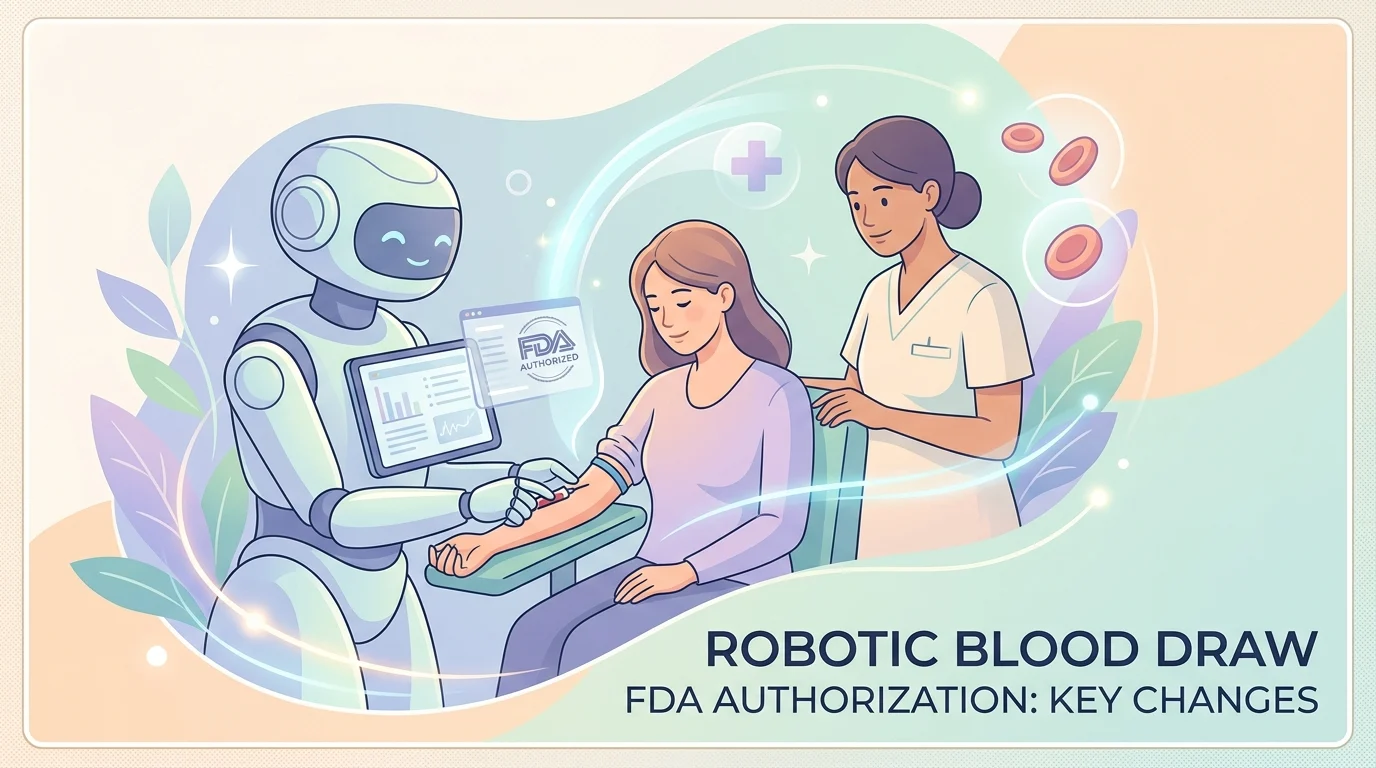
Robotic blood draw device guiding a needle into a forearm vein in an outpatient laboratory

⚕️ 本文仅供参考,不能替代医疗建议。请务必咨询医生以解读您的检查结果。.

A robotic blood draw is no longer a laboratory prototype: in August 2026 the US Food and Drug Administration authorized the first standalone device able to take blood from an adult’s arm without a human hand on the needle. Media coverage of the decision continued through the first week of September 2026, and the question most people ask is simple: is a machine as good as a person, and does it change my results? This article explains what was authorized, how the device works step by step, what the published trial data actually show, and what stays exactly the same once the tube reaches the laboratory.

What the FDA authorized in August 2026

On 19 August 2026 the FDA granted marketing authorization to the Aletta device, made by the Dutch company Vitestro, through the De Novo pathway. De Novo is the route used for a genuinely new type of low- to moderate-risk device, when no comparable product already exists to compare it with. Alongside the authorization, the agency set special controls covering labelling, performance testing and clinical testing.

Two limits matter for patients. The device is authorized for adults in outpatient settings only, not for children and not for hospital inpatients. And it is not unsupervised: a phlebotomist trained in blood collection starts each session and stays available throughout. One supervisor may oversee up to three devices at the same time, which is the practical reason the FDA framed the decision around the shortage of trained phlebotomists in the United States.

How a robotic blood draw actually works

The sequence is closer to an automated cash machine than to a surgical robot. The device guides you to position your arm, then you or the supervisor press a button to start.

  • It scans the arm with near-infrared light and Doppler ultrasound to find a suitable vein and to tell veins apart from arteries.
  • If no appropriate vein is found, it simply does not attempt the procedure.
  • Once a vein is identified, it applies the tourniquet, disinfects the skin, inserts the needle, swaps the collection tubes, removes and disposes of the needle, and places a bandage.
  • The supervising phlebotomist confirms that the tubes were filled in the correct order and that each one is adequately full.

Several safety layers run continuously. Disinfectant is applied to the skin during the ultrasound scan, the device is cleaned by a trained professional between patients, and if you move too much the needle detaches automatically and the draw stops. Onboard sensors can also pause the procedure and alert the supervisor. None of this removes the basic preparation rules you already know — our guide explains the blood test process, and a separate article covers fasting before a blood test.

What the published trial data show

The FDA decision rests on clinical data, and the largest study was published in Clinical Chemistry in August 2026. Based on articles retrieved from PubMed, the ADOPT multicentre trial ran in outpatient phlebotomy departments in the Netherlands and had two parts: a small comparison of results from robot-collected and hand-collected samples in the same people, then routine use in a much larger group.

What was measuredWhat the trial found
People studied in routine use1,633 outpatients
Success on the first stick, when a vein was foundAbout 95 out of 100 draws
People described as having difficult veinsAbout 93 out of 100
Adults aged 65 and overAbout 93 out of 100
Side effectsUncommon and all mild
Pain compared with a manual draw9 people in 10 said less pain or the same

The first part of the trial is the one that matters most for anyone who worries about the numbers on their report. Clotting tests, two enzymes and the platelet count were measured on both the robot-collected and the hand-collected sample from the same person, and no meaningful difference appeared. In plain terms: the collection method did not shift the results. That is the result a laboratory needs before it can trust a new way of filling a tube, and it is the reason the authorization was possible at all. Our explainer compares CBC and CMP if you want to see which of those lines appear on a routine panel.

最新科学进展

Three strands of research sit behind this authorization, and each one is worth translating into plain language.

First, the multicentre trial described above. What was found: a robot that chooses its own vein and inserts its own needle hit the vein on the first try roughly as often as trained humans do, including in people with difficult veins, and produced samples that gave the same numbers. What this means for you: if your laboratory installs one of these devices, the reference ranges on your report do not need to change, and a repeat draw should not be more likely.

Second, earlier work on smaller automated devices. A first-in-human study in 2019 tested a hand-held automated venipuncture device on 31 volunteers and reported success rates comparable to clinical standards, with each draw taking roughly a minute and a half. What this means for you: the idea has been maturing for years rather than arriving overnight, and the 2026 device is the point at which it became a regulated product instead of a research tool.

Third, the literature on needle fear, which is the main reason this technology is discussed outside laboratory circles. A systematic review and meta-analysis published in 2018 found needle fear in roughly 20 to 30 percent of young adults, more common in women than in men, and decreasing with age. A large international survey published in 2022 found that among people who reported needle phobia, about half said they avoided blood draws altogether, and that non-invasive alternatives and smaller needles were the changes they most wanted. What this means for you: avoiding a blood test because of the needle is common, it is not a personal failing, and it has a real cost when a condition goes undetected.

One caution applies to all of this. The trial was run in the Netherlands, largely by the company developing the device, in outpatient clinics that volunteered. Performance in ordinary clinics across many countries is still to be confirmed, and no study yet shows that robotic collection improves anyone’s health outcome — only that it fills tubes reliably.

What a robot does not change: reading your results

Automating the needle changes who holds it, not what the numbers mean. The tube still goes to the same analyser, the same reference ranges still apply, and a biologist or doctor still has to interpret the report in the context of your age, sex, treatment and symptoms. Two things therefore remain true.

  • A value outside the reference range is not automatically a disease. Our guide lists normal blood test ranges, and a companion article explains abnormal blood test results.
  • Comparing results over time still works best within the same laboratory, because dosing techniques differ slightly between sites.

It is also worth noting what the authorization does not cover. There is no needle-free method here: a needle still enters a vein. The device does not decide which tests to run, and it does not read the report. If you are preparing for surgery, our article describes blood work before surgery, and a separate explainer details the platelet count that appears on almost every panel.

If you dread the needle: what to say and what helps

Whether a person or a machine is holding the needle, the single most useful thing you can do is say that you are anxious before the draw starts. Staff can then change the setting rather than react to a problem.

  • Ask to lie down. Fainting during a blood draw is a vasovagal reaction: the nervous system overreacts, blood pressure and heart rate drop, and you pass out for under a minute. Lying down removes the risk of a fall, which is the part that actually causes injury.
  • Recognise the warning signs — sudden tiredness, a warm flush, pallor, nausea, sweating, tunnel vision. They usually appear 30 to 60 seconds beforehand, which is enough time to lie down.
  • Tense your muscles. Clenching a fist, interlocking the hands and pulling them apart, or crossing the legs and tightening them raises blood pressure and can stop an episode.
  • Drink water beforehand unless you have been told to fast completely, and do not stand up too quickly afterwards.
  • For children, a topical anaesthetic patch applied about an hour before the puncture is a standard option; ask the prescriber rather than the laboratory on the day.

A history of fainting is worth mentioning every time, not just once. And if fear has led you to postpone a prescribed test, say that too — it is a clinical fact, not an admission.

词汇表

学期定义
VenipunctureCollecting blood from a vein, usually at the inside of the elbow. The medical name for a standard blood draw.
PhlebotomistA professional trained to collect blood samples and to label and handle the tubes correctly.
De Novo pathwayA US regulatory route for a new type of low- to moderate-risk device, used when there is no comparable device to compare it against.
Special controlsConditions the FDA attaches to a device, covering labelling and required performance and clinical testing.
First-stick success rateThe proportion of draws in which enough blood is obtained at the first needle insertion, without a second attempt.
Doppler ultrasoundAn ultrasound technique that detects movement of blood, which is how the device distinguishes a vein from an artery.
Vasovagal reactionA reflex drop in blood pressure and heart rate, often triggered by needles or the sight of blood, causing brief fainting.
参考范围The interval of values expected in most healthy people for a given test, which varies with the method, age and sex.
Multicentre trialA study run at several sites at once, which makes the findings less dependent on the habits of a single team.

常见问题解答

Will a robot change my blood test results?

The published trial compared several tests on robot-collected and hand-collected samples from the same people — clotting times, two enzymes and the platelet count — and found no meaningful difference. That is the specific question laboratories had to answer before adopting the method, and the answer was that the collection route did not shift the numbers. Reference ranges therefore stay the same. As always, a result should be read alongside your history and symptoms rather than on its own.

Does a robotic blood draw hurt less?

In the trial, nine people in ten said the robot draw was less painful than a manual one or about the same; roughly one in five described it as far less painful. A minority found it more uncomfortable. So “less pain for most people” is a fair summary, and “painless” is not — a needle still enters the vein.

Can it take blood if my veins are hard to find?

That was one of the more encouraging findings: among people who described their own venous access as difficult, the first-stick success rate stayed above nine in ten once the device had identified a suitable vein. The important caveat is the second half of that sentence. If the scan finds no appropriate vein, the device does not attempt the draw, and a human takes over.

Is it safe to let a machine insert a needle?

Side effects in the trial were uncommon and all mild. The design also includes a needle that detaches automatically if you move too much, sensors that can pause the procedure, and a trained supervisor present throughout. No device is risk-free, but the authorization required evidence that the safety profile was comparable to a manual draw.

Is this available in my country?

The August 2026 decision applies to the United States, for adults in outpatient settings. Availability in any given clinic depends on the laboratory network buying and installing the devices, which takes time. Outside the United States, each regulator decides separately, so ask your own laboratory rather than assuming.

Does this mean fewer people will work in laboratories?

The FDA framed the authorization around a shortage of trained phlebotomists rather than a surplus. The model described allows one phlebotomist to oversee up to three devices, so the role shifts toward supervision and checking tubes rather than disappearing. A trained professional is still required for every session.

来源

  • US Food and Drug Administration — FDA Authorizes First-Of-Its-Kind Robotic Blood Draw Device, 19 August 2026 — fda.gov
  • MedlinePlus, US National Library of Medicine — Venipuncture, Medical Encyclopedia, reviewed 2025 — medlineplus.gov
  • Cleveland Clinic — Vasovagal Syncope: symptoms, causes and treatment, updated 2025 — my.clevelandclinic.org
  • Giesen LFP, Roest JA, Koopman FMA, et al. — Performance, Safety, and Patient Experience of an Autonomous Robotic Phlebotomy Device: A Multicenter Trial — Clinical Chemistry, 2026 — doi.org/10.1093/clinchem/hvag029
  • Leipheimer JM, et al. — First-in-human evaluation of a hand-held automated venipuncture device for rapid venous blood draws — Technology, 2019 — consensus.app
  • McLenon J, Rogers MAM — The fear of needles: a systematic review and meta-analysis — Journal of Advanced Nursing, 2018 — consensus.app
  • Alsbrooks K, Hoerauf K — Prevalence, causes, impacts, and management of needle phobia: an international survey of a general adult population — PLOS ONE, 2022 — consensus.app

延伸阅读

利用 AI DiagMe 了解您的实验室结果

Whoever draws the blood, the hard part is usually the page of numbers that comes back two days later. AI DiagMe reads the report you already have and explains it in plain language — the complete blood count, the kidney and liver panels, glucose, cholesterol, ferritin and the rest — so you arrive at your appointment with questions rather than anxiety. It helps you understand your results; it does not diagnose you and it does not replace your doctor.

几分钟内即可获得结果解读

作者

  • AI DiagMe

    AI DiagMe团队汇聚了医生、临床专家和医学编辑。我们的文章由健康传播专业人士撰写,并由我们科学委员会的医生进行审核和验证。该委员会由在血液科、内分泌科和全科等专科领域执业的医院医生组成。负责编辑工作的Julien Priour拥有巴黎高等商学院(HEC Paris)的MBA学位,并曾在法国国家可持续发展研究所(IRD,FUN-MOOC,2026)接受过科学写作和出版方面的培训。每篇文章都基于最新的临床指南和同行评审的医学出版物。.

    电子邮件 网站

相关文章