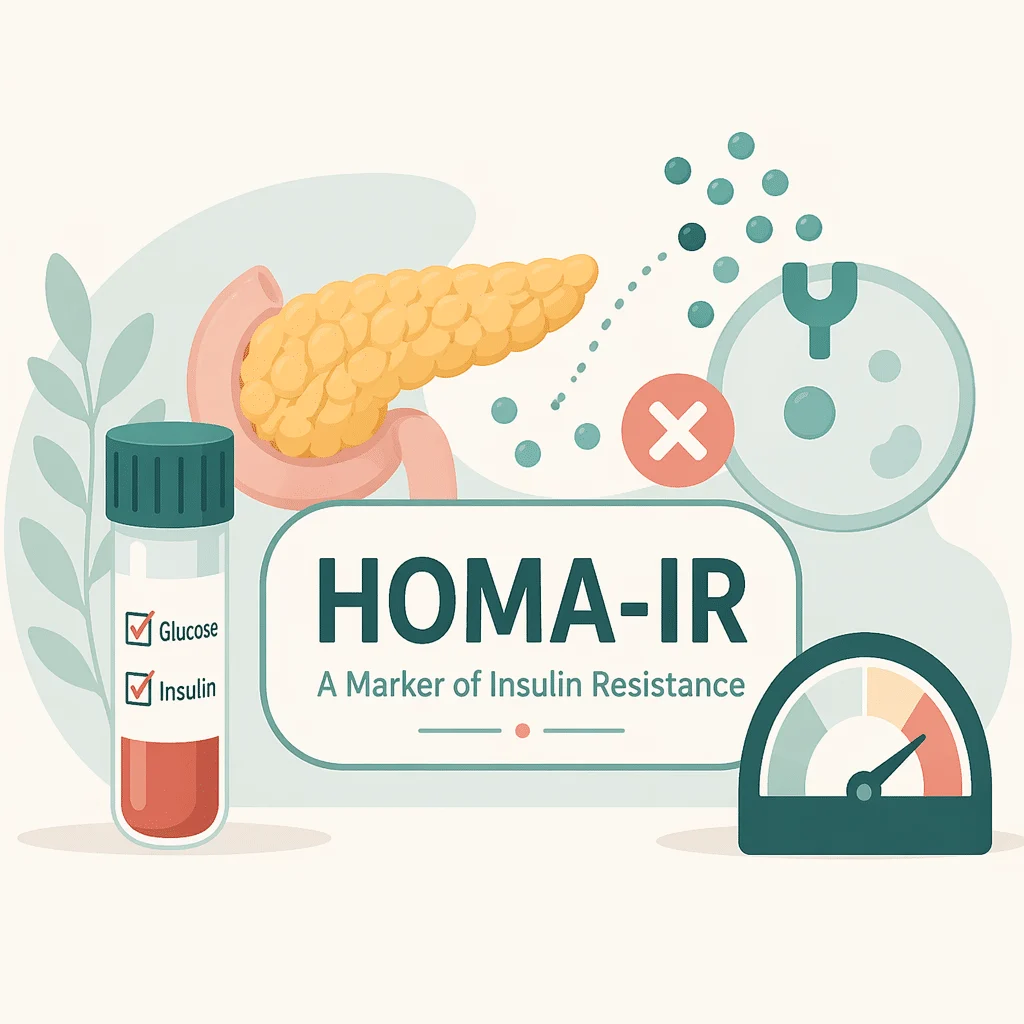
Att få ett provsvar med termen HOMA-IR väcker ofta fler frågor än det besvarar. Den här guiden förklarar vad HOMA-IR-testet mäter, hur poängen beräknas utifrån två vanliga blodvärden och vad ett normalt, gränsvärde eller högt resultat kan betyda för din metabola hälsa. Du hittar också testets kända begränsningar, nyare index som forskare studerar och praktiska råd om ditt värde är högt. Målet är tydlighet, inte oro – så att du kan diskutera dina provsvar med din läkare från en välgrundad position.
Vad HOMA-IR mäter och hur det beräknas
HOMA-IR står för Homeostatic Model Assessment of Insulin Resistance. Det är inte ett separat blodprov. Det är en beräkning som kombinerar två värden som redan finns på ett vanligt metabolt blodprov: fasteglukos och fasteinsulin. Eftersom båda värdena kommer från samma fasteprov kan ett laboratorium eller en läkare räkna ut HOMA-IR-poängen utan att beställa ett extra test.
Formeln multiplicerar fasteinsulinet (i mikroenheter per milliliter) med fasteglukos (i millimol per liter) och dividerar sedan resultatet med 22,5. Konstanten 22,5 kommer från den ursprungliga forskningen från 1985 som introducerade modellen, och den standardiserar poängen så att en frisk, insulinkänslig vuxen person tenderar att hamna nära 1,0.
Logiken bakom siffran är enkel. Insulin är det hormon som bukspottkörteln frisätter för att hjälpa glukos att lämna blodbanan och ta sig in i cellerna som energi. När cellerna svarar bra på insulin behöver bukspottkörteln inte arbeta hårt, vilket innebär att fasteinsulin förblir lågt i förhållande till fasteglukos. När cellerna motstår insulinets signal kompenserar bukspottkörteln genom att frisätta mer av det, vilket höjer produkten i beräkningen och driver upp poängen.
Läkare använder HOMA-IR eftersom det ger en uppskattning av en betydligt mer komplex forskningsmetod som kallas hyperinsulinemiskt-euglykemiskt clamp, vilket anses vara referensmetoden för att mäta insulinresistens direkt. Clamp-tekniken kräver kontinuerliga intravenösa glukos- och insulininfusioner under flera timmar i en forskningsmiljö, vilket gör den opraktisk för rutinvård. HOMA-IR ger en rimlig uppskattning från ett enda fasteprov, vilket är anledningen till att det fortfarande är det mest använda surrogatmåttet inom både klinisk praxis och befolkningsforskning.
Normala, gränsvärdes- och höga HOMA-IR-intervall
Referensintervallen för HOMA-IR är inte helt standardiserade, och värdena kan variera beroende på laboratoriet, den specifika insulinanalysen som används och den population som intervallet baseras på. Med det sagt använder de flesta läkare och publicerade studier riktmärken liknande dem nedan som en allmän utgångspunkt.
| HOMA-IR-poäng | Allmän tolkning |
|---|---|
| Under 1,0 | Optimal insulinkänslighet |
| 1,0 till 1,9 | Möjlig tidig eller mild insulinresistens |
| 2,0 till 2,9 | Troligen måttlig insulinresistens |
| 3,0 eller högre | Troligen betydande insulinresistens |
Ett enskilt HOMA-IR-värde är en ögonblicksbild, inte ett slutgiltigt svar. Hur länge du fastat, nylig sjukdom, dålig sömn och till och med vilken insulinanalys laboratoriet använder kan påverka resultatet med en märkbar marginal. En läkare vill vanligtvis se ett mönster över mer än ett test, tillsammans med din viktutveckling, midjemått, familjehistoria och andra värden, innan slutsatser dras om din metabola hälsa.
Vad som driver insulinresistens
Insulinresistens har sällan en enda orsak. Den tenderar att byggas upp gradvis av en kombination av faktorer som förstärker varandra under månader eller år.
Överskott av kroppsfett, särskilt visceralt fett som lagras runt bukorganen, är en av de mest konsekventa bidragande faktorerna som forskare har identifierat. Visceralt fett frigör inflammatoriska signaler och fettsyror som stör hur muskel- och leverceller svarar på insulin. En stillasittande livsstil förstärker denna effekt, eftersom regelbunden rörelse är ett av de mest direkta sätten kroppen ökar sin känslighet för insulin, oberoende av viktförändring.
Kosten spelar också en stödjande roll. Kostmönster med mycket raffinerade kolhydrater, tillsatt socker och ultraprocessad mat korrelerar med högre insulinresistens i befolkningsstudier, troligen genom upprepade blodsocker- och insulintoppar som håller bukspottkörteln i ständigt arbete. Läkare ser ofta detta mönster återspeglas i förhöjda triglycerider på ett standard lipidpanel, eftersom samma kost- och metabola faktorer tenderar att höja båda markörerna tillsammans. Kronisk sömnbrist och ohanterad stress höjer också cirkulerande kortisol, ett hormon som kan minska insulinets effekt på cellerna.
Genetik och ålder bidrar oberoende av livsstil. Ärftlighet för typ 2-diabetes ökar grundrisken, och insulinkänsligheten minskar naturligt något med åldern. Vissa tillstånd och läkemedel påverkar också, bland annat polycystiskt ovariesyndrom (PCOS), Cushings syndrom, vissa kortikosteroider och en del antipsykotiska läkemedel. Ingen av dessa faktorer garanterar insulinresistens på egen hand, men tillsammans förklarar de varför två personer med liknande vikt kan ha ganska olika HOMA-IR-värden.
HOMA-IR jämfört med fasteglukos och HbA1c
En vanlig fråga är varför en läkare skulle beräkna HOMA-IR när fasteglukos och HbA1c redan finns. De tre testerna mäter besläktade men olika saker, och var och en fyller en funktion.
| Testa | Vad det återspeglar | Typisk användning |
|---|---|---|
| HOMA-IR | Hur hårt bukspottkörteln arbetar för att hålla blodsockret normalt | Uppskattning av insulinresistens, ofta innan blodsockret stiger |
| Fastande glukos | Blodsockret vid ett enskilt fastetillfälle | Screening för prediabetes och diabetes |
| HbA1c | Genomsnittligt blodsocker under ungefär tre månader | Diagnos och långtidsuppföljning |
Den praktiska slutsatsen är att HOMA-IR kan fånga upp ett kompensatoriskt mönster – det vill säga att kroppen arbetar hårt för att hålla blodsockret normalt – innan den kompensationen börjar svikta och blodsocker eller HbA1c stiger. Det är därför en del läkare ser det som ett tidigt varningstecken, även om det i praktiken används mer inom forskning och specialistvård än vid rutinmässig screening inom primärvården. Den som vill jämföra sina egna värden över tid kan gå igenom båda markörerna direkt, eftersom våra guider täcker tolkning av fasteblodsocker och den HbA1c normalt intervall mer ingående.
Begränsningar med HOMA-IR-testet
HOMA-IR är en användbar uppskattning, inte ett exakt diagnostiskt verktyg, och att förstå dess begränsningar hjälper dig att sätta ett enskilt resultat i rätt perspektiv.
För det första är testet starkt beroende av korrekt fasta. Att äta, dricka något annat än vatten eller uppleva kraftig stress under timmarna före blodprovet kan påverka både glukos- och insulinvärden och ge ett missvisande resultat. För det andra är insulinanalyser inte helt standardiserade mellan olika laboratorier, vilket innebär att samma blodprov ibland kan ge något olika resultat på två olika lab. För det tredje speglar HOMA-IR enbart fastevärden. Det fångar inte hur kroppen hanterar glukos efter en måltid, något som en del forskare anser vara lika viktigt för den långsiktiga risken.
För det fjärde, och värt att känna till, påpekar ledande hälsomyndigheter att HOMA-IR i första hand utvecklades för och används inom forskning snarare än för vardaglig diagnostik. Enligt National Institute of Diabetes and Digestive and Kidney Diseases, testning för insulinresistens specifikt används huvudsakligen i forskningsstudier, och den vanliga screeningen för prediabetes och typ 2-diabetes bygger istället på fasteglukos, HbA1c eller ett oralt glukostoleranstest. Det betyder inte att HOMA-IR saknar värde. Det betyder att resultatet tolkas bäst av en läkare tillsammans med andra markörer, snarare än att läsas isolerat.
Slutligen varierar gränsvärden beroende på population, ålder, kön och kroppssammansättning, så ett tröskelvärde som validerats i en studiegrupp kanske inte stämmer exakt för en annan. Det är en av anledningarna till att forskare fortsätter att utforska kompletterande index, vilket diskuteras vidare nedan.
En enkel beslutsguide för ditt HOMA-IR-resultat
Om du tittar på ett HOMA-IR-värde i ett provsvar kan det här ramverket hjälpa dig att tänka igenom nästa steg – men din läkares råd har alltid företräde utifrån din samlade hälsobild.
- Värde under ungefär 1,0 till 1,9, utan andra oroande fynd: rutinmässig årlig eller vartannat år genomförd screening som en del av vanliga hälsokontroller är vanligtvis rimligt.
- Värde i ett gränsområde eller måttligt förhöjt, tillsammans med riskfaktorer som övervikt, stillasittande livsstil eller ärftlighet för diabetes: diskutera livsstilsförändringar och eventuell ny provtagning om tre till sex månader med din läkare.
- Tydligt förhöjt värde, särskilt i kombination med förhöjt fasteblodsocker, avvikande blodfetter eller symtom som ovanlig trötthet eller hudförändringar: boka en uppföljning snarast för att diskutera ytterligare utredning eller remiss till specialist.
När man ska träffa en läkare
Vissa situationer kräver att du kontaktar en vårdgivare relativt snart, snarare än att vänta på ett rutinmässigt uppföljningsbesök. Kontakta din läkare om ditt HOMA-IR-värde är högt och kombineras med förhöjt fasteglukos eller HbA1c, om du märker nya symtom som ihållande trötthet, ökad törst, täta trängningar att kissa eller mörka, sammetsliknande hudförändringar som kallas acanthosis nigricans, eller om du har en stark ärftlighet för typ 2-diabetes och aldrig har screenats för metabol risk. Kvinnor med oregelbunden mens, ökad hårväxt eller akne i kombination med ett högt värde bör också ta upp polycystiskt ovariesyndrom som ett möjligt sammankopplat tillstånd med sin läkare. Inget av dessa tecken är i sig en akutsituation, men de är goda skäl att boka en tid snarare än att vänta.
Livsstilsfaktorer som påverkar ditt värde
Det uppmuntrande är att insulinresistens ofta går att påverka, och HOMA-IR-värden kan förbättras märkbart med varaktiga livsstilsförändringar.
Regelbunden fysisk aktivitet är ett av de mest direkta verktygen som finns. Både konditionsträning och styrketräning förbättrar hur effektivt muskelcellerna tar upp glukos, och effekten kan visa sig inom några veckor av regelbunden träning – oberoende av större viktnedgång. Att sikta på ungefär 150 minuters måttlig aktivitet per vecka, kombinerat med två eller fler styrkepass, stämmer överens med rekommendationerna från ledande hälsoorganisationer för metabol hälsa i stort.
Kostmönster rika på fiber, grönsaker, fullkorn och magert protein – med begränsad mängd raffinerade kolhydrater och tillsatt socker – korrelerar konsekvent med bättre insulinkänslighet i forskningen. Ett medelhavsinspirerat kostmönster har i synnerhet upprepade belägg bakom sig för att stödja en hälsosammare glukos- och insulinhantering.
Viktkontroll, när det är relevant, har en oproportionerligt stor effekt. Banbrytande forskning från NIH-finansierade Diabetes Prevention Program visade att personer med hög risk för typ 2-diabetes som gick ner fem till sju procent av sin ursprungliga kroppsvikt genom kost och motion avsevärt minskade sin risk att utveckla diabetes – en effekt som är nära kopplad till förbättrad insulinkänslighet. Den som följer den här typen av risk över tid kan också läsa vår mer övergripande guide om diabetes – orsaker, symtom och behandling för sammanhang kring hur prediabetes kan utvecklas om dessa faktorer lämnas obehandlade. Att prioritera regelbunden och tillräcklig sömn samt bygga in stressreducerande vanor – som korta dagliga promenader eller andningsövningar – kompletterar de mest evidensbaserade åtgärderna som för närvarande finns tillgängliga.
Senaste vetenskapliga framsteg
Forskningen om insulinresistens är fortsatt aktiv, och några nyare fynd hjälper till att sätta HOMA-IR-testet i ett bredare sammanhang utan att förändra de grundläggande principer som beskrivs ovan.
Forskare har jämfört HOMA-IR med ett nyare och enklare alternativ som kallas triglycerider-glukosindex, ofta förkortat TyG. En analys av amerikanska nationella hälsoenkätdata visade att TyG-indexet presterade något bättre än HOMA-IR när det gällde att identifiera metabolt syndrom hos vuxna, även om båda markörerna hade ett tydligt samband med risk. Vad detta innebär för dig: TyG använder två värden – fastande triglycerider och fastande glukos – som redan ingår i ett standard lipid- och metabolpanel, så det kan ibland beräknas utan ett separat insulintest. Det ersätter inte HOMA-IR, men det visar att forskare aktivt arbetar med att förfina hur insulinresistens uppskattas från rutinprover. Notera: en tvärsnittsstudie undersöker en stor grupp människor vid ett enda tillfälle, vilket är användbart för att hitta samband men kan inte på egen hand bevisa att en faktor orsakar en annan.
En separat analys av en medelstort kinesisk samhällshälsokohort jämförde HOMA-IR och TyG-index med markörer för blodkärlshälsa, inte enbart diabetesrisk. Studien visade att HOMA-IR hade ett starkare samband med en markör för artärstelhet kallad ett avvikande CAVI-värde, samt med tidiga njurförändringar mätta via protein i urinen, medan TyG-index korrelerade starkare med ett annat mått på storskarig artärstelhet. Vad detta innebär för dig: det tyder på att HOMA-IR och TyG kan fånga något olika aspekter av kardiometabol risk snarare än att vara utbytbara, vilket förstärker varför läkare ofta tittar på ett mönster av markörer tillsammans i stället för att förlita sig på ett enda värde. Notera: en kohortstudie följer en definierad grupp människor över tid och hjälper forskare att observera hur en markör hänger samman med utfall i naturliga sammanhang, men den kan ändå inte fastställa orsak och verkan på samma sätt som en kontrollerad studie kan.
Ingen av denna forskning förändrar de grundläggande råden i den här artikeln. HOMA-IR är fortfarande ett användbart och välbeprövat mått på insulinresistens, och bör tolkas tillsammans med ditt fastande glukos, HbA1c, lipidpanel och din övergripande hälsobild av en kvalificerad kliniker.
Ordlista
| Kalla | Definition |
|---|---|
| HOMA-IR | Homeostatic Model Assessment of Insulin Resistance – ett beräknat värde som kombinerar fasteblodsocker och fasteinsulin. |
| Insulinresistens | Ett tillstånd där cellerna svarar dåligt på insulin, vilket gör att bukspottkörteln frisätter mer av det för att hålla blodsockret inom normalområdet. |
| Fastande insulin | Mängden insulin som cirkulerar i blodet efter en nattfasta – ett av de två värden som används för att beräkna HOMA-IR. |
| Fastande glukos | Blodsocker mätt efter fasta, som används både på egen hand för diabetesscreening och som en del av HOMA-IR-beräkningen. |
| HbA1c | Ett blodprov som speglar det genomsnittliga blodsockret under ungefär de senaste tre månaderna och som används för att diagnostisera och följa upp diabetes. |
| Metaboliskt syndrom | En kombination av tillstånd – bland annat högt blodtryck, överskott av bukfett och onormala kolesterolvärden – som tillsammans ökar risken för hjärt-kärlsjukdom och diabetes. |
| TyG-index | Triglycerid-glukosindex, ett nyare beräknat mått på insulinresistens baserat på fastande triglycerider och fastande blodsocker. |
| Visceralt fett | Fett lagrat kring bukens organ, skilt från underhudsfett, som är nära kopplat till insulinresistens. |
Vanliga frågor om HOMA-IR-testet
Kan jag beräkna mitt eget HOMA-IR-värde hemma?
Ja, om du har ditt fastande glukos och fastande insulin från ett nyligt blodprov kan du tillämpa standardformeln själv eller använda en HOMA-IR-kalkylator online. Att tolka vad värdet innebär för din hälsa kräver dock fortfarande kliniskt sammanhang – inklusive din viktutveckling, symtom och andra provsvar – så det är bäst att gå igenom ett egenberäknat resultat med din läkare i stället för att agera på det på egen hand.
Är HOMA-IR-testet detsamma som ett fasteinsulinprov?
Nej. Ett fastande insulintest mäter bara ett värde – mängden insulin som cirkulerar efter en nattfasta. HOMA-IR kombinerar det fastande insulinvärdet med fastande glukos i en specifik formel för att ge ett enda poäng som uppskattar insulinresistens mer fullständigt än något av värdena var för sig. Läsare som vill fördjupa sig i det enskilda värdet kan läsa vår guide till insulinblodprov, som förklarar fasteinsulin på egen hand.
Behöver jag fasta inför ett HOMA-IR-test?
Ja. Eftersom beräkningen beror på fastande glukos och fastande insulin krävs ett korrekt resultat att du fastar i åtta till tolv timmar innan provtagningen – vanligtvis över natten – med enbart vatten tillåtet. Mat, söta drycker eller till och med kaffe med grädde kan påverka resultatet.
Kan normalvärdet för HOMA-IR skilja sig åt mellan olika laboratorier?
Ja, och det här är en av de mer förvirrande aspekterna av testet för patienter. Olika laboratorier kan använda olika insulinanalyser och referenspopulationer, vilket kan förskjuta normalintervallet något. Jämför alltid ditt resultat med det specifika referensintervall som anges på ditt eget labbsvar, snarare än med ett värde du hittar någon annanstans.
Betyder ett högt HOMA-IR-värde att jag redan har diabetes?
Inte nödvändigtvis. Ett högt värde tyder på insulinresistens, vilket är en riskfaktor för prediabetes och typ 2-diabetes, men det är i sig inte en diabetesdiagnos. Diabetes diagnostiseras med hjälp av fasteblodsocker, HbA1c eller ett oralt glukostoleranstest utifrån specifika diagnostiska gränsvärden. Många med ett förhöjt HOMA-IR-värde utvecklar aldrig diabetes, särskilt om de gör livsstilsförändringar.
Kan ett HOMA-IR-värde förbättras, och hur snabbt i så fall?
Ja, HOMA-IR kan förbättras med varaktiga förändringar av fysisk aktivitet, kost, sömn och vikt, och viss forskning visar mätbara förbättringar av insulinkänsligheten redan inom några veckor efter att man börjat träna regelbundet. En tydlig och bestående förbättring av själva värdet märks oftast efter flera månaders konsekventa vanor, och din läkare kan hjälpa dig att bestämma ett lämpligt intervall för omtestning.
Källor
- National Institute of Diabetes and Digestive and Kidney Diseases (NIDDK) — Insulin Resistance & Prediabetes — National Institutes of Health, 2025 — läs NIDDK:s översikt
- Mayo Clinic Staff — Type 2 Diabetes: Symptoms and Causes — Mayo Clinic, 2025 — läs Mayo Clinics översikt
- Cleveland Clinic — Insulin Resistance: What It Is, Causes, Symptoms and Treatment — Cleveland Clinic, 2024 — läs Cleveland Clinics översikt
- Wan H, Cao H, Ning P — Superiority of the Triglyceride Glucose Index Over the Homeostasis Model in Predicting Metabolic Syndrome Based on NHANES Data Analysis — Scientific Reports, 2024 — visa studien på PubMed
- Liang J, Zhou T, Wang X, et al. — Comparison Between Triglyceride Glucose Index and Homeostasis Model Assessment of Insulin Resistance in Their Associations with Vascular Dysfunction: Danyang Study — Pulse, 2025 — visa studien på PubMed
Vidare läsning
- Fastande blodsocker: din kompletta guide till tolkning
- HbA1c normalt intervall: betydelse och målnivåer
- Insulinprov i blodet: förstå dina värden och vad de betyder
- C-peptidprov: värden, högt och lågt förklarat
- Diabetes: orsaker, symtom och behandlingar
Ett HOMA-IR-värde berättar sällan hela historien på egen hand, och det ger mest mening när det läses tillsammans med relaterade provsvar som fasteglukos, HbA1c och lipidpanel. Läkare upprepar ofta ett fasteinsulintest tillsammans med HOMA-IR för att bekräfta mönstret, och kan också kontrollera ditt C-peptidvärde när typen av insulinresistens är oklar. Att granska ett fullständigt omfattande metabolisk panel tillsammans med dessa markörer ger ofta en tydligare bild av det metabola hälsotillståndet än ett enskilt värde. AI DiagMe hjälper dig att förstå vad ditt eget labbsvar visar, på ett enkelt och begripligt språk, så att du kan gå till ditt nästa läkarbesök bättre förberedd. Tjänsten är utformad för att stödja din förståelse – inte för att ställa diagnos eller ersätta din läkare.
Förstå dina labresultat med AI DiagMe
Få dina resultat tolkade på några minuter