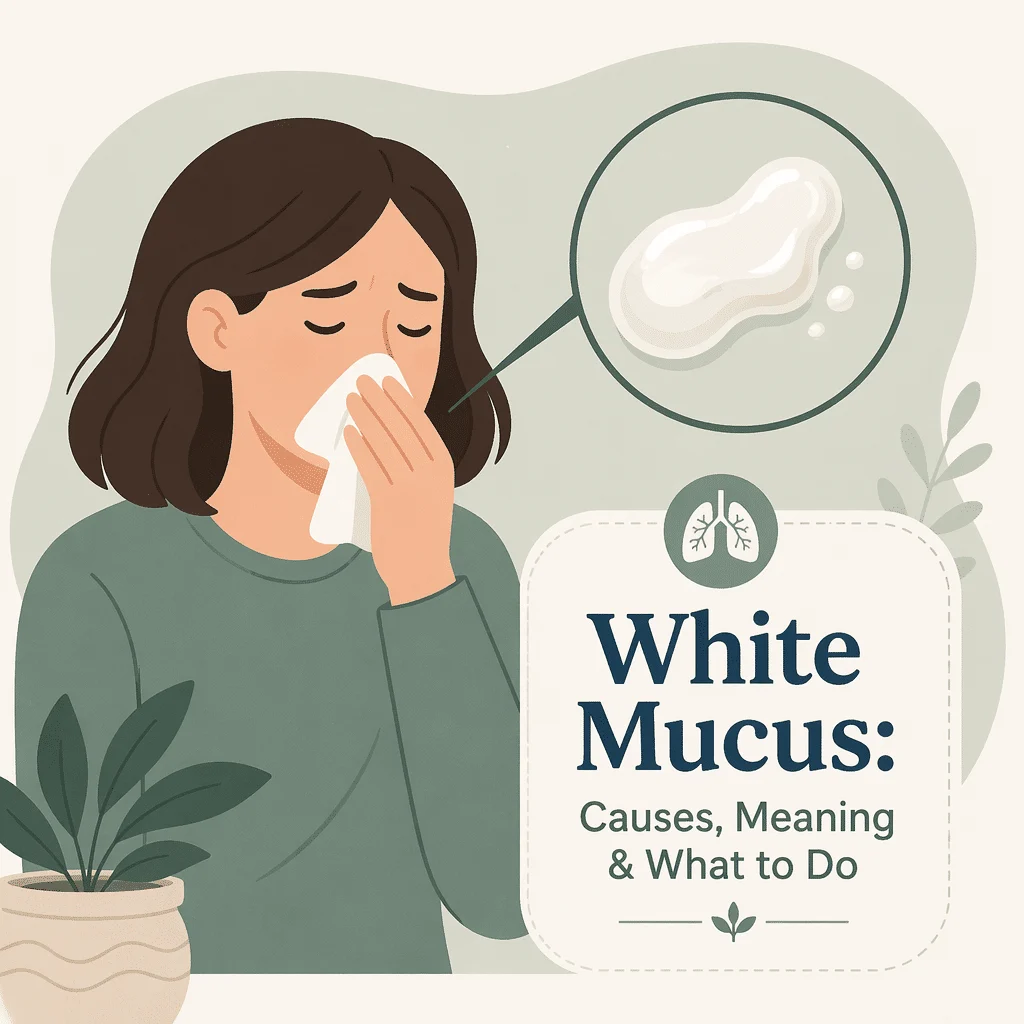
Vitt slem är ett av de mest sökta symtomen på internet, och bakom nästan varje sökning finns samma fråga: betyder det här att jag har en infektion som kräver antibiotika? Det korta svaret – och anledningen till att den här sidan finns – är nej. Färgen på ditt slem är en dålig vägledning för om bakterier är inblandade. Den speglar hur mycket vatten, hur många celler och hur mycket inflammatoriskt skräp slemmet innehåller, inte vilken organism som orsakade problemet.
I den här artikeln får du lära dig vad slem egentligen är, vad dess färg kan och inte kan berätta för dig, vad som vanligtvis gör slem vitt och tjockt, hur en vanlig förkylning förändras under en till två veckor, vad som verkligen skiljer en bakteriell bihåleinfektion från en viral, varför vita fläckar i munnen är ett annat problem, och vilka symtom som förtjänar läkarens uppmärksamhet.
Vad slem är och varför det förändrar utseende
Slem är inte avfall. Det är en aktiv vätska som kontinuerligt produceras av slemhinnan i din näsa, dina bihålor, halsen och luftvägarna – och du producerar ungefär en liter av det om dagen utan att märka det. Det mesta är vatten; resten är en blandning av stora sockerbelagda proteiner som kallas muciner, salter, antikroppar och antimikrobiella enzymer.
Den vätskan vilar på en matta av mikroskopiska hår som kallas cilier, vilka slår i samordnade vågor och för slemlagret stadigt bakåt mot halsen, där du sväljer det. Det här kallas mukociliär clearance, och det är så dina luftvägar fångar och avlägsnar damm, pollen, rökpartiklar och mikrober innan de når lungorna.
Utseendet beror därför på några faktorer: vatteninnehåll, cellinnehåll och hur länge slemmet har stått stilla. Tunt och klart betyder välhydrerat och i rörelse; tjockt, grumligt och vitt betyder mindre vatten och mer fast innehåll.
Vad slemfärgen säger – och inte säger
Det här är den del som de flesta missförstår, och det driver miljontals onödiga antibiotikaförfrågningar varje år.
Varför slem blir gult eller grönt
När slemhinnorna i luftvägarna är inflammerade av någon anledning rör sig vita blodkroppar som kallas neutrofiler in i vävnaden och in i slemmet. Neutrofiler innehåller ett enzym som kallas myeloperoxidas, vilket är naturligt grönt. När dessa celler ansamlas och bryts ned får slemmet en gul och sedan grön nyans. Pigmentet kommer från dina egna immunceller, inte från bakterier.
Eftersom neutrofiler aktiveras vid virusinfektion lika väl som vid bakterieinfektion är grönt slem dag fyra av en vanlig förkylning ett tecken på att immunförsvaret fungerar – inte att sjukdomen har förändrat karaktär. CDC slår tydligt fast att virus orsakar de flesta bihåleinflammationer och att många av dem inte behöver antibiotika alls.
Varför slem ser vitt eller grumligt ut
Vitt eller grumligt slem följer samma logik. Det är slem med en högre andel celler och cellulärt avfall och en lägre andel vatten. Trängsel och svullnad saktar ner cilier, så slemmet dröjer kvar, förlorar vatten och koncentreras. Det ser vitt ut snarare än genomskinligt eftersom celler och proteiner som är suspenderade i slemmet sprider ljuset.
Vitt slem identifierar alltså inte något specifikt ämne. Det talar om för dig att slemhinnan är inflammerad och att sekretionerna är mer koncentrerade än vanligt, vilket kan bero på en förkylning, ett allergiutbrott, ett torrt sovrum, uttorkning eller rökexponering.
Den praktiska slutsatsen är värd att säga rakt ut: be inte om antibiotika på grund av färgen på ditt slem. Antibiotika medför verkliga risker när de inte behövs, från diarré och utslag till allergiska reaktioner och resistenta infektioner. Om ditt slem smakar illa snarare än bara ser annorlunda ut täcker vår guide om illasmakande slem det, och blodstrimmigt nässlem är den enda förändringen i utseende som konsekvent förtjänar uppmärksamhet.
Vad som vanligtvis orsakar vitt slem
Vanlig förkylning är överlägset vanligast. Mer än tvåhundra respiratoriska virus kan orsaka en förkylning, och CDC noterar att symtomen vanligtvis når sin topp efter två till tre dagar och att förkylningar typiskt sett varar mindre än en vecka, även om svansen kan dra ut på tiden.
Allergisk rinit kommer på andra plats. Allergi mot pollen, kvalster, mögel eller djurepitel svullnar upp nässlemhinnan och ökar sekretionen, som börjar klar och vattnig och tjocknar till vit när täppheten tilltar. Blodprov visar ibland en ökning av eosinofiler, de vita blodkroppar som är mest inblandade vid allergi.
Nästäppa tjocknar också slemmet mekaniskt. Allt som trångar ihop näsgångarna, inklusive en sned nässkiljvägg eller näspolyper, saktar ner slemrörelsen och låter det torka ut.
Uttorkning och torr inomhusluft verkar från varsitt håll. Slem består till stor del av vatten, så att dricka för lite gör det tjockare, och centralvärme eller luftkonditionering torkar ut nässlemhinnan utifrån. Det är därför vitt slem är så mycket vanligare på vintern.
Rökning och vejpning irriterar båda luftvägarna till att producera mer slem, samtidigt som de skadar de cilier som rensar bort det, så mer slem rör sig långsammare. Långvariga rökare hostar ofta upp tjockt vitt eller grått slem på morgonen.
Kronisk rinosinuit är beteckningen när nässymtom och sinussymtom kvarstår i mer än ungefär tolv veckor. Slemmet tenderar att vara ihållande tjockt och grumligt, och det förtjänar en ordentlig utredning snarare än upprepade behandlingar riktade mot en förkylning.
Postnasal drip – slem som rinner ner längs baksidan av halsen – ger konstant harkling och en känsla av att något fastnat. Reflux gör något liknande: maginnehåll som når halsen irriterar slemhinnan och ökar tjockt, klibbigt slem, ofta med en sur smak och heshet på morgonen. Vår artikel om hosta vid syrareflux täcker det mönstret i sin helhet.
Hur en förkylning normalt utvecklas, dag för dag
Att förstå det vanliga förloppet vid en förkylning tar bort det mesta av oron kring färgen. Under de första en till två dagarna är slemmet klart, tunt och rikligt, och näsan rinner. Runt dag tre till fem ökar trängsel, cilierna saktar ner och slemmet blir märkbart tjockare och vitt eller grumligt. Mellan dag fyra och dag sju kan det bli gult och sedan grönt när neutrofiler ansamlas.
Sedan vänder det: färgen bleknar tillbaka från vitt till klart och täppan lättar, även om ett hosta kan dröja kvar i två till tre veckor.
Det viktiga att komma ihåg är att klar slemhinna som blir vit och tjockare under några dagar är ett helt normalt förlopp vid en förkylning. Det är ingen försämring, och det är ingen anledning att söka antibiotika.
Vad som faktiskt tyder på en bakteriell bihåleinfektion
Om färgen inte är avgörande, vad är det då? Svaret är hur sjukdomen utvecklas över tid, och hur allvarlig den är. CDC rekommenderar att du söker vård om du känner igen något av följande mönster.
Symtom som varar mer än ungefär tio dagar utan att bli bättre. Virusförkylningar har ett självbegränsande förlopp, så en sjukdom som planar ut på samma nivå efter tio dagar har slutat bete sig som en vanlig förkylning.
Svåra symtom redan från början. Svår huvudvärk eller smärta i ansiktet, eller feber som håller i sig mer än tre till fyra dagar – särskilt i sjukdomens allra första skede – är ett annat mönster än den gradvisa uppbyggnaden vid en förkylning.
Dubbel försämring. Det här är det mest användbara enskilda tecknet och det som folk oftast missar. Du blir bättre, märkbart och på riktigt, och sedan klart sämre igen. Det U-formade förloppet tyder på att en bakterieinfektion har fått fäste i bihålor som öppnats upp av viruset.
Även då beskriver CDC två strategier som ett alternativ till omedelbar antibiotikabehandling: avvaktande hållning, där din läkare följer upp dig om två till tre dagar, och fördröjt recept, där du håller ett recept och löser ut det bara om du inte blir bättre. Vår artikel om huruvida en sinusinfektion är smittsam täcker smittvägar och behandling.
Koppla det du ser till vad det brukar betyda
Den här tabellen är en vägledning till troliga förklaringar, inte en diagnos. Dina symtom som helhet spelar större roll än en enskild observation.
| Vad du ser | Vad det vanligtvis betyder | Vad man ska göra |
|---|---|---|
| Klart slem som blir vitt och tjockare under några dagar | Det vanliga mittenstadiet av en förkylning | Lindrande åtgärder och tid; antibiotika är inte indicerat |
| Tjockt vitt slem med täppt näsa och ingen feber | Täppa, allergi, torr luft eller uttorkning som koncentrerar slemmet | Vätskeintag, fuktad luft, sköljning med koksaltlösning; behandla allergitriggers |
| Vitt slem med symtom som varat mer än tio dagar utan förbättring | Beter sig inte längre som en vanlig förkylning | Sök läkare för bedömning, oavsett färg |
| Bättre en dag eller två, sedan klart sämre igen | Dubbel försämring, vilket kan tyda på bakteriell sinuit | Sök läkare omgående; detta är ett känt varningstecken |
| Vita fläckar i munnen som kan skrapas bort | Oral trush, en svampöverväxt, inte slem från luftvägarna | Boka en återbesök; den bakomliggande orsaken behöver identifieras |
| Små vita klumpar som hostas upp, med dålig andedräkt | Tonsillstenar, i sig själva ofarliga | Peta inte ut dem; kontakta en läkare om de återkommer |
Vitt slem jämfört med vita fläckar i munnen
Sökresultat blandar ihop två helt olika saker. Vitt slem är ett sekret; vita fläckar är en beläggning på ytan av munnen och halsmandlarna, och de betyder något helt annat.
Oral candidos (torsk)
Oral trush, eller oral candidos, är en överväxt av jästsvampen Candida, som normalt lever ofarligt i de flesta munnar och bara blir ett problem när balansen rubbas. Enligt MedlinePlus, från USA:s nationella medicinska bibliotek, visar den sig som vita, sammetsliknande sår på tungan och munslemhinnan, som kan blöda lite när de skrapas, och den kan göra det smärtsamt att svälja.
Omständigheterna som möjliggör det spelar större roll än utseendet. MedlinePlus listar steroidläkemedel, inklusive inhalatorer som används vid astma och KOL, diabetes med högt blodsocker, kemoterapi eller andra immunsupprimerande läkemedel, nyligen genomgången antibiotikakur, dåligt sittande tandproteser, HIV samt åldersgränser i båda riktningarna. Att skölja munnen efter användning av inhalerade kortikosteroider är standardmetoden för att minska den risken.
Torsk bör utredas snarare än behandlas på egen hand, eftersom det hos en vuxen kan vara det första synliga tecknet på oupptäckt diabetes eller ett immunproblem.
Tonsillstenar och andra vita fläckar
Tonsillstenar är små, mjuka, vitaktiga klumpar av kompakterade matrester och bakterier som bildas i fördjupningarna på tonsillernas yta. De är ofarliga, men orsakar dålig smak och dålig andedräkt som är oproportionerligt kraftig i förhållande till deras storlek. Vår guide till dolda tonsillstenar täcker vad du bör göra.
Inte varje vit fläck är torsk eller en sten. Ett sårigt område med svår halsont och feber, eller klustrade blåsor, kan vara något annat, och vår sida om halsherpes täcker en möjlighet. En fläck på en tonsill som inte försvinner bör undersökas.
Vad som faktiskt hjälper hemma
Inget av följande behandlar en infektion. Det här är lindrande åtgärder som gör tjockt slem lättare att leva med medan kroppen gör jobbet. Allt som rör läkemedel är en fråga för din läkare eller apotekspersonal.
Att dricka tillräckligt med vätska är det enklaste sättet att minska koncentrationen av dina sekret. Det förkortar inte en förkylning, men det gör slemmet tunnare och lättare att rensa bort.
Sköljning eller spray med koksaltlösning i näsan spolar bort slem, allergener och smuts och kan lindra nästäppa. Det finns en säkerhetsregel som är viktigare än någon teknik, och den är inte valfri.
Använd aldrig obehandlat kranvatten i en nässkölj. Den amerikanska läkemedelsmyndigheten FDA rekommenderar att man endast använder destillerat eller sterilt vatten som säljs som sådant, kranvatten som kokat i tre till fem minuter och sedan svalnat, eller vatten som filtrerats genom ett filter avsett att fånga upp smittämnen. Kranvatten är behandlat för att vara säkert att svälja, inte för att användas i näsan, och organismer som magsyran skulle förstöra kan överleva i näsgångarna och orsaka sällsynta men allvarliga infektioner. Tidigare kokt vatten bör förvaras i en ren, sluten behållare och användas inom 24 timmar, och själva redskapet bör tvättas och torkas mellan användningarna.
Fuktad luft förhindrar att nässlemhinnan torkar ut. CDC nämner en ren luftfuktare bland sina praktiska råd; ordet ren är viktigt, eftersom en försummad luftfuktare blir en källa till mögel och bakterier. Ånga från en varm dusch ger liknande effekt utan någon utrustning.
En varm kompress över näsan och pannan lindrar sinustrycket, och varma drycker är lugnande. Om du använder honung som lindringsmedel ska du tänka på att det aldrig får ges till ett barn under 12 månader på grund av risken för spädbarnsbotulism.
Att sluta röka eller använda e-cigaretter gör mer för kronisk slemproduktion än något annat medel, och det är den enda åtgärden här som tar itu med en orsak snarare än ett symptom. Att sova med huvudet något upphöjt minskar ansamlingen av sekret i halsen under natten. Lugnande åtgärder som halstabletter lindra halsirritationen utan att behandla den bakomliggande orsaken.
När man ska uppsöka läkare om vitt slem
De flesta episoder av vitt slem kräver inget annat än tålamod. Några kräver omedelbar bedömning.
Sök vård utan dröjsmål om vitt slem förekommer tillsammans med något av följande:
- Andningssvårigheter eller andfåddhet i vila
- Bröstsmärta
- Hostar upp blod
- Hög feber med svår huvudvärk eller stel nacke
- Svullnad eller rodnad runt ögat
- Förvirring eller ovanlig dåsighet
- Symtom som förvärras efter en initial förbättring
- En hosta som pågår i mer än ungefär tre veckor
Hos ett spädbarn, sök omedelbar vård vid snabb eller ansträngd andning, dåligt matintag eller stönande vid varje andetag.
Boka ett vanligt läkarbesök om symtomen har pågått i ungefär tio dagar utan att förbättras, om du har haft flera bihåleinflammationer det senaste året, om nässymtomen har varat längre än tolv veckor, eller om du har ett försvagat immunförsvar. Ihållande öronsmärta i kombination med nästäppa kan tyda på en öroninflammation.
Om din läkare utreder en möjlig infektion kan de kontrollera inflammationsmarkörer som C-reaktivt protein eller en fullständigt blodstatus med en differentialräkning av vita blodkroppar. Dessa hjälper till att skapa en helhetsbild; ingen av dem, och ingen slemlfärg, diagnostiserar en infektion på egen hand.
Senaste vetenskapliga framsteg inom förståelsen av slem och infektion
Ny forskning har fokuserat på en praktisk fråga: kan det en patient rapporterar, inklusive utseendet på sina sekret, hjälpa en kliniker att avgöra vem som faktiskt har nytta av ett antibiotikum?
En metaanalys från 2023 av individuella deltagardata samlade nio dubbelblinda placebokontrollerade studier med totalt 2 539 vuxna som sökte primärvård med kliniskt diagnostiserad akut rinosinuit. Forskarna byggde en statistisk modell utifrån demografiska uppgifter, tecken och symtom och testade om den kunde identifiera vilka som skulle ha nytta av antibiotika. Det kunde den inte – modellen presterade knappt bättre än slumpen. Vad detta betyder för dig: de vanliga tecknen på en bihåleinfektion, inklusive färgen på slemmet, kan inte på ett tillförlitligt sätt avgöra vem som behöver antibiotika och vem som inte gör det.
En amerikansk studie från 2026 rekryterade vuxna som sökte primär- eller akutvård med hosta och testade dem för 46 virala och bakteriella luftvägspatogener, med giltiga resultat för 618 personer. Snuva, feber, trånghet i bröstet och förvirring pekade mot virusinfektion, medan upphostningar, färgat slem och dubbelsjukdom – det vill säga att man mår bättre och sedan försämras igen – pekade mot bakterieinfektion. Men den bäst presterande riskpoängen förändrade bara sannolikheten för en rent viral infektion från ungefär 29 % till 79 %, och författarna konstaterar att den fortfarande behöver prospektiv validering. Vad detta betyder för dig: färgat slem bidrar något, tillsammans med andra faktorer, men avgör aldrig frågan på egen hand.
En systematisk översikt och metaanalys från 2026 av 57 studier jämförde bakterierna vid akut rinosinuit med dem vid kronisk rinosinuit och fann att de två är mikrobiologiskt skilda, vilket kräver olika behandling och antibiotikastrategier. Vad detta betyder för dig: ett bihåleproblem som har pågått i månader är inte bara en längre version av ett kortvarigt, och bör inte behandlas som om det vore det.
En systematisk översikt från 2026 undersökte den statistiska robustheten hos de randomiserade studier som ligger till grund för högsalin näsirrigation vid rinosinuit. Av åtta studier visade sig resultaten vara sköra: små förändringar i antalet deltagare med ett visst utfall skulle ha vänt slutsatserna. Vad detta innebär för dig: saltvattenssköljning är billig, lågriskfylld och ofta hjälpsam, men bevisen som stöder den är svagare än dess popularitet antyder.
Vanliga frågor
Betyder vitt slem att jag behöver antibiotika?
Nej. Det är det viktigaste budskapet på den här sidan. Färgen på slem – vitt, gult eller grönt – speglar hur koncentrerat det är och hur många av dina egna vita blodkroppar som finns i det. Det identifierar inte vilket ämne som är ansvarigt, och det är inte ett skäl att börja ta eller begära ett antibiotikum. CDC är tydliga med att virus orsakar de flesta bihåleinflammationer och att många inte behöver antibiotika alls. Det som bör leda till ett samtal om antibiotika är sjukdomsmönstret: symtom som drar ut mer än ungefär tio dagar utan förbättring, svåra symtom med feber från start, eller att man blir bättre och sedan tydligt försämras.
Hur länge ska vitt slem hålla i sig?
Vid en vanlig förkylning kan du förvänta dig att slemmet rinner klart en dag eller två, tjocknar och blir vitt eller grumligt runt dag tre till fem, möjligen blir gult eller grönt mitt i sjukdomen, och sedan avtar och lägger sig inom en till två veckor. En hosta kan hålla i sig längre än allt annat med två till tre veckor. Ihållande tjockt vitt slem utan andra symtom handlar ofta om torrhet, uttorkning eller irritantexponering snarare än infektion. Nässymtom som pågår längre än tolv veckor klassificeras som kronisk rinosinuit och bör utredas ordentligt snarare än att upprepade gånger behandlas som en förkylning.
Vad betyder de andra slemlarverna?
Mindre än de flesta tror. Gult och grönt slem beror på myeloperoxidas, ett grönt enzym som finns i neutrofiler, och kan uppträda vid virusförkylningar precis som vid bakterieinfektioner. Brunt eller rostfärgat slem beror oftast på gammalt blod eller inandade partiklar som rök eller damm. Svart slem är vanligast hos rökare på grund av miljöpåverkan, men bör undersökas hos personer med nedsatt immunförsvar. Rosa eller skummigt slem, samt färskt blod i slemmet, bör alltid bedömas av läkare. Vår artikel om illaluktande slem tar upp vad en obehaglig smak tillför bilden – vilket ofta är mer informativt än färgen.
Varför är mitt vita slem värre på morgonen?
Tre saker samverkar under natten. Slem rinner ner längs halsen och samlas där när du ligger plant, i stället för att sväljas kontinuerligt. Många andas genom munnen under sömnen, vilket torkar ut luftvägarna och gör slemmet tjockare. Och luften i sovrummet – särskilt med värmen på – är ofta mycket torrare än dagtidsluft. Ett mönster där besvären bara finns på morgonen och försvinner inom en timme efter uppstigning beror vanligtvis på läget och torr luft snarare än infektion. Att höja huvudändan på sängen och använda en luftfuktare i sovrummet brukar hjälpa.
Kan uttorkning eller torr luft ensamt göra slemmet vitt?
Ja, och det är en av de vanligaste och mest förbisedda förklaringarna. Slem består till största delen av vatten, så allt som minskar vatteninnehållet gör det tjockare, grumligare och vitare – utan att någon infektion behöver föreligga. För lite vätskeintag, uppvärmd eller luftkonditionerad inomhusluft, andning genom munnen och att bo på hög höjd kan alla orsaka detta. Det tydliga tecknet är att andra symtom saknas: ingen feber, ingen smärta i ansiktet, ingen ont i halsen – och att slemmet märkbart tunnas ut inom en dag eller två av att dricka mer och fukta luften.
Ska jag oroa mig för att hosta upp vitt slem varje morgon?
En liten mängd klart eller vitt upphostningsslem på morgonen är vanligt, särskilt hos personer som röker, vapar, har reflux eller lever med torr inomhusluft. Det som förändrar bilden är mängden, varaktigheten och de symtom som följer med. Att hosta upp stora mängder slem de flesta dagar under månader, en hosta som håller i sig längre än ungefär tre veckor, andnöd, ofrivillig viktnedgång, nattsvettningar eller blod i slemmet – allt detta motiverar ett läkarbesök. Dessa symtom kan peka mot tillstånd som kronisk bronkit eller bronkiektasi, som kräver en ordentlig diagnos snarare än upprepade antaganden om luftvägsinfektion.
Ordlista med nyckeltermer
| Kalla | Definition |
|---|---|
| Slem | Den skyddande vätska som produceras av slemhinnan i näsa, bihålor, svalg och luftvägar |
| Sputum | Slem som hostas upp från de nedre luftvägarna och lungorna, till skillnad från nässekretion |
| Mukociliär clearance | Den svepande rörelsen hos mikroskopiska hår som transporterar slemlagret ut ur luftvägarna |
| Neutrofil | En vit blodkropp som översvämmar inflammerad vävnad som svar på virus såväl som bakterier |
| Myeloperoxidas | Det naturligt gröna enzymet inuti neutrofiler som ger slem dess gula eller gröna färg |
| Rinosinuit | Inflammation i näsa och bihålor; akut form varar i veckor, kronisk form i mer än tolv veckor |
| Dubbelförsämring | Att bli bättre från en sjukdom och sedan tydligt försämras igen – ett känt varningstecken |
| Postnasal droppning | Slem från näsan och bihålorna som rinner ned längs baksidan av halsen |
| Oral candidos | Oral trast: överväxt av Candida-jäst som ger vita fläckar i munnen |
| Antibiotikastewardship | Att använda antibiotika endast när det sannolikt hjälper, för att begränsa skada och antibiotikaresistens |
Källor
- Grunderna om bihåleinflammation, Centers for Disease Control and Prevention
- Om förkylning, Centers for Disease Control and Prevention
- Är det säkert att skölja bihålorna med neti pot?, U.S. Food and Drug Administration
- Torsk – barn och vuxna, MedlinePlus, U.S. National Library of Medicine
- Hoogland J, Takada T, van Smeden M, et al. Prognosis and prediction of antibiotic benefit in adults with clinically diagnosed acute rhinosinusitis: an individual participant data meta-analysis. Diagnostic and Prognostic Research, 2023. https://doi.org/10.1186/s41512-023-00154-0
- Ebell M, Merenstein DJ, Barrett B, et al. Symptoms associated with detection of viral versus bacterial pathogens in outpatients with lower respiratory infections. Influenza and Other Respiratory Viruses, 2026. https://doi.org/10.1111/irv.70229
- Kim HO, Ha S, Shim JJ, et al. A systematic review and meta-analysis of bacterial pathogen prevalence in acute and chronic rhinosinusitis: implications for empiric antibiotic therapy and antimicrobial stewardship. International Journal of Infectious Diseases, 2026. https://doi.org/10.1016/j.ijid.2026.108762
- Sethi R, Oral K, Guda R, et al. The statistical fragility of saline nasal irrigation for rhinosinusitis: a systematic review. The Laryngoscope, 2026. https://doi.org/10.1002/lary.70601
Vidare läsning
- Illasmakande slem: orsaker och behandlingar
- Är en bihåleinfektion smittsam: orsaker och risker
- Hosta vid syrareflux: symtom och behandlingar
- Halstabletter: fördelar, användning och risker
- Kullerstensstrupe: orsaker, symtom och behandlingar
Förstå dina labresultat med AI DiagMe
Färgen på ditt slem är inget laboratorietest, och inget blodprov kan tala om för dig varför det blivit vitt. Men om dina symtom håller i sig eller om din läkare utreder en möjlig infektion kan de beställa ett fullständigt blodstatus, C-reaktivt protein eller ett svabbprov – och de värdena kan vara svåra att förstå på egen hand.
AI DiagMe förklarar vad sådana provsvar betyder på ett enkelt språk så att du kan ställa bättre frågor vid ditt nästa läkarbesök. Tjänsten ställer inga diagnoser och ersätter inte din läkare.
Få dina resultat tolkade på några minuter