



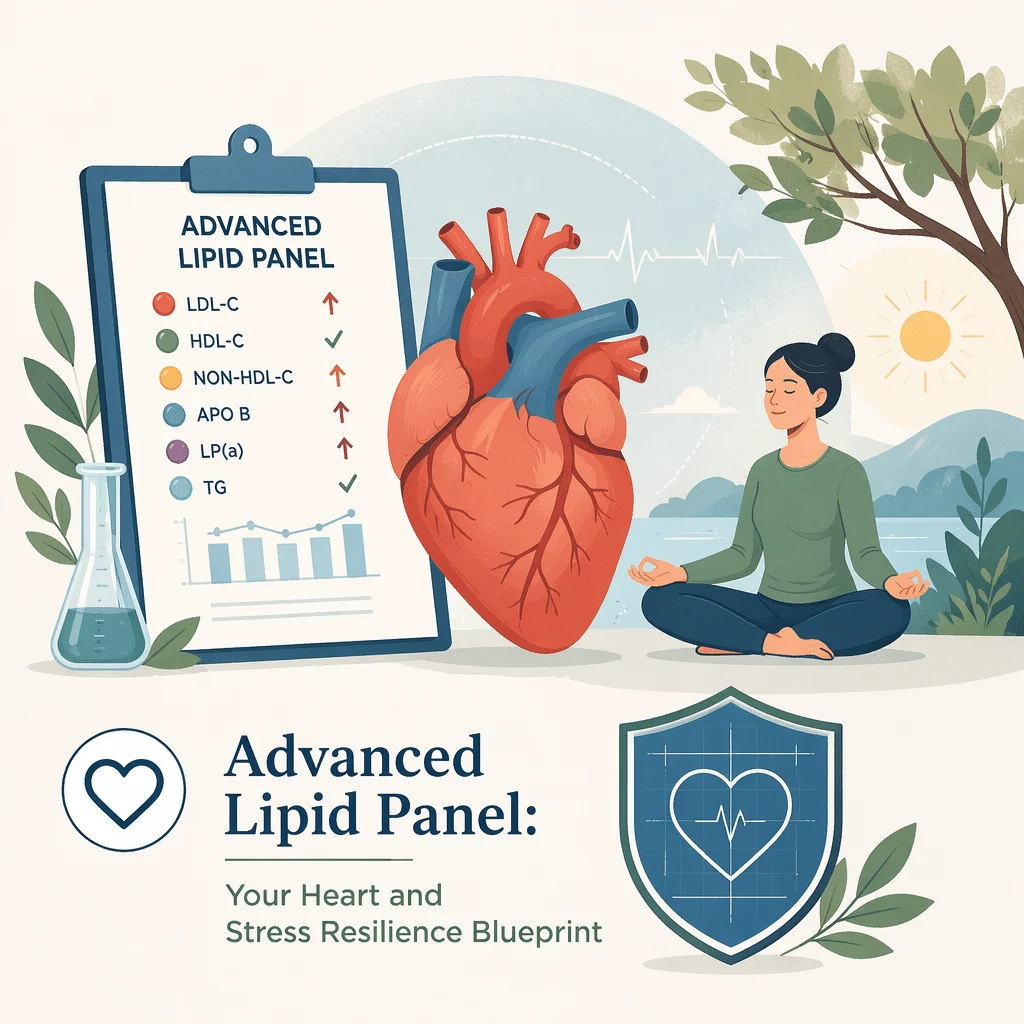
Um painel lipídico avançado vai além do exame de colesterol convencional para medir os marcadores mais diretamente ligados à formação de placas e infartos: apolipoproteína B (ApoB), lipoproteína(a), número de partículas de LDL e outros. Enquanto um painel básico estima a quantidade de colesterol que você carrega, o painel lipídico avançado analisa quantas partículas prejudiciais estão presentes e de que tipo são. Esse nível extra de detalhe pode revelar riscos em pessoas cujos resultados comuns de colesterol parecem tranquilizadores. Neste artigo, você vai entender o que o painel mede, como ele se diferencia de um exame de rotina, quem se beneficia dele e como interpretar os resultados.
O que um painel lipídico avançado mede
Um painel convencional informa o colesterol total, o colesterol LDL (LDL-C), o colesterol HDL e os triglicerídeos. O painel lipídico avançado mantém esses valores e acrescenta marcadores que descrevem o número de partículas, o tipo de partícula e o risco hereditário. O menu exato varia conforme o laboratório, mas as adições principais são consistentes.
| Marcador | O que ele acrescenta além do colesterol convencional |
|---|---|
| ApoB | Uma contagem direta de partículas aterogênicas (que formam placas) |
| Lipoproteína(a) | Risco hereditário que um painel de rotina não detecta |
| Número de partículas de LDL (LDL-P) | Total de partículas de LDL, que pode estar elevado mesmo quando o LDL-C parece normal |
| LDL pequeno e denso | A subfração de LDL menor, com maior capacidade de penetrar nas artérias |
| Colesterol não-HDL | Colesterol em todas as partículas aterogênicas combinadas |
| ApoA1 e proporções | O lado protetor e o equilíbrio entre partículas prejudiciais e protetoras |
Como ele se diferencia de um painel lipídico convencional
A diferença está em partículas versus massa de colesterol. Um painel de rotina mede o colesterol dentro das suas partículas e depois estima o LDL-C por meio de uma fórmula. Isso funciona bem para a maioria das pessoas, mas pode ser enganoso quando as partículas são pequenas e densas ou quando os triglicerídeos estão altos, pois o mesmo valor de LDL-C pode esconder contagens de partículas muito diferentes. Os exames avançados medem as partículas de forma mais direta, o que torna o quadro mais preciso exatamente nessas situações. Para conhecer a base sobre a qual os exames avançados se constroem, consulte um painel lipídico.
Os principais marcadores, um a um
ApoB: a contagem de partículas
Cada partícula aterogênica carrega uma molécula de ApoB, por isso a ApoB é a medida mais direta de quantas partículas formadoras de placa você possui. Muitos especialistas em lipídios a consideram o número mais importante de um painel avançado. Por merecer uma explicação completa, abordamos metas e interpretação em um guia dedicado à exame de ApoB.
Lipoproteína(a): o marcador hereditário
A lipoproteína(a), escrita Lp(a), é uma partícula semelhante ao LDL cujo nível é determinado principalmente pelos seus genes e permanece bastante estável ao longo da vida. Lp(a) elevada aumenta o risco de doenças cardíacas e AVC independentemente dos seus outros valores, por isso as diretrizes recomendam medi-la pelo menos uma vez na vida adulta. Se ela costuma ser alta na sua família, pergunte sobre rastreamento de lipoproteína(a).
Número de partículas de LDL e LDL pequeno e denso
O número de partículas de LDL (LDL-P) conta diretamente as partículas de LDL, e o LDL pequeno e denso identifica o subtipo com maior probabilidade de penetrar nas paredes das artérias. Quando o LDL-P está alto, mas o LDL-C parece normal, essa discrepância — chamada de discordância — indica um risco oculto. Esse é o principal motivo pelo qual os exames avançados existem.
ApoA1 e proporções
A ApoA1 está presente nas partículas protetoras de HDL, refletindo o lado benéfico do equilíbrio. Comparar as frações prejudiciais e protetoras, ou analisar o seu relação colesterol, acrescenta um contexto que um único número não consegue fornecer. Pessoas que também apresentam colesterol HDL baixo geralmente se beneficiam mais dessa visão mais completa.
Quem deve considerar o painel lipídico avançado?
Um painel lipídico avançado é mais útil quando um exame padrão deixa dúvidas sem resposta. Seu médico pode sugerí-lo se você tiver:
- Diabetes, pré-diabetes, síndrome metabólica ou resistência à insulina
- Triglicerídeos elevados ou LDL-C normal que parece inconsistente com o seu risco
- Histórico pessoal ou familiar de infarto ou AVC precoce
- Doença cardiovascular conhecida que você está gerenciando ativamente
- Dúvida sobre iniciar ou intensificar o tratamento
A diretriz de dislipidemia ACC/AHA de 2026 apoia o uso seletivo desses exames adicionais. Ela recomenda medir a Lp(a) pelo menos uma vez e usar a ApoB para refinar o risco e orientar o tratamento em pessoas com síndrome cardiovascular-renal-metabólica, diabetes tipo 2, triglicerídeos elevados ou doença cardíaca estabelecida que já atingiram suas metas de LDL-C e não-HDL-C.
Como interpretar um painel lipídico avançado
Leia o painel como um conjunto de pistas relacionadas, não como números isolados. O sinal mais informativo costuma ser a discordância: um marcador de número de partículas, como ApoB ou LDL-P, que está mais alto do que os valores de colesterol indicariam. As metas abaixo são frequentemente citadas, mas seus objetivos pessoais dependem do seu risco geral e devem ser definidos com seu médico.
| Marcador | Meta ou alerta frequentemente citado |
|---|---|
| ApoB | Geralmente ideal abaixo de 80 mg/dL; 130 mg/dL ou mais é considerado alto |
| Lipoproteína(a) | Alto a partir de 50 mg/dL (cerca de 125 nmol/L) |
| Número de partículas de LDL | Comparar com o LDL-C para identificar discordância |
| Colesterol não-HDL | Abaixo de 130 mg/dL para muitos adultos, mais baixo em casos de maior risco |
Jejum, custo e como o exame é realizado
Um painel lipídico avançado é feito com uma única coleta de sangue. O jejum geralmente não é necessário, embora alguns laboratórios solicitem 12 horas de jejum quando triglicerídeos ou um perfil lipídico completo estão incluídos — siga as orientações do seu laboratório. Os exames avançados custam mais do que um painel básico e nem sempre são cobertos pelo plano de saúde, por isso vale confirmar o preço e a cobertura com antecedência e conversar com seu médico sobre quais marcadores extras fazem sentido para o seu caso.
Últimos avanços científicos
As pesquisas continuam aprimorando a forma como esses marcadores adicionais melhoram a previsão de risco. Veja o que os estudos mais recentes acrescentam, em linguagem simples.
Um estudo de 2025 comparou medidas lipídicas padrão e avançadas, além de marcadores de inflamação, em pessoas com e sem doença arterial coronariana. Os modelos que incluíram marcadores avançados — como LDL pequeno e denso, lipoproteína(a) e análise detalhada das partículas de HDL — previram a doença com mais precisão do que os modelos baseados apenas no colesterol convencional. Em termos práticos, o detalhamento extra ajudou a identificar pessoas de alto risco cujos exames comuns pareciam apenas levemente alterados. São achados de pesquisa que ainda precisam de confirmação em grupos mais amplos, mas reforçam por que os exames no nível de partículas podem ser importantes.
Uma análise de 2025 com mais de 41.000 adultos do UK Biobank (um grande grupo acompanhado ao longo do tempo) constatou que, quando ApoB e o número de partículas de LDL divergiam, o ApoB era o melhor preditor de infartos e artérias bloqueadas, com o risco aumentando mesmo em pequenas discordâncias. O que isso significa para você é que medir o número de partículas, e não apenas o colesterol, pode detectar riscos que um exame de rotina deixaria passar.
Esses resultados mais recentes se baseiam em um consenso laboratorial consolidado de que o não-HDL-C, a ApoB e o número de partículas de LDL aprimoram a avaliação de risco por meio da análise de discordância, especialmente em pessoas com triglicerídeos elevados ou LDL-C muito baixo. A conclusão prática é consistente: os exames avançados são mais valiosos quando o quadro padrão é incerto.
Glossário
- Painel lipídico avançado: exame de sangue ampliado que acrescenta marcadores de partículas e de risco hereditário ao exame de colesterol convencional.
- ApoB (apolipoproteína B): proteína presente em cada partícula aterogênica; uma contagem direta do número de partículas.
- Lipoproteína(a): partícula hereditária semelhante ao LDL que representa um risco cardiovascular independente.
- Número de partículas de LDL (LDL-P): a contagem total de partículas de LDL no sangue.
- LDL pequeno e denso: o subtipo de LDL menor e mais denso, com maior probabilidade de penetrar nas paredes das artérias.
- Não-HDL-C: colesterol total menos HDL, abrangendo todas as partículas aterogênicas.
- ApoA1: a principal proteína nas partículas protetoras de HDL.
- Discordância: uma divergência entre a massa de colesterol e o número de partículas.
Perguntas frequentes
O que é um painel lipídico avançado? É um exame de colesterol ampliado que inclui marcadores como ApoB, lipoproteína(a) e número de partículas de LDL para oferecer uma visão mais completa do risco cardíaco do que um painel convencional.
Qual a diferença em relação ao painel lipídico convencional? O painel convencional estima o colesterol transportado pelas partículas, enquanto o painel avançado mede quantas partículas existem e de que tipo, o que pode revelar riscos que os valores de colesterol não detectam.
É necessário estar em jejum? Muitas vezes não, mas alguns laboratórios solicitam 12 horas de jejum quando os triglicerídeos ou um perfil lipídico completo estão incluídos. Siga as orientações do seu laboratório.
Quanto custa? Custa mais do que um painel básico e a cobertura varia, por isso confirme o preço e os benefícios do seu plano de saúde antes de realizar o exame.
É possível reduzir a lipoproteína(a)? A Lp(a) é predominantemente genética e muda pouco com o estilo de vida, por isso o foco costuma ser no controle adequado dos outros fatores de risco. Novas terapias direcionadas estão sendo estudadas.
E se o meu painel convencional estiver normal? Um painel avançado ainda pode revelar riscos ocultos — especialmente ApoB elevada, Lp(a) alta ou número elevado de partículas — em pessoas cujos exames de rotina parecem normais.
Leitura complementar
- Exame de ApoB: o número mais importante
- Painel lipídico completo explicado
- Rastreamento de lipoproteína(a)
- Apolipoproteína A1 e partículas protetoras
- Colesterol alto: entenda, previna e aja
Fontes
- American College of Cardiology / American Heart Association. Diretriz 2026 para o Manejo da Dislipidemia (nota de imprensa), 2026. https://newsroom.heart.org/news/accaha-issue-updated-guideline-for-managing-lipids-cholesterol
- Cleveland Clinic. Exame de Apo B. https://my.clevelandclinic.org/health/diagnostics/24992-apolipoprotein-b-test
- Devaraj S, Semaan JR, Jialal I. Bioquímica, Apolipoproteína B. StatPearls, NIH National Library of Medicine, 2023. https://www.ncbi.nlm.nih.gov/books/NBK538139/
- Langlois MR, et al. Quantifying Atherogenic Lipoproteins: EAS-EFLM Consensus Statement. Clinical Chemistry, 2018. https://consensus.app/papers/details/d00ab47984df5a5b941c198fdd1eb065/
- Stock E, et al. HDL Particles, Inflammation, and Coronary Heart Disease Risk. Nutrients, 2025. https://consensus.app/papers/details/d85453427e575146859d80f3c0e0c721/
- Epstein E, et al. A apolipoproteína B supera o número de partículas de LDL como marcador de risco cardiovascular no UK Biobank. Eur J Prev Cardiol, 2025. https://consensus.app/papers/details/4b787ca8162d5dbe969b3f334d8ead3a/
Entenda os resultados dos seus exames com o AI DiagMe.
Um painel lipídico avançado gera muitos números, e o significado deles está em como se encaixam entre si. O AI DiagMe lê o exame que você enviou e explica o que seus valores de ApoB, lipoproteína(a), número de partículas e colesterol podem significar para a saúde do seu coração, em linguagem clara, para que você possa preparar perguntas objetivas para o seu médico. Ele ajuda você a entender seus resultados; não diagnostica doenças nem substitui seu médico.
Obtenha a interpretação dos seus resultados em minutos.