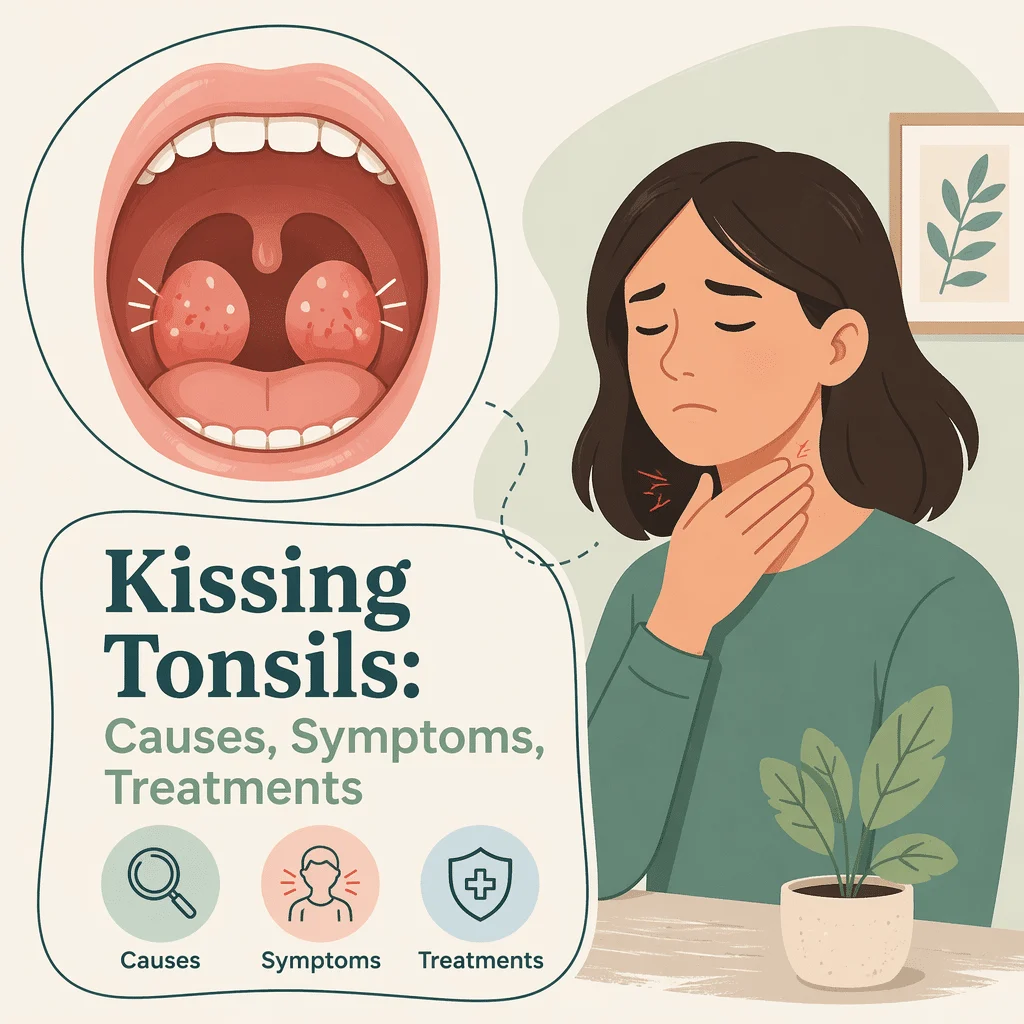
Kissing tonsils are tonsils that have grown so large they touch, or almost touch, in the middle of the throat. Doctors call this grade 4 tonsillar hypertrophy on the Brodsky scale, the simple ruler used to measure tonsil size during a routine throat exam. The name sounds alarming, but it describes a size, not a diagnosis: some people with kissing tonsils breathe, sleep and swallow normally, while others struggle every night. In this article you’ll learn what makes tonsils enlarge this much, how the grading scale works, which symptoms deserve a prompt appointment, how doctors choose between watching, medicine and surgery, and what a blood test can add when the cause of the swelling is unclear.
What kissing tonsils are
The palatine tonsils are two pads of immune tissue set into the side walls of the throat, one behind each side of the tongue. They sample germs that arrive through the mouth and nose and help train the immune system, which is why they are proportionally largest in early childhood. Kissing tonsils describe the extreme end of normal variation: tissue that has expanded until the two pads meet at the midline and leave only a narrow channel for air and food.
Enlargement is usually a slow, painless process. Tonsil tissue that is repeatedly stimulated by infection, allergens or irritants responds by growing more immune cells, and that added bulk does not always shrink back between episodes. The result is a throat that looks dramatic on examination even when the person feels well.
Kissing tonsils versus tonsillitis
The two are often confused. Tonsillitis is inflammation, usually short lived, with pain, redness, fever and sometimes white patches. Kissing tonsils are a matter of size, which may persist for years without any pain at all. A person can have large tonsils and no infection, an infection with normal sized tonsils, or both at once. Telling them apart matters, because pain and fever point toward treating an infection, while chronic bulk without pain points toward assessing breathing. When only one side swells, our team explains the causes of unilateral tonsillitis.
The Brodsky grading scale: how doctors size tonsils
Rather than guessing, clinicians grade tonsils from 0 to 4 according to how much of the oropharynx, the opening at the back of the mouth, the tissue blocks. The scale takes seconds with a light and a tongue depressor, and it gives everyone the same vocabulary. Kissing tonsils sit at the top of this scale, at grade 4.
| Brodsky grade | Share of the throat opening taken up | What it usually means in practice |
|---|---|---|
| Grade 0 | None; tonsils sit inside their pockets or have been removed | No obstruction from tonsil tissue |
| Grade 1 | Up to about a quarter | Common and generally unremarkable |
| Grade 2 | About a quarter to a half | Visibly enlarged, often without symptoms |
| Grade 3 | About a half to three quarters | Snoring and noisy breathing become more likely |
| Grade 4 | More than three quarters; the tonsils meet or nearly meet | The pattern called kissing tonsils; sleep and swallowing are assessed closely |
Why the grade alone does not decide treatment
A grade is a starting point, not a verdict. The scale measures width seen from the front, so it can underestimate tonsils that extend backward or downward, and a case report published in 2026 described a patient whose airway was more obstructed on endoscopy than the mouth exam suggested. Just as often the reverse is true: a child with grade 4 tonsils may sleep soundly, while a child with grade 2 tonsils and a small jaw may not. Symptoms, sleep quality and daytime function carry more weight than the number itself.
What causes kissing tonsils
Repeated and chronic infection
The most common driver is a history of frequent throat infections. Each episode recruits immune cells into the tonsils, and after enough episodes the tissue stays enlarged. Viruses cause most sore throats; group A streptococcus is the main bacterial cause and the one worth identifying, because it is treatable and carries its own complications.
Sudden swelling: infectious mononucleosis
Not all enlargement is gradual. Infectious mononucleosis, caused by the Epstein-Barr virus, can swell the tonsils dramatically over a few days, alongside fever, deep fatigue and swollen neck glands. This acute form matters because the airway can narrow quickly. Reports in the medical literature, including a 2024 case of an adult who needed a breathing tube, describe severe upper airway obstruction as an uncommon but genuine complication of mononucleosis. A 2023 review for family physicians reached a practical conclusion: steroids should not be used for ordinary mononucleosis symptoms in children, and are reserved for situations such as a threatened airway. Our library also covers the symptoms of throat herpes, another viral cause of a painful throat.
Allergies, irritants and body weight
Persistent nasal allergy, secondhand smoke and chronic reflux keep the throat lining irritated and can contribute to lasting enlargement. Body weight matters too. In a 2026 study of children with overweight and obesity, enlarged tonsils stood out as the single strongest predictor of being at high risk for sleep apnea, which suggests the two factors compound each other rather than acting alone.
Structural crypts and debris
Large tonsils have deep surface pits, and those pits collect food particles, cells and bacteria that harden into pale lumps. This is a nuisance rather than a danger, though it explains persistent bad breath in many people with big tonsils. This guide covers the symptoms of hidden tonsil stones.
Symptoms and complications
Signs during sleep
Sleep is where kissing tonsils usually announce themselves. Loud habitual snoring, pauses in breathing followed by a gasp, mouth breathing, restless tossing, unusual sleeping positions with the neck extended, night sweats and bedwetting that returns after being resolved are the classic pattern. Together these point toward obstructive sleep apnea, in which the airway repeatedly narrows or closes during sleep. Our team describes the diagnosis and treatment of sleep apnea.
Signs during the day
Daytime clues include a muffled or hot potato voice, chronic mouth breathing with dry lips, trouble swallowing larger pieces of food, slow eating, picky eating in young children, and bad breath. Adults more often report a persistent sensation of something in the throat, a changed voice and unrefreshing sleep.
Why untreated obstruction matters
Children rarely respond to poor sleep by looking sleepy. They more often become irritable, inattentive or hyperactive, which is why disturbed breathing at night can be mistaken for a behavior problem. A 2026 systematic review pooling long term studies confirmed that obstructive sleep apnea and attention deficit hyperactivity disorder occur together in children more often than chance would predict. Growth, learning and blood pressure can all be affected when significant obstruction continues for months or years, which is the main reason clinicians take grade 4 tonsils seriously even when the person is not in pain.
When to see a doctor
Large tonsils alone are not an emergency. The following signs, however, deserve a medical opinion rather than watchful waiting at home.
- Snoring most nights, especially with visible pauses in breathing, gasping or choking sounds
- Working hard to breathe during sleep: chest pulling inward, neck stretched back, or sitting up to breathe
- Difficulty swallowing solid food, or avoiding food because swallowing is uncomfortable
- A muffled voice, drooling, or an inability to swallow saliva
- A child who has stopped gaining weight or has slipped down the growth curve
- Daytime sleepiness, morning headaches, or a new decline in attention and school performance
- Sore throat with high fever that is not improving after two to three days
Seek urgent care for shortness of breath at rest, noisy breathing while awake, an inability to swallow saliva, a swollen throat with severe one sided pain, or lips that look blue or gray. These suggest an airway that is narrowing quickly rather than a slow enlargement.
How kissing tonsils are diagnosed
The throat exam
Diagnosis begins with looking. A clinician grades the tonsils, checks the tongue position, examines the nose for blockage, and asks about snoring, choking, daytime behavior and school performance. Adenoids, the lymph tissue behind the nose, are often enlarged at the same time and may be assessed with a small flexible camera or an X-ray.
Sleep studies
Because size and symptoms match imperfectly, an overnight sleep study, called polysomnography, is the reference test when apnea is suspected. It counts breathing interruptions per hour and measures oxygen levels, and it distinguishes simple snoring from apnea, which changes the treatment conversation.
What blood tests can and cannot tell you
No blood test measures tonsil size. What blood work does well is sort out cause, particularly when the swelling is recent, painful or accompanied by fever, and that is often the missing piece when someone is told only that their tonsils are large.
- A complete blood count shows the pattern of white blood cells: a rise in lymphocytes with unusual looking cells points toward a viral illness such as mononucleosis, while a neutrophil predominant pattern is more typical of a bacterial infection.
- A heterophile antibody test, often called a monospot, or Epstein-Barr virus serology helps confirm mononucleosis when the picture is suggestive.
- C-reactive protein and the erythrocyte sedimentation rate gauge how much inflammation is present, though neither identifies the germ responsible.
- A rapid strep test or throat swab culture checks specifically for group A streptococcus.
Read together, these results help separate an acute infection that will settle from long standing enlargement that will not. Our team explains how to read a complete blood count. This article details the causes of high lymphocytes, and our team also covers the causes of high neutrophils. We describe the role of C-reactive protein as an inflammation marker, and this guide explains the meaning of the erythrocyte sedimentation rate. For antibody results, this article explains the meaning of IgM antibody results.
Treatment options
Watchful waiting and supportive care
When symptoms are mild, doing nothing active is a legitimate plan. Tonsils tend to shrink relative to the throat during later childhood, and many children outgrow the problem. Watchful waiting means scheduled review rather than being forgotten: symptoms are reassessed, and the plan changes if sleep worsens.
Medicines
Antibiotics treat a bacterial infection and can shrink tonsils that are swollen because of that infection, but they do not reduce tissue enlarged by years of stimulation. Nasal sprays help when blocked nasal breathing adds to the obstruction. Allergy treatment, reflux management, and avoiding tobacco smoke all remove ongoing irritants. Our library describes the signs of an amoxicillin allergy, a common reason a first line antibiotic is changed.
Surgery
Removing the tonsils, usually together with the adenoids, is the most effective treatment for obstruction caused by kissing tonsils, and it is generally considered when sleep apnea is confirmed, when swallowing or growth is affected, or when infections are both frequent and documented. A partial technique that shaves the tonsil down rather than removing it entirely is increasingly used in children whose problem is obstruction rather than infection, because recovery tends to be quicker. Surgery carries real if uncommon risks, chiefly bleeding and dehydration from painful swallowing during recovery, so the decision balances how much the obstruction is costing against those risks.
Adults with kissing tonsils
Adults are less likely to outgrow enlargement and more likely to have several contributors at once, including body weight, nasal obstruction and the shape of the jaw. Tonsillectomy still helps selected adults, but sleep apnea in adults frequently persists afterward and may need continuous positive airway pressure or other measures alongside surgery. Any tonsil that is enlarged on one side only, firm, or associated with weight loss should be examined by a specialist rather than assumed to be simple hypertrophy.
Latest scientific advances
Research since 2023 has refined when to operate and when to wait. The findings below come from studies indexed in PubMed, and each is followed by what it means for a family facing this decision.
Surgery helps mild cases, but the gains are modest
A 2025 systematic review and meta-analysis, which pooled 27 studies, found that adenotonsillectomy improved both sleep questionnaire scores and measured breathing interruptions in children with mild obstructive sleep apnea, and outperformed simply waiting. The authors were careful to note that the average improvements were small and that individual circumstances should guide the choice. What this means for you: for mild cases, surgery is a reasonable option rather than an obligation, and a discussion about your child’s specific symptoms is more useful than a rule.
Waiting is often safe, but symptoms need rechecking
An analysis published in 2026 followed children with mild sleep disordered breathing who were observed rather than operated on, drawn from the control group of a large randomized trial. Over a year, only about one child in eight got measurably worse on a repeat sleep study, yet more than half still had persistent or worsening symptoms. What this means for you: watchful waiting rarely leads to a sudden deterioration, but a follow up appointment matters, because feeling no better is a common and legitimate reason to revisit the plan.
A saline spray is a sensible first step
A randomized clinical trial published in JAMA Pediatrics in 2026 tested nasal sprays in children aged 3 to 12 with obstructive sleep disordered breathing. Six weeks of plain saline resolved symptoms in close to a third of them, and adding a steroid spray for a further six weeks produced no extra benefit over continuing saline; overall about half improved. What this means for you: a simple, low risk saline spray used consistently for a few months is a reasonable first move before a sleep study or surgery is considered, though it will not resolve severe obstruction.
Tonsil size is a clue, not a prediction
A 2026 Finnish study of children with additional medical conditions found that tonsil surgery improved sleep apnea substantially, yet the size of the tonsils correlated only weakly with how much each child improved. A separate 2026 study reported that swallowing related quality of life was markedly worse in children with enlarged tonsils and disturbed breathing, returned to normal three months after surgery, and again was not tied to the tonsil grade. A secondary analysis of a major randomized trial, published in 2025, adds a mechanical explanation: how easily the throat collapses and how the body responds to it vary from child to child, independently of tonsil bulk. What this means for you: a grade 4 result does not predict how much you will benefit, and a lower grade does not rule benefit out. These are all observational or secondary analyses, so they inform the conversation rather than settle it.
Weight and attention symptoms belong in the picture
Among children with overweight and obesity studied in 2026, enlarged tonsils were the strongest single predictor of being at high risk for sleep apnea. And a 2026 systematic review of long term studies confirmed that obstructive sleep apnea and attention deficit hyperactivity disorder cluster together in children. What this means for you: if a child has both large tonsils and daytime attention or behavior difficulties, mentioning the night time breathing to the clinician is worthwhile, because the two may be connected.
Glossary
| Term | Definition |
|---|---|
| Adenoids | A patch of immune tissue high behind the nose. It often enlarges at the same time as the tonsils and is removed in the same operation. |
| Adenotonsillectomy | Surgery that removes both the tonsils and the adenoids in one procedure. |
| Apnea-hypopnea index | The average number of times per hour that breathing stops or becomes very shallow during sleep. It is the main number produced by a sleep study. |
| Brodsky scale | A 0 to 4 grading system that records how much of the throat opening the tonsils occupy. Grade 4 corresponds to kissing tonsils. |
| Complete blood count (CBC) | A common blood test that counts red cells, white cells and platelets. The white cell pattern helps suggest whether an infection is viral or bacterial. |
| Heterophile antibody test | A rapid blood test, often called a monospot, used to support a diagnosis of infectious mononucleosis. |
| Infectious mononucleosis | An illness usually caused by the Epstein-Barr virus, with fever, sore throat, marked fatigue and swollen glands. It can enlarge the tonsils quickly. |
| Oropharynx | The middle part of the throat, visible at the back of the open mouth, where the tonsils sit. |
| Polysomnography | An overnight sleep study that records breathing, oxygen levels, heart rate and sleep stages. It is the reference test for sleep apnea. |
| Tonsillar hypertrophy | The medical term for enlarged tonsils. Grade 4 tonsillar hypertrophy is the formal name for kissing tonsils. |
Frequently asked questions
Are kissing tonsils an emergency?
In most cases, no. Tonsils that have enlarged slowly over months or years are not an emergency, even at grade 4, and are handled through a scheduled appointment. The situation changes when swelling comes on quickly, as it can with infectious mononucleosis or an abscess. Trouble breathing at rest, noisy breathing while awake, inability to swallow saliva, drooling in someone old enough to control it, or bluish lips call for urgent care the same day. The distinguishing question is usually how fast things changed.
Are kissing tonsils dangerous?
The size itself is not dangerous, but the obstruction it can cause deserves attention. The main concern is obstructive sleep apnea, where repeated interruptions in breathing fragment sleep and lower oxygen levels. Over time that can affect growth, learning, behavior and blood pressure in children. Many people with grade 4 tonsils have none of this and need no treatment, which is why the assessment focuses on how you sleep, eat and function rather than on the appearance alone.
What is the medical term for kissing tonsils?
The formal term is grade 4 tonsillar hypertrophy, sometimes written as grade 4 tonsils or severe adenotonsillar hypertrophy when the adenoids are enlarged too. Hypertrophy simply means that tissue has increased in size. The informal name comes from the appearance of the two tonsils meeting in the midline.
Can adults get kissing tonsils?
Yes. Enlargement is most common in children between roughly three and eight years old, but it happens in adults, either persisting from childhood or developing after repeated infections. In adults it is more likely to sit alongside other contributors such as body weight, nasal blockage or jaw shape, and treatment is more often a combination of approaches than surgery alone. New enlargement on one side only in an adult should always be examined by a specialist.
Will antibiotics shrink kissing tonsils?
Only when the swelling is caused by a current bacterial infection. In that situation antibiotics treat the infection and the tonsils return to their baseline size, which may still be large. Antibiotics do not reduce tissue that has enlarged over years of repeated stimulation, and they have no effect on viral causes. Repeated courses prescribed in the hope of shrinking chronically large tonsils are not effective and contribute to antibiotic resistance.
Can kissing tonsils come back after surgery?
Complete removal of the tonsils makes regrowth very unlikely, though small amounts of remaining tissue can occasionally enlarge again. Partial techniques that shave the tonsil down preserve a rim of tissue by design, so a small proportion of children need a repeat procedure later. Adenoids can also regrow in young children. When symptoms return after surgery, the cause is often something other than the tonsils, such as nasal allergy or another site of narrowing in the airway, which is why a fresh assessment is preferred over assuming regrowth.
Sources
- MedlinePlus Medical Encyclopedia — Tonsillitis — U.S. National Library of Medicine, 2025 — https://medlineplus.gov/ency/article/001043.htm
- National Heart, Lung, and Blood Institute — Sleep Apnea — National Institutes of Health, 2025 — https://www.nhlbi.nih.gov/health/sleep-apnea
- Mayo Clinic — Tonsillitis: Symptoms and causes, 2025 — https://www.mayoclinic.org/diseases-conditions/tonsillitis/symptoms-causes/syc-20378479
- Cleveland Clinic — Tonsillitis: Symptoms, Causes and Treatment, 2025 — https://my.clevelandclinic.org/health/diseases/21146-tonsillitis
- Johns Hopkins Medicine — Tonsillitis, 2025 — https://www.hopkinsmedicine.org/health/conditions-and-diseases/tonsillitis
- Alomari O, Ertan SN, Mokresh ME, et al. — Revisiting the efficiency and necessity of adenotonsillectomy in children with mild obstructive sleep apnea: a systematic review and meta-analysis — European Archives of Oto-Rhino-Laryngology, 2025 — https://doi.org/10.1007/s00405-025-09380-2
- Kirkham EM, Ishman S, Garetz S, et al. — Progression of mild sleep-disordered breathing in children managed with watchful waiting — Journal of Clinical Sleep Medicine, 2026 — https://doi.org/10.1007/s44470-026-00082-y
- Nixon GM, Anderson D, Baker A, et al. — Intranasal Treatments for Children With Sleep-Disordered Breathing: The MIST+ Randomized Clinical Trial — JAMA Pediatrics, 2026 — https://doi.org/10.1001/jamapediatrics.2025.5717
- Virkkunen J, Kirjavainen T, Nokso-Koivisto J, Sakki AJ — Tonsil surgery is an effective treatment for pediatric obstructive sleep apnea irrespective of underlying comorbidities — International Journal of Pediatric Otorhinolaryngology, 2026 — https://doi.org/10.1016/j.ijporl.2026.112883
- Faranesh N, Zoabi T — Swallowing dysfunction and quality of life in children with tonsillar hypertrophy and sleep-disordered breathing: a prospective cohort study — International Journal of Pediatric Otorhinolaryngology, 2026 — https://doi.org/10.1016/j.ijporl.2026.112926
- Suriyasathaporn J, Tanphaichitr A, Densupsoontorn N, et al. — Prevalence of high risk for obstructive sleep apnea and its impact on quality of life in children with overweight and obesity — International Journal of Pediatric Otorhinolaryngology, 2026 — https://doi.org/10.1016/j.ijporl.2026.112912
- Tsou PY, Alex RM, Redline S, et al. — Pathophysiological traits in pediatric obstructive sleep apnea: a secondary analysis of the CHAT clinical trial — Annals of the American Thoracic Society, 2025 — https://doi.org/10.1513/AnnalsATS.202412-1302OC
- Leow BHW, Tan CJ, Yeo BSY, et al. — Association between attention deficit hyperactivity disorder and obstructive sleep apnea in children: a systematic review and meta-analysis — Journal of Attention Disorders, 2026 — https://doi.org/10.1177/10870547261426094
- Gomes K, Goldman RD — Corticosteroids for infectious mononucleosis — Canadian Family Physician, 2023 — https://doi.org/10.46747/cfp.6902101
- Peralta DP, Chang AY — Severe upper airway obstruction in a patient with infectious mononucleosis — Cureus, 2024 — https://doi.org/10.7759/cureus.58735
- Aboobakar RM, Ibañez GAM, Mestre LGI — Clinical-endoscopic discrepancy in severe tonsillar hypertrophy: when oropharyngeal examination underestimates airway obstruction — Cureus, 2026 — https://doi.org/10.7759/cureus.108029
Further reading
- How to Read Your Blood Test Results: A Complete Guide
- Normal Blood Test Ranges: A Reference Chart Explained
- Abnormal Blood Test Results: What They Mean and What to Do
- Sinus Infection: Symptoms, Causes, and Treatments
- Ear Infection Symptoms, Causes, and Treatments
Understand your lab results with AI DiagMe
When tonsils are large, the useful question is often why, and blood work is a large part of that answer. AI DiagMe reads your report and explains, in plain language, what a complete blood count, a mononucleosis antibody test, C-reactive protein or a sedimentation rate suggest about whether an infection is driving the swelling or whether the enlargement is long standing. It helps you understand the numbers and prepare better questions for your appointment. It does not make a diagnosis and does not replace your doctor, who examines your throat and decides what to do next.
Get your results interpreted in minutes