




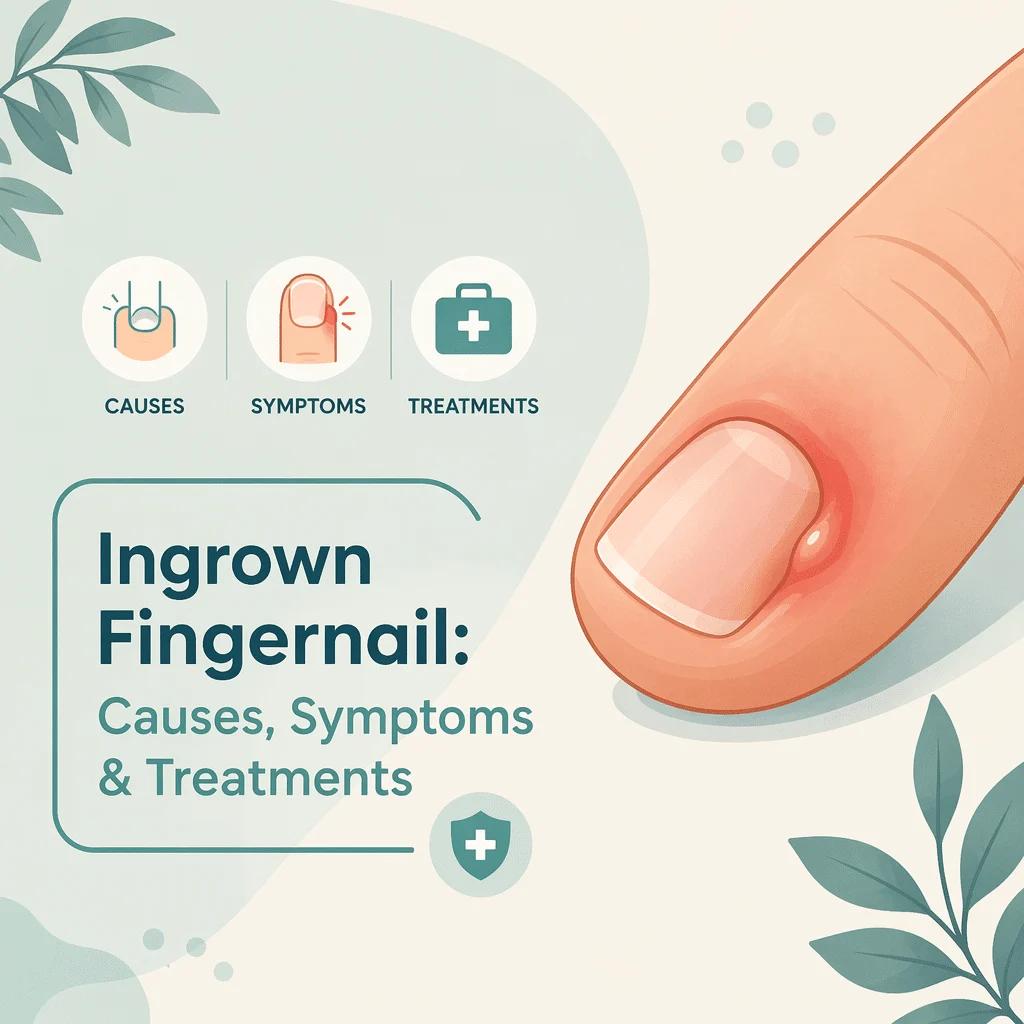
An ingrown fingernail happens when the edge of a nail presses into the soft skin folding around it, causing pain, redness, swelling and sometimes pus. It is far less common than an ingrown toenail, but it hurts more for its size, and it can turn into a genuine infection within a day or two. In this article you will learn how to tell an irritated nail fold from an infection that needs a clinician, what safe home care looks like in the first 48 hours, which lab tests add something, and what recent research has changed.
What an ingrown fingernail actually is
Each nail plate slides forward inside a shallow groove. The walls of that groove are the lateral nail folds, and the ridge of skin at the base is the proximal fold, the part most people call the cuticle. An ingrown fingernail develops when the nail edge stops sliding cleanly and presses into or pierces one of those folds. Skin then reacts as it would to a splinter: it swells, reddens and becomes tender.
Two things follow. The problem starts as a mechanical one, so lasting relief comes from changing how the nail edge meets the skin rather than from medication alone. And once the skin barrier is broken, bacteria that live harmlessly on your hands can slip underneath, at which point irritation becomes an infection of the nail fold, known as paronychia.
Most research on ingrown nails has been done on toes, so the risk figures you read often come from toenail studies. The mechanics carry across, but hands are washed, scrubbed, bitten and manicured far more than feet, so moisture and repeated small injuries dominate. If your trouble is on the foot instead, a separate guide covers diabetic toenail changes.
What causes an ingrown fingernail
Almost every ingrown fingernail traces back to one of six situations, and the prevention step differs in each.
Biting, picking and torn hangnails
Nail biting and cuticle picking lead the list on the hand. Both leave a ragged nail edge and an open seam of skin at once. Tearing off a hangnail, the strip of loose skin beside the nail, rips the seal that keeps water and bacteria out of the fold.
Cutting the nail too short or too curved
Rounding the corners leaves a hidden spur of nail under the skin, and cutting into the quick removes the buttress that holds the fold away from the nail edge. As the nail grows out, that spur meets skin instead of open air.
Manicures, gels and artificial nails
Aggressive cuticle trimming, hard pushing back of the proximal fold, filing under the free edge and gel or glue-on enhancements all disturb the seal at the base of the nail. Shared, poorly cleaned implements add bacteria and yeast.
Wet work and constant moisture
Dishwashing, cleaning, hairdressing, food handling and healthcare work keep the nail folds soft and waterlogged, and softened skin gives way under a nail edge far more easily. This is the classic route to a low-grade swelling that grumbles on.
Medicines that reshape the nail folds
Some targeted cancer treatments, in particular EGFR inhibitors and MEK inhibitors, make the nail folds fragile and inflamed. A 2024 review mapping two decades of paronychia research found drug-induced nail fold inflammation has become one of the field’s busiest topics. High-dose vitamin A derivatives used for acne can do something similar. Tell the prescribing team early.
Health conditions that raise the risk
A 2024 matched study of more than 6,000 people with ingrown nails, drawn from a large United States research database, found the condition clustered with fungal nail disease, type 2 diabetes, obesity, poor circulation and lower household income. Skin problems that crack the fingertips also contribute; our library explains eczema and atopic dermatitis.
Symptoms: from early irritation to a red-flag infection
An ingrown fingernail rarely arrives all at once. It moves through recognizable stages, and the stage you are in decides what to do next.
Early irritation, usually in the first one to three days, looks like a narrow band of redness along one side of the nail, tenderness when you press or type, mild swelling and no discharge. The finger still works normally.
An established infection looks different: the swelling turns rounded and shiny, the redness widens, the finger throbs on its own rather than only when touched, warmth is obvious, and a bead of yellow or white pus may sit under the skin. The Centers for Disease Control and Prevention lists redness, swelling, pain, warmth to the touch, pus or other drainage, and fever as signs of a skin infection that deserves a clinician’s attention.
Warning signs that justify same-day care:
- Throbbing that keeps you awake or needs regular painkillers
- Swelling of the fingertip pad, not just the side of the nail
- Red streaks traveling up the finger or hand, or a tender lump in the armpit
- Fever, chills or feeling unwell
- Numbness, a tight shiny fingertip, or a finger you cannot bend
- No improvement after two days of home care, the interval the CDC uses as a prompt to seek help
- Diabetes, a weakened immune system, chemotherapy, or poor circulation
A rash spreading well beyond the finger deserves its own assessment; we describe the main types of skin rash.
Ingrown fingernail, paronychia, felon or herpetic whitlow?
Four problems crowd into the same small piece of skin and are treated very differently. A 2025 narrative review for emergency clinicians makes the key distinction explicit: infection confined to the nail fold behaves nothing like pus trapped in the fingertip pad, which can squeeze the tissue hard enough to choke off its blood supply. Use the table to place your own finger.
| Problem | How it starts | Where the swelling sits | Pus? | What it usually needs |
|---|---|---|---|---|
| Ingrown fingernail, not infected | Nail edge presses into the side fold after biting or close trimming | A thin ridge along one side of the nail | No | Soaks, protection, letting the corner grow past the fold |
| Acute paronychia | Bacteria enter through the broken fold within a day or two | Rounded shiny swelling hugging the nail edge | Often, one yellow pocket | Early soaks; a clinician may drain it and consider antibiotics |
| Felon | Infection reaches the fleshy pad of the fingertip | The whole fingertip turns tense and hard | Yes, under pressure | Urgent assessment, usually surgical drainage |
| Herpetic whitlow | A cold sore virus enters the skin after contact with a cold sore | Side or tip of the finger, with grouped blisters | No, clear blisters instead | Antiviral treatment; cutting into it is avoided |
Herpetic whitlow is the one to be careful about. It comes from a cold sore virus, not bacteria, and produces a cluster of small clear blisters rather than one pocket of yellow pus. Opening it does not help and can spread it, so the label changes the treatment. A related article covers shingles symptoms and testing.
The other trap is time. Anything that has grumbled on for more than six weeks is called chronic paronychia, and a 2023 study of tissue from affected nail folds found it looked primarily inflamed rather than infected, with yeast and bacteria behaving more like passengers than drivers. That helps explain why repeated antibiotic courses often fail in long-standing cases while barrier protection works better.
Safe home care in the first 48 hours
At the early stage, with no pus and no fever, simple measures settle most cases.
- Soak the finger in warm water for ten to fifteen minutes, three or four times a day. Plain water is enough.
- Dry the finger thoroughly, then keep it dry. Waterlogged skin is what gave way in the first place.
- Apply a plain barrier ointment and a loose dressing so the sore fold does not catch on things.
- Use an over-the-counter pain reliever according to the label if you need one.
- Let the nail grow until the corner clears the fold, then cut straight across.
- Remove the trigger: no biting, no picking, gloves for wet work, no manicure on that finger until it settles.
What not to do matters just as much.
- Do not dig the nail corner out with scissors, tweezers or a needle. Cutting into an inflamed fold deepens the wound and pushes bacteria further in.
- Do not squeeze or lance a pus pocket yourself. Trapped pus needs draining under clean conditions by someone trained.
- Do not pack cotton under the nail edge or leave a damp dressing on overnight.
- Do not restart a leftover antibiotic from a previous illness.
Reassess at 48 hours. Clearly better means carry on; the same or worse, or any warning sign, means arrange to be seen.
What a clinician can do, and when antibiotics or drainage matter
The most useful recent shift is a clearer line between infections that need a procedure and those that do not. The 2025 emergency medicine review concluded that early nail fold and early fingertip infections can often be managed with antibiotics and local care alone, while an established collection of pus needs to be opened. Timing decides treatment more than the label does.
Expect a clinician to press gently around the nail to locate any pocket, ask how long it has been there, look for blisters, check sensation and movement, and ask about diabetes, chemotherapy and hand-intensive work. Some emergency departments now place a small ultrasound probe on the finger; in a 2024 study of fifty people with hand infections, bedside ultrasound changed the plan in roughly four cases in ten.
For a stubborn ingrown fingernail that is not infected, two small randomized trials from a Spanish research group are worth knowing about. In the first, reshaping the nail with an acrylic overlay beat the traditional gauze wick tucked under the nail edge: most of the gauze group had the problem return, against about one in ten of the reshaped group. In the second, a local anti-inflammatory injection reduced swelling faster than gauze packing, though one injection did not reliably prevent relapse. Both were small and done on toes, so treat them as promising directions rather than settled practice.
If the nail seems pushed backwards into its base rather than sideways, ask about retronychia. A 2023 case series called it a repeatedly misdiagnosed cause of persistent nail fold swelling, cured by removing the trapped nail.
Which lab tests help with an infected ingrown fingernail
For a straightforward, early ingrown fingernail, no blood test adds anything. Testing earns its place when the infection looks like it is spreading, when it keeps coming back, or when your health raises the stakes.
- A full blood count with a white cell breakdown, to see whether your body has mounted a whole-system response. Our library explains what neutrophils do, and a companion article covers a high neutrophil count.
- An inflammation marker. C-reactive protein rises quickly with bacterial infection, and a 2023 study of ninety hand infections found higher levels tracked with more severe disease and longer hospital stays. We explain raised CRP results, and some services still order an erythrocyte sedimentation rate.
- Procalcitonin, in hospital, when the question is whether bacteria have reached the bloodstream. Our guide covers the procalcitonin test.
- A swab or sample of pus for culture and sensitivity testing, which names the organism and the antibiotics it responds to. In that same series, roughly one sample in six grew nothing, so a negative culture does not rule out infection. A 2024 review of hand infection management stresses matching the antibiotic to the culture result rather than continuing a broad one.
- Glucose testing when infections keep returning. We explain what an HbA1c result means and how to read a fasting blood glucose level.
Resistant bacteria such as MRSA can cause skin infections, which is one reason a sample is taken rather than assuming a standard antibiotic will work. If you are handed a panel instead of one number, we compare a complete blood count and a metabolic panel.
How to stop ingrown fingernails from coming back
Prevention is where the mechanical view pays off. Mayo Clinic guidance on nail care is short and specific: keep nails clean and dry, trim straight across and round the tip only slightly, use sharp clippers, avoid biting nails or picking at hangnails, and leave the cuticle alone, because that seal protects the nail root from infection.
Practical additions for hands that get heavy use:
- Trim after a shower, when the nail is softer, and file any rough corner instead of tearing it.
- Wear waterproof gloves with a cotton liner for dishes, cleaning and gardening, and change them once they feel damp.
- Moisturize the nail folds daily, since supple skin resists a nail edge better than cracked skin.
- Ask a nail technician to skip cuticle cutting and hard pushing back, and bring your own tools where you can.
- Treat a fungal nail rather than living with it, because a thickened nail presses into the fold more easily.
- If you take a targeted cancer therapy, ask about nail protection before problems start. A 2025 evidence summary pulled twelve practical recommendations out of twenty studies, covering risk assessment, education, protection and treatment.
- If you have diabetes, keeping glucose in your target range and checking your hands as carefully as your feet reduces the chance of a small break becoming an infection.
Latest scientific advances
Research on nail fold problems has been quietly busy over the past three years. Here is what has changed, and what it means for you.
Long-standing swelling is more inflammation than infection
Researchers examined tissue from nail folds affected for more than six weeks and found inflammation dominated, with yeast and bacteria looking like opportunists rather than the cause. What this means for you: if a swollen fold has dragged on for months and antibiotics have not helped, the next step is more likely to be barrier protection than another prescription.
A clearer rule for when a finger infection needs draining
The 2025 emergency medicine review set out that early nail fold and fingertip infections can often be treated with antibiotics and local care, while a walled-off pocket of pus needs opening. What this means for you: being seen early changes the treatment you are offered, and waiting at home is reasonable only while the finger improves.
Cancer treatments are now a cause worth planning around
A study mapping twenty years of publications found nail fold inflammation from targeted cancer drugs to be one of the most active research areas, and a 2025 evidence summary distilled twelve practical recommendations. What this means for you: nail protection belongs in the first conversation about these treatments, not the one after a painful finger.
Gentler ways to reshape a nail are being tested
Two small randomized trials compared conservative options for nails not yet infected. Reshaping the nail with an overlay led to far fewer recurrences than the traditional gauze wick, and a local anti-inflammatory injection reduced swelling faster than packing. What this means for you: conservative treatment is a legitimate first step, and removing the nail is not the only option.
Glossary of key terms
| Term | Definition |
|---|---|
| Onychocryptosis | The medical name for an ingrown nail, on a finger or a toe. |
| Paronychia | Inflammation or infection of the skin fold around a nail. Acute paronychia comes on over days; chronic paronychia lasts more than six weeks. |
| Lateral nail fold | The wall of skin running along each side of the nail. This is where an ingrown fingernail usually presses in. |
| Cuticle (eponychium) | The thin seal of skin at the base of the nail that keeps water and bacteria out of the nail root. |
| Hangnail | A small strip of loose skin beside the nail. Pulling it off breaks the seal and opens a route for infection. |
| Felon | An infection inside the fleshy pad of the fingertip, where pus is trapped under pressure. It needs urgent care. |
| Herpetic whitlow | A finger infection caused by a cold sore virus, producing grouped clear blisters rather than a pocket of pus. |
| Retronychia | A nail pushed backwards into the fold at its base, which can look exactly like ordinary nail fold swelling. |
| MRSA | Methicillin-resistant Staphylococcus aureus, a bacterium that resists several common antibiotics and can cause skin infections. |
| Culture and sensitivity | A laboratory test that grows bacteria from a sample and checks which antibiotics work against them. |
Frequently asked questions
Will an ingrown fingernail heal itself?
A mild one often does. Once the trigger is removed and the corner of the nail grows past the fold, the skin usually recovers on its own with warm soaks and protection. What does not resolve by itself is a trapped pocket of pus, which stays painful until it is drained, or a long-standing swollen fold, which tends to need barrier protection and anti-inflammatory treatment. Use the two-day rule: improving means keep going, unchanged or worse means get it looked at.
How long do ingrown fingernails last?
Early irritation with no infection commonly settles within a few days to two weeks, mostly determined by how fast the nail edge clears the fold. Fingernails grow roughly two to three times faster than toenails, which is why fingers usually recover more quickly. An infected fold treated promptly often improves within a few days of drainage or antibiotics. A fold that has been swollen for more than six weeks is a different problem and can take months to calm down.
What does an early stage fingernail infection look like?
The redness stops hugging the nail edge as a thin line and starts to widen and round out. The swelling looks shiny and slightly tight, the finger feels warm, and the pain shifts from tenderness on pressure to a throb of its own. A faint yellow or white blush under the skin means pus is beginning to collect. At that point warm soaks alone are unlikely to be enough.
Can I dig out an ingrown fingernail at home?
No, and it is the single most common way a small problem becomes a large one. Scissors, tweezers and needles deepen the break in the skin, drive surface bacteria inward and can leave a nail spur behind that guarantees a repeat. If the nail edge genuinely has to be lifted or a wedge removed, it is a quick clinic procedure done with proper numbing and clean instruments.
Is there anything that works overnight?
Nothing removes an ingrown fingernail overnight, but you can reduce pain quite quickly. A long warm soak before bed, careful drying, a barrier ointment, a loose dressing and an over-the-counter pain reliever will usually make the night more comfortable. The nail edge still needs days to grow clear. If the pain is bad enough to need relief around the clock, that is a reason to be seen rather than to try harder at home.
Why does my ingrown fingernail throb?
Throbbing means pressure. The fingertip is a set of small compartments with little room to expand, so swelling or pus quickly presses on nerve endings and small blood vessels, and the pain follows your pulse. Throbbing that continues when the hand is still, or that wakes you, suggests something is trapped and should be assessed the same day rather than watched.
Sources
- National Library of Medicine, MedlinePlus Medical Encyclopedia — Paronychia
- Centers for Disease Control and Prevention — MRSA Basics
- Mayo Clinic — Fingernails: Do’s and don’ts for healthy nails
- StatPearls, National Center for Biotechnology Information — Paronychia
- StatPearls, National Center for Biotechnology Information — Hand Infection
- Gottlieb M, Long B — Management of Finger Felons and Paronychia: A Narrative Review — Journal of Emergency Medicine, 2025
- Rocha BP, Kimura LY, Fernandes NC, et al — Histopathological analysis of chronic paronychia — International Journal of Dermatology, 2023
- Hill RC, Stubblefield O, Vlahovic TC, Lipner SR — Onychocryptosis Is Associated with Low Income in a Matched Cohort Study Using the All of Us Database — Skin Appendage Disorders, 2024
- Savitha S, Jaiswal AK, Kumar P, et al — Retronychia: A Misdiagnosed Cause of Paronychia — Journal of Cutaneous and Aesthetic Surgery, 2023
- Zhou C, Wang Y, Liu J, et al — Global trends and hotspots in research of paronychia: A bibliometric analysis — Medicine (Baltimore), 2024
- Li K, Chen Y, Zhang X, et al — Best evidence summary for preventing and managing epidermal growth factor receptor inhibitors induced paronychia in cancer patients — Frontiers in Oncology, 2025
- García Martínez MT, Becerro de Bengoa Vallejo R, Losa Iglesias ME, et al — Comparative study between nail retraining with gauze bandaging and the nail remodeling with acrylics as a conservative treatment for stage I and IIa onychocryptosis — Journal of Cosmetic Dermatology, 2023
- García-Martínez MT, Becerro de Bengoa Vallejo R, Losa Iglesias ME, et al — Effectiveness of Local Glucocorticoid Infiltration Versus Traditional Gauze Bandaging for the Treatment of Onychocryptosis: A Randomized Controlled Trial — Healthcare (Basel), 2024
- Song E, Seidelman J, Hammert W, Saltzman E — Diagnosis and Management of Hand Infections — Journal of Hand Surgery (American Volume), 2024
- Rein S, Hanisch U, Zwipp H, et al — Microbiologic Analysis of Hand Infections: A Prospective Study — Surgical Infections, 2023
- Haidar DA, Peterson WJ, Minges P, et al — Evaluation of hand infections in the emergency department using point-of-care ultrasound — World Journal of Emergency Medicine, 2024
Further reading
- Complete blood count: how to read your results
- CRP blood test: how to read your inflammation results
- Diabetes blood tests: glucose, HbA1c and insulin explained
- Psoriasis symptoms: types, causes and triggers
- Folliculitis or herpes: how to tell the difference
Understand your lab results with AI DiagMe
An infected ingrown fingernail is recognized by looking at the finger, but the tests that follow a spreading or recurring infection are often the confusing part. AI DiagMe reads your report and explains in plain language what a white cell count, an inflammation marker such as C-reactive protein, a wound culture or a blood sugar result actually says about you. It helps you understand your own numbers and prepare better questions for your appointment. It does not diagnose you and does not replace your doctor.
Get your results interpreted in minutes