
































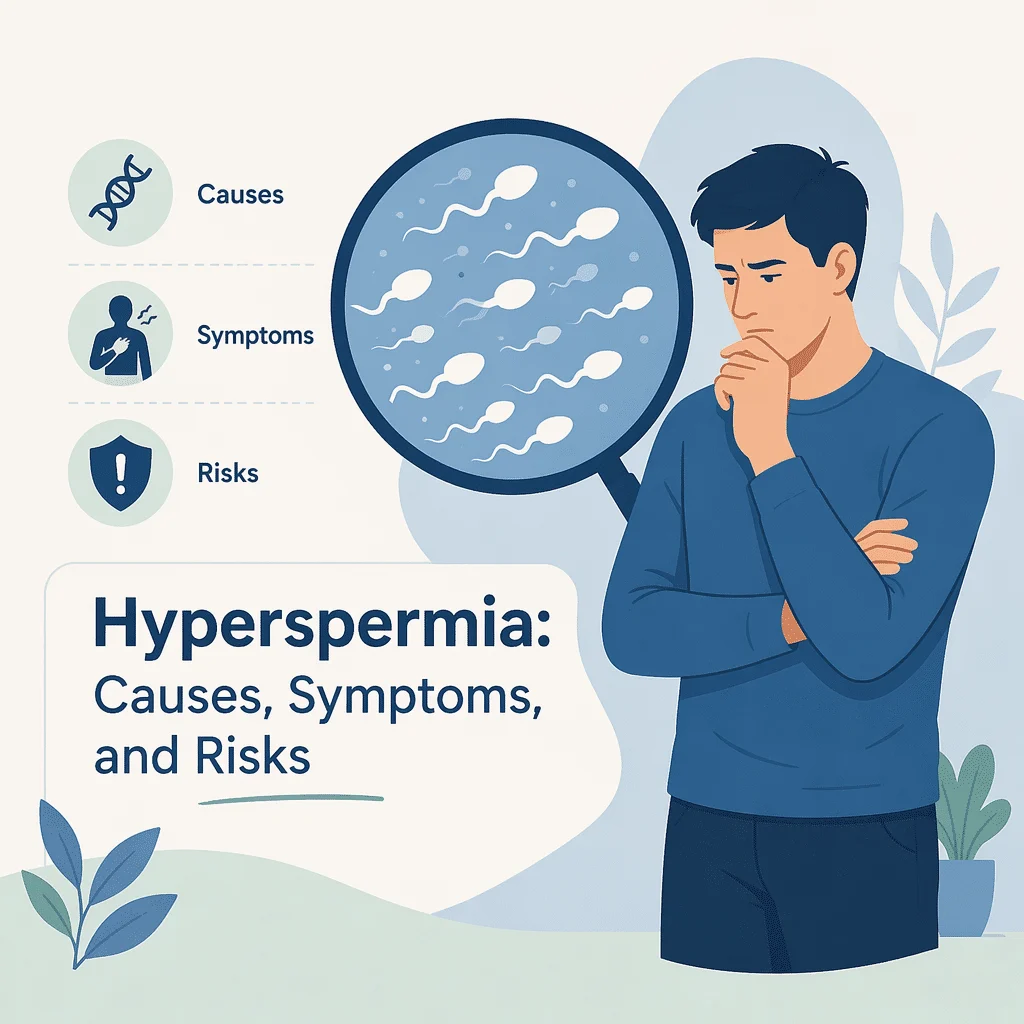
Hyperspermia is the label a laboratory applies when a single ejaculate contains an unusually large volume of semen. It is a semen analysis finding rather than something most men would notice on their own, and it is far less discussed than the opposite problem, a low volume. In the large majority of cases it is benign, and the most common explanation is entirely ordinary: a long gap since the previous ejaculation. In this article you will learn how a laboratory measures semen volume, why the threshold that defines a high volume differs from one lab to the next, when a large sample genuinely deserves follow-up, and which blood tests a clinician usually orders alongside a semen analysis.
What hyperspermia means on a semen analysis report
A semen analysis is a laboratory test performed on a complete ejaculate collected in a sterile container. Volume is the first line of the report: the technician measures how much fluid the sample contains, in milliliters, before counting anything in it. Most of that fluid does not come from the testicles. Roughly two thirds is produced by the seminal vesicles and most of the remainder by the prostate, with sperm making up only a small fraction of the total. That is why volume says more about the accessory glands than about sperm production.
The measurement behind the label
The World Health Organization laboratory manual for the examination and processing of human semen sets the reference limits that most laboratories report against. It defines a lower limit of roughly 1.5 milliliters; below that the sample is reported as hypospermia. The manual does not set a formal upper limit, which is the root of much of the confusion around the term hyperspermia.
Why the threshold is not the same in every lab
Because there is no internationally agreed ceiling, each laboratory sets its own. In practice, most flag volumes above somewhere between 5.5 and 6.3 milliliters, while some published reference ranges run as high as 7.6 milliliters before a sample is considered unusual. Two laboratories can therefore look at the same sample and describe it differently. When you read a report, look at the range printed next to your own result rather than at a figure quoted on a website. Our team also explains how to read your blood test results.
Why hyperspermia is not a diagnosis: reference limits versus cut-offs
This distinction is the single most misunderstood point in this area, and almost no article states it plainly. The WHO figures are not thresholds separating healthy men from sick ones. They are percentiles drawn from men who had recently fathered a child: the published lower limits sit at the fifth percentile of that fertile population, meaning that ninety-five out of a hundred recent fathers scored above them.
Two consequences follow. A result under a reference limit is not a diagnosis of infertility, because some men in the fertile group scored there too. And a result outside the range at the top end, which is what hyperspermia describes, is not a disease, because the range was never built to identify one. A semen analysis describes a sample on one particular day. It is a probability statement about a population, read one man at a time, and it needs a clinician to place it in context alongside a partner’s assessment, a physical examination and, often, a second sample.
What affects a hyperspermia result before you even reach the lab
Several everyday factors move the volume figure, and they act before the sample is ever handed over. Reviewing them is usually the most productive first step when a report comes back with a high volume.
- Abstinence interval. The number of days since the previous ejaculation is the strongest single influence on volume. Standard practice is two to seven days; a longer gap inflates the figure.
- Completeness of collection. The first portion of an ejaculate carries most of the sperm, the later portion most of the fluid. Losing part of the sample, or collecting more completely than last time, changes both the volume and the counts.
- Hydration and general health. Marked dehydration, a recent fever or an acute illness can all shift semen parameters for weeks, because sperm take roughly two to three months to develop.
- Time and temperature before analysis. Semen liquefies after collection and must be examined promptly and kept near body temperature; delays alter what the technician measures.
- Natural variation. Repeat samples from the same man differ substantially from week to week even when nothing has changed.
None of these is a medical problem, and together they account for most reports of hyperspermia. They are also why clinicians commonly repeat a semen analysis several weeks later before drawing any conclusion from an unusual figure.
When a high semen volume actually matters
Most men with hyperspermia have no underlying condition and no fertility problem. There are, however, three situations in which the finding is worth following up.
The dilution effect: concentration versus total sperm count
Sperm concentration is expressed per milliliter. Spread the same number of sperm through more fluid and the concentration falls, even though nothing about sperm production has changed. This is why a very large sample can produce a concentration that looks low while the total sperm count — concentration multiplied by volume — is entirely normal. Total count is the more informative of the two figures, and the one to check first when hyperspermia comes with a concentration below the reference limit.
Inflammation of the prostate and seminal vesicles
Because the accessory glands supply most of the fluid, inflammation or infection of the prostate or the seminal vesicles can alter both the volume and the composition of semen. White blood cells in the sample, an abnormal pH, pain on ejaculation or urinary symptoms all point in that direction and warrant assessment. Our team also covers urinary tract infections and explains the CRP inflammation marker, which a clinician may use to gauge inflammation elsewhere in the body.
Hormonal and other contributors
Testosterone and prolactin influence the secretory activity of the accessory glands, so hormonal imbalance can occasionally show up in the fluid fraction of a sample. This is an uncommon explanation for hyperspermia, and it is investigated through blood testing rather than through the semen analysis itself. If the appearance of the sample is also abnormal, that is a separate question: this guide covers brown semen and hematospermia.
What a full semen analysis reports
Volume is one line among many. The table below sets out what each parameter measures and how a high volume interacts with it — the quickest way to see why volume alone rarely settles anything.
| Parameter | What it measures | Effect of a high volume |
|---|---|---|
| Volume | Total fluid in the ejaculate, in milliliters | The parameter itself; mostly reflects the seminal vesicles and prostate |
| Sperm concentration | Sperm per milliliter of semen | Can be pulled down by dilution without any drop in production |
| Total sperm count | Concentration multiplied by volume | Unaffected by dilution; the more reliable figure when volume is high |
| Motility | Proportion of sperm moving, and how well they move forward | Not directly changed by volume, but influenced by the abstinence interval |
| Morphology | Proportion of sperm with a normal shape | Independent of volume |
| Vitality | Proportion of sperm that are alive | Independent of volume; checked when motility is low |
| pH | Acidity or alkalinity of the sample | Can shift when the accessory glands are inflamed |
| Leukocytes | White blood cells in the sample | Raised counts suggest inflammation or infection rather than dilution |
The blood tests that go with a semen analysis
A semen analysis describes the output. Blood tests describe the machinery that produced it, which is why a fertility workup pairs the two. A clinician typically starts with a small hormone panel and adds to it depending on what the semen analysis showed; hyperspermia on its own rarely triggers extra tests beyond these. This guide covers the male hormone panel in detail.
- Testosterone, the main androgen produced by the testicles, drives sperm production and the secretory activity of the accessory glands. Our team details testosterone as a blood marker.
- Follicle-stimulating hormone, released by the pituitary gland, stimulates the cells that support sperm production; a raised level suggests the testicles are not responding. We also explain the FSH blood test.
- Luteinizing hormone tells the testicles to make testosterone, so it helps separate a testicular problem from a pituitary one. This page describes the LH blood test.
- Prolactin, when elevated, suppresses the hormonal signals that keep sperm production running. Our team covers high prolactin levels.
- Thyroid-stimulating hormone screens for a thyroid disorder, which can disturb reproductive hormones indirectly. This guide explains the TSH blood test.
If infection or inflammation is suspected, a urine test is often added to the panel; our team explains a urinalysis report.
Hyperspermia symptoms, and when to see a doctor
Hyperspermia on its own is typically silent. It produces no pain, no discomfort and no visible change, which is why it is almost always discovered on a laboratory report rather than noticed by the person concerned. Claims that a high volume causes fatigue or weakness are not supported by evidence.
Symptoms occurring alongside hyperspermia point to something else that needs assessment rather than to the volume itself. Arrange a medical appointment if you notice pain or burning on ejaculation, blood or an unusual color in the semen, pain in the testicles, perineum or lower abdomen, fever, or urinary symptoms such as urgency or difficulty passing urine. See a clinician too if you and your partner have been trying to conceive for twelve months without success, or six months if your partner is over thirty-five.
Latest scientific advances
Research over the past three years has focused less on hyperspermia as a condition and more on how the conditions of collection shape every number on the report. Here is what that work shows, in plain language.
A 2024 review pooling eighty-five studies examined how the abstinence interval — the gap since the previous ejaculation — affects semen. The longer the gap, the larger the volume and the higher the total sperm count. The average difference between a short and a long interval was around one milliliter, enough on its own to move a result from the middle of a reference range toward the top of it. What this means for you: if a report flags hyperspermia, the number of days you waited is the first thing worth checking. The authors note that this is an association observed across studies, not proof that the interval alone causes the change.
A second 2024 analysis, restricted to randomized controlled trials — the design in which participants are assigned at random, which limits bias — found the same pattern with an important qualification. Longer abstinence produced bigger volumes and higher concentrations, but sperm moved forward less well and showed more damage to their DNA. What this means for you: a larger sample is not automatically a better sample, and volume should never be read on its own.
A 2025 systematic review covering more than thirty thousand samples agreed: shortening the interval below two days lowers volume and concentration while improving how well sperm swim. The WHO recommendation of two to seven days remains the standard, because it is the window in which results can fairly be compared with reference values. This is still an active research question rather than a settled one.
Finally, a 2023 study of men already being evaluated for infertility is a useful caution about single results: among those whose first semen analysis fell above the WHO reference limits, roughly six in ten had a second analysis that fell below them. What this means for you: one semen analysis is a snapshot, not a verdict, and repeating it after several weeks is normal practice rather than a sign that something was wrong. A 2024 review of the sixth edition of the WHO manual, published in 2021, makes the same point about how those values are meant to be used: as reference figures for comparison, not as a pass or fail line.
Glossary of key terms
| Term | Definition |
|---|---|
| Hyperspermia | An ejaculate volume above the upper end of a laboratory’s reference range. There is no universal threshold. |
| Hypospermia | The opposite finding: an ejaculate volume below the lower reference limit, around 1.5 milliliters. |
| Semen analysis | A laboratory test that measures the volume of an ejaculate and examines the sperm it contains. |
| Seminal vesicles | Paired glands behind the bladder that produce most of the fluid in semen. |
| Sperm concentration | The number of sperm in one milliliter of semen. It falls when the same sperm are diluted in more fluid. |
| Total sperm count | Concentration multiplied by volume: the total number of sperm in the whole sample. |
| Abstinence interval | The time between the previous ejaculation and the collection of the sample, usually two to seven days. |
| Reference limit | A percentile taken from a reference population, used for comparison. It is not a diagnostic threshold. |
| Leukocytes | White blood cells. Raised numbers in semen suggest inflammation or infection of the reproductive tract. |
| Hematospermia | The presence of blood in semen, which usually changes its color and should be assessed by a clinician. |
Frequently asked questions
Is hyperspermia dangerous?
On its own, no. A high semen volume is a laboratory observation, not a disease, and it does not damage the reproductive organs or general health. What matters is the rest of the report and whether any symptoms accompany it. A high volume alongside a low sperm concentration, white blood cells in the sample or pain on ejaculation is worth investigating, because those findings suggest a separate cause.
Does hyperspermia reduce fertility?
Usually not. The main way a very large volume can matter is dilution: the same number of sperm spread through more fluid gives a lower concentration per milliliter. Since the total sperm count corrects for that, a normal total count alongside a high volume is reassuring. Fertility depends on many parameters together — count, movement, shape and vitality — as well as on the partner’s assessment. No single line on a semen analysis predicts whether conception will happen.
How much semen counts as a high volume?
There is no single figure. Laboratories commonly flag volumes above somewhere between 5.5 and 6.3 milliliters, and some reference ranges run to 7.6 milliliters before a sample is described as unusual. The WHO manual only defines a lower limit, near 1.5 milliliters, and leaves the upper end to individual laboratories. Always read the reference range printed beside your own result, because a figure flagged in one laboratory may be reported as normal in another.
Can hyperspermia be caused by medication?
Medication more often reduces semen volume than increases it, but drugs affecting ejaculation, prostate function or hormonal signaling can change the fluid fraction of a sample in either direction. If you take a regular medication and your report is unexpected, bring the list to your appointment rather than stopping anything yourself. A clinician can judge whether a drug plausibly explains the finding.
Should I repeat the semen analysis?
Often, yes. Semen parameters vary considerably from one sample to the next in the same man, so a single result is a snapshot. When a first analysis is unexpected, standard practice is to repeat it after several weeks, keeping the abstinence interval within the two to seven day window and collecting the sample completely. Two consistent reports carry far more weight than one unusual one.
Sources
- MedlinePlus, National Library of Medicine — Semen Analysis — medlineplus.gov
- Cleveland Clinic — Semen Analysis: Purpose, Procedure and Results — my.clevelandclinic.org
- Eunice Kennedy Shriver National Institute of Child Health and Human Development — What are some possible causes of male infertility? — nichd.nih.gov
- Vasan SS et al. — Semen Analysis — StatPearls, NCBI Bookshelf — ncbi.nlm.nih.gov
- Du C, Li Y, Yin C et al. — Association of abstinence time with semen quality and fertility outcomes: a systematic review and dose-response meta-analysis — Andrology, 2024 — pubmed.ncbi.nlm.nih.gov/38197853
- Lo Giudice A, Asmundo MG, Cimino S et al. — Effects of long and short ejaculatory abstinence on sperm parameters: a meta-analysis of randomized-controlled trials — Frontiers in Endocrinology, 2024 — pubmed.ncbi.nlm.nih.gov/38828413
- Raditya M, Hari Soejono A, Siswanto MA et al. — Impact of Shorter Abstinence Periods on Semen Parameters: A Systematic Review and Meta-Analysis — The World Journal of Men’s Health, 2025 — pubmed.ncbi.nlm.nih.gov/39434390
- Chawre S, Khatib MN, Rawekar A et al. — A Review of Semen Analysis: Updates From the WHO Sixth Edition Manual and Advances in Male Fertility Assessment — Cureus, 2024 — pubmed.ncbi.nlm.nih.gov/39081428
- Boeri L, Pozzi E, Capogrosso P et al. — Infertile men with semen parameters above WHO reference limits at first assessment may deserve a second semen analysis — PLoS One, 2023 — pubmed.ncbi.nlm.nih.gov/36656872
Further reading
- Fertility blood test panel: hormones to check for men and women
- Low testosterone in men: symptoms and treatments
- PSA blood test: what your result means
- Erectile dysfunction causes and what lab markers can reveal
- Abnormal blood test results: what they mean and what to do
Understand your lab results with AI DiagMe
A semen analysis rarely stands alone, and the blood work ordered alongside it is where most of the unfamiliar numbers appear. AI DiagMe reads your laboratory report and explains each line in plain language, from testosterone and FSH to prolactin, TSH and inflammation markers, so you can see what falls inside the reference range and what your clinician is likely to focus on. It helps you understand your results and prepare better questions. It does not make a diagnosis and it does not replace your doctor.
Get your results interpreted in minutes