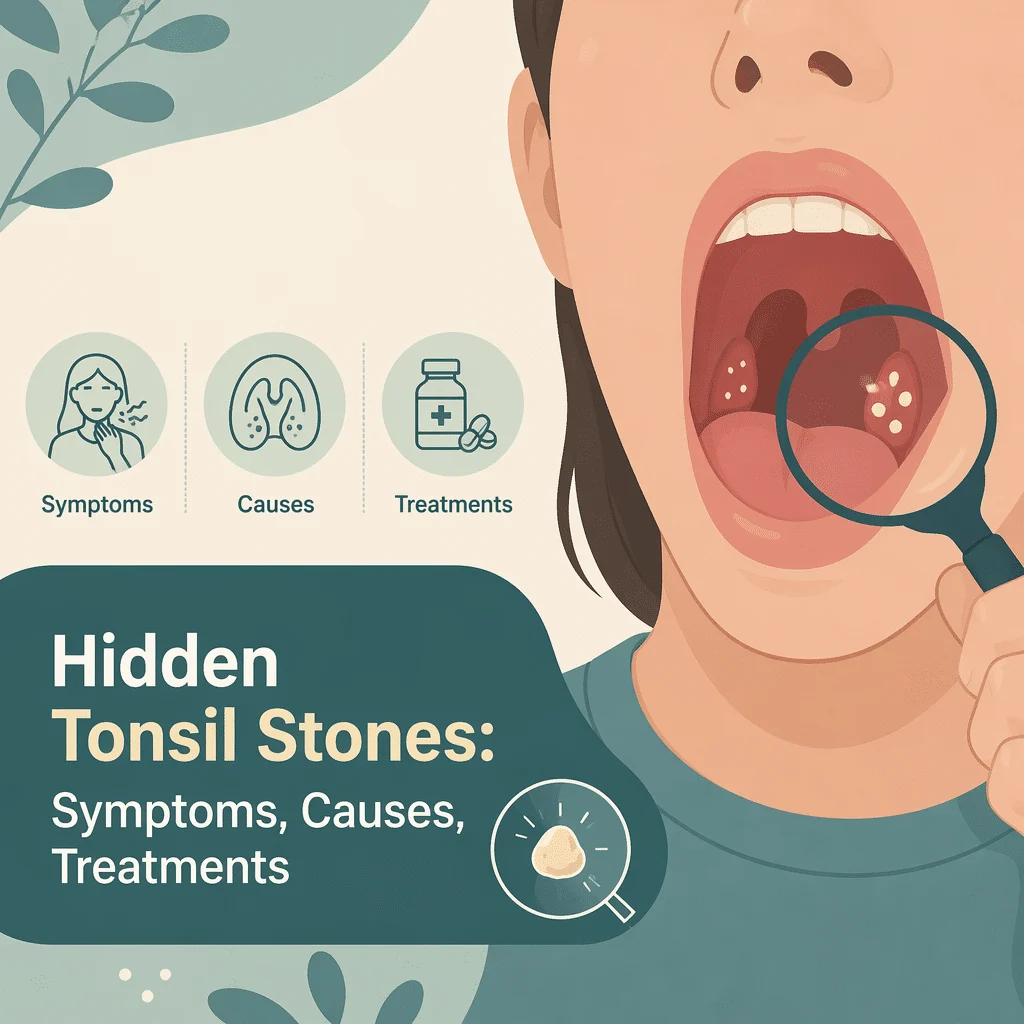
Hidden tonsil stones are small, hard clumps that form deep inside the folds of your tonsils, tucked so far back that you often cannot see them in the mirror. Also called tonsilloliths, they build up slowly from trapped food, dead cells, mucus, and bacteria that harden over time. Because they hide low in the crevices, many people never spot them, yet they can still cause stubborn bad breath, a scratchy throat, or an odd taste. In almost all cases they are harmless. In this article you will learn what causes hidden tonsil stones, how to recognize the signs, which removal methods are safe, and when to see a doctor.
What are hidden tonsil stones?
Your tonsils are two soft pads of lymph tissue at the back of the throat. Their surface is dotted with small pockets called tonsil crypts, which are shallow in some people and deep and branching in others. When debris settles into a deep crypt and stays there, it slowly calcifies into a tonsillolith, the medical name for a tonsil stone.
A stone near the surface may show up as a white or yellow speck. Hidden tonsil stones are different: they sit deep in the crypt, often behind a fold of tissue, so the mirror shows nothing. You may only sense them through bad breath or a feeling that something is caught in your throat. Most are the size of a grain of rice, though some grow larger.
Why some tonsil stones stay out of sight
Two things keep these deposits hidden. The deepest crypts curve inward, so a stone can lodge where the eye cannot reach, and swollen tonsil tissue can overhang the openings. People with very large tonsils that nearly touch may trap more debris, a pattern our library describes in a guide covering enlarged kissing tonsils. Even when you cannot see a stone, it is usually harmless. As patient guidance from the Cleveland Clinic on tonsil stones explains, these deposits are rarely a sign of anything dangerous.
What hidden tonsil stones are made of
Inside, a tonsil stone blends old food particles, shed cells, and mucus with bacteria and sometimes fungi, which form a sticky biofilm. Over time, calcium and other mineral salts settle into the mass and harden it, which is why an established stone feels gritty rather than soft.
Symptoms of hidden tonsil stones
Out of view, these stones are usually noticed by how they feel rather than how they look. The most telling sign is persistent bad breath that does not improve much with brushing, flossing, or mouthwash. Others describe a sore patch on one side of the throat, a metallic or foul taste, or the feeling that something is stuck when they swallow.
Some people also cough up small white or yellowish flecks; these are stones that have worked loose from a crypt. A less obvious symptom is ear pain on the same side, because the tonsils and the ear share nerve pathways. The table below pairs common symptoms with what they may point to.
| Symptom you notice | What it may point to |
|---|---|
| Bad breath that brushing does not fix | Trapped stones releasing smelly sulfur gases |
| White or yellow flecks you cough up | Small stones dislodging from the crypts |
| Scratchy or sore feeling on one side | A stone lodged in a crypt, or tonsillitis |
| Ear pain with a healthy ear | Referred pain along shared throat nerves |
| Something stuck when swallowing | A larger stone pressing on the tonsil |
| Metallic or bad taste in the mouth | Bacteria and debris concentrated in a stone |
These signs overlap with other throat conditions, so they are clues, not proof. A bumpy throat surface has its own causes, which our team explains in an article covering a cobblestone-textured throat. White patches can also come from a viral infection, which our writers describe in a piece covering throat herpes symptoms.
What causes hidden tonsil stones, and who is at risk
The root cause is simple: material collects in a tonsil crypt faster than the body can clear it. Deep, branching crypts are the single biggest factor, and their shape is largely something you are born with, which is why some people form stones repeatedly while others never do.
Common risk factors
Several everyday factors raise the risk:
- Repeated or long-standing tonsillitis, which scars and widens the crypts over time.
- Poor oral hygiene, which leaves more food particles and bacteria in the mouth.
- A dry mouth from dehydration, mouth-breathing, some medicines, or alcohol, since saliva normally rinses debris away.
- Postnasal drip, where mucus from the nose and sinuses pools near the tonsils.
- Smoking, which changes the mouth environment and dries the tissues.
Ongoing sinus problems feed the debris supply, a link our writers explore in a guide that covers a lingering sinus infection. Acid rising from the stomach can irritate the throat too, as our team explains in an overview of a chronic acid reflux cough. None of these causes are dangerous alone, but together they help debris settle where it should not.
How doctors diagnose hidden tonsil stones
A doctor or dentist can often identify tonsil stones with a simple look inside the mouth. Because hidden stones sit deep, the clinician may gently press on the tonsil or ask you to say certain sounds so the crypts open. Many are found by chance during a routine dental exam or a scan done for other reasons.
When a stone is buried too deep to see, imaging helps; a CT scan shows calcified deposits clearly, and stones sometimes appear on dental X-rays. Blood tests do not find the stone itself, but if your throat is inflamed a doctor may order a complete blood count report. To gauge inflammation, a doctor may also review the C-reactive protein inflammation marker when symptoms are severe.
How to get rid of hidden tonsil stones
Most hidden tonsil stones need little more than patience, and many loosen and fall out on their own. When you want to move things along, be gentle. The tonsils are delicate, and aggressive poking with sharp objects can cut the tissue, cause bleeding, or push a stone deeper. Learning how to remove tonsil stones safely matters more than doing it quickly.
Safe at-home care
Several low-risk steps help dislodge stones and control the bad breath they cause:
- Gargle with warm salt water once or twice a day to loosen debris and soothe the throat.
- Use an alcohol-free mouthwash, since alcohol dries the mouth and can make matters worse.
- Try a firm gargle or gentle cough, which is often enough to pop a loose stone free.
- Aim a water flosser at the stone carefully, on its lowest setting, to nudge it out.
- Drink plenty of water so saliva keeps rinsing the crypts.
Avoid digging with fingernails, toothpicks, or metal tools. If a stone will not come loose gently, it is safer to leave it or ask a professional for help.
When professional removal or surgery makes sense
An ear, nose, and throat specialist can remove stubborn or large stones using suction, gentle instruments, or a procedure called laser cryptolysis that smooths the crypts so debris no longer collects. For people who get painful stones again and again, or who also have frequent tonsillitis, a doctor may discuss removing the tonsils entirely, an operation called a tonsillectomy. This is reserved for severe, recurrent cases because surgery carries its own risks. A one-sided sore throat that keeps returning deserves its own check, which our team details in a guide that explains one-sided tonsillitis.
How to prevent hidden tonsil stones
You cannot change the shape of your tonsil crypts, but you can reduce how much debris reaches them. Consistent oral hygiene is the foundation: brush twice a day, clean your tongue, and floss so fewer particles linger overnight. A saltwater or alcohol-free rinse after meals clears the tonsil area before debris settles.
Staying well hydrated keeps saliva flowing, one of your body’s built-in cleaning systems. Treating the triggers helps too: managing allergies and postnasal drip, easing acid reflux, and stopping smoking all lower the daily debris load. Referred ear discomfort can travel the same nerve paths, and our team breaks down ear infection symptoms and causes for readers who want to tell them apart. Together, these habits make stones far less frequent.
When to see a doctor
These stones are usually harmless, but certain signs are worth checking. See a healthcare professional if you notice any of the following:
- Bad breath or throat discomfort that persists despite good oral hygiene and gentle home care.
- A tonsil stone that keeps coming back or grows large enough to make swallowing hard.
- Severe or one-sided throat pain, a high fever, or swelling that makes it hard to breathe or swallow.
- Bleeding, a hard lump that will not go away, or a sore on the tonsil that lasts more than two to three weeks.
- Repeated episodes of tonsillitis alongside the stones.
A lasting one-sided lump or ulcer is rarely serious, but because it can occasionally signal something that needs attention, it should be examined rather than ignored.
Latest scientific advances
Recent research has sharpened how we understand these deposits, and the overall message is reassuring.
A 2023 clinical review in American Family Physician concluded that small tonsil stones are a common, everyday finding that can simply be watched, with surgery needed only rarely. What this means for you: finding a hidden tonsil stone is usually not a reason for alarm or an operation.
A 2023 laboratory study in the journal Pathogens found that the branching bacteria living in tonsil crypts are best seen as normal residents of the mouth, called saprophytes, rather than a cause of disease. What this means for you: the bacteria in a stone are largely the same ones that live harmlessly in everyone’s mouth, so a stone is not an infection you have caught.
A 2024 imaging pilot study in BMC Oral Health found stones were more common in people who also had more gum disease, known as periodontitis, especially older adults. What this means for you: a stone can be a gentle nudge to look after your gums. This was a small, early study, so it points to a link rather than proof.
A 2023 review in Clinical Oral Investigations described how an imbalance of mouth bacteria produces smelly sulfur gases, called volatile sulfur compounds, and that better oral hygiene, and sometimes probiotics, can help. What this means for you: controlling the whole mouth’s bacteria, not only the visible stone, is often the key to fresher breath.
Glossary of key terms
| Term | Definition |
|---|---|
| Tonsillolith | The medical name for a tonsil stone, a hard deposit that forms in a tonsil crypt. |
| Tonsil crypts | Small pockets and folds on the surface of the tonsils where debris can collect. |
| Halitosis | The medical word for bad breath. |
| Biofilm | A sticky film of bacteria that clings to surfaces such as the teeth and tonsils. |
| Globus sensation | The feeling of a lump in the throat when nothing is truly blocking it. |
| Volatile sulfur compounds | Smelly gases made by mouth bacteria that are a major cause of bad breath. |
| Postnasal drip | Mucus from the nose and sinuses that trickles down the back of the throat. |
| Periodontitis | Gum disease that damages the tissue and bone that hold the teeth in place. |
| Tonsillectomy | Surgery to remove the tonsils, used for severe or recurrent problems. |
Frequently asked questions
Are hidden tonsil stones dangerous?
For nearly everyone, no. They are a benign nuisance rather than a threat, and not a form of cancer. Their main downside is bad breath and mild throat discomfort. Very large stones can occasionally make swallowing uncomfortable, and any hard lump that lasts should be examined, but most need only gentle care.
How do you get rid of tonsil stones you cannot see?
Start gently: gargle warm salt water, use an alcohol-free rinse, and try a firm cough or low-pressure water flosser to loosen the stone. Do not dig with sharp objects, because that can injure the tonsil. If a hidden stone will not budge or keeps returning, an ear, nose, and throat specialist can remove it safely.
Can mouthwash get rid of tonsil stones?
Mouthwash will not dissolve an established stone, but it helps. An alcohol-free antibacterial rinse reduces the bacteria and debris that feed new stones and masks the bad breath they cause. Alcohol-based products dry the mouth and are best avoided. Think of rinsing as prevention, not a way to remove a stone.
Does a water flosser remove tonsil stones?
It can, if you use it carefully. Set it to the lowest pressure, aim across the stone rather than into the tonsil, and stop if it hurts. The gentle stream can wash a loose stone from a shallow crypt, but for deep hidden stones it may not reach far enough.
Why do I keep getting tonsil stones?
Recurrence usually comes down to the shape of your tonsils. Deep, branching crypts naturally trap more debris, so stones return even after you clear them. Ongoing dry mouth, postnasal drip, reflux, smoking, or repeated tonsillitis keep the debris supply high, so good oral hygiene and treating those triggers help most.
Sources
- Cleveland Clinic — Tonsil Stones: Symptoms, Causes, Removal and Treatment, 2024 — clevelandclinic.org
- Mayo Clinic (Joel Streed, with Pao Vang, MD) — All about tonsil stones, 2024 — newsnetwork.mayoclinic.org
- Johns Hopkins Medicine — Tonsillitis — hopkinsmedicine.org
- Smith KL, Hughes R, Myrex P — Tonsillitis and Tonsilloliths: Diagnosis and Management — American Family Physician, 2023 — pubmed.ncbi.nlm.nih.gov
- Zieba N, et al. — The Clinical Significance of Actinomyces in Histopathological Samples after Tonsillectomy — Pathogens, 2023 — doi.org/10.3390/pathogens12121384
- Oda M, et al. — Correlation between tonsilloliths and bone defects from periodontitis on imaging analysis: a pilot study — BMC Oral Health, 2024 — doi.org/10.1186/s12903-023-03769-3
- Li Z, et al. — Halitosis: etiology, prevention, and the role of microbiota — Clinical Oral Investigations, 2023 — doi.org/10.1007/s00784-023-05292-9
Further reading
- Complete Blood Count (CBC): How to Read Your Results
- Erythrocyte Sedimentation Rate (ESR): Understanding This Marker
- Kissing Tonsils: Causes, Symptoms, Treatments
- Unilateral Tonsillitis: Causes, Symptoms, Treatments
- Sinus Infection: Causes, Risks, and Whether It Is Contagious
Understand your lab results with AI DiagMe
Tonsil stones do not show up on a blood test, but the throat symptoms around them sometimes prompt one. When a sore throat, fever, or swollen glands raise the question of infection, tests such as a throat swab or culture, a strep test, or a complete blood count help your doctor see what is going on. AI DiagMe helps you read those results in plain language, so you understand what each value means and what to ask next. It helps you understand your results, not diagnose you, and never replaces your doctor’s judgment.
Get your results interpreted in minutes