




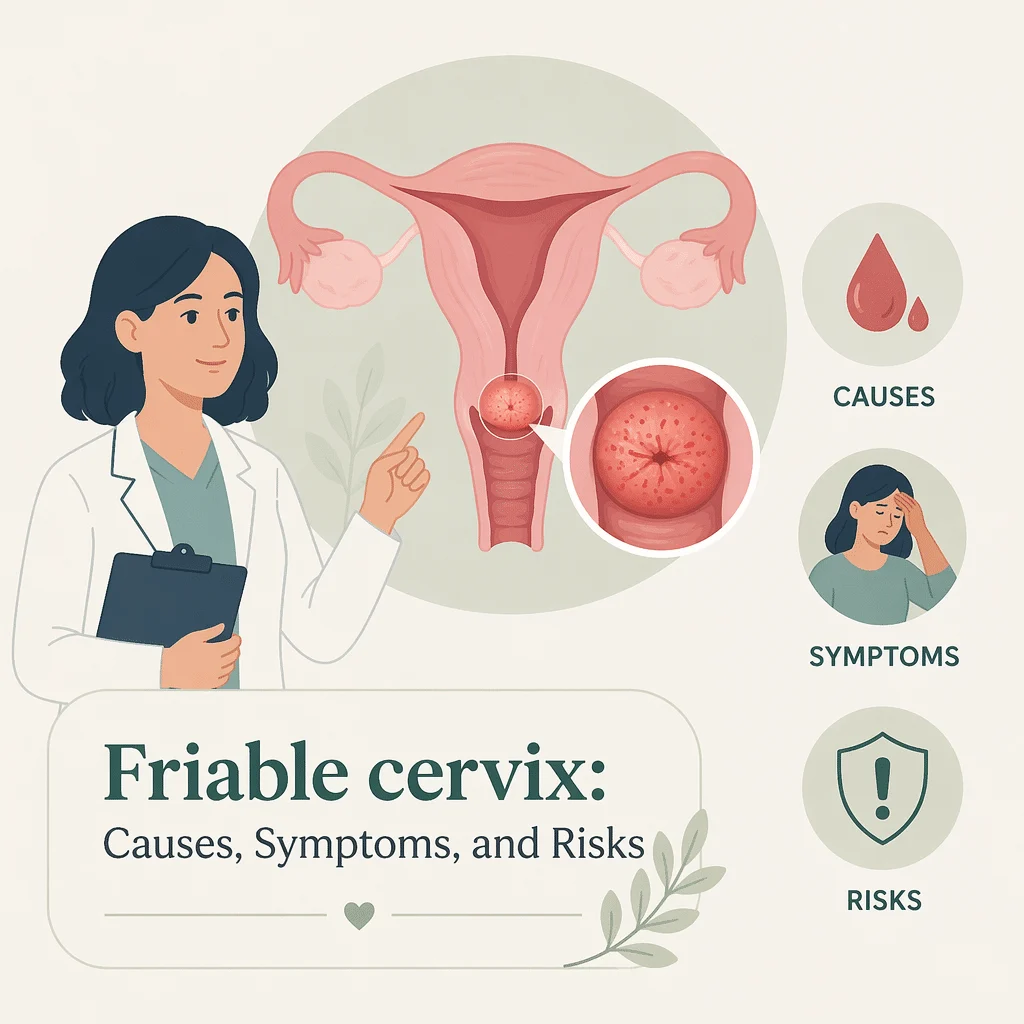
Een fragiele cervix is een baarmoederhals waarvan het oppervlak zo kwetsbaar is dat het bloedt of vlekt na slechts licht contact, zoals seks, een uitstrijkje of het inbrengen van een tampon. Het woord “fragiel” betekent simpelweg “gemakkelijk beschadigd of geïrriteerd,” en artsen gebruiken het om weefsel te beschrijven dat ontstoken lijkt en bij de minste aanraking bloedt. Het is een lichamelijke bevinding, geen diagnose op zichzelf, en de meeste aandoeningen die eraan ten grondslag liggen zijn gewoon en goed te behandelen. Toch verdient bloedverlies na seks altijd een goede controle, omdat het soms op iets ernstiger kan wijzen. In dit artikel lees je wat een fragiele cervix betekent, wat de oorzaken zijn, welke symptomen je in de gaten moet houden, hoe artsen de diagnose stellen, hoe de behandeling werkt en wanneer je een afspraak moet maken.
Wat betekent een fragiele cervix?
De baarmoederhals is het smalle, onderste deel van de baarmoeder dat uitkomt in de bovenkant van de vagina. Het oppervlak is normaal gesproken glad, stevig en lichtroze. Wanneer dat oppervlak ontstoken, dunner of bedekt raakt met kwetsbaarder cellen, kan het bloeden na zacht contact. Dat is wat een arts bedoelt wanneer ze tijdens een onderzoek een fragiele cervix vaststellen: het weefsel bloedt veel gemakkelijker dan gezond baarmoederhalsweefsel zou moeten.
Fragiliteit is een beschrijving, geen ziekte op zich. Een verpleegkundige of arts kan dit noteren na een speculumonderzoek of een routinematige uitstrijktest, wanneer de baarmoederhals begint te bloeden zodra het wattenstaafje of de spatel er lichtjes langs strijkt. De bevinding geeft uw zorgteam aan dat er iets is dat het oppervlak irriteert of verzwakt, en wijst hen op de eigenlijke vraag: waarom bloedt de baarmoederhals zo snel?
Is een fragiele baarmoederhals altijd een probleem?
Meestal niet. Bij veel mensen is de oorzaak klein en omkeerbaar, zoals een tijdelijke infectie of een normale, hormoongerelateerde verandering in de baarmoederhalscellen. Bij anderen bloedt de baarmoederhals door een behandelbare aandoening die gewoon de juiste zorg nodig heeft. In een klein deel van de gevallen zijn er voorstadia van kankercellen aanwezig, en dat is precies waarom een bloedende baarmoederhals nooit genegeerd mag worden, ook niet als u zich verder volkomen goed voelt. Een grondige evaluatie is een kwestie van zorgvuldigheid, niet van het verwachten van het ergste.
Wat veroorzaakt een fragiele baarmoederhals?
Verschillende aandoeningen kunnen de baarmoederhals kwetsbaar maken. Ze variëren van kortdurende infecties tot natuurlijke hormonale veranderingen en, minder vaak, voorstadia van kankercellen. Inzicht in de belangrijkste oorzaken maakt het makkelijker te begrijpen waarom uw arts mogelijk meerdere onderzoeken aanvraagt voordat er een behandelplan wordt vastgesteld.
Infectie en cervicitis
Ontsteking van de baarmoederhals, ook wel cervicitis genoemd, is een van de meest voorkomende redenen waarom het oppervlak snel bloedt. Seksueel overdraagbare aandoeningen zijn veelvoorkomende oorzaken, waaronder gonorroe, trichomoniasis en chlamydia. Een eenvoudig uitstrijkje kan chlamydiaidentificeren, en door de infectie te behandelen kalmeert de ontsteking doorgaans, waarna het bloeden stopt. Verstoringen die niet seksueel overdraagbaar zijn, zoals bacteriële vaginose, kunnen de baarmoederhals eveneens ontsteken. Seksueel overdraagbare aandoeningen komen zeer veel voor en zijn absoluut niet iets om u voor te schamen; testen is gewoon een verstandig onderdeel van goed voor uw gezondheid zorgen.
Cervicale ectropion
Soms verspreiden de zachte, klierachtige cellen die normaal de binnenkant van het baarmoederhalskanaal bekleden zich naar het buitenoppervlak van de baarmoederhals. Dit wordt cervicale ectropion genoemd, en u hoort het ook wel cervicale erosie noemen, hoewel er niets werkelijk geërodeerd is. Die binnenste kanaalcellen zijn kwetsbaarder en rijkelijk voorzien van kleine bloedvaatjes, waardoor ze sneller bloeden dan de stevigere cellen aan de buitenkant. Ectropion komt vaak voor tijdens de zwangerschap, bij gebruik van gecombineerde hormonale anticonceptie en gedurende de vruchtbare jaren. Het is niet schadelijk en heeft vaak geen behandeling nodig, tenzij het bloeden hinderlijk wordt.
Hormonale veranderingen, zwangerschap en de overgang
Hormonen hebben een grote invloed op de baarmoederhals. Een hogere oestrogeenspiegel tijdens de zwangerschap of bij gebruik van de pil kan ectropion en extra doorbloeding bevorderen. Dat is een van de redenen waarom de baarmoederhals tijdens de zwangerschap gevoeliger is en dan vaak onschuldig bloedt. Na de overgang gebeurt het omgekeerde: een dalende oestrogeenspiegel kan de baarmoederhals en de vaginawand dunner en droger maken, waardoor het weefsel op een andere manier kwetsbaar wordt. Dezelfde hormonale veranderingen liggen ten grondslag aan veel bekende overgangsklachten. Wanneer een verschuiving in de hormoonspiegels een rol kan spelen, kan een arts een vrouwelijk hormoonpanel aanvragen om een vollediger beeld te krijgen van wat er aan de hand is.
Omdat de kans op een gevoelige, snel geïrriteerde baarmoederhals tijdens de zwangerschap groter is, is een beetje bloedverlies na seks of een uitstrijkje bij zwangere vrouwen normaal en zelden op zichzelf een reden tot bezorgdheid. Elk bloedverlies tijdens de zwangerschap moet toch aan uw zorgverlener worden gemeld, die geruststelling gevend bloedverlies kan onderscheiden van een probleem dat aandacht vereist. De reguliere prenatale zorg omvat al bloedonderzoek tijdens de zwangerschap, en uw team kan extra controles uitvoeren wanneer bloedverlies een verklaring nodig heeft.
Poliepen en lichamelijke irritatie
Baarmoederhalspoliepen zijn kleine, meestal goedaardige uitgroeiingen die als een druppel aan de baarmoederhals hangen. Ze zijn kwetsbaar en kunnen bloeden na seks of een onderzoek. Alledaagse irritatie kan ook een rol spelen: een slecht passend pessarium of diafragma, veelvuldig spoelen, chemische irriterende stoffen in zeep of sprays, of heftige gemeenschap kunnen het slijmvlies beschadigen. Het verwijderen van een poliep of het wegnemen van de irriterende factor lost het bloedverlies vaak op zonder verdere behandeling.
HPV, voorstadia van kanker en baarmoederhalskanker
Minder vaak weerspiegelt de kwetsbaarheid abnormale celveranderingen die verband houden met het humaan papillomavirus. Een aanhoudende infectie met een hoog-risico HPV-type kan in de loop van meerdere jaren voorstadia van kanker veroorzaken en, in een minderheid van de gevallen, baarmoederhalskanker. Dat is waarom artsen bloedverlies na seks serieus nemen: het doel van onderzoek is deels om baarmoederhalskankeruit te sluiten, niet om ervan uit te gaan dat het aanwezig is. Geruststellend is dat routinematig bevolkingsonderzoek betrouwbaar een hoog-risico HPV-infectie opspoort lang voordat er problemen ontstaan, en dat is precies waarom regelmatige controles zo goed werken.
Veelvoorkomende oorzaken in één oogopslag
| Mogelijke oorzaak | Typische aanwijzingen | Gebruikelijke aanpak |
|---|---|---|
| Cervicitis (infectie) | Afscheiding, bloedverlies na seks, soms helemaal geen klachten | De infectie opsporen en behandelen |
| Cervicale ectropion | Vaak geen klachten; licht bloedverlies; komt veel voor tijdens de zwangerschap of bij gebruik van de pil | Meestal geen behandeling nodig; een kleine ingreep als het bloedverlies hinderlijk is |
| Laag oestrogeen (overgang) | Droogheid, dunner worden van het slijmvlies, bloedverlies na seks | Droogheid aanpakken; lokale oestrogeenopties bespreken |
| Baarmoederhalspoliep | Bloedvlekjes na seks of tussen menstruaties | Eenvoudige verwijdering als het bloedt |
| HPV-gerelateerde celveranderingen | Vaak geen klachten; ontdekt bij screening | Colposcopie, controle of behandeling indien nodig |
Symptomen van een fragiele cervix
Een fragiele cervix veroorzaakt vaak helemaal geen klachten en wordt alleen ontdekt tijdens een routineonderzoek. Als er wel symptomen optreden, is het meest typische teken licht bloedverlies of bloedvlekjes na seks, ook wel postcoïtaal bloedverlies genoemd. Afhankelijk van de oorzaak van de kwetsbaarheid kunnen er ook andere tekenen optreden.
- Bloedvlekjes of licht bloedverlies na geslachtsgemeenschap
- Bloedverlies of bloedvlekjes tussen menstruaties
- Ongewone vaginale afscheiding die verandert in kleur, hoeveelheid of geur
- Lichte bekkenpijn of pijn tijdens seks
- Oppervlakkige irritatie die ook kan leiden tot Vaginale branderigheid
Deze symptomen overlappen met veel alledaagse aandoeningen, dus op zichzelf wijzen ze niet op één specifieke diagnose. Wat telt, is het patroon. Herhaaldelijk bloedverlies na seks, nieuwe of onaangenaam ruikende afscheiding, of bloedverlies tussen menstruaties verdienen allemaal een professionele beoordeling in plaats van een afwachtende houding. Een korte notitie bijhouden van wanneer het bloedverlies optreedt en wat het lijkt uit te lokken, kan je arts helpen de oorzaak sneller te vinden.
Hoe wordt een broze baarmoederhals gediagnosticeerd?
Omdat kwetsbaarheid een aanwijzing is en geen diagnose, is het doel van het bezoek het vinden van de onderliggende oorzaak. Het gaat er niet om je ongerust te maken, maar om de bevinding te koppelen aan de juiste — en vaak heel eenvoudige — verklaring. Je arts combineert doorgaans een kort gesprek over je voorgeschiedenis met een lichamelijk onderzoek en een of meer gerichte tests.
Gynaecologisch onderzoek en uitstrijkje
Tijdens een gynaecologisch onderzoek kan de arts met behulp van een speculum de baarmoederhals bekijken en nagaan of deze bij aanraking bloedt. Een uitstrijkje (PAP-test) verzamelt enkele cellen om te controleren op afwijkende veranderingen, terwijl een HPV-test zoekt naar het hoogrisicoviris. De nationale richtlijnen van het American College of Obstetricians and Gynecologists leggen uit wanneer elke test wordt aanbevolen. Veel mensen krijgen een normaal uitstrijkje met een positieve HPV-test, een veelvoorkomende uitslag die je arts in de juiste context kan plaatsen en op de juiste manier kan opvolgen.
Testen op infecties
Uitstrijkjes van de baarmoederhals en vagina kunnen infecties opsporen zoals gonorroe, trichomoniasis en bacteriële vaginose. Omdat deze behandelbaar zijn, lost vroeg uitsluiten of bevestigen het probleem vaak snel op en voorkomt het verdere verspreiding. Soms worden urineonderzoeken naast uitstrijkjes gebruikt, zodat het proces snel en eenvoudig verloopt.
Colposcopie en biopsie
Als screening afwijkende cellen aantoont, is de volgende stap vaak een colposcopie: een gedetailleerde blik op de baarmoederhals met een verlichte vergrootlens. De arts kan een klein stukje weefsel afnemen, een biopsie, om in het laboratorium te onderzoeken. Zo bevestigen of sluiten artsen voorstadia van kanker uit, en dit is de betrouwbaarste manier om een baarmoederhals te beoordelen die ondanks behandeling van eenvoudigere oorzaken kwetsbaar blijft.
Behandeling: de onderliggende oorzaak aanpakken
Er bestaat geen standaardbehandeling voor een kwetsbare baarmoederhals, omdat de juiste aanpak volledig afhangt van de oorzaak. Zodra de oorzaak duidelijk is, is de behandeling doorgaans eenvoudig en effectief.
- Infecties: antibiotica voor bacteriële seksueel overdraagbare aandoeningen en bacteriële vaginose, of de juiste medicatie voor andere infecties, verhelpen de ontsteking meestal.
- Cervicale ectropion: vereist vaak geen behandeling; bij aanhoudend bloedverlies kan een arts het kwetsbare gebied afsluiten met warmte, kou (cryotherapie) of zilvernitraat.
- Laag oestrogeen na de menopauze: vaginale vochtinbrengende middelen of lokaal oestrogeen kunnen de weefselsterkte herstellen wanneer dat passend is.
- Poliepen: een snelle ingreep op de polikliniek kan een bloedende poliep verwijderen, meestal met weinig of geen ongemak.
- Voorstadia van kanker: de behandeling verwijdert of vernietigt de afwijkende cellen en is zeer effectief wanneer het vroeg wordt ontdekt.
Wat de oorzaak ook is, behandeling ervan stopt het bloedverlies doorgaans en herstelt het comfort. Je arts zal ook vervolgonderzoek aanbevelen op een schema dat past bij je leeftijd en voorgeschiedenis, zodat elke verandering tijdig wordt opgemerkt.
Wanneer moet je een arts raadplegen?
De meeste oorzaken van een kwetsbare, snel bloedende baarmoederhals zijn goedaardig, maar bloedverlies na seks is een symptoom dat je nooit zelf moet proberen te diagnosticeren. Maak een afspraak als je een van de volgende klachten opmerkt.
- Bloedverlies na seks dat meer dan één keer voorkomt of steeds terugkeert
- Bloedverlies of tussentijds bloedverlies buiten de menstruatie om, of enig bloedverlies na de menopauze
- Nieuwe, overvloedige of onaangenaam ruikende vaginale afscheiding
- Bekkenpijn, koorts of pijn tijdens seks
- Een uitgesteld uitstrijkje of een uitstrijkje met afwijkende uitslag
Zoek snel medische hulp als het bloedverlies hevig is, als je zwanger bent en bloedt, of als je je flauw of ernstig ziek voelt. In de overgrote meerderheid van de gevallen is een vroeg onderzoek geruststellend, en wanneer er toch iets behandeld moet worden, wordt het probleem ontdekt terwijl het het gemakkelijkst te behandelen is.
Recente wetenschappelijke ontwikkelingen
Onderzoek uit de periode 2023–2026 heeft de manier waarop de baarmoederhals wordt gescreend en beoordeeld veranderd, wat relevant is voor iedereen bij wie de baarmoederhals als kwetsbaar is omschreven. Dit is wat de nieuwste bevindingen voor jou betekenen, in begrijpelijke taal uitgelegd.
Mogelijk kunt u zelf een HPV-monster afnemen
In 2026 heeft de American Cancer Society haar richtlijnen bijgewerkt om zelfafgenomen vaginale monsters voor HPV-testen te ondersteunen, waarbij iemand zelf een uitstrijkje neemt in plaats van uitsluitend te vertrouwen op een monster dat door een zorgverlener wordt afgenomen (Perkins en collega's, 2026). Een expertconsensus uit 2025 kwam tot dezelfde conclusie (Wentzensen en collega's, 2025). Wat dit voor u betekent: baarmoederhalsonderzoek wordt steeds toegankelijker, en een gevoelige of snel geïrriteerde baarmoederhals hoeft geen belemmering meer te zijn om u te laten testen.
Bevolkingsonderzoek begint nu met de HPV-test
Een systematische review uit 2025 — een studie die meerdere eerdere onderzoeken samenvoegt om het totale bewijs te wegen — ondersteunde HPV-gebaseerd onderzoek als de meest effectieve manier om baarmoederhalskanker te voorkomen (Pillay en collega's, 2025). Wat dit voor u betekent: als deze bevinding aanleiding geeft tot onderzoek, is een HPV-test een krachtige eerste stap, en een negatieve uitslag voor hoogrisicovormen van HPV is sterk geruststellend, ook wanneer de baarmoederhals er geïrriteerd uitziet.
Colposcopie wordt steeds meer gestandaardiseerd
Een Europese expertconsensus gepubliceerd in 2023 stelde duidelijkere normen vast voor colposcopie, het vergroot onderzoek van de baarmoederhals dat wordt gebruikt wanneer de uitslag van het bevolkingsonderzoek afwijkend is (McGee en collega's, 2023). Wat dit voor u betekent: als u wordt doorverwezen voor een colposcopie om het bloedverlies te verklaren, is de procedure van kliniek tot kliniek steeds consistenter en beter onderbouwd door wetenschappelijk bewijs. Dit zijn bemoedigende ontwikkelingen, geen instructies voor zelfbehandeling; beslissingen over onderzoek moeten altijd worden genomen samen met een zorgverlener die uw voorgeschiedenis kent.
Woordenlijst met belangrijke termen
| Termijn | Definitie |
|---|---|
| Fragiele cervix | Een baarmoederhals waarvan het oppervlak gemakkelijk bloedt of vlekt na licht contact, zoals seks of een uitstrijkje. |
| Baarmoederhals | Het smalle, onderste deel van de baarmoeder dat uitkomt in de bovenkant van de vagina. |
| Cervicitis | Ontsteking van de baarmoederhals, vaak veroorzaakt door een infectie. |
| Cervicale ectropion | Een veelvoorkomende, onschadelijke toestand waarbij zachtere cellen van het binnenste kanaal op de buitenkant van de baarmoederhals liggen en sneller bloeden. |
| Bloedverlies na gemeenschap | Bloedverlies of vlekken na seks. |
| Hpv (humaan papillomavirus) | Een zeer veelvoorkomend virus; aanhoudende hoogrisicovormen kunnen veranderingen in de baarmoederhalscellen veroorzaken. |
| Uitstrijkje | Een uitstrijkje waarbij cellen van de baarmoederhals worden onderzocht op afwijkende veranderingen. |
| Colposcopie | Een nauwkeurig onderzoek van de baarmoederhals met een verlichte vergrootlens, gebruikt wanneer de uitslag van het bevolkingsonderzoek afwijkend is. |
| Biopsie | Het wegnemen van een klein weefselmonster voor onderzoek in een laboratorium. |
| Bacteriële vaginose | Een veelvoorkomende verstoring van de bacteriële balans in de vagina die de baarmoederhals kan irriteren. |
Veelgestelde vragen
Betekent een fragiele baarmoederhals dat ik kanker heb?
Nee. Bij de meeste mensen komt het door een veelvoorkomende, behandelbare aandoening zoals een infectie, cervicale ectropion of een hormonale verandering, niet door kanker. Omdat bloedverlies na seks soms een vroeg teken kan zijn van precancereuze veranderingen, laten artsen dit onderzoeken voor de zekerheid. Uitstrijkjes en, indien nodig, een colposcopie kunnen kanker met grote zekerheid uitsluiten.
Kan een fragiele baarmoederhals normaal zijn?
Soms wel. Cervicale ectropion, waarbij de baarmoederhals vaak een beetje bloedt, is een normale variatie die vooral veel voorkomt tijdens de zwangerschap, in de vruchtbare jaren en bij het gebruik van hormonale anticonceptie. Het is geen ziekte en heeft vaak geen behandeling nodig. Toch moet een arts bevestigen dat ectropion, en niet een andere oorzaak, verantwoordelijk is voor het bloedverlies voordat je ervan uitgaat dat het onschuldig is.
Kan een fragiele baarmoederhals vanzelf herstellen?
Dat hangt af van de oorzaak. Als de fragiliteit het gevolg is van een kortdurende infectie, herstelt de baarmoederhals na behandeling van die infectie doorgaans binnen een paar weken. Ectropion kan vanzelf verdwijnen zodra de hormoonspiegels veranderen, bijvoorbeeld na een zwangerschap. Oorzaken zoals poliepen of precancereuze veranderingen vereisen echter een specifieke behandeling en lossen niet op door gewoon af te wachten.
Is een fragiele baarmoederhals veel voorkomend tijdens de zwangerschap?
Ja. Hogere oestrogeenspiegels en een toegenomen bloedtoevoer maken een gevoelige baarmoederhals tijdens de zwangerschap veel voorkomend, en licht bloedverlies na seks of een onderzoek is op dat moment vaak onschuldig. Je moet bloedverlies tijdens de zwangerschap toch altijd melden bij je zorgverlener, die het verschil kan bepalen tussen gewoon bloedverlies en iets wat nadere aandacht vereist.
Kan een fragiele baarmoederhals de vruchtbaarheid beïnvloeden?
Een fragiele baarmoederhals op zich veroorzaakt doorgaans geen onvruchtbaarheid. Wat telt, is de onderliggende aandoening. Onbehandelde seksueel overdraagbare infecties kunnen zich bijvoorbeeld soms verspreiden naar de voortplantingsorganen, dus het diagnosticeren en behandelen van de oorzaak helpt zowel je huidige comfort als je vruchtbaarheid op de lange termijn te beschermen.
Is het veilig om seks te hebben met een fragiele baarmoederhals?
Meestal wel, hoewel je achteraf licht bloedverlies kunt opmerken. Als seks oncomfortabel is of het bloedverlies hevig of aanhoudend is, is het verstandig om even te pauzeren en eerst een arts te raadplegen. Zodra de onderliggende oorzaak is behandeld, kunnen de meeste mensen hun normale activiteiten hervatten zonder bloedverlies.
Bronnen
- Mayo Clinic — Cervicitis: Symptomen en oorzaken — mayoclinic.org
- Cleveland Clinic — Cervicitis: Oorzaken, symptomen, diagnose en behandeling — clevelandclinic.org
- MedlinePlus (U.S. National Library of Medicine) — Cervicitis — medlineplus.gov
- American College of Obstetricians and Gynecologists — Baarmoederhalskankerscreening — acog.org
- Perkins RB, Wolf AMD, Church TR, et al. — Zelf afgenomen vaginale monsters voor hpv-testen: een update van de richtlijn voor baarmoederhalskankerscreening van de American Cancer Society — CA: A Cancer Journal for Clinicians, 2026 — pubmed.ncbi.nlm.nih.gov
- Wentzensen N, Massad LS, Clarke MA, et al. — Zelf afgenomen vaginale monsters voor hpv-testen: aanbevelingen van het Enduring Consensus Cervical Cancer Screening and Management Guidelines Committee — Journal of Lower Genital Tract Disease, 2025 — pubmed.ncbi.nlm.nih.gov
- Pillay J, Gates A, Guitard S, et al. — Screening voor de preventie en vroege opsporing van baarmoederhalskanker: systematische reviews voor de Canadian Task Force on Preventive Health Care — Systematic Reviews, 2025 — pubmed.ncbi.nlm.nih.gov
- McGee AE, Alibegashvili T, Elfgren K, et al. — Europese consensusverklaring over expertcolposcopie — European Journal of Obstetrics & Gynecology and Reproductive Biology, 2023 — pubmed.ncbi.nlm.nih.gov
Verder lezen
- Hpv-zelfafnametest: wat is er nieuw in de baarmoederhalsscreening
- Misselijkheid tijdens de perimenopauze: oorzaken en behandelingen
- FSH-bloedtest: wat zegt dit belangrijke voortplantingshormoon over je gezondheid
- Handleiding voor zwangerschapstesten: nauwkeurigheid en interpretatie
- Antibioticaresistente gonorroe: wat verandert er aan uw labuitslag
Begrijp uw laboratoriumresultaten met AI DiagMe.
Als een kwetsbare baarmoederhals heeft geleid tot een uitstrijkje, hpv-test of soa-test, kunnen de uitslagen moeilijk te begrijpen zijn. AI DiagMe helpt je de meest voorkomende gynaecologische en laboratoriumuitslagen te begrijpen — van een uitstrijkje en hpv-screening tot een soa-panel of een volledig bloedbeeld — in duidelijke en eenvoudige taal. Het is bedoeld om je te helpen je uitslagen te begrijpen en betere vragen voor te bereiden voor je afspraak, niet om een diagnose te stellen of je arts te vervangen.
Ontvang binnen enkele minuten een interpretatie van uw resultaten.