





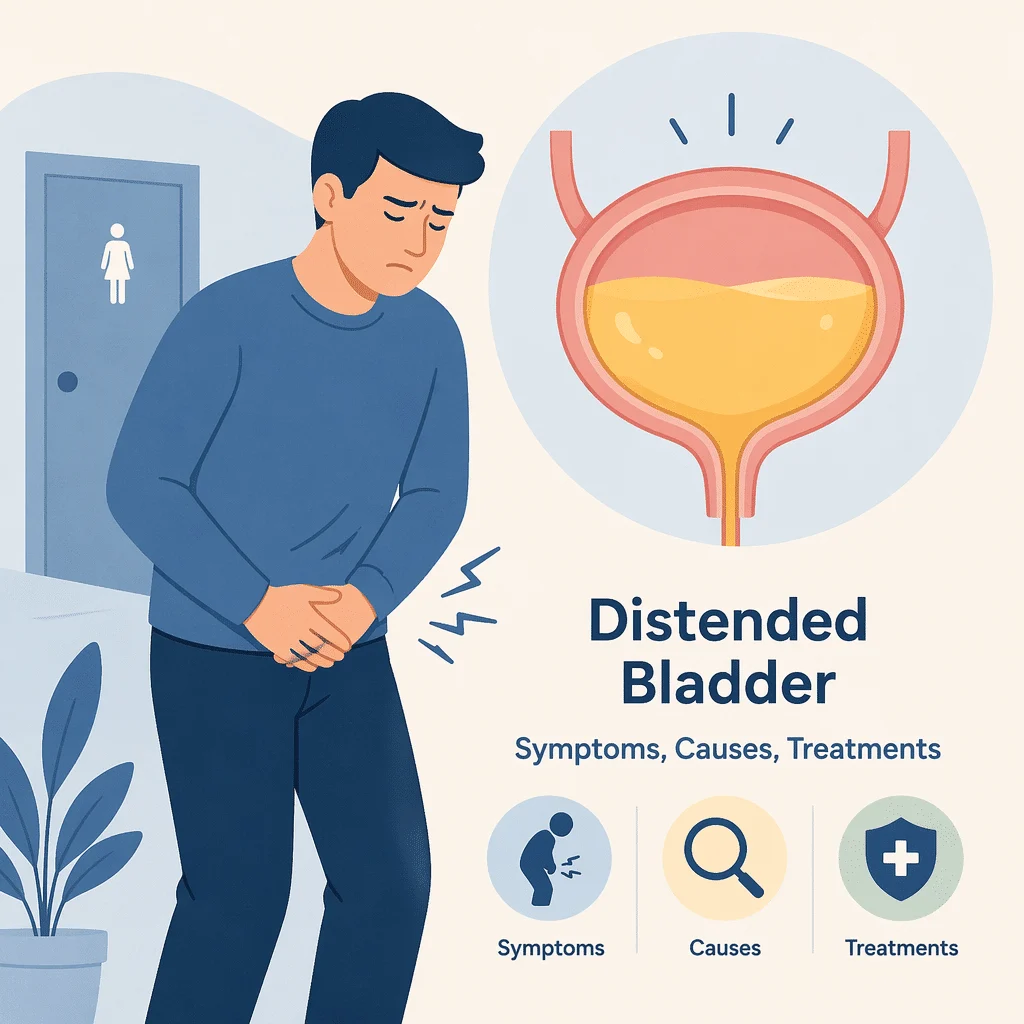
Een uitgerekte blaas ontstaat wanneer urine zich ophoopt en de blaas ver voorbij zijn normale grootte oprekt, meestal omdat hij zich niet kan legen zoals hij zou moeten. Je kunt een strak, ongemakkelijk vol gevoel laag in je buik voelen, moeite hebben om te beginnen met plassen, of kleine hoeveelheden urine verliezen zonder waarschuwing. Bij sommige mensen bouwt het probleem zich langzaam en onopgemerkt op; bij anderen komt het plotseling en pijnlijk. Dit artikel legt uit wat een uitgerekte blaas is, de symptomen en waarschuwingssignalen om op te letten, de oorzaken, hoe artsen het vaststellen en hoe het wordt behandeld. Het benoemt ook de situatie die als een medisch noodgeval geldt: een plotselinge, pijnlijke onmogelijkheid om überhaupt urine te lozen.
Wat betekent een uitgerekte blaas?
De blaas is een spierachtig, ballonvormig orgaan dat urine opslaat totdat je klaar bent om naar het toilet te gaan. Een gezonde volwassen blaas kan comfortabel ongeveer 400 tot 600 milliliter bevatten, ruwweg twee kopjes, en de eerste aandrang om te plassen ontstaat meestal wanneer de blaas voor ongeveer 150 tot 250 milliliter gevuld is. Een uitgerekte blaas is een blaas die verder is opgerekt dan dit comfortabele bereik, omdat urine zich sneller ophoopt dan ze wordt afgevoerd, of omdat ze helemaal niet kan worden afgevoerd.
Artsen noemen dit soms blaasdilatatie of een overvol blaas. Het is op zichzelf geen ziekte, maar een teken dat er iets de normale lediging verstoort. Het onderliggende probleem is vaak urineretentie, wat betekent dat de blaas urine vasthoudt die eigenlijk al had moeten worden geloosd. Het opsporen en behandelen van die onderliggende oorzaak is wat de blaas en de nieren op de lange termijn beschermt.
Acute versus chronische blaasdilatatie
Acute dilatatie ontstaat snel. De blaas vult zich, de aandrang wordt hevig, en toch komt er weinig of geen urine. Dit is oncomfortabel, vaak ernstig, en vereist snelle medische aandacht.
Chronische dilatatie ontwikkelt zich geleidelijk over weken of maanden, doordat na elk toiletbezoek kleine hoeveelheden urine achterblijven. Omdat het langzaam opbouwt, ervaren sommige mensen verrassend weinig klachten, zelfs wanneer er een grote hoeveelheid is opgehoopt. Dat is een van de redenen waarom het probleem onopgemerkt kan blijven totdat een routineonderzoek of scan het aan het licht brengt.
Symptomen van een uitgerekte blaas
De symptomen hangen af van hoe snel de blaas is uitgerekt en van de oorzaak. Veelvoorkomende tekenen zijn:
- Een gevoel van volheid, druk of een zeurende pijn laag in de buik
- Moeite om de urinestraal op gang te brengen, of moeten persen om te beginnen
- Een zwakke, trage of onderbroken urinestraal
- Het gevoel dat de blaas nooit volledig leeg is
- Vaak plassen, maar telkens slechts een kleine hoeveelheid
- Meerdere keren per nacht opstaan om te plassen, ook wel nycturie genoemd
- Ongewild kleine hoeveelheden urine verliezen, ook wel overloopincontinentie genoemd
Bij chronische gevallen kan een uitgerekte blaas soms worden gevoeld als een stevige zwelling laag in de buik. Omdat deze tekenen overlappen met andere urineproblemen, is een goede beoordeling belangrijk. Frequent kleine hoeveelheden plassen en nadruppelen kunnen bijvoorbeeld worden verward met een eenvoudige overactieve blaas, terwijl het werkelijke probleem een blaas is die nooit volledig leegloopt.
Waarschuwingssignalen bij acute urineretentie
Een plotselinge en volledige onmogelijkheid om te plassen, zeker in combinatie met een pijnlijke, opgezette onderbuik, is een medische noodsituatie die acute urineretentie wordt genoemd. De blaas kan niet leeglopen, de druk stijgt snel en het ongemak is vaak hevig. Iedereen die plotseling helemaal geen urine meer kan lozen en dit soort pijn voelt, moet onmiddellijk spoedeisende hulp zoeken, omdat de blaas snel geleegd moet worden om schade te voorkomen.
Wat veroorzaakt een opgezette blaas?
Bijna elke oorzaak valt in een van twee categorieën: er is iets dat de urineafvoer blokkeert, of de blaasspier en de bijbehorende zenuwen werken niet goed genoeg om urine naar buiten te duwen. Soms treden beide tegelijk op.
Een blokkade van de urineafvoer
Wanneer urine niet vrij kan wegvloeien, hoopt het zich op en rekt de blaas uit. Bij mannen is de meest voorkomende oorzaak een vergrote prostaat, ook wel benigne prostaathyperplasie genoemd, die de urethra samenknijpt naarmate de klier met de leeftijd groeit. Andere blokkades zijn een vernauwde urethra, ook wel strictuur genoemd, door een vroegere infectie of letsel; ernstige constipatie die op de blaashals drukt; en, minder vaak, tumoren in het bekken. Stenen vlak bij de blaasuitgang kunnen de doorstroom ook belemmeren, dus artsen kunnen nierstenen.
Zenuw- en spierproblemen, of neurogene blaas
De blaas is afhankelijk van een voortdurende wisselwerking tussen zenuwen en spieren om op het juiste moment samen te trekken en te ontspannen. Wanneer die signalen verstoord raken, ontstaat een neurogene blaas die mogelijk niet krachtig genoeg samentrekt om volledig leeg te lopen. Onder de zenuwgerelateerde oorzaken zien artsen regelmatig langdurige diabetes. Na verloop van jaren kan een hoge bloedsuiker stilletjes de zenuwen beschadigen die de blaas aansturen. Dezelfde verstoring kan optreden na een dwarslaesie, een hernia, of een beroerte, en komt ook voor bij zenuwziekten zoals multiple sclerose. In elk geval wordt urine vastgehouden en rekt de blaas geleidelijk uit.
Medicijnen, operaties en andere uitlokkende factoren
Sommige medicijnen verminderen het vermogen van de blaas om samen te trekken of de uitgang te sluiten, waaronder bepaalde antihistaminica, decongestiva, sommige antidepressiva en opioïde pijnstillers. Urineretentie komt ook vaak voor direct na een operatie onder narcose en na een bevalling, wanneer zwelling, pijn en tijdelijke zenuweffecten het leeglopen van de blaas belemmeren. Deze uitlokkende factoren zijn vaak van korte duur, maar kunnen de blaas toch voldoende uitrekken om behandeling nodig te maken.
| Veelvoorkomende oorzaak | Typische aanwijzingen |
|---|---|
| Vergrote prostaat (BPH) | Oudere man, zwakke urinestraal, nadruppelen, geleidelijk ontstaan over jaren |
| Urethrastrictuur | Persen bij het plassen, vroegere infectie, letsel of gebruik van een katheter |
| Neurogene blaas | Diabetes of een neurologische aandoening, weinig aandrang ondanks een volle blaas |
| Bijwerking van medicatie | Klachten beginnen na het starten van een nieuw geneesmiddel, zoals een neusdruppel of een opiaat |
| Na een operatie of bevalling | Moeite met plassen in de uren tot dagen daarna |
| Ernstige constipatie | Harde ontlasting en een vol gevoel in de buik naast de plasklachten |
Waarom een onbehandelde uitgerekte blaas gevaarlijk is
Een blaas die langdurig overrekt blijft, herstelt niet vanzelf. Na verloop van tijd kan het vasthouden van te veel urine tot echte complicaties leiden:
- Urine die stilstaat bevordert de groei van bacteriën, wat kan leiden tot een urineweginfectie.
- Voortdurende overrekking verzwakt de blaasspier, waardoor deze nog minder goed samentrekt — een vicieuze cirkel die de urineretentie verergert.
- Wanneer de druk richting de nieren oploopt, kan urine zich daar ophopen — een aandoening die hydronefrose wordt genoemd — en bij aanhouden de nieren beschadigen.
- Achtergebleven urine bevordert ook de vorming van blaassteentjes en kan in sommige gevallen leiden tot bloed in de urine.
Het goede nieuws is dat deze problemen grotendeels te voorkomen zijn als de aandoening tijdig wordt herkend en de oorzaak wordt behandeld. Dat is waarom aanhoudende plasklachten beter onderzocht dan genegeerd worden.
Wanneer moet je een arts raadplegen?
Maak een afspraak bij de huisarts als u regelmatig moet persen om te plassen, het gevoel heeft dat uw blaas nooit helemaal leeg is, 's nachts herhaaldelijk wakker wordt om te plassen, of onverwacht urine verliest. Zoek direct spoedhulp als u plotseling helemaal niet meer kunt plassen en uw onderbuik pijnlijk en opgezwollen is, of als plasklachten gepaard gaan met koorts, koude rillingen, rugpijn of braken — dit kan wijzen op een infectie of nierbetrokkenheid.
Hoe een uitgerekte blaas wordt vastgesteld
De diagnose begint met uw verhaal en een lichamelijk onderzoek. Een arts vraagt naar uw plasstraal, hoe vaak u plast, uw medicijnen en eerdere operaties, en voelt vervolgens de onderbuik, waar een uitgerekte blaas soms voelbaar is als een ronde weerstand boven het schaambeen.
De belangrijkste test is snel en pijnloos: een blasscan, een kleine draagbare echografie die meet hoeveel urine er na het plassen achterblijft. Deze resterende hoeveelheid heet het post-mictioneel residu, en een hoge waarde bevestigt dat de blaas niet goed leegloopt. Artsen voegen hier vaak een urineonderzoek aan toe om te controleren op infectie of bloed in de urine. Voor een volledig overzicht van het diagnostisch traject beschrijft National Institute of Diabetes and Digestive and Kidney Diseases de standaardstappen.
Om de nierfunctie te beoordelen, kan een arts een nierfunctiepanelaanvragen. Het laboratorium rapporteert ook uw creatininewaarde en berekent de eGFR filtratiesnelheid, twee waarden die laten zien hoe goed de nieren filteren. Bij mannen kunnen artsen ook de PSA bloedtest en de prostaat onderzoeken; een afwijkend resultaat kan aanleiding geven tot verder onderzoek naar prostaatkanker. Wanneer het beeld complex is, meten gespecialiseerde urodynamische tests de druk en doorstroming in de blaas, en een camera-onderzoek dat cystoscopie wordt genoemd, kijkt rechtstreeks naar de urethra en de blaas.
Hoe een uitgerekte blaas wordt behandeld
De behandeling bestaat uit twee delen: de directe druk verlichten en vervolgens de oorzaak aanpakken waardoor de blaas niet goed leegloopt.
Bij acute urineretentie is de eerste stap het leegdraineren van de blaas met een katheter, een dun, flexibel slangetje dat in de blaas wordt ingebracht om de opgesloten urine af te voeren. Dit geeft snel verlichting en beschermt de nieren. Wanneer de uitgang volledig geblokkeerd is of een katheter niet via de urethra kan worden ingebracht, kan in plaats daarvan een tijdelijk slangetje door de onderbuik worden geplaatst, een zogenaamde suprapubische katheter.
Nadat de blaas is geleegd, verschuift de aandacht naar de onderliggende oorzaak. Een vergrote prostaat kan worden behandeld met medicijnen die de klier ontspannen of doen krimpen, of met een ingreep wanneer medicatie niet voldoende helpt. Vernauwingen kunnen worden verwijderd of hersteld. Als een geneesmiddel de oorzaak is, kan een arts de dosering aanpassen. Constipatie wordt behandeld, infecties worden opgehelderd en nierstenen worden verwijderd. Een stabiele bloedsuikerregeling helpt de blaaszenuwen te beschermen bij mensen met diabetes.
Omgaan met een neurogene blaas
Wanneer zenuwen het probleem zijn, is het doel de blaas regelmatig te legen en de druk laag te houden zodat de nieren veilig blijven. Veel mensen leren schone intermitterende katheterisatie, waarbij ze een paar keer per dag een katheter gebruiken om de blaas op een vast tijdstip te legen. Bekkenbodertherapie, geplande mictie, blaastraining en specifieke medicijnen kunnen elk een rol spelen. Een uroloog of een gespecialiseerd team begeleidt dit langetermijnplan doorgaans.
Kan een uitgerekte blaas weer normaal worden?
Vaak wel, vooral wanneer de oorzaak vroeg wordt ontdekt. Zodra de obstructie of de uitlokkende factor is behandeld en de blaas regelmatig wordt geleegd, kan een licht tot matig uitgerekte blaas veel van zijn spanning terugkrijgen. Wanneer de uitrekking ernstig of langdurig is geweest, herstelt de spier mogelijk niet volledig en kan blijvende behandeling nodig zijn. Vroege aandacht geeft de blaas de beste kans op herstel.
Recente wetenschappelijke ontwikkelingen
Onderzoek naar urineretentie en de neurogene blaas verfijnt voortdurend hoe artsen deze aandoening diagnosticeren en behandelen. Hieronder volgen enkele recente bevindingen, vertaald naar begrijpelijke taal.
Hoe clinici beslissen wanneer de blaas geleegd moet worden, wordt steeds nauwkeuriger. Een expertpanel in de Verenigde Staten stelde in 2024 een stapsgewijze richtlijn op, waarin wordt aanbevolen dat clinici het blaasvolume meten met een snelle echografie voordat ze een katheter plaatsen, en dit alleen doen boven bepaalde volumedrempelwaarden. Wat dit voor u betekent: minder onnodige katheters en een lager risico op de infecties die ze kunnen veroorzaken. (Chrouser en collega's, JAMA Network Open, 2024.)
De manier waarop de blaas wordt geleegd kan het herstel beïnvloeden, niet alleen het infectierisico. Een studie uit 2025 onder meer dan duizend mensen met een dwarslaesie toonde aan dat degenen die werden behandeld met intermitterende, in-en-uit-katheters ongeveer twee keer zo vaak binnen een jaar de natuurlijke blaasfunctie herkregen als degenen met een permanente, verblijfskatheter. Wat dit voor u betekent: voor veel mensen heeft intermitterende katheterisatie op vaste tijden de voorkeur boven een langdurige verblijfskatheter. Dit was een observationeel onderzoek, dus het toont een sterk verband aan in plaats van definitief bewijs, maar het bevestigt de huidige praktijk. (Aude en collega's, JAMA Network Open, 2025.)
Bij mannen kan vroege behandeling van een vergrote prostaat urineretentie voorkomen. Een review uit 2025 meldde dat de combinatie van twee veelgebruikte prostaatmedicijnen de kans dat klachten verergeren tot urineretentie meer verlaagt dan elk medicijn afzonderlijk. Wat dit voor u betekent: als u last heeft van een zwakke straal en een geleidelijk uitdijende blaas door prostaatvergroting, kan behandeling meer doen dan alleen klachten verlichten; het kan ook het risico op een plotselinge verstopping verminderen. (Wei en collega's, JAMA, 2025.)
Tot slot publiceerden internationale specialisten in 2025 nieuwe richtlijnen voor mensen bij wie blaasproblemen voortkomen uit een neurologische aandoening. De aanbevelingen benadrukken eenvoudige controles, zoals vragen naar urineklachten, het bijhouden van een blaagdagboek en het meten van het post-mictioneel residu — de urine die na het plassen in de blaas achterblijft — en geven de voorkeur aan intermitterende katheterisatie bij retentie, terwijl antibiotica worden afgeraden bij bacteriën die worden gevonden zonder klachten. Wat dit voor u betekent: een praktische, duidelijk omschreven leidraad voor de bescherming van de blaas en nieren wanneer zenuwen betrokken zijn. (Panicker en collega's, European Journal of Neurology, 2025.)
Woordenlijst met belangrijke termen
| Termijn | Definitie |
|---|---|
| Uitgerekte blaas | Een blaas die verder is uitgerekt dan zijn normale capaciteit omdat hij zich niet goed kan legen. |
| Urineretentie | Het onvermogen om de blaas volledig of helemaal niet te legen; dit kan acuut of chronisch zijn. |
| Post-mictioneel residu | De hoeveelheid urine die in de blaas achterblijft direct nadat u heeft geprobeerd te plassen. |
| Neurogene blaas | Blaasdisfunctie veroorzaakt door zenuwschade of een neurologische aandoening. |
| Benigne prostaathyperplasie (BPH) | Een goedaardige vergroting van de prostaat die de urineafvoer bij mannen kan blokkeren. |
| Overloopincontinentie | Kleine hoeveelheden urine verliezen omdat de blaas te vol is om meer vast te houden. |
| Katheterisatie | De blaas leegmaken met een dun, flexibel buisje dat een katheter wordt genoemd. |
| Hydronefrose | Zwelling van een nier wanneer urine terugstroomt en niet normaal kan afvloeien. |
| Urodynamisch onderzoek | Tests die de druk, capaciteit en urinestroming van de blaas meten. |
| Nycturie | Één of meerdere keren per nacht wakker worden om te plassen. |
Veelgestelde vragen
Wat betekent een uitgerekte blaas?
Het betekent dat de blaas zich heeft gevuld en uitgerekt tot voorbij zijn normale grootte, omdat de urine niet goed wordt afgevoerd. De uitrekking zelf is een signaal, geen diagnose. Het wijst op een onderliggende oorzaak, zoals een blokkade van de uitgang of een zenuw- of spierprobleem waardoor de blaas de urine niet volledig kan uitpersen. Die oorzaak opsporen is de sleutel tot behandeling en het voorkomen van complicaties.
Wat veroorzaakt een uitgerekte blaas bij vrouwen?
Bij vrouwen zijn veelvoorkomende oorzaken een neurogene blaas door aandoeningen zoals multiple sclerose of diabetes, verzakking van bekkenorganen die de uitgang afknelt, ernstige constipatie, en de tijdelijke urineretentie die kan optreden na een bevalling, bekkenoperatie of verdoving. Bepaalde medicijnen kunnen ook een rol spelen. Omdat prostaatproblemen geen factor zijn, richt het onderzoek bij vrouwen zich op de bekkenbodem, de zenuwen en eventuele obstructies, aan de hand van een lichamelijk onderzoek en een blaasscan.
Is een uitgerekte blaas gevaarlijk?
Dat kan het zijn als het onbehandeld blijft, want langdurig overrekken kan leiden tot infecties, verzwakking van de blaasspier en in sommige gevallen belasting van de nieren. De meest urgente vorm is acute urineretentie, waarbij je plotseling helemaal niet meer kunt plassen — dit vereist spoedeisende zorg. Dat gezegd hebbende, worden veel gevallen opgespoord en behandeld voordat er schade ontstaat, en de vooruitzichten zijn over het algemeen goed zodra de oorzaak wordt aangepakt.
Kan een uitgerekte blaas weer normaal worden?
Vaak wel, vooral als het probleem vroeg wordt ontdekt en de oorzaak wordt behandeld. Door de blaas regelmatig leeg te maken en leeg te houden, kan een licht tot matig uitgerekte blaas veel van zijn spierspanning terugkrijgen. Als de uitrekking ernstig is geweest of lang heeft aangehouden, is volledig herstel minder zeker en hebben sommige mensen blijvende begeleiding nodig — nog een reden om een controle niet uit te stellen.
Kan ik een uitgerekte blaas thuis behandelen?
Een opgezette blaas is niets om zelf te behandelen, want de opgesloten urine moet worden afgevoerd en de onderliggende oorzaak moet worden vastgesteld. Als je plotseling niet meer kunt plassen, behandel het dan als een noodgeval in plaats van te wachten. Bij mildere, aanhoudende klachten kan een arts maatregelen voorstellen zoals geplande plasschema's of een medicatiebeoordeling, maar die komen na een goede beoordeling, niet in plaats daarvan.
Wanneer is een opgezette blaas een noodgeval?
Behandel het als een noodgeval wanneer je helemaal niet kunt plassen en je onderbuik pijnlijk en opgezwollen is. Dit is acute urineretentie, en de blaas moet snel worden geleegd om de blaas en de nieren te beschermen. Zoek ook snel medische hulp als een opgezet gevoel gepaard gaat met koorts, koude rillingen, ernstige rugpijn of braken, wat kan wijzen op een infectie of aantasting van de nieren.
Bronnen
- National Institute of Diabetes and Digestive and Kidney Diseases (NIDDK) — Urinary Retention — National Institutes of Health, 2023 — niddk.nih.gov
- Cleveland Clinic — Urinary Retention: Causes, Diagnosis and Treatment — Cleveland Clinic, 2024 — my.clevelandclinic.org
- MedlinePlus — Urination: difficulty with flow — U.S. National Library of Medicine — medlineplus.gov
- Chrouser K, et al. — Urinary Retention Evaluation and Catheterization Algorithm for Adult Inpatients — JAMA Network Open, 2024 — doi.org/10.1001/jamanetworkopen.2024.22281
- Aude CA, et al. — Catheterization Method and Functional Recovery of Neurogenic Bladder in Spinal Cord Injury — JAMA Network Open, 2025 — doi.org/10.1001/jamanetworkopen.2025.22030
- Wei JT, et al. — Lower Urinary Tract Symptoms in Men: A Review — JAMA, 2025 — doi.org/10.1001/jama.2025.7045
- Panicker JN, et al. — EAN, EFAS and INUS guidelines on the assessment and treatment of neurogenic urinary and sexual symptoms — European Journal of Neurology, 2025 — doi.org/10.1111/ene.70119
Verder lezen
- Blaaskanker: symptomen en waarschuwingssignalen
- BUN-creatinineverhouding: betekenis en waarden
- Schuimende urine verklaard: oorzaken en risico's
- Urinekleur: inzicht in oorzaken en veranderingen
- Erectieproblemen: oorzaken en bijbehorende onderzoeken
Begrijp uw laboratoriumresultaten met AI DiagMe.
Een opgezette blaas wordt vaak voor het eerst ontdekt via dezelfde onderzoeken die laten zien wat er in je urinewegen gebeurt. AI DiagMe helpt je de uitslag te begrijpen van onderzoeken zoals een urineonderzoek, je creatinine- en nierfunctiewaarden, en een PSA-waarde — allemaal in duidelijke, begrijpelijke taal. Als je deze waarden begrijpt, kun je een beter gesprek voeren met je arts over een zwakke straal of het gevoel dat je blaas niet goed leegt. AI DiagMe helpt je je uitslagen te begrijpen; het stelt geen diagnoses en vervangt je arts niet.
Ontvang binnen enkele minuten een interpretatie van uw resultaten.