










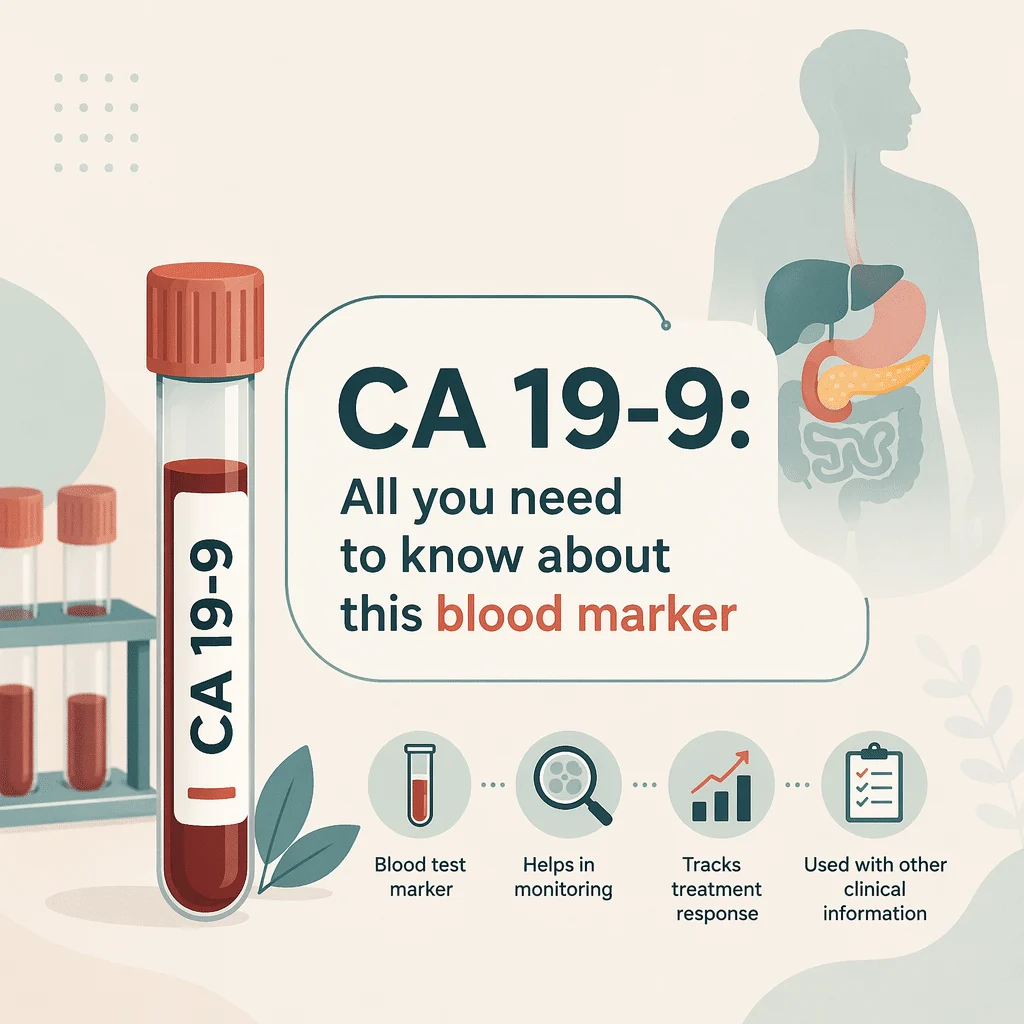
De CA 19-9 bloedtest meet een stof die de alvleesklier en galwegen in de bloedbaan afgeven, en artsen gebruiken deze test voornamelijk om een al bekende kanker te volgen, niet om er een op te sporen. Als uw waarde verhoogd is, neem dan even de tijd voordat u het ergste aanneemt. Goedaardige aandoeningen zoals een geblokkeerde galgang, galstenen, een ontstoken alvleesklier of geelzucht op zichzelf zijn veelvoorkomende verklaringen, en ze kunnen deze waarde veel hoger doen uitvallen dan de meeste mensen verwachten.
In dit artikel lees je wat CA 19-9 precies is, waarom artsen het aanvragen, waarom ongeveer 5 tot 10% van de mensen het helemaal niet kan aanmaken, waarom een verhoogde waarde vaak een onschuldige oorzaak blijkt te hebben, waarom de trend over meerdere metingen meer zegt dan één enkel getal, en wanneer een uitslag het waard is om snel met je arts te bespreken.
Wat CA 19-9 is
CA 19-9 staat voor koolhydraatantigeen 19-9. Het is een molecuul van suikers en eiwitten dat zich bevindt op het oppervlak van cellen die de alvleesklier, de galwegen, de maag en de darm bekleden. Bij iedereen lekt er een kleine hoeveelheid in het bloed, waardoor ook een gezond persoon een meetbare waarde heeft.
Laboratoria meten het met een immunoassay, een techniek waarbij antilichamen aan het molecuul binden om het te tellen. De uitslag wordt weergegeven in eenheden per milliliter, geschreven als U/mL. De meeste laboratoria beschouwen alles onder ongeveer 37 U/mL als binnen de normale waarden, al verschilt de exacte grenswaarde per laboratorium omdat verschillende fabrikanten verschillende testkits gebruiken.
CA 19-9 wordt ingedeeld als tumormarker. Dat klinkt definitiever dan het is. Een tumormarker is simpelweg een stof die de neiging heeft te stijgen wanneer bepaalde vormen van kanker aanwezig zijn, maar die niet uitsluitend door kanker wordt aangemaakt. Ook ontstoken, geïrriteerd of afgesloten weefsel produceert het, en gezond weefsel doet dat in kleine hoeveelheden ook. Als je een breder beeld wilt van hoe deze groep tests werkt, kun je ons overzicht lezen van tumormarkers en hun beperkingen.
Het belangrijkste om te onthouden is dat CA 19-9 een neiging meet, geen diagnose stelt. Het is één regel op een laboratoriumuitslag en lost op zichzelf niets op.
Waarom artsen CA 19-9 meten, en waarom het geen screeningstest is
De belangrijkste rol van CA 19-9 is het bewaken van het ziektebeloop. Wanneer iemand al de diagnose alvleesklierkanker of galwegkanker heeft gekregen, weerspiegelt de waarde vaak hoeveel ziekte er aanwezig is. Artsen gebruiken het om te zien of chemotherapie aanslaat, om na een operatie op een terugkeer te letten en om de prognose te helpen inschatten. Op die manier ingezet, samen met scans en hoe de persoon zich daadwerkelijk voelt, heeft het zijn waarde bewezen.
Waarvoor CA 19-9 niet bedoeld is, is het controleren van een gezond persoon op alvleesklierkanker. Het National Cancer Institute stelt uitdrukkelijk dat studies naar circulerende tumormarkers als screeningsinstrument over het algemeen hebben aangetoond dat deze markers niet goed werken voor screening: ze missen te veel mensen die de ziekte wél hebben, en ze geven bij te veel mensen een vals alarm die de ziekte niet hebben.
De rekensom daarachter is de moeite waard om te begrijpen, want die verklaart veel onnodige angst. Alvleesklierkanker komt weinig voor in de algemene bevolking. Wanneer je een test die slechts matig nauwkeurig is toepast op een grote groep mensen bij wie de kans op een aandoening zeer klein is, is bijna elk positief resultaat een vals alarm. De test functioneert niet verkeerd. Er wordt simpelweg een vraag aan gesteld die hij niet kan beantwoorden.
Waar CA 19-9 echt nuttig is
- Bijhouden of een bekende alvleesklier- of galwegkanker reageert op de behandeling.
- Letten op terugkeer van de ziekte tijdens de follow-up na een operatie.
- Aanvullende informatie geven bij scans en klachten wanneer een diagnose wordt uitgezocht.
- Helpen bij het inschatten van de prognose zodra een diagnose is bevestigd.
Merk op dat elk van deze toepassingen uitgaat van een bekende situatie. Geen ervan is “controleren of ik kanker heb”.
Het Lewis-antigeen probleem: waarom sommige mensen nauwelijks CA 19-9 aanmaken
Dit is het allerbelangrijkste om te begrijpen over CA 19-9, en het is het onderdeel dat de meeste artikelen overslaan.
Je lichaam kan het CA 19-9-molecuul alleen aanmaken als het beschikt over een bepaald enzym, dat wordt bepaald door het Lewis-bloedgroepsysteem. Het Lewis-systeem is een reeks erfelijke bloedgroepmarkers, vergelijkbaar met de bloedgroepen A, B en O. Ongeveer 5 tot 10% van de mensen erft een variant waardoor ze CA 19-9 helemaal niet kunnen aanmaken. Deze mensen worden Lewis-negatief genoemd.
De gevolgen zijn ingrijpend. Iemand die Lewis-negatief is, kan vergevorderde alvleesklierkanker hebben en toch een CA 19-9-uitslag van bijna nul laten zien. De test klopt wel degelijk en het laboratorium heeft geen fout gemaakt. Er is simpelweg niets te meten, omdat het lichaam het molecuul nooit aanmaakt.
Dit werkt twee kanten op, en beide zijn van belang:
- Een geruststellend lage CA 19-9 bij iemand die Lewis-negatief is, zegt helemaal niets over de aan- of afwezigheid van kanker.
- CA 19-9 kan niet worden gebruikt om de behandeling te volgen bij iemand die Lewis-negatief is, omdat er geen waarde is die omhoog of omlaag kan gaan. De arts zal in dat geval vertrouwen op scans en andere markers.
Als je CA 19-9-uitslag nul of niet meetbaar is, is het verstandig dit met je arts te bespreken, zeker als de test is aangevraagd vanwege een concrete zorg. Het is een bekende beperking, die eenvoudig uit te leggen is, en die van invloed is op hoe de verdere follow-up het beste gepland kan worden.
Waarom een hoge CA 19-9 zo vaak een goedaardige oorzaak heeft
Een verhoogd CA 19-9 is geen kankerdiagnose. In de dagelijkse praktijk zijn goedaardige oorzaken gebruikelijk, en sommige daarvan leveren getallen op die er alarmerend uitzien.
Het mechanisme is makkelijker te begrijpen dan het klinkt. CA 19-9 wordt normaal gesproken via de gal afgevoerd. Wanneer de gal niet goed kan wegvloeien — door een galsteen, ontsteking, zwelling of littekenweefsel — hoopt de stof zich op en komt in plaats daarvan in de bloedbaan terecht. Ontstoken weefsel produceert er ook meer van. Het niveau kan dus sterk stijgen zonder dat er ook maar één kankercel bij betrokken is.
Aandoeningen die CA 19-9 vaak verhogen zonder dat er sprake is van kanker, zijn onder meer galstenen die een galgang blokkeren, cholangitis (infectie of ontsteking van de galgangen), acute of chronische ontsteking van de alvleesklier, cirrose en andere chronische leverziekten, en geelzucht door vrijwel elke oorzaak. Geelzucht verdient een aparte vermelding: de vergeling zelf, ongeacht de onderliggende oorzaak, kan CA 19-9 aanzienlijk verhogen.
Het bemoedigende is wat er daarna gebeurt. Wanneer de onderliggende blokkade wordt opgeheven — door een steen te verwijderen, een stent te plaatsen om de galgang te draineren, of simpelweg de infectie te behandelen — daalt CA 19-9 doorgaans, vaak sterk en vaak binnen enkele weken. Die daling is op zichzelf al informatief, en het is één van de redenen waarom artsen voorzichtig zijn met het interpreteren van een hoog niveau bij iemand met geelzucht. Ze wachten vaak, behandelen de obstructie en herhalen de test.
Dit is ook waarom CA 19-9 zelden alleen wordt beoordeeld. Uw arts zal het doorgaans naast uw leverfunctietests, uw totale bilirubinewaarde, uw alkalische fosfatase-uitslag en, als de alvleesklier de zorg is, uw amylase- en lipasewaardenbekijken. Een hoog CA 19-9 in combinatie met een geblokkeerde-galgang-patroon bij die tests vertelt een heel ander verhaal dan een hoog CA 19-9 bij iemand wiens leverwaardes volledig normaal zijn.
| Patroon | Veelvoorkomende oorzaken | Wat er daarna meestal gebeurt |
|---|---|---|
| Licht verhoogd, geen klachten, leverwaardes normaal | Individuele variatie, lichte ontsteking, roken, goedaardige eierstok- of schildklieraandoeningen | De test wordt doorgaans na enkele weken herhaald om te zien of de waarde daalt |
| Duidelijk verhoogd, met geelzucht of een geblokkeerde-galgang-patroon bij leverwaardes | Galstenen, cholangitis, galwegobstructie, cirrose, hepatitis | De obstructie of infectie wordt eerst behandeld, waarna CA 19-9 opnieuw wordt gemeten zodra de gal weer wegvloeit |
| Zeer hoog, met gewichtsverlies, rugpijn of een afwijking op een scan | Vereist gedegen onderzoek; kanker is één van de mogelijkheden | Beeldvorming zoals een CT-scan, MRI of endoscopische echografie, en doorgaans een biopsie, omdat alleen weefselonderzoek een diagnose kan bevestigen |
| Gestaag stijgend over meerdere tests in hetzelfde laboratorium | Betekenisvol ongeacht de beginwaarde; de richting is het signaal | Geeft aanleiding tot nader onderzoek en beeldvorming, ook als elk afzonderlijk getal er onopvallend uitziet |
| Bijna nul of niet aantoonbaar | Normaal voor de meeste mensen, maar kan wijzen op een Lewis-negatieve status | Als kanker serieus wordt vermoed, vertrouwt de arts op scans in plaats van op deze marker |
Hoe je je CA 19-9-uitslag leest
Op een laboratoriumuitslag staat CA 19-9 gewoonlijk onder een kopje zoals tumormarkers, met daarnaast de eigen referentiewaarde van het laboratorium — vaak iets als “< 37 U/mL”. Een waarde boven die grens wordt vaak gemarkeerd met een asterisk of in een andere kleur weergegeven. Die markering betekent “buiten het bereik dat dit laboratorium hanteert”. Het betekent niet “kanker”.
De trend telt zwaarder dan het getal
Eén enkele CA 19-9-waarde is een momentopname, en een onbetrouwbare bovendien. Wat artsen werkelijk in de gaten houden, is de richting over meerdere tests. Een waarde die maandenlang stabiel blijft, is geruststellend, ook als die boven de referentiewaarde ligt. Een waarde die test na test gestaag stijgt, verdient aandacht, zelfs als elk afzonderlijk getal nog bescheiden lijkt.
Om die trend betekenis te geven, moeten de tests vergelijkbaar zijn. Verschillende fabrikanten gebruiken verschillende meetmethoden, die op hetzelfde bloedmonster merkbaar verschillende uitkomsten kunnen geven. Een uitslag van 45 in het ene laboratorium en 60 in het andere hoeft dus helemaal geen echte verandering in jouw lichaam te weerspiegelen. Daarom zal je arts proberen je controles steeds in hetzelfde laboratorium met dezelfde methode te laten uitvoeren. Als je zorg verschuift tussen ziekenhuizen, is het echt de moeite waard dit te vermelden — een sprong die puur door een methodewisseling wordt veroorzaakt, kan er anders uitzien als een verandering in je gezondheid.
Kleine schommelingen van ongeveer 15 tot 20% tussen opeenvolgende tests zijn doorgaans gewoon de normale meetonnauwkeurigheid, en niet iets wat er in je lichaam gebeurt.
Wat een normale CA 19-9 wel en niet betekent
Een normale CA 19-9 is geen bewijs van een goede gezondheid, en het is belangrijk daar eerlijk over te zijn.
Een normale uitslag sluit alvleesklierkanker niet uit. Sommige tumoren, met name kleine vroege tumoren, geven simpelweg niet genoeg van de marker af om het bloedgehalte te verhogen. En, zoals hierboven vermeld, zal iemand met een Lewis-negatieve status nooit een verhoogde waarde laten zien, ongeacht wat er in het lichaam gebeurt. Een geruststellend getal bij iemand met aanhoudende, onverklaarde klachten mag het gesprek niet beëindigen.
Dit gaat in tegen het instinct, dus het is de moeite waard het duidelijk te zeggen: als u symptomen heeft die u zorgen baren en uw CA 19-9 normaal is uitgevallen, verdienen die symptomen nog steeds nader onderzoek. De bloedtest heeft de vraag niet beantwoord. Scans, en soms weefselmonsters, zijn wat de vraag beantwoordt.
Evenzo is een lage CA 19-9 bij iemand zonder klachten iets waar u verder niet over hoeft na te denken. Laag is normaal. Er bestaat niet zoiets als een zorgwekkend lage CA 19-9, en er hoeft niets te worden gedaan om die te verhogen.
Wanneer moet je een arts raadplegen?
Maak snel een afspraak als u last heeft van
- Vergeling van de huid of het oogwit, donkere urine of bleke ontlasting.
- Aanhoudende pijn in de bovenbuik, zeker als die doorstraalt naar uw rug.
- Onverklaarbaar gewichtsverlies, of een langdurig gebrek aan eetlust.
- Nieuwe jeuk zonder uitslag, wat kan optreden bij problemen met de galwegen.
- Een CA 19-9 die bij opeenvolgende tests blijft stijgen, ongeacht de afzonderlijke waarden.
Zoek dringend medische hulp als je het volgende hebt
- Hevige buikpijn met koorts en rillingen, wat kan wijzen op een infectie van de galwegen.
- Geelzucht die plotseling optreedt of snel erger wordt.
- Aanhoudend braken met hevige pijn in de bovenbuik.
Als u een verhoogde CA 19-9 heeft zonder klachten en zonder andere afwijkingen, is de gebruikelijke aanpak niet een onmiddellijke reeks tests. Uw arts zal de meting doorgaans na een bepaalde tijd herhalen en de trend bekijken, omdat een eenmalige verhoogde waarde vaak vanzelf normaliseert. Die afwachtende aanpak betekent niet dat uw arts het licht opneemt. Het is de verstandige reactie op een test die veel onschuldige ruis produceert.
Nieuwste wetenschappelijke ontwikkelingen in CA 19-9-onderzoek
Recent onderzoek heeft grotendeels bevestigd en aangescherpt wat clinici al vermoedden over deze marker, en veel ervan is oprecht geruststellend.
Een review uit 2025 in het Canadian Journal of Gastroenterology & Hepatology onderzocht hoe het Lewis-bloedgroepsysteem de CA 19-9 bepaalt. De bevinding: mensen die de relevante Lewis-antigenen missen, produceren vrijwel geen CA 19-9, en de review stelt dat het negeren hiervan de diagnostische nauwkeurigheid vermindert en de resultaten moeilijker te interpreteren maakt. De review oppert de mogelijkheid om iemands Lewis-type te bepalen naast de marker zelf. Wat dit voor u betekent: als uw CA 19-9 zeer laag is en er een echte klinische vraag te beantwoorden valt, kan dat lage getal meer zeggen over uw erfelijke biologie dan over uw gezondheid, en het is de moeite waard te vragen of de uitslag in uw geval betrouwbaar is.
Twee recente casusrapporten, gepubliceerd in 2025 en 2026, laten zien hoe sterk een goedaardige aandoening deze marker kan verhogen. Beide zijn het waard om te kennen als u naar een hoog getal staart. In het eerste rapport, gepubliceerd in Frontiers in Medicine, dreef een leverabces (een afgebakende infectiehaard) CA 19-9 op tot in de duizenden — een niveau dat de meeste mensen alleen bij vergevorderde kanker zouden verwachten. Nadat het abces was gedraineerd en antibiotica waren toegediend, daalde de waarde snel. Het team verzamelde ook acht eerder gepubliceerde gevallen waarbij hetzelfde was gebeurd. In het tweede rapport, gepubliceerd in het tijdschrift Medicine, had een vrouw met geelzucht door hepatitis een sterk verhoogde CA 19-9; uitgebreide beeldvorming toonde geen tumor aan, en haar waarde normaliseerde zodra haar lever werd behandeld. Wat dit voor u betekent: een zeer hoog getal op zichzelf bewijst niets, en hoe de waarde zich gedraagt nadat het onderliggende probleem is behandeld, geeft vaak het antwoord. Artsen zien dit patroon regelmatig genoeg om het te verwachten.
Tot slot volgde een studie uit 2025 in Surgery de CA 19-9-patronen tijdens chemotherapie en operatie bij mensen met alvleesklierkanker, en stelde een manier voor om die patronen te classificeren. De bevinding: hoe de marker zich in de loop van de tijd ontwikkelde, gaf meer inzicht in de uitkomsten dan welke afzonderlijke meting dan ook. Wat dit voor u betekent: dit is het duidelijkste bewijs tot nu toe voor iets wat uw arts u waarschijnlijk al heeft verteld — namelijk dat het verloop van de curve belangrijker is dan één enkel punt daarop.
Onderzoek gaat ook door naar de combinatie van CA 19-9 met andere markers en met nieuwere bloedtesten, omdat geen enkele marker tot nu toe goed genoeg is gebleken om alleen te staan.
Glossarium
| Termijn | Definitie |
|---|---|
| CA 19-9 | Koolhydraatantigeen 19-9, een suiker-eiwitverbinding die wordt aangemaakt door cellen die de alvleesklier en galwegen bekleden, meetbaar in het bloed |
| Tumormarker | Een stof die kan stijgen wanneer bepaalde kankers aanwezig zijn, maar die ook door goedaardige aandoeningen en gezond weefsel wordt geproduceerd |
| Lewis-bloedgroepsysteem | Een erfelijk stelsel van bloedgroepmarkers dat bepaalt of uw lichaam het CA 19-9-molecuul kan aanmaken |
| Lewis-negatief | Beschrijft de ongeveer 5 tot 10% van de mensen die geen CA 19-9 kunnen aanmaken, waardoor hun uitslag dicht bij nul blijft, zelfs als er een ziekte aanwezig is |
| Galgang | De buis die gal van de lever en galblaas naar de dunne darm transporteert |
| Galwegobstructie | Een blokkade die de normale galafvoer verhindert, vaak veroorzaakt door een galsteen, ontsteking of een groei |
| Cholangitis | Infectie of ontsteking van de galwegen, die doorgaans pijn, koorts en geelzucht veroorzaakt |
| Geelzucht | Vergeling van de huid en het oogwit door een ophoping van bilirubine in het bloed |
| Immunoassay | De laboratoriumtechniek waarbij antilichamen worden gebruikt om een specifiek molecuul, zoals CA 19-9, op te sporen en te kwantificeren |
| U/mL | Eenheden per milliliter, de meeteenheid die wordt gebruikt om CA 19-9-waarden uit te drukken |
Veelgestelde vragen
Wat is een normale CA 19-9-waarde?
De meeste laboratoria beschouwen een CA 19-9-waarde onder ongeveer 37 U/mL als normaal. Dit getal is echter niet universeel. Elk laboratorium stelt zijn eigen referentiewaarden vast op basis van de testkit die het gebruikt en de populatie die het bedient. Vergelijk uw uitslag daarom altijd met de referentiewaarden die op uw eigen rapport staan, en niet met waarden die u online hebt gevonden. Er is geen ondergrens om u zorgen over te maken: een lage of niet-detecteerbare CA 19-9 is normaal en vereist geen actie. Omdat verschillende testmethoden verschillende getallen opleveren, is het vergelijken van een uitslag van het ene laboratorium met de referentiewaarden van een ander een van de meest voorkomende oorzaken van onnodige ongerustheid.
Hoe hoog moet een CA 19-9-waarde zijn voordat een arts zich zorgen maakt?
Er bestaat geen vaste grenswaarde waarbij een uitslag van goedaardig naar ernstig omslaat. Zeer hoge waarden worden vaker in verband gebracht met kanker, maar een goedaardige galwegobstructie of infectie kan ook waarden in de honderden of zelfs duizenden veroorzaken, en sommige kankers verhogen de marker helemaal niet. Wat uw arts afweegt, is het totaalplaatje: uw klachten, uw leverwaardes, wat scans laten zien, of de gal goed afvloeit en de richting waarin de waarde zich in de loop van de tijd ontwikkelt. Een getal op zichzelf, hoe hoog ook, levert geen oordeel op.
Kunnen twee laboratoria verschillende CA 19-9-uitslagen geven voor hetzelfde bloed?
Ja, en dat verrast mensen regelmatig. Verschillende fabrikanten maken verschillende CA 19-9-tests, en die zijn niet volledig uitwisselbaar. Hetzelfde monster kan daardoor in twee laboratoria merkbaar verschillende waarden opleveren. Een verandering tussen tests die op verschillende plaatsen zijn uitgevoerd, kan de testmethode weerspiegelen en niet iets wat er in uw lichaam gebeurt. Als u wordt gevolgd, probeer uw tests dan steeds in hetzelfde laboratorium te laten uitvoeren en vertel uw arts als uw zorg is overgedragen. Het is een klein detail dat veel verwarring voorkomt.
Hebben voeding of medicijnen invloed op de CA 19-9-bloedtest?
CA 19-9 wordt niet noemenswaardig beïnvloed door wat je eet, en geen enkel dieet verhoogt of verlaagt het. Nuchter zijn is doorgaans niet vereist, hoewel je arts je kan vragen te nuchteren voor andere tests die tegelijkertijd worden afgenomen. Medicijnen veranderen de marker ook niet rechtstreeks, maar alles wat je lever of galstroom beïnvloedt, kan hem indirect verschuiven. Roken hangt samen met iets hogere waarden. Vertel je arts altijd wat je gebruikt, want dat helpt hen het hele overzicht te interpreteren en niet alleen deze ene waarde.
Als mijn CA 19-9 hoog is, wat gebeurt er dan?
Meestal minder dan mensen vrezen. Als je geen klachten hebt en je andere uitslagen normaal zijn, is de meest gebruikelijke volgende stap simpelweg de meting na enkele weken herhalen om te zien of de waarde daalt, want geïsoleerde verhogingen zakken vaak vanzelf. Als je geelzucht hebt of je leverwaardes wijzen op een verstopping, is de prioriteit dat eerst te behandelen en daarna opnieuw te meten, omdat het opheffen van een verstopping de waarde doorgaans doet dalen. Als er een echte verdenking bestaat, volgt beeldvorming zoals een CT-scan, MRI of endoscopische echografie, want beelden en weefsel — niet deze bloedtest — zijn wat een diagnose vaststelt.
Is CA 19-9 nuttig bij andere kankers dan alvleesklierkanker?
Het wordt voornamelijk gebruikt bij alvleesklier- en galwegkanker, waar het een duidelijke rol speelt bij de opvolging. Het kan ook stijgen bij maag-, darm-, lever- en bepaalde eierstokkankers, maar voor die aandoeningen geven artsen doorgaans de voorkeur aan andere markers. Als je arts een ander orgaan onderzoekt, zal hij of zij meestal een marker kiezen die daar beter bij past, zoals de CEA-bloedtest voor de opvolging van darmkanker. De keuze van de marker hangt volledig af van de vraag die gesteld wordt, wat nog een reden is waarom geen enkele bloedtest als algemene kankercheck kan dienen.
Bronnen
- Tumormarkers — National Cancer Institute (NCI)
- CA 19-9 bloedtest (alvleesklierkanker) — MedlinePlus, U.S. National Library of Medicine
- Pancreatitis — National Institute of Diabetes and Digestive and Kidney Diseases (NIDDK)
- Liu Y, Zhang J, Zheng Z, Zheng W, Fang L, Zhou F, Liang B — The Interplay Between CA19-9 and the Lewis Blood Group System: Implications for the Diagnosis of Gallbladder Cancer — Canadian Journal of Gastroenterology & Hepatology, 2025 — https://doi.org/10.1155/cjgh/8465615
- Dhingra S, Raman P, Ramsaroop T, Harrison I, Bergsten T, Nusbaum E, Feldman LE — Elevated serum CA 19-9 level mimicking pancreaticobiliary carcinoma from a hepatic abscess: case report and literature review — Frontiers in Medicine, 2025 — https://doi.org/10.3389/fmed.2024.1470046
- Cui Y, Zhang Y, Huang Y, Feng R, Chen Q — Hepatocellulaire geelzucht met abnormaal hoog CA19-9: een casusrapport — Medicine (Baltimore), 2026 — https://doi.org/10.1097/MD.0000000000046994
- Maekawa A, Oba A, Mie T, Sawa Y, Baba H, Kobayashi K, Ono Y, Sato T, Ito H, Sasaki T, Ozaka M, Sasahira N, Takamatsu M, Ban D, Inoue Y, Takahashi Y — De rol van CA 19-9-veranderingen bij multidisciplinaire behandeling van alvleesklierkanker: voorstel voor de PANC-classificatie — Surgery, 2025 — https://doi.org/10.1016/j.surg.2025.109783
Verder lezen
- CA 125 bloedwaarde: een uitlegwijzer
- Alfa-fetoproteïne (AFP) bloedtest
- PSA (prostaat-specifiek antigeen) uitgelegd
- GGT-test: leverenzymresultaten uitgelegd
- Direct bilirubine: begrijp je testuitslag
Begrijp uw laboratoriumresultaten met AI DiagMe.
Labuitslagen leggen zichzelf zelden uit, en een waarde als CA 19-9 naast uw bilirubine, leverfunctietests en lipase kan moeilijk te begrijpen zijn. AI DiagMe vertaalt die cijfers naar begrijpelijke taal, zodat u kunt zien wat elke waarde meet en wat het referentiebereik van uw laboratorium betekent. Het helpt u uw uitslagen te begrijpen en betere vragen voor te bereiden. Het stelt geen diagnose en vervangt uw arts niet.
Ontvang binnen enkele minuten een interpretatie van uw resultaten.