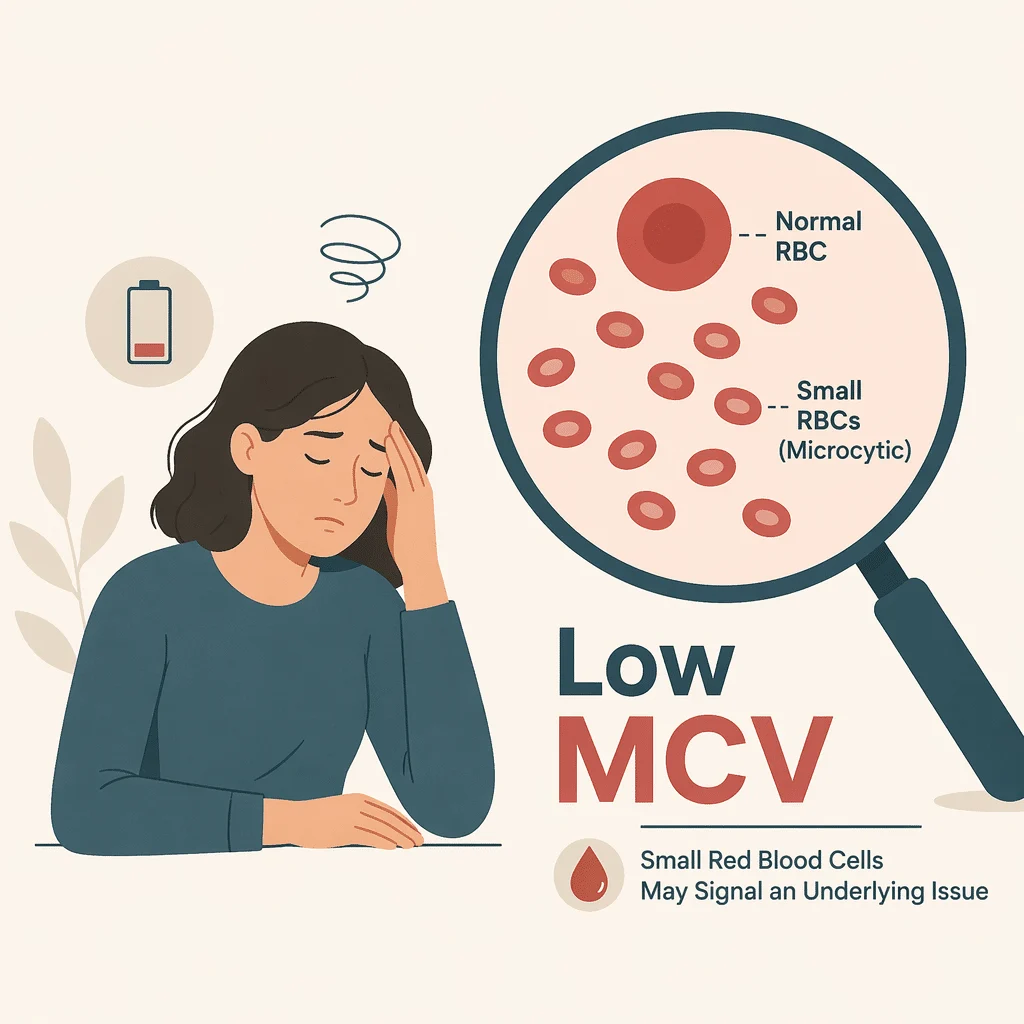
MCV rendah berarti sel darah merah Anda lebih kecil dari ukuran normal. Ini adalah salah satu hasil tidak normal yang paling sering ditemukan pada pemeriksaan darah lengkap, dan merupakan petunjuk — bukan diagnosis. Dua penyebab yang sangat berbeda mencakup sebagian besar kasus: kekurangan zat besi, yang perlu ditangani dan perlu dicari penyebabnya, serta sifat talasemia, yaitu kondisi pembawa (carrier) yang diturunkan secara genetik dan tidak berbahaya serta tidak memerlukan pengobatan sama sekali. Membedakan keduanya sangat penting, karena kesalahan identifikasi bisa berarti bertahun-tahun mengonsumsi tablet zat besi yang tidak perlu, atau terlewatnya sumber perdarahan yang sebenarnya ada.
Dalam artikel ini Anda akan mempelajari apa yang diukur oleh MCV, apa yang bisa dan tidak bisa diungkapkan oleh sel darah merah yang kecil, bagaimana dokter membedakan kekurangan zat besi dari sifat talasemia menggunakan angka-angka yang sudah ada di laporan Anda, penyebab-penyebab yang lebih jarang, serta pemeriksaan apa yang kemungkinan akan dilakukan dokter Anda selanjutnya.
Apa yang sebenarnya diukur oleh MCV
MCV adalah singkatan dari mean corpuscular volume (volume rata-rata sel darah merah): ukuran rata-rata satu sel darah merah, yang dilaporkan dalam femtoliter (fL). Nilai ini tercantum di setiap hitung darah lengkap bersama hemoglobin, hematokrit, serta jumlah sel darah putih dan trombosit. Sebagian besar laboratorium menggunakan kisaran referensi sekitar 80 hingga 100 fL untuk orang dewasa, sehingga hasil di bawah 80 fL biasanya akan ditandai. Batas nilai ini berbeda-beda antar laboratorium dan berbeda pula pada anak-anak, jadi bandingkan angka Anda dengan rentang nilai yang tercetak di laporan Anda sendiri.
Alat analisis mengukur puluhan ribu sel dalam hitungan detik, menghasilkan ukuran rata-rata (MCV) sekaligus ukuran seberapa besar variasi ukuran tersebut: lebar distribusi sel darah merah, atau RDW. Ini adalah salah satu angka yang paling berguna dalam laporan tersebut.
Ukuran sel darah merah bukan sesuatu yang acak. Sel darah merah pada dasarnya adalah kantong hemoglobin, sehingga ketika tubuh tidak dapat memproduksi hemoglobin yang cukup, tubuh membentuk sel-sel yang lebih kecil. Mekanisme tunggal inilah yang mendasari hampir semua penyebab MCV rendah: ada sesuatu yang membatasi produksi hemoglobin, baik zat besi yang dibutuhkan untuk membangunnya maupun rantai protein globin yang membentuk strukturnya. Panduan kami tentang Tes darah MCV menjelaskan cara nilai ini dilaporkan.
Apa yang bisa dan tidak bisa diberitahu oleh MCV rendah
MCV rendah, dengan sendirinya, hanya memberi tahu satu hal: sel darah merah Anda berukuran kecil. Dokter menyebut kondisi ini mikrositosis. Nilai ini tidak memberi tahu apakah Anda mengalami anemia, bagaimana kondisi Anda, atau apa penyebabnya. Mikrositosis dan anemia adalah dua hal yang berbeda.
Anemia berarti kadar hemoglobin yang rendah. Anda bisa memiliki MCV rendah dengan kadar hemoglobin yang sepenuhnya normal — hal ini umum terjadi pada sifat talasemia dan pada tahap paling awal kekurangan zat besi — dan Anda juga bisa mengalami anemia dengan MCV yang normal. Kedua angka ini menjawab pertanyaan yang berbeda.
Ini juga tidak mengatakan apa pun yang dapat diandalkan tentang gejala. Sel darah merah yang kecil itu sendiri tidak menyebabkan apa pun: rasa lelah, sesak napas saat beraktivitas, atau pucat timbul dari anemia jika memang ada, atau dari kondisi yang mendasarinya. Banyak orang dengan MCV yang terus-menerus rendah merasa sehat sepenuhnya selama puluhan tahun.
Yang bisa dilakukannya adalah mempersempit kemungkinan. Ini menyingkirkan penyebab yang sama sekali berbeda di balik MCV tinggi, di mana sel-sel besar mengarah ke vitamin B12 atau kekurangan folat, alkohol, penyakit hati, atau masalah tiroid. Sel yang kecil sebagian besar mengarah ke dua kondisi.
Kekurangan zat besi versus sifat talasemia: pola pada laporan Anda
Inilah pertanyaan yang paling penting, dan sebagian besar jawabannya sudah ada di depan Anda. Kedua kondisi ini menghasilkan sel darah merah yang kecil dan pucat, sehingga MCV saja tidak dapat membedakan keduanya. Tiga atau empat angka yang dibaca bersama-sama biasanya bisa.
Jumlah sel darah merah adalah petunjuk tunggal yang paling informatif
Jumlah sel darah merah (RBC) adalah banyaknya sel darah merah per satuan darah, yang tercetak di dekat MCV pada sebagian besar laporan. Pada kekurangan zat besi, tubuh tidak dapat membangun hemoglobin yang cukup, sehingga menghasilkan lebih sedikit sel dan ukurannya kecil: jumlah sel darah merah biasanya rendah atau normal. Pada sifat talasemia, sumsum tulang mengompensasi dengan memproduksi sel-sel kecil dalam jumlah besar, sehingga jumlah sel darah merah sering kali normal atau bahkan tinggi, meskipun hemoglobin hanya sedikit berkurang.
MCV rendah yang berdampingan dengan jumlah sel darah merah yang tinggi adalah pola yang seharusnya membuat dokter berpikir cermat sebelum langsung memberikan zat besi.
RDW memberi tahu Anda apakah sel-sel tersebut seragam kecilnya
RDW mengukur seberapa besar variasi ukuran sel darah merah. Pada kekurangan zat besi, zat besi habis secara bertahap, sehingga darah Anda mengandung campuran sel-sel lama berukuran normal dan sel-sel baru yang lebih kecil, dan variasi ini mendorong RDW naik. Pada sifat talasemia, kelainan ini sudah ada sejak lahir dan memengaruhi setiap sel secara merata, sehingga sel-selnya seragam kecil dan RDW biasanya normal.
RDW tinggi dengan MCV rendah cenderung mengarah ke kekurangan zat besi. RDW normal dengan MCV rendah cenderung mengarah ke sifat talasemia. Keduanya tidak mutlak, tetapi arahnya benar-benar informatif.
Ferritin menyelesaikan sebagian besar kasus
Ferritin mencerminkan cadangan zat besi Anda dan biasanya menentukan jawabannya: rendah pada kekurangan zat besi, normal pada sifat talasemia. Menafsirkannya memiliki kerumitan tersendiri, karena peradangan dapat mendorong nilainya naik dan menyembunyikan defisiensi yang sebenarnya — itulah mengapa dokter terkadang menambahkan saturasi transferrin atau penanda inflamasi. Artikel pendamping kami tentang feritin rendah membahas kendala-kendala tersebut, penyebab kekurangan zat besi, dan cara penyelidikannya; halaman ini tetap berfokus pada apa yang disampaikan oleh indeks sel darah merah itu sendiri kepada Anda.
Di mana indeks Mentzer berperan
Dokter terkadang menggunakan cara cepat yang disebut indeks Mentzer: MCV dibagi jumlah sel darah merah. Hasil di bawah 13 secara tradisional dibaca sebagai mendukung sifat talasemia, di atas 13 sebagai mendukung kekurangan zat besi. Ini adalah aturan praktis untuk skrining, bukan sebuah tes. Rumus ini memformalkan pengamatan di atas, bahwa sifat talasemia menghasilkan banyak sel kecil sementara kekurangan zat besi menghasilkan lebih sedikit, dan rumus ini cukup sering keliru sehingga tidak boleh digunakan untuk mengambil kesimpulan. Ada beberapa rumus serupa, dan tidak ada satu pun yang menggantikan ferritin dan pengujian konfirmasi.
Bagaimana sifat talasemia sebenarnya dikonfirmasi
Kecurigaan bukanlah diagnosis. Sifat talasemia dikonfirmasi dengan elektroforesis hemoglobin atau kromatografi cair kinerja tinggi (HPLC), metode laboratorium yang memisahkan dan mengukur berbagai jenis hemoglobin. Pada sifat talasemia beta, peningkatan fraksi hemoglobin A2 memberikan jawabannya; sifat talasemia alfa tidak selalu terdeteksi dengan cara ini dan mungkin memerlukan pengujian genetik.
| Fitur pada laporan Anda | kekurangan zat besi | Sifat talasemia |
|---|---|---|
| MCV (ukuran rata-rata sel) | Rendah, dan cenderung semakin turun seiring waktu jika tidak diobati | Rendah, dan stabil selama bertahun-tahun pada tes sebelumnya |
| Jumlah sel darah merah (RBC) | Biasanya rendah atau normal | Sering kali normal atau tinggi |
| RDW (variasi ukuran sel) | Biasanya meningkat, ukuran sel bervariasi | Biasanya normal, sel berukuran seragam dan kecil |
| Ferritin | Rendah | Normal |
| Asal-usul keluarga dan riwayat | Latar belakang apa pun; sering dikaitkan dengan pola makan, menstruasi, atau kehilangan darah | Lebih umum pada keturunan tertentu; anggota keluarga mungkin memiliki gambaran yang sama |
| Tes konfirmasi | Ferritin dan pemeriksaan zat besi, lalu mencari penyebabnya | Elektroforesis hemoglobin atau HPLC |
Satu hal yang perlu diperhatikan: keduanya bisa terjadi bersamaan, dan gambaran campuran ini mengaburkan setiap pola di atas. Itulah salah satu alasan mengapa ferritin diukur secara langsung, bukan hanya diasumsikan.
Mengapa ketepatan diagnosis ini sangat penting
Sifat thalassemia sering kali keliru didiagnosis sebagai kekurangan zat besi. Akibatnya, banyak orang mengonsumsi suplemen zat besi selama bertahun-tahun, bahkan berpuluh-puluh tahun, untuk kondisi yang tidak bisa diatasi dengan zat besi.
Zat besi yang tidak akan pernah membantu
Pada trait talasemia, masalahnya bukan kekurangan zat besi, melainkan variasi genetik dalam pembentukan rantai globin hemoglobin, dan menambah asupan zat besi tidak akan mengubah hal itu. MCV tetap rendah, penderita terus mengonsumsi tablet, dan semua orang mengira defisiensinya membandel padahal sebenarnya tidak ada.
Ini bukan hal yang tidak berbahaya. Suplemen zat besi umumnya menyebabkan sembelit, mual, dan ketidaknyamanan perut, dan konsumsi zat besi yang tidak perlu dalam jangka panjang dapat berkontribusi pada kelebihan zat besi, yaitu masalah penumpukan yang terlihat pada hemokromatosis. Mengonsumsi zat besi untuk MCV rendah yang tidak jelas penyebabnya justru lebih berisiko dalam situasi sebaliknya: jika Anda benar-benar kekurangan zat besi karena kehilangan darah di suatu tempat, zat besi mungkin menaikkan angka Anda cukup untuk menutupi masalah sementara sumbernya tidak ditemukan.
Aturannya sederhana: cari tahu penyebab MCV rendah sebelum mengobatinya, dan biarkan dokter Anda memutuskan apakah zat besi diperlukan dan berapa lama.
Apa artinya membawa sifat ini bagi keluarga Anda
Sifat thalassemia itu sendiri biasanya tidak menimbulkan gejala dan tidak memerlukan pengobatan. Orang dengan sifat ini mungkin mengalami anemia ringan yang stabil sepanjang hidup, atau bahkan tidak sama sekali, dan harapan hidupnya normal. Mengetahui bahwa anemia ringan yang sudah ada sejak kecil sebenarnya adalah status pembawa yang tidak berbahaya merupakan kabar baik yang sesungguhnya.
Satu implikasi nyata adalah untuk perencanaan keluarga. Sifat ini diturunkan, dan jika kedua pasangan membawa sifat yang memengaruhi rantai globin yang sama, setiap kehamilan memiliki kemungkinan melahirkan anak dengan bentuk thalassemia serius yang bergantung pada transfusi darah. Itulah tepatnya mengapa deteksi pembawa ada dan mengapa konseling genetik ditawarkan. Menurut CDC, siapa pun yang memiliki kerabat dengan talasemia, atau yang keluarganya berasal dari wilayah di mana kondisi ini umum terjadi, dapat berkonsultasi dengan konselor genetik mengenai risiko mereka sendiri.
Mengenai keturunan: sifat thalassemia lebih umum ditemukan pada orang dengan latar belakang keluarga dari kawasan Mediterania, Timur Tengah, Asia Selatan dan Tenggara, serta Afrika. Ini menjadi alasan mengapa tes lebih mudah ditawarkan, bukan sebuah diagnosis. Orang dari berbagai latar belakang bisa membawa sifat ini, dan orang dari berbagai latar belakang pula bisa mengalami kekurangan zat besi. Keturunan Anda mungkin mendorong dilakukannya tes; hanya hasil tes yang memberikan jawabannya.
Penyebab lain yang lebih jarang dari MCV rendah
Anemia penyakit kronis, yang juga disebut anemia inflamasi, adalah jenis ketiga yang paling umum. Peradangan akibat artritis reumatoid, penyakit radang usus, infeksi kronis, penyakit ginjal, atau kanker mengubah cara tubuh mengelola zat besi: cadangannya cukup, tetapi tubuh menguncinya. MCV pada kondisi ini biasanya normal, meskipun bisa turun sedikit jika kondisinya sudah berlangsung lama. Penanda inflamasi yang meningkat seperti CRP disertai ferritin yang normal atau tinggi mengarah ke kondisi ini.
Keracunan timbal jarang terjadi tetapi penting, terutama pada anak-anak. Timbal mengganggu enzim yang membangun heme, inti hemoglobin yang mengandung zat besi, dan dapat menyebabkan anemia mikrositik. CDC mencatat bahwa tidak ada kadar timbal dalam darah yang aman bagi anak-anak dan bahwa sebagian besar anak dengan timbal dalam darahnya tidak menunjukkan gejala yang jelas, itulah mengapa tes kadar timbal dalam darah adalah satu-satunya cara untuk mengetahuinya. Cat lama di rumah yang dibangun sebelum tahun 1978, beberapa obat tradisional dan peralatan masak impor, serta pipa air tertentu tetap menjadi sumber yang paling umum.
Anemia sideroblastik adalah kelompok gangguan yang tidak umum di mana sumsum tulang memiliki zat besi yang tersedia tetapi tidak dapat menggunakannya untuk membentuk hemoglobin. Beberapa bentuknya bersifat bawaan; yang lain terjadi akibat alkohol, obat-obatan tertentu, atau penyakit sumsum tulang, dan diagnosisnya biasanya memerlukan pemeriksaan sumsum tulang.
Defisiensi tembaga jarang terjadi tetapi dapat menyerupai anemia jenis lain, kadang disertai jumlah sel darah putih yang rendah. Kondisi ini dapat terjadi setelah operasi bariatrik, malabsorpsi, atau asupan seng yang berlebihan, yang menghambat penyerapan tembaga. A tes darah tembaga menyelesaikan masalah ketika gambarannya tidak dapat dijelaskan.
Kapan penyebab MCV rendah perlu segera dicari
Satu skenario yang perlu diketahui setiap pembaca. Ketika defisiensi besi terkonfirmasi pada pria di usia berapa pun, atau pada wanita yang telah melewati masa menopause, kondisi ini tidak boleh hanya ditangani dengan pemberian zat besi. Tubuh tidak memiliki jalur normal untuk kehilangan zat besi dalam jumlah signifikan pada kelompok-kelompok ini, sehingga sumber perdarahan harus dicari, biasanya di saluran pencernaan. Pemeriksaan tersebut dilakukan untuk menemukan tukak, peradangan, dan yang terpenting, kanker kolorektal pada stadium yang masih dapat ditangani. Artikel kami tentang feritin rendah menjelaskan bagaimana penilaian tersebut dilakukan.
Pada wanita yang sedang menstruasi, haid yang berat sejauh ini merupakan penjelasan yang paling umum, dan hal ini perlu dibicarakan secara terbuka, bukan sekadar diasumsikan. Pada anak kecil, defisiensi zat besi, pola makan, paparan timbal, dan pertumbuhan perlu dipertimbangkan secara bersamaan, itulah mengapa penilaian oleh dokter anak lebih baik daripada membeli suplemen sendiri di apotek.
Apa yang akan diperiksa dokter Anda selanjutnya
Perkirakan pemeriksaan ferritin terlebih dahulu, sering kali disertai pemeriksaan panel studi zat besi yang mencakup zat besi serum, transferin, dan saturasi transferin. Dokter Anda akan membaca RDW dan jumlah sel darah merah yang sudah ada di laporan Anda, serta akan melihat hasil hitung darah sebelumnya: MCV rendah yang stabil selama sepuluh tahun menceritakan kisah yang sangat berbeda dibandingkan yang baru saja muncul.
Jika polanya mengarah pada kondisi pembawa (carrier), atau hasil pemeriksaan besi kembali normal, elektroforesis hemoglobin atau HPLC merupakan langkah konfirmasi, dan apusan darah mungkin akan diperiksa. Jika defisiensi besi terkonfirmasi tanpa penjelasan yang jelas, penyakit celiac adalah penyebab penyerapan zat besi yang buruk yang mudah terlewatkan, dan serologi celiac sering ditambahkan. Tergantung pada usia, jenis kelamin, dan gejala Anda, pemeriksaan saluran pencernaan mungkin dilakukan, dan pada anak-anak kadar timbal dalam darah mungkin diperiksa.
Tanda bahaya: kapan harus mencari saran medis
Segera hubungi dokter atau cari pertolongan medis segera jika MCV rendah disertai salah satu kondisi berikut:
- Sesak napas saat istirahat, nyeri dada, atau jantung berdebar
- Tinja berwarna hitam seperti ter, darah yang terlihat pada tinja, atau muntah darah
- Penurunan berat badan yang tidak dapat dijelaskan
- MCV rendah pada pria dari segala usia, atau pada wanita yang sudah menopause, yang memerlukan pencarian penyebabnya, bukan sekadar pemberian zat besi
- Menstruasi berat yang menyebabkan darah mengalir deras atau keluarnya gumpalan darah
- MCV rendah pada anak, di mana paparan timbal dan pertumbuhan perlu dinilai dengan tepat
Jangan mulai mengonsumsi suplemen zat besi untuk MCV rendah yang belum jelas penyebabnya sebelum dokter Anda mengetahui alasannya.
Kemajuan ilmiah terkini dalam membaca hasil MCV rendah
Penelitian terbaru berfokus pada masalah ini: memisahkan defisiensi besi dari sifat talasemia secara cepat dan andal. Menurut PubMed, beberapa temuan menonjol.
Sebuah studi perbandingan tahun 2024 di Cureus menguji delapan rumus diskriminasi pada orang dengan sel darah merah yang kecil dan pucat, dibandingkan dengan standar referensi ferritin dan hemoglobin HPLC. Mereka yang mengalami kekurangan zat besi memiliki ukuran sel dan kandungan hemoglobin yang lebih rendah serta RDW yang lebih tinggi dibandingkan mereka dengan sifat talasemia, dan indeks Mentzer menunjukkan hasil yang baik, meskipun indeks yang lebih baru menunjukkan hasil yang lebih baik lagi (Hans A, Atreja CB, Batra N; DOI). Artinya bagi Anda: perbedaan RDW dan ukuran sel yang dijelaskan sebelumnya nyata dan dapat diukur, dan para klinisi memiliki beberapa aturan praktis yang tidak ada satu pun dianggap sebagai patokan pasti.
Sebuah studi tahun 2025 di Computers in Biology and Medicine menguji 25 rumus diskriminasi dan empat algoritma pembelajaran mesin pada populasi campuran yang juga mencakup orang sehat dan pembawa varian hemoglobin lainnya. Rumus-rumus tersebut kehilangan akurasi dalam campuran yang lebih realistis itu, sementara model pembelajaran mesin tetap andal (Saha S, Sharma P, Jain AK, dan rekan-rekan; DOI). Artinya bagi Anda: rumus indeks dirancang untuk pilihan dua arah, sementara klinik nyata menghadapi lebih banyak kemungkinan dari itu, yang menjadi alasan kuat untuk tidak menghitung sendiri hasilnya.
Sebuah studi tahun 2023 di Clinica Chimica Acta membangun alat pembelajaran mesin untuk tugas yang sama dan melaporkan sesuatu yang penting secara klinis: di antara para pembawa dalam kelompok mereka, sebagian kecil yang cukup signifikan juga mengalami kekurangan zat besi pada saat yang bersamaan (Zhang F, Yang J, Wang Y, dan rekan-rekan; DOI). Artinya bagi Anda: sifat pembawa tidak melindungi Anda dari kekurangan zat besi sekaligus, sehingga diagnosis pembawa tidak menutup permasalahan ini selamanya.
Sebuah studi tahun 2024 dalam Clinical Pediatrics membangun dan memvalidasi secara eksternal sebuah model khusus untuk anak-anak yang dirujuk untuk evaluasi sel darah merah berukuran kecil, dengan menggabungkan RDW, kadar hemoglobin, dan jumlah sel darah merah (Ogino J, Wilson ML, Hofstra TC, Chan RY; DOI). Apa artinya bagi Anda: MCV rendah pada anak memerlukan penilaian oleh dokter spesialis anak, bukan penerapan aturan dewasa secara sembarangan.
Sebuah studi tahun 2026 dalam Cureus melakukan skrining pada wanita hamil dengan sel darah merah berukuran kecil dan pucat menggunakan indeks sel darah merah ditambah ferritin sebelum konfirmasi dengan HPLC. Para penulis menyatakan tujuannya dengan jelas: diferensiasi yang akurat mencegah terapi zat besi yang tidak perlu dan mengidentifikasi pembawa sifat, serta indeks yang dikombinasikan dengan ferritin menunjukkan hasil yang baik (Bamrah D, Nautiyal R, Kala M, dan rekan-rekan; DOI). Apa artinya bagi Anda: mencegah pengobatan zat besi yang tidak diperlukan adalah tujuan utama dari pemeriksaan ini, bukan sekadar pertimbangan tambahan.
Pertanyaan yang sering diajukan
Apakah MCV rendah selalu berarti kekurangan zat besi?
Tidak, dan inilah hal terpenting yang perlu Anda pahami dari halaman ini. Kekurangan zat besi memang merupakan penyebab paling umum dari MCV rendah, tetapi sifat thalassemia menghasilkan gambaran sel darah merah kecil yang hampir identik dan sama sekali tidak memerlukan zat besi. Anemia akibat peradangan kronis, paparan timbal, anemia sideroblastik, dan kekurangan tembaga menyumbang sebagian kecil kasus lainnya. Cara membedakannya adalah dengan melihat jumlah sel darah merah, RDW, dan ferritin secara bersamaan — bukan hanya MCV saja — kemudian dikonfirmasi dengan pemeriksaan yang sesuai. Mengasumsikan kekurangan zat besi adalah kesalahan yang justru menyebabkan pengobatan tidak efektif selama bertahun-tahun.
Apakah saya perlu mengonsumsi zat besi untuk MCV yang rendah?
Tidak tanpa mengetahui penyebab MCV yang rendah. Jika penyebabnya adalah sifat thalassemia, zat besi tidak akan memberikan manfaat apa pun pada hasil pemeriksaan dan dapat menyebabkan gangguan lambung; selain itu, konsumsi zat besi yang tidak diperlukan dalam jangka panjang berisiko menyebabkan kelebihan zat besi. Jika penyebabnya adalah kekurangan zat besi akibat perdarahan, mengonsumsi zat besi sendiri dapat memperbaiki angka pemeriksaan cukup untuk menunda pencarian sumber perdarahan. Pengobatan zat besi tepat dilakukan ketika dokter telah memastikan adanya defisiensi dan mempertimbangkan penyebabnya, sementara dosis, bentuk sediaan, dan durasi pengobatan adalah keputusan yang harus dibuat oleh dokter Anda.
Apakah sifat thalassemia berbahaya?
Untuk Anda secara pribadi, biasanya tidak. Sifat thalassemia umumnya tidak menimbulkan gejala, tidak memerlukan pengobatan, dan tidak mempersingkat usia hidup. Sebagian orang memiliki anemia ringan yang stabil sejak masa kanak-kanak. Yang perlu diperhatikan adalah perencanaan keluarga: jika kedua pasangan membawa sifat yang memengaruhi bagian hemoglobin yang sama, anak dapat mewarisi bentuk thalassemia berat yang bergantung pada transfusi darah. Itulah mengapa identifikasi pembawa sifat dan konseling genetik dianjurkan, dan mengapa diagnosis pada satu anggota keluarga sering mendorong pemeriksaan pada anggota keluarga lainnya.
Angka MCV berapa yang dianggap rendah?
Sebagian besar laboratorium untuk orang dewasa menggunakan kisaran referensi sekitar 80 hingga 100 fL, sehingga hasil di bawah 80 fL biasanya ditandai. Kisaran ini berbeda antara satu laboratorium dengan laboratorium lain, serta antara kelompok usia yang berbeda; nilai pada anak-anak lebih rendah dan berubah seiring pertumbuhan. Hasil yang sedikit di bawah batas pada seseorang yang merasa sehat sangat berbeda maknanya dibandingkan nilai yang sangat rendah, dan dokter Anda akan menafsirkannya bersama kadar hemoglobin, indeks darah lainnya, serta hasil pemeriksaan sebelumnya — bukan sekadar membandingkannya dengan angka tetap.
Bisakah MCV rendah terjadi dengan hemoglobin yang normal?
Ya, dan ini umum terjadi. Ukuran sel darah merah sering kali menurun sebelum hemoglobin turun, sehingga deplesi besi tahap awal dapat menunjukkan MCV rendah sementara hemoglobin masih normal. Sifat talasemia sering menghasilkan MCV rendah dengan hemoglobin normal atau hanya sedikit berkurang, karena sumsum tulang memproduksi sel-sel kecil ekstra sebagai kompensasi. MCV rendah dengan hemoglobin normal tetap perlu dicari penjelasannya, namun bukan merupakan kondisi darurat.
Berapa lama waktu yang dibutuhkan agar MCV yang rendah membaik?
Hal ini sepenuhnya bergantung pada penyebabnya, dan dalam beberapa kasus MCV tidak akan membaik sama sekali. Sel darah merah hidup sekitar 120 hari, sehingga ketika defisiensi yang dapat diobati berhasil ditangani, ukuran rata-rata sel darah merah akan meningkat secara bertahap selama beberapa minggu hingga bulan seiring sel-sel baru menggantikan yang lama, dan pemeriksaan ulang biasanya dijadwalkan sesuai dengan waktu tersebut. Jika penyebabnya adalah sifat thalassemia, MCV akan tetap rendah secara permanen — dan hal itu memang diharapkan, bukan berarti pengobatan gagal. MCV yang stabil rendah selama bertahun-tahun pada hasil pemeriksaan justru merupakan petunjuk yang berguna.
Daftar istilah kunci
| Ketentuan | Definisi |
|---|---|
| MCV (volume korpuskular rata-rata) | Ukuran rata-rata sel darah merah, dilaporkan dalam femtoliter pada pemeriksaan darah lengkap |
| Mikrositosis | Istilah medis untuk sel darah merah yang lebih kecil dari normal, yang berarti MCV rendah |
| RDW (lebar distribusi sel darah merah) | Ukuran seberapa besar variasi ukuran sel darah merah satu sama lain dalam sampel yang sama |
| Jumlah sel darah merah (RBC) | Jumlah sel darah merah dalam volume darah tertentu |
| Ferritin | Protein yang menyimpan zat besi; kadarnya dalam darah mencerminkan seberapa banyak cadangan zat besi dalam tubuh |
| Sifat talasemia | Status pembawa sifat yang diturunkan secara genetik yang membuat sel darah merah berukuran kecil, namun biasanya tidak menimbulkan gejala atau penyakit |
| Elektroforesis hemoglobin | Metode laboratorium yang memisahkan jenis-jenis hemoglobin untuk mengidentifikasi thalassemia dan kondisi terkait |
| HPLC (kromatografi cair kinerja tinggi) | Teknik laboratorium yang presisi untuk mengukur fraksi hemoglobin seperti hemoglobin A2 |
| Indeks Mentzer | MCV dibagi jumlah sel darah merah, digunakan sebagai petunjuk skrining kasar dan bukan sebagai diagnosis |
| Anemia penyakit kronis | Anemia yang disebabkan oleh peradangan jangka panjang, di mana zat besi yang tersimpan tidak dapat digunakan dengan baik |
Sumber
- Centers for Disease Control and Prevention. About Thalassemia.
- National Heart, Lung, and Blood Institute. What Is Thalassemia?
- MedlinePlus Medical Encyclopedia, National Library of Medicine. RBC indices.
- Centers for Disease Control and Prevention. Preventing Childhood Lead Poisoning.
- Hans A, Atreja CB, Batra N. Distinguishing Iron Deficiency Anemia From Beta-Thalassemia Trait: Comparative Analysis of CRUISE Index and Other Traditional Diagnostic Indices. Cureus. 2024.
- Saha S, Sharma P, Jain AK, et al. Detection of beta-Thalassemia trait from a heterogeneous population with red cell indices and parameters. Computers in Biology and Medicine. 2025.
- Zhang F, Yang J, Wang Y, et al. TT@MHA: A machine learning-based webpage tool for discriminating thalassemia trait from microcytic hypochromic anemia patients. Clinica Chimica Acta. 2023.
- Ogino J, Wilson ML, Hofstra TC, Chan RY. A Novel Discriminating Tool for Microcytic Anemia in Childhood. Clinical Pediatrics. 2024.
- Bamrah D, Nautiyal R, Kala M, et al. Screening for beta-Thalassemia Trait in Pregnant Women With Microcytic Hypochromic Anemia and Its Impact on Pregnancy Outcomes. Cureus. 2026.
Bacaan lebih lanjut
- Memahami kadar MCV tinggi: penyebab dan gejalanya
- Ferritin rendah: penyebab, gejala, dan pengobatan
- Penjelasan tes darah RDW: apa arti variasi ukuran sel darah merah Anda?
- Penjelasan tentang saturasi zat besi: kadar dan penyebabnya
- Transferin: tes darah untuk transportasi zat besi
MCV Anda jarang berarti banyak jika dilihat sendiri. Dibaca bersama jumlah sel darah merah, RDW, dan ferritin Anda, angka-angka ini mulai membentuk gambaran yang jelas tentang mengapa sel darah merah Anda kecil. AI DiagMe membaca angka-angka tersebut secara bersamaan dan menjelaskan dalam bahasa yang mudah dipahami apa yang ditunjukkan oleh pola tersebut serta apa yang perlu Anda tanyakan kepada dokter. Ini membantu Anda memahami hasil Anda; tidak mendiagnosis anemia dan tidak menggantikan dokter Anda.
Pahami hasil lab Anda dengan AI DiagMe.
Dapatkan interpretasi hasil Anda dalam hitungan menit.