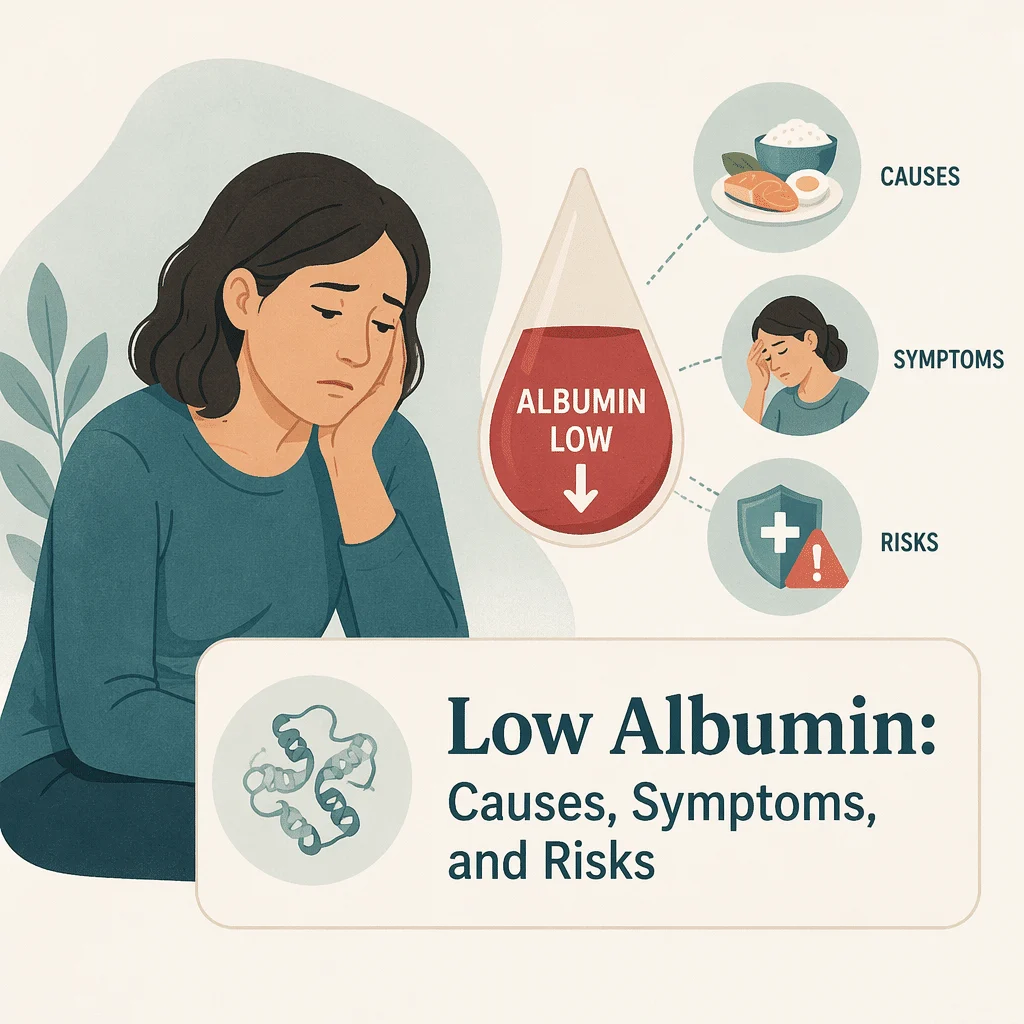
Hasil albumin rendah pada tes darah berarti protein utama yang beredar dalam darah Anda telah turun di bawah rentang normal. Albumin diproduksi oleh hati, dan fungsi utamanya adalah menahan cairan di dalam pembuluh darah, sehingga penurunannya sering kali ditandai dengan pembengkakan di pergelangan kaki, kaki, atau sekitar mata. Banyak orang mengira penyebabnya adalah kurang gizi. Namun pada kenyataannya, penjelasan yang paling mungkin adalah peradangan akibat infeksi, cedera, operasi baru-baru ini, atau kambuhnya suatu kondisi kronis. Dalam artikel ini, Anda akan mempelajari apa yang diukur oleh albumin, empat kondisi yang dapat menurunkannya, tes lanjutan mana yang dapat membedakannya, dan kapan hasil yang terus menurun perlu mendapat perhatian medis.
Fungsi albumin dalam tubuh
Albumin adalah protein yang paling banyak terdapat dalam plasma darah. Hati Anda memproduksinya secara terus-menerus dan melepaskannya ke dalam aliran darah, di mana ia menjalankan dua fungsi yang penting dalam kehidupan sehari-hari.
Menjaga cairan tetap di dalam pembuluh darah Anda
Pembuluh darah memang sedikit bocor secara alami. Albumin menciptakan tarikan ke dalam yang disebut tekanan onkotik, yang menarik air kembali dari jaringan sekitar ke dalam pembuluh. Ketika kadar albumin turun cukup rendah, tarikan tersebut melemah dan cairan menumpuk di jaringan. Inilah mengapa pembengkakan adalah gejala yang paling erat kaitannya dengan hasil albumin rendah, dan mengapa pembengkakan pertama kali muncul di tempat-tempat yang terpengaruh gravitasi.
Membawa hormon, obat-obatan, dan kalsium
Albumin juga berfungsi sebagai kendaraan pengangkut, mengikat dan membawa hormon tiroid, kalsium, bilirubin, asam lemak, dan berbagai obat-obatan. Peran ini memiliki konsekuensi praktis: ketika albumin rendah, kadar kalsium total pada panel pemeriksaan Anda bisa tampak rendah secara semu, padahal kalsium aktif sebenarnya normal. Dokter biasanya melakukan koreksi untuk ini, itulah mengapa keduanya dilaporkan bersama-sama.
Rentang normal albumin dan batas kadar rendah
Sebagian besar laboratorium di Amerika Serikat melaporkan albumin serum orang dewasa sekitar 3,5 hingga 5,0 gram per desiliter, sama dengan 35 hingga 50 gram per liter. Referensi klinis StatPearls menetapkan rentang tersebut sebagai normal untuk orang dewasa, dan penelitian paling sering mendefinisikan hipoalbuminemia — istilah medis untuk albumin rendah — sebagai nilai di bawah 3,5 gram per desiliter.
Penurunan ringan, sedang, dan nyata
Tidak ada skala penilaian resmi, tetapi dokter biasanya berpikir dalam rentang tertentu. Hasil yang sedikit di bawah batas normal, di kisaran 3 rendah, adalah hal umum dan sering bersifat sementara. Hasil di kisaran 2 tinggi biasanya menunjukkan adanya masalah aktif. Di bawah sekitar 2,5 gram per desiliter, pembengkakan kemungkinan besar akan terjadi. Yang paling penting adalah arah perubahannya: satu hasil yang sedikit rendah jauh kurang berarti dibandingkan nilai yang terus menurun.
Mengapa rentang normal di laboratorium Anda mungkin berbeda
Setiap laboratorium menetapkan rentang nilainya sendiri, sehingga rentang yang tercetak pada laporan Anda adalah yang berlaku untuk Anda. Kadar albumin juga cenderung lebih rendah pada orang dewasa yang lebih tua dan selama kehamilan, ketika volume darah meningkat dan mengencerkan konsentrasinya, serta berbaring dalam waktu lama dapat sedikit menurunkan hasil pemeriksaan. Satu panduan menjelaskan secara rinci kadar albumin normal dalam darah dan urin.
Empat alasan albumin menjadi rendah
Hampir setiap penyebab masuk ke dalam salah satu dari empat mekanisme: hati memproduksi lebih sedikit, ginjal membocorkannya, usus kehilangannya, atau peradangan menekan produksi dan mendorong albumin keluar dari aliran darah. Menentukan mana yang berlaku adalah tujuan dari pemeriksaan lanjutan.
Peradangan dan penyakit akut, penyebab paling umum sekaligus paling sering disalahpahami
Albumin adalah apa yang dalam ilmu laboratorium disebut reaktan fase akut negatif. Ketika tubuh Anda memicu respons peradangan, hati mengubah prioritasnya: hati meningkatkan produksi protein seperti C-reactive protein sambil mengurangi produksi albumin. Peradangan juga membuat kapiler lebih bocor, sehingga albumin merembes ke jaringan sekitar. Hasilnya adalah kadar albumin dalam darah yang benar-benar rendah, yang tidak ada hubungannya dengan apa yang Anda makan.
Hal ini penting untuk interpretasi. Pneumonia, infeksi saluran kemih, operasi yang baru dilakukan, atau kambuhnya artritis semuanya dapat menurunkan albumin dalam hitungan hari, dan angkanya biasanya pulih dalam beberapa minggu berikutnya. Jika albumin Anda rendah sementara C-reactive protein Anda tinggi, peradangan adalah penjelasan yang paling mungkin, dan mencari penyebab gizi hanya akan membuang waktu. Artikel terpisah menjelaskan kadar CRP tinggi.
Penyakit hati
Karena hati memproduksi albumin, kerusakan hati yang berlangsung lama pada akhirnya akan mengurangi pasokannya. Albumin memiliki waktu paruh sekitar tiga minggu, sehingga kadarnya merespons secara bertahap, bukan dalam semalam, dan albumin rendah akibat penyakit hati biasanya menandakan masalah yang sudah berlangsung lama. Sirosis adalah kondisi yang paling umum dikaitkan, dan National Institute of Diabetes and Digestive and Kidney Diseases mencantumkan pembengkakan pada kaki, pergelangan kaki, atau telapak kaki serta penumpukan cairan di perut sebagai gejalanya.
Albumin rendah akibat masalah hati jarang muncul sendiri. Enzim hati, bilirubin, dan waktu pembekuan biasanya ikut berubah, itulah mengapa albumin termasuk dalam panel hati standar. Panduan lain membahas tes fungsi hati.
Kehilangan albumin melalui urin akibat masalah ginjal
Ginjal yang sehat menjaga protein tetap berada di dalam darah dan tidak masuk ke urine. Ketika unit penyaring ginjal rusak, albumin bocor ke dalam urine dan kadar albumin dalam darah pun ikut turun. Sindrom nefrotik adalah bentuk paling parah dari kondisi ini, dengan tiga tanda khas yang mudah dikenali: protein berlebih dalam urine, albumin darah yang rendah, dan pembengkakan. Pola ini juga mencakup kelopak mata yang bengkak serta pembengkakan pada kaki dan tungkai.
Jika albumin rendah muncul tanpa infeksi atau masalah hati yang jelas, memeriksa urine adalah langkah berikutnya yang paling berguna. Rasio albumin-kreatinin urine, disingkat ACR, mengukur seberapa banyak albumin yang bocor relatif terhadap konsentrasi urine dan hanya membutuhkan satu sampel. Urine yang terus-menerus berbusa adalah tanda yang perlu disebutkan kepada dokter. Perpustakaan kami menjelaskan panel fungsi ginjal, dan halaman khusus membahas urin berbusa. Kami juga membahas protein dalam urin.
Kehilangan albumin melalui usus dan asupan yang tidak mencukupi
Saluran pencernaan dapat kehilangan protein secara langsung atau gagal menyerap zat-zat pembentuk protein yang dibutuhkan tubuh. Penyakit radang usus, penyakit celiac, dan sekelompok kondisi yang disebut enteropati kehilangan protein semuanya memungkinkan protein keluar melalui dinding usus yang rusak.
Asupan protein yang tidak mencukupi dapat menurunkan albumin, tetapi pada orang yang sehat, hal ini membutuhkan kekurangan yang berlangsung lama karena albumin berubah sangat lambat. Albumin rendah yang semata-mata disebabkan oleh pola makan jarang terjadi, kecuali pada gangguan makan yang parah, penyakit stadium lanjut, atau kesulitan menelan. Ketika asupan yang buruk menjadi penyebabnya, hampir selalu ada tanda-tanda lain: penurunan berat badan, penyusutan otot, serta kadar zat besi atau vitamin yang rendah. Perpustakaan kami membahas intoleransi gluten dan penyakit celiac.
Perbandingan keempat penyebab
| Apa yang terjadi | Petunjuk dari panel darah yang sama | Tes yang biasanya memberikan kepastian |
|---|---|---|
| Peradangan atau penyakit akut | C-reactive protein meningkat, globulin sering meningkat, albumin turun dalam beberapa hari | C-reactive protein ditambah pemeriksaan albumin ulang setelah pemulihan |
| Penyakit hati | Enzim hati dan bilirubin tidak normal, pembekuan darah lebih lambat | Panel hati, tes pembekuan darah, dan pencitraan hati |
| Kehilangan melalui ginjal | Enzim hati normal, pembengkakan yang mencolok, kolesterol sering meningkat | Protein urine dan rasio albumin-kreatinin urine |
| Kehilangan albumin melalui usus atau asupan rendah | Kadar zat besi atau vitamin rendah, penurunan berat badan, gejala pencernaan | Tes celiac, kalprotektin feses, tinjauan pola makan |
Gejala albumin rendah
Penurunan ringan biasanya tidak menimbulkan gejala apa pun dan ditemukan secara kebetulan saat pemeriksaan rutin. Gejala mulai muncul ketika kadarnya turun lebih jauh, dan sebagian besar berkaitan dengan cairan yang keluar dari aliran darah.
Pembengkakan dan lokasi kemunculannya
Pembengkakan, yang dalam istilah medis disebut edema, adalah tanda utama kondisi ini. Biasanya dimulai di kaki dan pergelangan kaki, lalu semakin parah sepanjang hari seiring Anda berdiri dan berjalan. Menekan jari ke kulit di atas tulang kering mungkin meninggalkan lekukan yang lambat menghilang, yang disebut pitting. Kelopak mata yang bengkak saat bangun tidur umum terjadi pada kasus yang berkaitan dengan ginjal. Cairan juga dapat menumpuk di perut atau di sekitar paru-paru, menyebabkan sesak napas.
Gejala yang berasal dari penyebab yang mendasarinya
Selain pembengkakan, sebagian besar gejala yang dirasakan berasal dari kondisi yang menyebabkan albumin turun, bukan dari rendahnya protein itu sendiri. Kelelahan, nafsu makan buruk, dan kelemahan tubuh sering terjadi namun tidak spesifik. Kulit atau mata yang menguning mengarah pada masalah hati, urine berbusa mengarah pada ginjal, diare dan penurunan berat badan mengarah pada saluran pencernaan, dan demam mengarah pada infeksi.
Tes-tes yang mengelilingi albumin dalam laporan hasil Anda
Albumin hampir tidak pernah diukur sendiri. Nilai-nilai lain dalam laporan yang sama sering kali menjelaskan hasilnya lebih cepat daripada nilai albumin itu sendiri.
Total protein dan rasio albumin terhadap globulin
Total protein adalah jumlah albumin ditambah globulin, kelompok protein utama lainnya yang mencakup antibodi. Karena albumin biasanya menyumbang sedikit lebih dari separuh total protein, keseimbangan antara keduanya memberikan informasi penting, dan MedlinePlus menyebut perbandingan ini sebagai standar. Albumin rendah dengan globulin tinggi menunjukkan peradangan kronis. Albumin rendah dengan globulin rendah menunjukkan kehilangan protein, melalui ginjal atau usus. Satu artikel menjelaskan rasio albumin terhadap globulin, kami juga menjelaskan kadar globulin rendah, dan panduan lainnya menjelaskan hasil elektroforesis protein.
Mengapa prealbumin bukan penanda nutrisi seperti yang selama ini diyakini
Prealbumin, yang juga disebut transthyretin, lama dipromosikan sebagai penanda nutrisi yang lebih cepat karena masa pergantiannya sekitar dua hari, bukan tiga minggu. Masalahnya adalah prealbumin berperilaku persis seperti albumin saat terjadi peradangan — nilainya turun ketika tubuh mengalami stres, terlepas dari asupan makanan. Sebuah tinjauan tahun 2025 tentang penilaian nutrisi laboratorium menyimpulkan bahwa albumin dan transthyretin mencerminkan respons fase akut dan tidak boleh dijadikan penanda malnutrisi. Oleh karena itu, prealbumin rendah tidak membuktikan adanya penyebab dari sisi nutrisi.
Kapan albumin diperiksa dan apa langkah selanjutnya
Albumin jarang diminta secara tersendiri. Nilai ini muncul sebagai salah satu baris dalam panel metabolik komprehensif, yaitu panel darah empat belas tes yang digunakan untuk pemeriksaan kesehatan umum, atau dalam panel fungsi hati. Albumin juga tercantum dalam penilaian pra-operasi serta pemantauan penyakit ginjal dan hati. Sebuah artikel pendamping menjelaskan panel metabolik komprehensif.
Urutan yang biasanya diikuti dokter
Karena satu hasil rendah dapat memiliki banyak penjelasan, pemeriksaan lanjutan dilakukan secara bertahap. Dokter Anda akan menanyakan apakah Anda baru-baru ini merasa tidak sehat, lalu membaca keseluruhan panel sebelum memesan pemeriksaan baru.
- Konfirmasi hasilnya. Tes ulang, setelah penyakit akut berlalu, dapat membedakan penurunan sementara dari penurunan yang menetap.
- Periksa adanya peradangan. C-reactive protein dan hitung darah lengkap dapat mengidentifikasi respons fase akut.
- Periksa fungsi hati. Enzim, bilirubin, dan waktu pembekuan darah menunjukkan apakah produksi albumin menjadi masalahnya.
- Periksa urine. Rasio albumin-kreatinin urine atau pengukuran protein dapat mengidentifikasi kehilangan albumin melalui ginjal.
- Periksa saluran pencernaan dan status gizi. Tes celiac, penanda tinja, pemeriksaan zat besi, dan riwayat pola makan dilakukan apabila langkah-langkah sebelumnya tidak memberikan hasil yang jelas.
Apa yang sebenarnya dilakukan dalam pengobatan
Tidak ada obat yang meningkatkan albumin sebagai tujuan itu sendiri. Pengobatan ditujukan pada penyebabnya: antibiotik untuk infeksi, imunosupresi untuk kondisi ginjal atau usus, penanganan sirosis, atau dukungan nutrisi jika asupan makanan memang menjadi masalah. Albumin intravena memang ada, tetapi itu adalah perawatan rumah sakit untuk situasi tertentu, bukan solusi untuk angka rendah pada laporan hasil lab. Mengonsumsi lebih banyak protein tidak akan memperbaiki albumin rendah yang disebabkan oleh peradangan atau kehilangan melalui urine.
Kapan harus menemui dokter?
Sebagian besar hasil albumin rendah ditemukan saat pemeriksaan rutin dan bisa ditindaklanjuti pada janji temu biasa. Beberapa kasus memerlukan penanganan lebih cepat.
- Segera cari pertolongan medis jika mengalami sesak napas saat istirahat atau saat berbaring, karena ini dapat menandakan adanya cairan di sekitar paru-paru.
- Segera cari pertolongan medis jika perut membengkak dengan cepat, nyeri perut hebat, atau demam disertai pembengkakan.
- Hubungi dokter Anda segera jika terjadi pembengkakan pada kedua kaki, kelopak mata bengkak di pagi hari, atau urine yang terus-menerus berbusa.
- Hubungi dokter Anda segera jika kulit atau mata menguning, atau jika seseorang dengan penyakit hati yang sudah diketahui mengalami kebingungan.
- Buat janji rutin jika hasil sedikit rendah tanpa gejala, dan perkirakan akan dilakukan tes ulang daripada pemeriksaan lebih lanjut.
- Buat janji rutin jika Anda mengalami penurunan berat badan tanpa sebab yang jelas, diare berkepanjangan, atau memiliki kondisi ginjal, hati, atau usus jangka panjang.
Kemajuan ilmiah terkini
Penelitian dalam tiga tahun terakhir telah mempertajam cara dokter membaca hasil albumin rendah. Arahnya konsisten: albumin mengukur seberapa sakit seseorang, bukan seberapa baik pola makannya.
Albumin adalah sinyal keparahan, bukan skor nutrisi
Sebuah tinjauan tahun 2025 tentang penilaian nutrisi laboratorium di unit perawatan intensif menyimpulkan bahwa albumin mencerminkan peradangan, pergeseran cairan, dan fungsi organ—bukan asupan nutrisi—sehingga tidak boleh dijadikan penanda kekurangan gizi. Artinya bagi Anda, kadar albumin yang rendah selama atau setelah sakit bukan berarti Anda perlu lebih banyak protein. Itu adalah tanda bahwa tubuh Anda sedang menghadapi sesuatu, dan langkah yang tepat adalah menemukan serta menangani penyebabnya, lalu memeriksa ulang kadarnya.
Sebuah studi tahun 2023 pada penderita penyakit hati kronis stadium lanjut mengukur seberapa cepat hati memproduksi albumin, dan menemukan bahwa produksinya memang benar-benar berkurang—seiring dengan tingkat kerusakan hati—berbeda dengan kondisi peradangan akut. Artinya bagi Anda, kadar albumin rendah akibat masalah hati mencerminkan kekurangan produksi yang nyata dan berkembang secara perlahan, sehingga dipantau selama berbulan-bulan, bukan dari minggu ke minggu.
Sebuah studi Denmark tahun 2025 pada orang dengan kehilangan protein yang banyak melalui urine dan kadar albumin darah yang rendah menemukan bahwa sebagian besar sudah mengalami pembengkakan yang terlihat saat masalah tersebut teridentifikasi. Artinya bagi Anda, pembengkakan atau bengkak perlu dilaporkan ke dokter, karena cenderung muncul bersamaan dengan penurunan angka albumin, bukan jauh setelahnya.
Albumin rendah memprediksi pemulihan yang lebih berat setelah operasi
Sebuah tinjauan sistematis tahun 2026 yang menggabungkan dua puluh tiga studi dengan lebih dari enam ratus ribu pasien operasi perut menemukan bahwa orang dengan kadar albumin rendah sebelum operasi memiliki risiko infeksi luka sekitar dua kali lebih tinggi setelahnya. Tinjauan terpisah tahun 2025 tentang operasi penggantian sendi menemukan bahwa albumin rendah berkaitan dengan lebih banyak rawat inap ulang dan operasi berulang. Sebuah meta-analisis tahun 2023 tentang operasi kanker kolorektal menemukan lebih banyak komplikasi dan rawat inap lebih lama pada kadar di bawah 3,5 gram per desiliter, meskipun kaitannya dengan kematian masih belum jelas.
Artinya bagi Anda: jika operasi direncanakan dan albumin Anda rendah, tim dokter mungkin ingin memahami penyebabnya terlebih dahulu. Tinjauan-tinjauan ini menggambarkan sebuah asosiasi, bukan bukti bahwa albumin rendah menyebabkan komplikasi; kondisi ini sering kali menandai penyakit yang mendasarinya, yang mungkin justru menjadi penyebab kerusakan sebenarnya. Meta-analisis menggabungkan hasil dari banyak penelitian sebelumnya menjadi satu perkiraan keseluruhan.
Penurunan albumin mencerminkan tingkat keparahan infeksi akut
Sebuah tinjauan sistematis tahun 2025 tentang demam berdarah dengue, yang menggabungkan tujuh belas studi, menemukan bahwa pasien dengan penurunan albumin lebih dari dua kali lebih mungkin mengalami penyakit berat, terutama pada anak-anak. Hal ini menggambarkan prinsip fase akut bagi Anda: pada infeksi yang singkat namun intens, albumin turun sebanding dengan seberapa berat penyakit menyerang, dalam hitungan hari. Nutrisi tidak berperan dalam rentang waktu tersebut.
Memberikan albumin kembali tidak mengatasi masalah yang mendasarinya
Ini adalah penelitian paling berguna bagi siapa pun yang tergoda untuk mengobati angkanya saja. Sebuah tinjauan tahun 2024 yang menggabungkan dua puluh empat uji coba acak tentang albumin intravena pada orang dewasa dengan sepsis tidak menemukan manfaat kelangsungan hidup secara keseluruhan, dan tinjauan ahli tahun 2025 tentang terapi albumin pada sirosis menyimpulkan bahwa ini bukan pengobatan yang cocok untuk semua orang — membantu dalam beberapa situasi namun mengecewakan dalam situasi lain. Artinya bagi Anda, mengoreksi nilai laboratorium itu sendiri bukanlah tujuan utama. Uji coba acak mengalokasikan orang ke dalam kelompok pengobatan secara acak, dan ini merupakan uji terkuat untuk mengetahui apakah suatu pengobatan benar-benar bekerja. Itulah mengapa dokter Anda mencari penyebabnya, bukan sekadar menambah kadar protein.
Pertanyaan yang sering diajukan
Kadar albumin berapa yang dianggap berbahaya?
Tidak ada ambang batas yang berlaku universal, dan konteks lebih penting daripada angkanya sendiri. Nilai di bawah sekitar 2,5 gram per desiliter adalah titik di mana pembengkakan mulai mungkin terjadi dan di mana kondisi yang mendasarinya biasanya cukup serius untuk memerlukan penanganan aktif. Hasil di kisaran 3-an yang rendah pada seseorang yang baru saja mengalami infeksi atau operasi adalah hal yang umum dan sering kali bersifat sementara. Dokter Anda akan mempertimbangkan angka tersebut bersama gejala Anda, hasil panel pemeriksaan lainnya, dan bagaimana nilai itu berubah dari waktu ke waktu — bukan menjadikan satu angka tertentu sebagai patokan mutlak.
Apakah kadar albumin yang rendah bisa dipulihkan?
Seringkali ya, jika penyebab dasarnya dapat diobati. Albumin yang turun akibat infeksi atau operasi biasanya akan naik kembali dengan sendirinya dalam beberapa minggu setelah Anda pulih. Albumin yang hilang melalui ginjal umumnya membaik ketika kondisi ginjal berhasil dikendalikan. Albumin rendah akibat sirosis lanjut lebih sulit dipulihkan karena kapasitas produksinya memang sudah berkurang, meskipun penanganan penyakit hati tetap membantu. Pemulihan diukur dalam hitungan minggu hingga bulan, bukan hari, karena albumin berputar secara perlahan dalam tubuh.
Apakah makan lebih banyak protein dapat meningkatkan albumin?
Hanya jika asupan yang benar-benar tidak mencukupi adalah penyebabnya, yang merupakan mekanisme paling jarang di antara keempat mekanisme yang ada dalam kondisi dengan akses gizi yang baik. Jika peradangan, kebocoran melalui ginjal, atau penyakit hati yang menjadi penyebabnya, tambahan protein dari makanan tidak akan memperbaikinya — bahkan pada beberapa kondisi ginjal dan hati, asupan protein yang sangat tinggi justru bisa merugikan. Nutrisi yang baik mendukung pemulihan dan layak untuk diperhatikan, tetapi ini adalah langkah pendukung, bukan pengobatan utama. Konsultasikan dengan dokter Anda sebelum melakukan perubahan pola makan yang besar jika ada kondisi ginjal atau hati yang terlibat.
Mengapa albumin rendah pada pasien kanker?
Biasanya karena respons peradangan yang menyertai kanker, yang diperparah pada sebagian orang oleh berkurangnya nafsu makan dan efek pengobatan. Tumor serta aktivitas imun di sekitarnya melepaskan sinyal yang menekan produksi albumin dan membuat pembuluh darah lebih bocor — mekanisme fase akut yang sama seperti yang terjadi pada infeksi. Itulah mengapa albumin rendah sering digunakan sebagai penanda umum seberapa lanjut atau agresif suatu kondisi, dan mengapa albumin muncul dalam banyak skor prognosis pada berbagai jenis kanker.
Apakah albumin rendah selalu menandakan sesuatu yang serius?
Tidak. Hasil yang sedikit rendah adalah temuan insidental yang umum, terutama setelah sakit, selama kehamilan, pada orang lanjut usia, atau setelah berbaring lama di rumah sakit. Hal ini menjadi lebih bermakna ketika nilainya sangat rendah, ketika tetap rendah pada pemeriksaan ulang setelah pemulihan, ketika disertai pembengkakan, atau ketika hasil lain pada panel yang sama juga tidak normal. Kombinasi tersebut, bukan nilai yang berdiri sendiri, yang mendorong dilakukannya pemeriksaan lebih lanjut.
Berapa lama albumin bisa membaik?
Albumin memiliki waktu paruh sekitar tiga minggu, sehingga perubahannya berlangsung lambat dibandingkan kebanyakan tes darah. Setelah infeksi atau operasi sembuh, perlu beberapa minggu sebelum nilainya kembali ke kondisi semula, dan dokter biasanya menunggu setidaknya dua hingga empat minggu sebelum memeriksa ulang. Pemeriksaan ulang yang terlalu cepat sering kali menunjukkan sedikit perubahan dan dapat menimbulkan kekhawatiran yang tidak perlu. Jika hasil Anda dipantau untuk kondisi hati atau ginjal jangka panjang, interval tiga hingga enam bulan lebih umum digunakan.
Glosarium
| Ketentuan | Definisi |
|---|---|
| Albumin | Protein paling banyak dalam plasma darah, diproduksi oleh hati. Albumin menjaga cairan tetap berada di dalam pembuluh darah dan membawa hormon, kalsium, serta berbagai obat-obatan. |
| Hipoproteinemia | Istilah medis untuk kadar albumin darah di bawah rentang referensi laboratorium, yang paling sering didefinisikan sebagai di bawah 3,5 gram per desiliter. |
| Reaktan fase akut negatif | Protein darah yang justru turun — bukan naik — saat tubuh mengalami peradangan. Albumin adalah contoh yang paling dikenal, itulah mengapa kadarnya turun saat infeksi atau setelah operasi. |
| Tekanan onkotik | Tarikan ke dalam yang diberikan oleh protein dalam darah terhadap air, menjaga cairan tetap berada di dalam pembuluh. Ketika albumin turun, tarikan ini melemah dan cairan bocor ke jaringan. |
| Edema | Pembengkakan yang disebabkan oleh penumpukan cairan di jaringan tubuh, paling terlihat di kaki, pergelangan kaki, tungkai bawah, dan sekitar mata. |
| Sindrom nefrotik | Gangguan ginjal yang ditandai dengan kehilangan protein dalam jumlah besar melalui urine, albumin darah yang rendah, dan pembengkakan, yang disebabkan oleh kerusakan pada filter ginjal. |
| Rasio albumin terhadap kreatinin (ACR) | Tes urine yang membandingkan albumin dengan kreatinin untuk menunjukkan seberapa banyak albumin yang bocor, disesuaikan dengan tingkat pengenceran sampel. |
| Enteropatia kehilangan protein | Sekelompok kondisi di mana protein keluar dari tubuh melalui dinding usus yang rusak atau meradang. |
| Prealbumin (transthyretin) | Protein darah yang berputar dalam waktu sekitar dua hari. Dulu digunakan sebagai penanda nutrisi, kini diketahui juga turun saat terjadi peradangan. |
| Panel metabolik komprehensif (CMP) | Sekelompok empat belas tes darah rutin yang mencakup fungsi ginjal, enzim hati, elektrolit, glukosa, dan protein termasuk albumin. |
Sumber
- MedlinePlus, National Library of Medicine — Albumin Blood Test. MedlinePlus
- MedlinePlus, National Library of Medicine — Total Protein and Albumin/Globulin (A/G) Ratio. MedlinePlus
- National Institute of Diabetes and Digestive and Kidney Diseases — Nephrotic Syndrome in Adults. NIDDK
- National Institute of Diabetes and Digestive and Kidney Diseases — Symptoms and Causes of Cirrhosis. NIDDK
- Gounden V, Vashisht R, Jialal I — Hypoalbuminemia — StatPearls, NCBI Bookshelf, 2024. Rak Buku NCBI
- Ostermann M — Laboratory assessment of nutritional status in ICU patients — Current Opinion in Clinical Nutrition and Metabolic Care, 2025. PubMed
- Amouzandeh M, Sundstrom A, Wahlin S, Wernerman J, Rooyackers O, Norberg A — Albumin and fibrinogen synthesis rates in advanced chronic liver disease — American Journal of Physiology: Gastrointestinal and Liver Physiology, 2023. PubMed
- Kelddal S, Tofig BJ, Hvas AM, Grove EL, Christiansen CF, Birn H — Edema and outcome in patients with nephrotic-range albuminuria and hypoalbuminemia: a Danish multicenter cohort study — American Journal of Nephrology, 2025. PubMed
- Omer HFE, Saga MBA, Naser YWS, et al. — Association between preoperative hypoalbuminemia and surgical site infection in abdominal surgery: a systematic review and meta-analysis — Patient Safety in Surgery, 2026. PubMed
- Tischler EH, Tsai SHL, McDermott JR, et al. — Hypoalbuminemia associated perioperative mortality, reoperation, and readmission rates among total joint arthroplasty procedures: a systematic review and meta-analysis — European Journal of Orthopaedic Surgery and Traumatology, 2025. PubMed
- Christina NM, Tjahyanto T, Lie JG, et al. — Hypoalbuminemia and colorectal cancer patients: any correlation? A systematic review and meta-analysis — Medicine, 2023. PubMed
- Shabil M, Bushi G, Apostolopoulos V, et al. — Hypoalbuminemia as a predictor of severe dengue: a systematic review and meta-analysis — Expert Review of Anti-infective Therapy, 2025. PubMed
- Bai Z, Lai Y, Han K, Shi L, Guan X, Xu Y — Human albumin for adults with sepsis: an updated systematic review and meta-analysis of randomized controlled trials — Medicine, 2024. PubMed
- Trebicka J, Garcia-Tsao G — Kontroversi mengenai terapi albumin pada sirosis — Hepatology, 2025. PubMed
Bacaan lebih lanjut
- Rasio AST/ALT: makna dan cara membacanya
- ALT tinggi: penyebab, kadar, dan kapan harus khawatir
- Kadar kreatinin urine: panduan dan interpretasi
- Kalprotektin feses: memahami hasil tes
- Cara membaca hasil tes darah: panduan sederhana.
Pahami hasil lab Anda dengan AI DiagMe.
Hasil albumin yang rendah baru bermakna jika dilihat bersama panel pemeriksaan lainnya: enzim hati yang menunjukkan seberapa baik hati Anda bekerja, total protein dan globulin yang mengungkap apakah protein sedang hilang atau tidak diproduksi dengan cukup, C-reactive protein yang menandai adanya peradangan, serta protein urine yang mengarah pada kondisi ginjal. AI DiagMe membaca semua nilai tersebut secara bersamaan dan menjelaskan dalam bahasa yang mudah dipahami apa yang ditunjukkan oleh kombinasi hasil tersebut, serta pertanyaan apa yang sebaiknya Anda tanyakan kepada dokter. Layanan ini membantu Anda memahami hasil pemeriksaan Anda; bukan untuk mendiagnosis Anda, dan tidak menggantikan peran dokter Anda.
Dapatkan interpretasi hasil Anda dalam hitungan menit.