
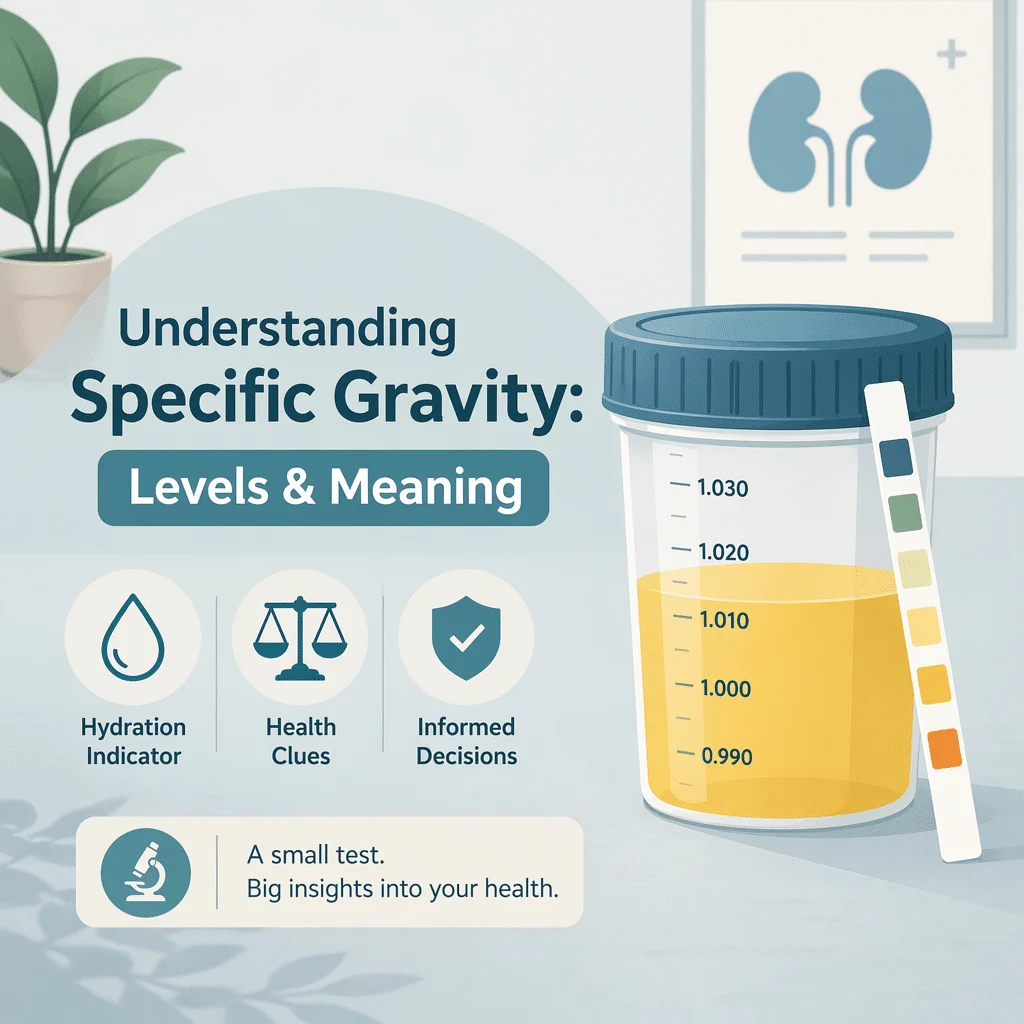
Urine specific gravity is the line on a urinalysis report that tells you how concentrated your urine is compared with plain water. Water is 1.000, and most urine sits somewhere between about 1.005 and 1.030. It is one of the least dramatic numbers on the page and one of the most useful, because it sets the context for everything else the dipstick found. For a pad-by-pad tour of the test, and how a sample should be collected, start with our guide to interpreting urinalysis results.
In this article you’ll learn what specific gravity measures, why it changes how every other result on the strip should be read, what pushes it high or low, what a value stuck around 1.010 can suggest, how laboratories measure it and what interferes, and when a result is worth raising with your doctor.
What urine specific gravity measures
Specific gravity compares the density of your urine with that of pure water, which is assigned 1.000. Urine is always denser, because it carries dissolved material: urea, creatinine, sodium, potassium, chloride, sulfates and phosphates, plus whatever else the kidneys are clearing that day. The more of that is packed into each drop, the higher the number climbs.
So the reading is really a statement about water. When the body has reason to hold on to water, the kidneys reabsorb it and the same dissolved load ends up in less liquid, so the number rises. When there is water to spare, the load is spread through more liquid and the number falls. A healthy adult kidney can swing across most of the 1.005 to 1.030 range in a single day, and that flexibility is itself a sign the concentrating machinery works.
One reference point is worth remembering, because the rest of this article leans on it: blood plasma has a specific gravity of roughly 1.010. Urine at 1.010 is filtered plasma the kidney has neither concentrated nor diluted.
A single value, though, is close to meaningless on its own. The same person can produce 1.028 at seven in the morning and 1.004 two hours after a large drink, and both are normal. The reading only means something alongside when the sample was passed, what the person had been drinking, whether they had been sweating, vomiting or feverish, and what the other pads showed.
Why specific gravity changes how every other urine result should be read
This is the part that rarely gets explained, and it is why specific gravity earns its place on the strip. Almost every other pad reports a concentration: how much of something there is per unit of urine. Specific gravity tells you how much water it is dissolved in. Change the water, and the reading changes, without anything changing inside the body.
In a very dilute sample, everything is diluted. Protein, glucose, ketones, blood and the white-cell marker are spread thinner, so each pad has less to detect. A negative on a watery sample is therefore less reassuring than it looks, and a genuine abnormality can slip past. In a concentrated sample the opposite happens: small amounts are crowded together, so trace findings are exaggerated. A trace of protein or a few red cells at 1.030 often means much less than the same result at 1.012.
Each pad has its own article: the white-cell marker in leukocyte esterase in urine, leaked kidney protein in protein in urine, sugar in glucosuria, fat-breakdown products in ketones in urine, red cells in hematuria. What this article adds is the layer underneath all five.
A worked example
Picture two people giving a urine sample on the same morning, whose kidneys are each leaking exactly the same small quantity of protein per hour.
The first has had nothing to drink since the previous evening. Their sample is concentrated, at 1.028. That quantity of protein sits in a small volume of liquid, so its concentration is high and the protein pad reads positive.
The second had been sipping steadily all morning and again in the waiting room. Their sample is dilute, at 1.003. The identical quantity of protein is spread through several times as much liquid, its concentration falls below what the pad can register, and the protein result comes back negative.
Same kidneys, same leak, opposite results. The strip is not malfunctioning: it reports a concentration, which depends on how much water is present. Three consequences follow. A first-morning sample is preferred for some tests, because overnight the urine concentrates naturally and faint abnormalities are easier to catch. Loading up on fluid before a urine test is counterproductive, because it washes out the signal being looked for. And when an abnormal result appears on a very dilute or very concentrated sample, the next step is usually not a diagnosis but a repeat sample.
Laboratories work around this by expressing a substance as a ratio to urine creatinine, which is produced at a fairly steady rate. Dividing by creatinine cancels most of the dilution effect, which is why a ratio on a random sample is more trustworthy than a raw dipstick grade.
What makes urine specific gravity high
A high value means concentrated urine, which usually means the kidneys are conserving water: a normal response far more often than a problem.
The commonest reason is simply not having taken in much fluid, particularly overnight. First-morning urine is concentrated in almost everybody, so a high reading there is expected rather than alarming. Fluid lost through vomiting, diarrhea, heavy sweating or fever does the same, and the reading then reflects the illness. Significant fluid loss also affects circulation, covered in our article on dehydration and blood pressure.
Some conditions make the body hold on to water when it does not need to. Heart failure and advanced liver disease both do this, as can certain hormonal problems and reduced blood flow to the kidneys. There, a persistently high value is one piece of a larger picture and is never read alone.
Finally, some things raise the number without changing true water balance: large amounts of protein or sugar in the urine, contrast dye from a recent scan, certain intravenous fluids. The measurement section explains why. Persistently concentrated urine also favors mineral deposits, linking this reading to urine crystals and, over time, to kidney stones.
What makes urine specific gravity low
A low value means dilute urine. The everyday explanation is that plenty of fluid has been taken in and the kidneys are doing what they should: shedding the surplus. A single low reading after a big drink is not a finding.
Diuretics, prescribed for blood pressure, heart failure or fluid retention, also lower the reading by design. That is the drug working, not a problem with the test. Never stop, skip or change the dose of a diuretic because of a urine result; if the number concerns you, raise it with the prescriber.
The readings that matter clinically are those where the kidney cannot concentrate urine even when it should. When the tubules are damaged, by long-standing kidney disease, severe infection, inherited tubular disorders or some medicines, urine stays watery whatever the person drinks. That pattern is investigated with blood and kidney function tests, not a dipstick alone; our page on high BUN and creatinine levels covers the usual next steps.
Very dilute urine with large volumes and constant thirst
One combination deserves its own paragraph: passing large volumes of very dilute urine, day and night, with thirst that does not settle. That points toward conditions in which arginine vasopressin, the hormone that tells the kidney to hold on to water, is either missing or ignored.
These conditions were formally renamed in 2022. Central diabetes insipidus is now arginine vasopressin deficiency, or AVP-D; nephrogenic diabetes insipidus is now arginine vasopressin resistance, or AVP-R. In deficiency the brain does not release enough of the hormone; in resistance it is released but the kidney does not respond.
The renaming was driven partly by patient safety: the old label was being confused with diabetes mellitus in hospitals, with serious harm when hormone replacement was withheld as a result. The new names are now standard terminology, so you may see either version on a report.
Uncontrolled diabetes mellitus can produce a similar picture by a different route. When blood sugar is high enough that glucose spills into the urine, it drags water with it, so volumes rise and thirst follows. A blood glucose test separates the two quickly. Either way, this combination is a reason to see a doctor rather than to watch and wait.
When the value is stuck in the middle: isosthenuria
Most people focus on whether a number is high or low. With specific gravity, one of the most informative patterns is a number that will not move. Isosthenuria is the term for urine fixed at roughly 1.010, sample after sample, whatever the fluid intake or time of day. Remember the reference point: 1.010 is about the specific gravity of blood plasma. Urine sitting there is filtrate the tubules have neither concentrated nor diluted on the way out. The kidney still filters, but has lost the ability to adjust.
That loss of range is a recognized feature of chronic kidney disease, and can appear before other markers look dramatic, because concentrating urine is demanding work that damaged tubules give up early. A reading of 1.030 tells you someone was concentrating hard that morning; a reading that never leaves the 1.008 to 1.012 band across morning, afternoon and post-fasting samples tells you something about the organ itself. A fixed value can therefore be more informative than a single high or low one.
Isosthenuria is a pattern, not a diagnosis, and not to be concluded from your own reports. If your results look like this, ask your doctor whether kidney function testing is warranted.
How specific gravity is measured, and what interferes with it
Three methods are in use, and they do not measure the same thing, which is why they can disagree. The dipstick pad is a chemical reaction, not a density measurement.
The pad contains a polymer that releases hydrogen ions in proportion to the ionic strength of the urine, and a dye changes color as the local acidity shifts. So it responds to charged particles such as sodium, potassium and chloride, but not to uncharged molecules: glucose, urea and contrast dye are effectively invisible to it.
A refractometer, the instrument most laboratories use, measures how much the urine bends light. Refractive index rises with anything dissolved in the sample, charged or not, so a refractometer does register glucose, contrast media, large amounts of protein and dextran infusions, and reads higher than the dipstick on the same specimen. Neither is wrong; they answer different questions. After a scan with contrast, or when sugar or protein is spilling heavily, the refractometer value can sit well above what the kidney’s water handling would suggest.
The dipstick has the opposite quirk. Strongly alkaline urine can falsely lower the reading, and many analyzers correct for this by adding a small fixed amount when the pH pad is above a set threshold. Our article on normal urine pH levels explains what drives urine acidity. Old or badly stored samples drift too, so laboratories limit how long a specimen can sit before concentration markers stop being reliable.
When precision genuinely matters, the reference method is urine osmolality, which counts dissolved particles directly rather than inferring them from density or refraction. It is used in formal water deprivation testing and in research on concentrating ability. Specific gravity is the screening version: fast, cheap, on every strip, and adequate for most purposes as long as its limits are understood.
When to see a doctor about a specific gravity result
The table below sets out the patterns people most often ask about. These are typical situations, not a way to read your own report; any result belongs with the clinician who ordered the test.
| Reading and situation | What it usually means | What usually happens next |
|---|---|---|
| High on a first-morning sample | Normal overnight concentration; the kidneys conserved water while you slept | Nothing on its own; the other pads are read knowing the sample is concentrated |
| High after a day of vomiting, diarrhea or fever | The body is conserving water after fluid loss; the reading reflects the illness | Contact your doctor about the illness, especially if fluids cannot be kept down |
| Low after drinking a lot shortly before the appointment | A washed-out sample; the other pads are less able to detect small abnormalities | The lab may request a repeat sample, often first thing in the morning |
| Persistently around 1.010 on repeated samples | Isosthenuria: urine neither concentrated nor diluted, suggesting reduced concentrating ability | Ask your doctor whether blood and urine kidney function tests are appropriate |
| Very low with large urine volumes and constant thirst | The kidney is not holding on to water; the cause needs identifying | See a doctor promptly; blood sugar and hormone testing are usually arranged |
A note on fluids, since this always comes up. There is no single correct amount for everyone: needs vary with body size, activity, climate, illness and medicines. And in heart failure, several kinds of kidney disease and on dialysis, fluid intake is a careful clinical calculation where increasing it can be harmful. Any change there belongs with your medical team, not a lab value.
Seek medical advice without delay if you have
- Very large volumes of urine together with constant thirst, particularly if this is new
- Very little urine, or none at all, for many hours
- Confusion or drowsiness alongside signs of fluid loss
- Swelling of the legs, ankles or abdomen together with breathlessness
- Fever with pain in the flank or side
- Dark or blood-stained urine
These are reasons to contact a doctor or urgent care service whatever any urine reading shows.
Latest scientific advances in urine concentration testing
The studies below were identified through PubMed and published between 2023 and 2026. Full references are in Sources.
What was found: across two cohorts in Singapore and France, people with type 2 diabetes whose fasting urine osmolality was in the lowest third were more likely to reach kidney failure or a doubling of blood creatinine over several years than those in the highest third, even after accounting for filtration rate and protein in the urine. What this means for you: the ability to concentrate urine, which specific gravity approximates and osmolality measures precisely, seems to carry information about kidney health that standard tests miss. It supports asking about a persistently low or fixed reading.
What was found: a 2025 clinical review worked through the diagnosis of hypotonic polyuria, the term for passing large volumes of dilute urine, using the renamed categories of arginine vasopressin deficiency and resistance, and confirmed the new terms have entered the vocabulary used in medical records. It also described how copeptin, a marker released alongside the hormone, can settle cases where the water deprivation test is unclear. What this means for you: the renaming is not cosmetic, and diagnosis has moved on. A blood marker may now replace or supplement a long test without fluids.
What was found: two analyses, one pooling data from athletes and active adults and one measuring 346 military personnel, both found that people with more fat-free mass show higher urine specific gravity at the same actual state of hydration, and the military study concluded the usual cutoff for calling someone dehydrated may be too strict for muscular people. What this means for you: printed thresholds are population averages, and body composition shifts them. One more reason not to read a single value as a verdict on your own fluid status.
What was found: a laboratory study of refrigerated urine found color and osmolality stayed stable for up to three weeks, while specific gravity drifted after about two days. What this means for you: it is more fragile than it looks, another reason a lab may prefer a fresh sample. One honest caveat: recent literature comparing dipstick and refractometer readings in humans is thin, so the measurement section rests on laboratory-medicine reference texts.
Frequently asked questions
What does high specific gravity in urine mean?
In most cases it simply means the sample was concentrated: the kidneys were holding on to water, which is what they are supposed to do overnight, in warm weather, during a fever or after any fluid loss. A high value is a description of the sample, not a diagnosis. It becomes clinically interesting when it is persistent without an obvious explanation, when it appears alongside symptoms, or when it accompanies other abnormal findings on the same test. It can also be pushed up artificially by large amounts of sugar or protein in the urine, or by contrast dye from a recent scan.
Can I use urine specific gravity to check my hydration at home?
Not reliably, and we would not recommend using it that way. Specific gravity reflects a single moment and is influenced by what you last drank, when you last passed urine, your body composition, your diet, your medicines and any illness. Research shows the standard cutoffs shift with muscle mass alone. Home dipsticks are also the least accurate of the available methods and drift with storage. Urine color charts have the same limitation and are affected by B vitamins, beetroot, food dyes and several medicines, so treat them as a very rough guide at best. Any real concern belongs with a clinician rather than with a home reading.
Why was my urine sample rejected or the test repeated?
Very often because of concentration. A sample that is extremely dilute cannot reliably rule anything out, since small amounts of protein, sugar, blood or white cells fall below the detection threshold. A sample that is extremely concentrated can exaggerate trace findings and produce results that look worse than the underlying situation. Laboratories may also repeat a test if the sample was old, stored badly, visibly contaminated, or collected during menstruation or straight after heavy exercise. A repeat is standard quality control and is not a sign that something worrying was found.
Is a specific gravity of 1.010 bad?
A one-off value of 1.010 is completely unremarkable. It sits in the middle of the normal range and simply means that particular sample was neither concentrated nor dilute. What can be significant is a value that stays close to 1.010 on repeated samples taken at different times of day and under different fluid conditions, because that suggests the kidney has lost its ability to swing the number up or down. That pattern, called isosthenuria, is something for a doctor to assess with kidney function tests, not something to conclude from one or two reports.
Does drinking water before a urine test change the result?
Yes, and usually not in a helpful direction. Taking on a large amount of fluid shortly before giving a sample dilutes everything in it, which lowers the specific gravity and can turn a genuine abnormality into a negative result. If you have been asked for a first-morning sample, that instruction exists precisely because overnight urine is naturally concentrated and easier to read. Follow whatever preparation instructions your clinic gives you, and if you were asked to restrict fluids beforehand but could not, say so when you hand the sample in.
What is the difference between specific gravity and urine osmolality?
Specific gravity measures density, so it responds both to how many particles are dissolved and to how heavy those particles are. Osmolality counts the number of dissolved particles regardless of their size, which is closer to what the kidney is actually regulating. In practice the two usually track each other, but they can separate when the urine contains a few very heavy molecules, such as glucose, protein or contrast dye, which lift specific gravity more than osmolality. Osmolality is the more precise test and is used when the answer really matters, for example in formal assessment of concentrating ability.
Glossary
| Term | Definition |
|---|---|
| Specific gravity | The density of a fluid compared with pure water, which is 1.000. In urine it indicates how concentrated the sample is. |
| Osmolality | A count of the number of dissolved particles in a fluid. The reference measure of urine concentration. |
| Isosthenuria | Urine fixed at roughly the concentration of blood plasma, about 1.010, on repeated samples. |
| Refractometer | A laboratory instrument that estimates concentration by measuring how much a sample bends light. |
| Reagent strip | The dipstick used in urinalysis. Its specific gravity pad reacts to charged particles rather than to density. |
| Arginine vasopressin | The hormone, also called antidiuretic hormone, that signals the kidney to conserve water. |
| Arginine vasopressin deficiency (AVP-D) | The 2022 name for central diabetes insipidus, in which too little of the hormone is released. |
| Arginine vasopressin resistance (AVP-R) | The 2022 name for nephrogenic diabetes insipidus, in which the kidney does not respond to the hormone. |
| Polyuria | Passing abnormally large volumes of urine. |
| First-morning sample | Urine collected on waking, naturally concentrated and preferred for some tests. |
Sources
- MedlinePlus, U.S. National Library of Medicine. Urine specific gravity test. https://medlineplus.gov/ency/article/003587.htm
- National Institute of Diabetes and Digestive and Kidney Diseases (NIDDK). Diabetes Insipidus. https://www.niddk.nih.gov/health-information/kidney-disease/diabetes-insipidus
- National Institute of Diabetes and Digestive and Kidney Diseases (NIDDK). Chronic Kidney Disease Tests and Diagnosis. https://www.niddk.nih.gov/health-information/kidney-disease/chronic-kidney-disease-ckd/tests-diagnosis
- Jialal I. Urinalysis. StatPearls, NCBI Bookshelf, U.S. National Library of Medicine. https://www.ncbi.nlm.nih.gov/books/NBK557685/
- Liu JJ, Liu S, de Keizer J, et al. Fasting urine osmolality and risk of kidney disease progression in patients with type 2 diabetes. Nephrology Dialysis Transplantation. 2026. Identified via PubMed. https://doi.org/10.1093/ndt/gfaf264
- Newell-Price J, Drummond JB, Gurnell M, et al. Approach to the Patient With Suspected Hypotonic Polyuria. The Journal of Clinical Endocrinology and Metabolism. 2025. Identified via PubMed. https://doi.org/10.1210/clinem/dgae565
- Heileson JL, Sergi TE, Wilson PB. The Relationship Between Urine Specific Gravity and Fat-Free Mass in Military Personnel. Journal of the American Nutrition Association. 2026. Identified via PubMed. https://doi.org/10.1080/27697061.2025.2604221
- Wilson PB, Winter IP. Fat-Free Mass Is Positively Associated With Urine Specific Gravity in Athletes and Active Adults: A Quantitative Review. Translational Sports Medicine. 2024. Identified via PubMed. https://doi.org/10.1155/tsm2/8827027
- Jiwan NC, Appell CR, Keefe MS, et al. Storing urine samples with moisture preserves urine hydration marker stability up to 21 days. International Urology and Nephrology. 2023. Identified via PubMed. https://doi.org/10.1007/s11255-023-03581-6
Further reading
- Urine creatinine levels: guide and interpretation
- Urine color: understanding causes and changes
- Urine electrolytes: interpreting your test results
- eGFR: understanding your kidney filtration rate
- Sodium: understanding your analysis
A urinalysis report rarely comes with an explanation, and specific gravity is one of the lines people most often skip. AI DiagMe reads your results and puts them into plain language, including how figures such as specific gravity, creatinine and sodium relate to one another on the same report. It is a tool for understanding, not for diagnosis: it does not diagnose conditions, does not assess your hydration or your kidney function, and does not replace your doctor.
Understand your lab results with AI DiagMe
Get your results interpreted in minutes