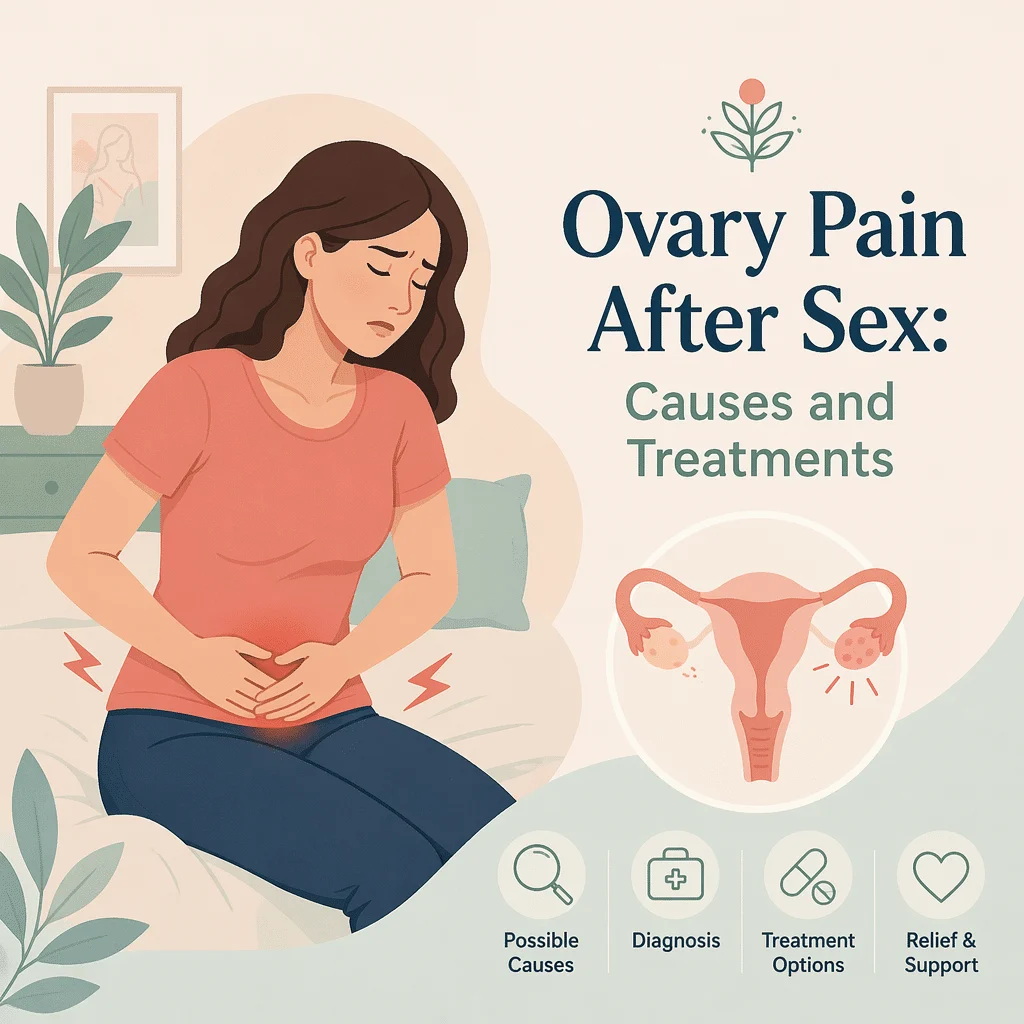
Ovary pain after sex is a common reason women look for answers, and in most cases it is not dangerous. The sensation usually sits low in the abdomen or on one side of the pelvis, and it may fade in minutes or ache for a day. Sometimes it really does come from the ovary. Often it comes from a neighboring organ, a muscle, or a nerve that lies close by. A small number of cases point to something that needs urgent attention.
In this article you’ll learn which conditions most often cause pain in the ovary area after intercourse, which warning signs justify an emergency visit, how doctors work out the cause, which lab tests and scans genuinely help, and what actually relieves the pain. The aim is to help you describe your symptoms precisely and ask better questions at your next appointment.
What ovary pain after sex actually is
Pain that follows intercourse has a medical name: dyspareunia. Clinicians divide it into two broad patterns. Entry pain is felt at the opening of the vagina, usually immediately. Deep pain is felt higher up, in the pelvis or lower abdomen, and it is the pattern most women describe as ovary pain. Mayo Clinic lists deep pain with thrusting as a distinct symptom, separate from burning or entry pain, and that distinction shapes the whole diagnostic path.
Why the ovary is not always the culprit
The ovaries sit deep in the pelvis, surrounded by the fallopian tubes, the bowel, the bladder, the uterus, and a dense web of ligaments and nerves. Any of these structures can produce pain in exactly the same spot. The nervous system cannot cleanly separate signals arriving from neighboring organs, so a tender loop of bowel or a clenched pelvic floor muscle can feel indistinguishable from an ovary. This is why a proper assessment matters far more than guessing from where the ache seems to sit.
Pain that is ordinary and pain that is not
A brief twinge that fades within minutes, happens occasionally, and does not disrupt your life is usually harmless. Pain becomes a medical question when it repeats, intensifies, wakes you at night, arrives with bleeding or fever, or makes you start avoiding sex. Noting when the pain occurs in your cycle is one of the most useful things you can bring to a consultation.
Common causes of ovary pain after sex
Several conditions produce the same complaint. The list below runs roughly from most to least frequent in women of reproductive age.
Ovulation and functional ovarian cysts
Each month an ovary grows a follicle that releases an egg, then forms a small structure called the corpus luteum. Both are fluid-filled, and both can be tender. Intercourse around mid-cycle can jostle a swollen ovary and set off a sharp, one-sided pain. If a small cyst leaks or ruptures, the fluid irritates the lining of the pelvis and the ache can persist for a day or two. MedlinePlus notes that most ovarian cysts are harmless and typically form during ovulation, and the majority resolve on their own within one or two cycles. Our library explains the link between ovarian cyst size and symptoms.
Endometriosis and deep pain
Endometriosis occurs when tissue resembling the uterine lining grows outside the uterus, often on the ovaries, on the ligaments behind the uterus, or on the bowel. These deposits inflame and can bind organs together with scar tissue. Deep pain during and after sex is one of the most characteristic symptoms, and it is frequently worse in the days before a period. Endometriosis is still diagnosed late in many women, so pain after sex that keeps returning deserves to be taken seriously rather than normalized. Our team covers the diagnosis and treatment of endometriosis.
Symptoms that start after a sterilisation procedure have their own explanation: see what lies behind post-tubal ligation syndrome.
Pelvic inflammatory disease and other infections
Pelvic inflammatory disease, usually shortened to PID, is an infection of the upper reproductive tract that generally spreads upward from a sexually transmitted infection such as chlamydia or gonorrhea. The Centers for Disease Control and Prevention lists lower abdominal pain, unusual discharge with an odor, fever, bleeding between periods, and pain or bleeding during intercourse among its symptoms. Untreated PID can scar the fallopian tubes, so it is one of the causes worth excluding early. Our guide covers the symptoms and treatment of a chlamydia infection.
A tight or overactive pelvic floor
The pelvic floor is a sling of muscles supporting the bladder, uterus, and rectum. When these muscles stay chronically tense, penetration compresses them and they answer with spasm and aching that can outlast sex by hours. Cleveland Clinic identifies pelvic floor dysfunction as one of the medical conditions behind painful intercourse. It often develops alongside another painful condition: the body guards against pain, the muscles tighten, and the tightness becomes a second source of pain in its own right.
Position, depth, and the shape of the uterus
Deep penetration can press directly on the cervix, on the ovaries, or on the ligaments behind the uterus. Some women have a uterus that tilts backward rather than forward, an anatomical variation called a retroverted uterus. It is not a disease, but it positions the ovaries where deep thrusting is more likely to reach them. Changing position or limiting depth sometimes removes the problem completely.
Less common causes
- Uterine fibroids or adenomyosis, which make the uterus bulky and tender
- Adhesions left by earlier pelvic surgery, appendicitis, or infection
- Bladder pain syndrome, also called interstitial cystitis
- Irritable bowel syndrome, which overlaps with pelvic pain surprisingly often
- Vaginal dryness related to menopause, breastfeeding, or certain contraceptives
- A fragile cervix that bleeds and stings on contact
This guide describes the causes and risks of a friable cervix.
Red flags: when ovary pain after sex is an emergency
Most pain after sex can wait for a routine appointment. A few patterns cannot. The table below matches what you notice to how quickly you should act.
| What you notice | What it may point to | What to do |
|---|---|---|
| Sudden, severe, one-sided pain with nausea or vomiting | Ovarian torsion, a twisted ovary losing its blood supply | Go to an emergency department immediately |
| Severe pain with dizziness, fainting, or a racing heart | A ruptured cyst with internal bleeding, or a ruptured ectopic pregnancy | Call emergency services |
| Pain with a late or missed period and a positive pregnancy test | Possible ectopic pregnancy | Same-day medical assessment |
| Pain with fever, chills, or discharge with an odor | Pelvic inflammatory disease | Same-day or next-day appointment |
| Heavy or repeated bleeding after sex | A cervical, uterine, or infectious cause | Appointment within a few days |
| Pain that returns every month or has lasted for months | Endometriosis, cysts, or pelvic floor dysfunction | Book a gynecology appointment |
Ovarian torsion deserves particular attention. It is uncommon, but an ovary can lose its blood supply within hours, so acting quickly matters more than waiting for certainty.
How doctors evaluate ovary pain after sex
No single test explains pain after sex. The answer comes from combining your account, an examination, and a small number of targeted investigations.
The conversation and the examination
Expect questions about where the pain sits, whether it appears on entry or with depth, how long it lasts, where you are in your cycle, your contraception, your bowel and bladder habits, and your sexual history. A pelvic examination then lets the clinician press on specific structures, including the cervix, the ovaries, the ligaments behind the uterus, and the pelvic floor muscles, to find which one reproduces your pain. That single step often narrows the list dramatically.
Imaging
Transvaginal ultrasound is the first-line scan. It shows the ovaries in detail, measures cysts, detects free fluid, and can assess blood flow using Doppler. MRI is added when deep endometriosis is suspected or when an ultrasound finding needs clarifying. According to a 2023 clinical review of adnexal masses published in American Family Physician, transvaginal ultrasound is the imaging test of choice in this situation, most masses found in this region turn out to be benign, and a pregnancy test should be obtained in anyone of reproductive age.
Lab tests that narrow the list
Blood and urine tests rarely give the whole answer on their own, but they rule possibilities in and out quickly. Which ones make sense depends entirely on your symptoms.
| Test | What it helps clarify |
|---|---|
| Pregnancy test (hCG) | Confirms or excludes pregnancy, including an ectopic pregnancy, in anyone of reproductive age |
| Swabs for chlamydia and gonorrhea | Identifies the infections that most often lead to pelvic inflammatory disease |
| Complete blood count | Shows raised white cells suggesting infection, or anemia suggesting blood loss |
| C-reactive protein (CRP) | Signals active inflammation somewhere in the body |
| Urinalysis and urine culture | Separates a urinary tract infection from a gynecological cause |
| Female hormone panel (FSH, LH, estradiol) | Clarifies cycle disorders, ovarian function, and dryness linked to menopause |
| CA 125 | Used selectively when a cyst looks complex, keeping in mind that it also rises in endometriosis and other benign conditions |
Our team explains the accuracy and interpretation of a pregnancy test. A companion article describes the role of CRP as an inflammation marker.
Our guide reviews a female hormone panel and its four core markers. A separate article explains the meaning of a raised CA 125 result. Because cycle disorders and ovarian cysts often travel together, our library also details the tests used to diagnose PCOS.
Treatments that relieve ovary pain after sex
Treatment follows the cause. When one cause is clear, targeted therapy usually works well. When several overlap, which is common, a combined plan works better than any single measure.
Treating the underlying condition
Antibiotics clear pelvic inflammatory disease and should start promptly, with partner treatment to prevent reinfection. Most functional cysts need only observation and a repeat scan. Surgery, generally by laparoscopy, is reserved for torsion, for cysts that persist or grow, and for endometriosis that has not responded to medical treatment.
Hormonal options
Combined hormonal contraception suppresses ovulation, which removes the mid-cycle swelling that triggers pain in some women and prevents new functional cysts from forming. Progestin-only options, including the hormonal intrauterine device, thin the uterine lining and reduce endometriosis-related pain. These medicines control symptoms rather than cure the condition, and pain can return once they stop.
Pelvic floor physical therapy
A pelvic floor physical therapist assesses muscle tone and retrains the muscles to release instead of clench. Treatment usually blends manual therapy, breathing and relaxation work, graded dilator use, and education about how pain works. It has become one of the better-supported treatments for deep pain during sex, as the research section below explains.
Relief you can organize yourself
- Nonsteroidal anti-inflammatory medication shortly before intercourse, if your doctor agrees it suits you
- A heating pad on the lower abdomen afterward
- Generous use of a water-based or silicone-based lubricant
- Positions that let you control depth, such as being on top or lying on your side
- Emptying your bladder before sex
- Avoiding intercourse in the days around ovulation, if that is reliably when pain strikes
- A short pain diary recording the date, the cycle day, the position, and how long the pain lasted
Because mid-cycle symptoms often cluster together, our library also covers the causes of ovulation spotting.
Latest scientific advances
Research published over the past three years has sharpened several parts of this picture. The findings below are summarized in everyday language, with the usual caution that one study rarely changes practice on its own.
Why endometriosis can hurt more than its size suggests
A 2023 review looked at why deep pain during sex is so common in endometriosis. Researchers found that extra nerve fibers grow into the tissue around endometriosis deposits, more of them than in healthy tissue, and that local inflammation appears to drive that growth. Several studies also found that the number of nerve fibers tracks with how severe the pain during sex is. What this means for you: the intensity of your pain is not a measure of how extensive your disease looks on a scan, and being told the deposits are small does not mean the pain is imagined. This is still a research concept that needs confirming in larger studies before it changes treatment.
Physical therapy carries the strongest evidence
A 2024 systematic review and meta-analysis, meaning a study that pools the results of many trials, combined 38 randomized trials involving more than 2,000 women with chronic pelvic pain. Multimodal physical therapy, which mixes hands-on treatment, exercises, and education rather than relying on one technique, reduced pain more than usual care or placebo, and the authors rated the certainty of that evidence as high. Psychological therapy on its own did not meaningfully change pain intensity, though it slightly improved sexual function. What this means for you: if a clinician offers pelvic floor physical therapy, the evidence behind that offer is unusually solid.
A closer look at physiotherapy in deep endometriosis
A small randomized trial published in 2023 followed 30 women with deep infiltrating endometriosis. Those given five sessions of pelvic floor physiotherapy reported less pain during sex, less chronic pelvic pain, and better muscle relaxation, and satisfaction with the treatment was high. Questionnaires covering bladder, bowel, and sexual function, however, showed no clear difference between the groups. What this means for you: physiotherapy is a reasonable step for the pain itself, but it is not a fix for every pelvic symptom, and this trial was too small to settle the question.
Hormonal treatment for deep endometriosis
A 2024 meta-analysis pooled five studies of dienogest, a progestin taken daily, in women with deep infiltrating endometriosis. Pain during sex improved, as did period pain and everyday pelvic pain, and the deposits themselves shrank. Headache and reduced sex drive were more frequent while taking it. What this means for you: it is an option worth discussing with a gynecologist, but the evidence rests on a few hundred participants in total, and the trade-off in side effects is real.
What emergency department data say about a twisted ovary
A 2024 review of every ovarian torsion case reaching one hospital emergency department across a year found that almost all the women had sudden abdominal pain, usually on one side, and most also had nausea or vomiting. Ultrasound identified the problem before surgery in the large majority. Notably, blood flow on the scan looked abnormal in only about half of them. What this means for you: a scan showing normal blood flow does not rule out torsion. If pain comes on suddenly and severely, describe it clearly and ask to be reassessed rather than accept quick reassurance.
Pain after sex is usually more than one problem
A 2025 clinical review of chronic pelvic pain in women concluded that the condition affects up to roughly one in four women and most often results from several overlapping pain conditions plus a nervous system that has become oversensitive, rather than from a single lesion. Its authors note that laboratory and imaging tests have limited value when used broadly and should be chosen to answer a specific question raised by your symptoms. A 2023 review of pelvic infection added that pelvic inflammatory disease presents in very variable ways, that clinicians should keep a low threshold for suspecting it, and that the risk of long-term complications stays meaningful even when antibiotics work well. What this means for you: expect a plan with several strands, and do not postpone care for a suspected infection simply because you start to feel better.
Glossary of key terms
| Term | Definition |
|---|---|
| Adnexa | The structures beside the uterus, meaning the ovaries, the fallopian tubes, and their supporting ligaments. |
| Corpus luteum | The small hormone-producing structure left behind in the ovary after an egg is released. It can be tender and occasionally forms a cyst. |
| Dyspareunia | The medical term for persistent or recurring pain during or after sexual intercourse. |
| Endometriosis | A condition in which tissue resembling the uterine lining grows outside the uterus, causing inflammation, pain, and sometimes scarring. |
| Laparoscopy | Keyhole surgery in which a thin camera is passed through a small cut in the abdomen to look at, and often treat, the pelvic organs. |
| Ovarian torsion | A surgical emergency in which an ovary twists on its supporting ligaments and its blood supply is cut off. |
| Pelvic floor dysfunction | A problem with the coordination of the muscles supporting the pelvic organs. When those muscles stay too tight, penetration becomes painful. |
| Pelvic inflammatory disease (PID) | An infection of the upper female reproductive organs, most often spreading upward from an untreated sexually transmitted infection. |
| Retroverted uterus | A uterus that tilts backward toward the spine instead of forward. It is a normal anatomical variation, not a disease. |
| Transvaginal ultrasound | A scan using a slim probe placed in the vagina, giving a close, detailed view of the uterus and ovaries. |
Frequently asked questions
Does ovary pain after sex mean I am pregnant?
On its own, no. Pain after sex is not a reliable sign of pregnancy, and the causes described above are far more common. That said, pain combined with a late or missed period does need a pregnancy test, because an ectopic pregnancy, where the embryo implants outside the uterus, can cause one-sided pain and is a medical emergency. Early pregnancy can also come with mild cramping after sex from normal changes in blood flow to the pelvis. If a test is positive and you have one-sided pain, contact a healthcare professional the same day.
Why does only my left or my right ovary hurt after sex?
One-sided pain is usual rather than unusual. Ovulation happens in one ovary at a time, so a swollen follicle or a fresh corpus luteum sits on one side each cycle. Cysts, endometriosis deposits, and adhesions also tend to be asymmetric. The side itself does not identify the cause, though sudden severe pain confined to one side, especially with nausea or vomiting, is the pattern that raises concern about ovarian torsion and needs urgent assessment.
Is pelvic pain after sex normal?
Occasional mild discomfort that settles quickly is common and not usually a sign of disease. Pain is not something you should simply accept, however, if it happens regularly, gets worse over time, lasts for hours, or changes how you feel about intimacy. Persistent pain during or after sex is a recognized medical symptom with identifiable causes and effective treatments. Being told to relax or use more lubricant, without any assessment, is not adequate care for pain that keeps coming back.
How can I relieve pain after sex at home?
A heating pad on the lower abdomen, an over-the-counter anti-inflammatory if your doctor considers it suitable for you, and rest will usually ease a short episode. Ahead of time, a generous amount of lubricant, positions that let you control the depth of penetration, a slower pace, and emptying your bladder beforehand all help. Keeping a brief diary of when pain occurs in your cycle is valuable, because a clear pattern often points straight to the cause and saves time at your appointment.
What does it mean if I bleed as well as hurt after sex?
Bleeding after sex, known as postcoital bleeding, has its own list of causes. It can come from an inflamed or fragile cervix, an infection such as chlamydia, a cervical polyp, vaginal dryness with small tears, or changes in the cells of the cervix. Combined with pain, it is worth a medical appointment rather than watchful waiting, and it generally prompts a cervical examination and a screening test. Heavy bleeding with severe pain, dizziness, or fainting is an emergency.
Why do my ovaries hurt after sex during ovulation?
Around ovulation the follicle enlarges before releasing an egg, then the corpus luteum forms, and a small amount of fluid or blood can escape into the pelvis. The ovary is physically bigger and more sensitive at this point in the cycle, so pressure during deep penetration reaches an already tender organ. Some women feel this every cycle as mid-cycle pain, sometimes called mittelschmerz. It is generally harmless, though pain severe enough to disrupt your routine each month deserves discussion, since ovulation-suppressing contraception often resolves it.
Sources
- Mayo Clinic — Painful intercourse (dyspareunia): symptoms and causes, 2025 — mayoclinic.org
- MedlinePlus, National Library of Medicine — Ovarian Cysts, 2024 — medlineplus.gov
- Centers for Disease Control and Prevention — About Pelvic Inflammatory Disease (PID), 2024 — cdc.gov
- Cleveland Clinic — Dyspareunia (painful intercourse): causes and treatment, 2023 — my.clevelandclinic.org
- Eunice Kennedy Shriver National Institute of Child Health and Human Development — Pelvic Pain, 2020 — nichd.nih.gov
- Meisenheimer ES, Carnevale AM — Chronic Pelvic Pain in Women: Evaluation and Treatment — American Family Physician, 2025 — PubMed
- Starzec-Proserpio M, Frawley H, Bø K, Morin M — Effectiveness of nonpharmacological conservative therapies for chronic pelvic pain in women: a systematic review and meta-analysis — American Journal of Obstetrics and Gynecology, 2024 — DOI
- Wheeler V, Umstead B, Chadwick C — Adnexal Masses: Diagnosis and Management — American Family Physician, 2023 — PubMed
- Mwaura AN, Marshall N, Anglesio MS, Yong PJ — Neuroproliferative dyspareunia in endometriosis and vestibulodynia — Sexual Medicine Reviews, 2023 — DOI
- Wu H, Liu JJ, Ye ST, Liu J, Li N — Efficacy and safety of dienogest in the treatment of deep infiltrating endometriosis: a meta-analysis — European Journal of Obstetrics, Gynecology and Reproductive Biology, 2024 — DOI
- Del Forno S, Cocchi L, Arena A, et al. — Effects of Pelvic Floor Muscle Physiotherapy on Urinary, Bowel, and Sexual Functions in Women with Deep Infiltrating Endometriosis: A Randomized Controlled Trial — Medicina (Kaunas), 2023 — DOI
- Tabbara F, Hariri M, Hitti E — Ovarian torsion: a retrospective case series at a tertiary care center emergency department — PLoS One, 2024 — DOI
- Hunt S, Vollenhoven B — Pelvic inflammatory disease and infertility — Australian Journal of General Practice, 2023 — DOI
Further reading
- Menopause symptoms, stages, and treatment
- Ovarian cancer: symptoms, causes, testing, and treatment
- Urinary tract infection: symptoms, causes, and treatment
- Understanding vaginal burning: causes and treatments
- HPV: causes, symptoms, and treatments
Understand your lab results with AI DiagMe
Working out why sex hurts often starts with a handful of ordinary results: a pregnancy test, swabs for chlamydia and gonorrhea, a complete blood count, a CRP measuring inflammation, or a hormone panel. Those numbers are easy to collect and hard to read, and a value flagged as abnormal rarely explains itself. AI DiagMe turns your lab report into plain language, showing which markers sit outside their reference range and what usually lies behind that pattern. It helps you understand your results and prepare your questions. It does not diagnose you and it does not replace your doctor.
Get your results interpreted in minutes