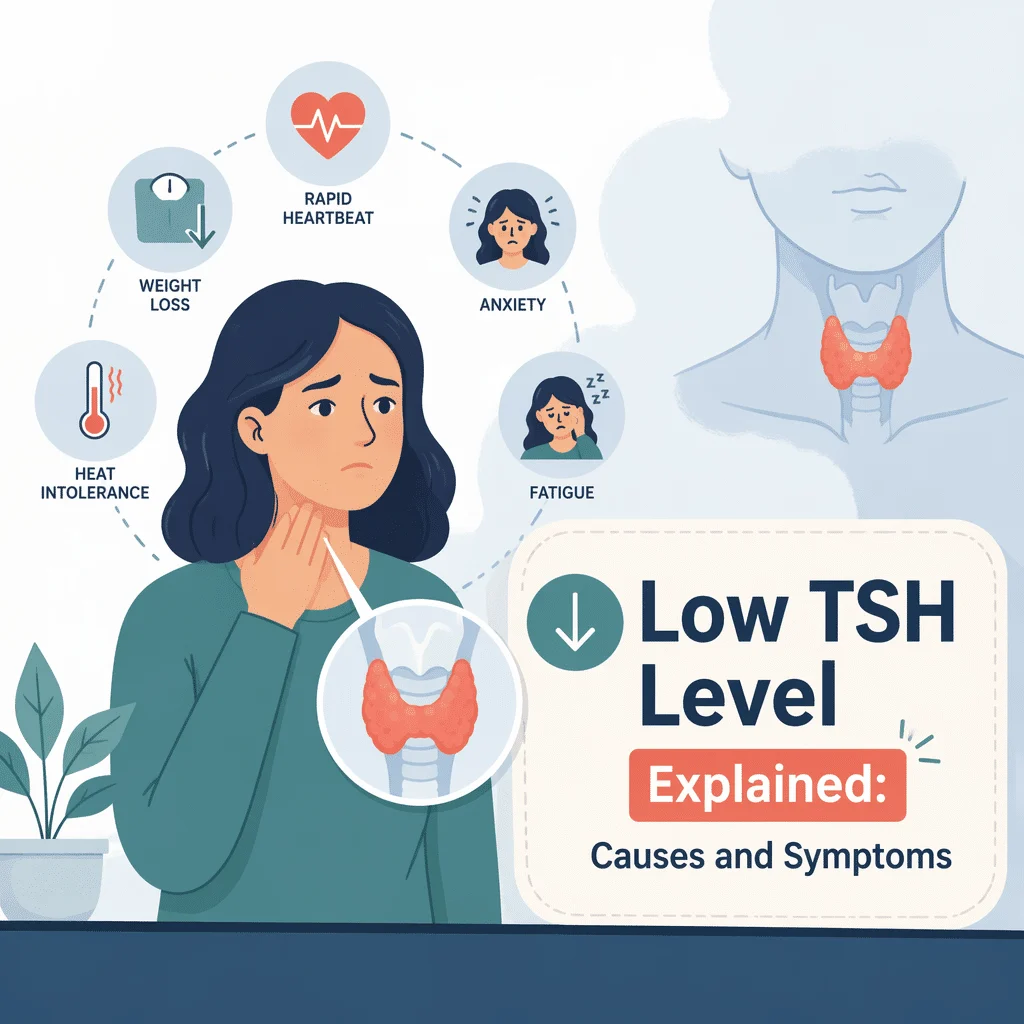
Seeing a low TSH level flagged on a lab report is unsettling, mostly because the number seems to say the opposite of what it means. TSH stands for thyroid-stimulating hormone, and it is not made by the thyroid at all: it is the instruction the pituitary gland sends to tell the thyroid how hard to work. When thyroid hormone is plentiful, the pituitary turns that instruction down. So a low result usually points to a thyroid producing too much hormone, not too little.
In this article you’ll learn how that inverted relationship works, how doctors read TSH alongside T4 and T3 to reach one of three very different conclusions, what causes the result, which symptoms tend to come with it, and which warning signs deserve prompt medical attention.
What a low TSH level actually means
Thyroid-stimulating hormone is produced by the pituitary gland, a pea-sized gland at the base of the brain. Its job is to tell the thyroid, a butterfly-shaped gland in the front of the neck, how much hormone to release. The thyroid answers with two hormones, thyroxine (T4) and triiodothyronine (T3), which set the pace of your metabolism: heart rate, body temperature, digestion, and how quickly you burn energy.
The pituitary constantly samples how much thyroid hormone is circulating and adjusts its instruction accordingly. This is a feedback loop, and it behaves like a thermostat: once the room is warm enough, the thermostat stops calling for heat. When thyroid hormone is abundant, the pituitary lowers its TSH signal. When thyroid hormone runs short, it raises it.
Why the relationship is inverted
That thermostat logic is why the numbers feel backwards. A low TSH level usually means there is too much thyroid hormone in the blood, so the pituitary has dialed its instruction down. A high TSH means the opposite: the thyroid is underperforming and the pituitary is calling louder. Our team also explains the causes and risks of a high TSH result.
One consequence matters for anyone reading a report at home. TSH is a signal about hormone supply, not a measurement of the hormones themselves, so it has to be read next to the thyroid hormones before it means anything definite. It also moves slowly, which is why a single low value taken during or shortly after an illness may not reflect your usual thyroid function.
Ranges vary more than most people expect
Laboratories do not all use the same TSH assay, the same units or the same cut-offs, so the range printed on your report belongs to that laboratory. Ranges also shift during pregnancy, trimester by trimester, and tend to drift upward with age. That is why a value sitting just under the lower limit is treated very differently from a deeply suppressed one, and why doctors repeat the test rather than act on a single reading. Our team also explains the normal ranges used for thyroid tests.
Low TSH with T4 and T3: three very different conclusions
A low TSH level is the start of the interpretation, not the end of it. What decides the meaning is the pattern it forms with free T4 and free T3, the circulating thyroid hormones measured on the same sample or at a follow-up draw. Three combinations account for almost every case, and they point in genuinely different directions.
| Result pattern | What it usually means | What it typically leads to |
|---|---|---|
| Low TSH with high free T4 and/or high free T3 | Overt hyperthyroidism: the thyroid is releasing more hormone than the body needs, and the pituitary has switched its signal almost off | Finding the cause with thyroid antibodies, an ultrasound or an uptake scan, then discussing treatment |
| Low TSH with normal free T4 and normal free T3 | Subclinical hyperthyroidism: hormone output sits at the top of what the body will accept, but not above it. Common, often mild, sometimes temporary | Repeating the tests after several weeks or months; treatment is considered case by case rather than automatically |
| Low TSH with low free T4 | Central (secondary) hypothyroidism: the pituitary or hypothalamus is not sending enough signal, so the thyroid is underactive despite the low TSH. Uncommon but important | Assessing the pituitary itself, including other pituitary hormones and, in some cases, imaging |
The third pattern is the reason a low TSH should never be taken as automatic proof of an overactive thyroid. In that scenario the gland is underactive, and managing the person as though the thyroid were overactive would be exactly the wrong move. Our library also covers the symptoms and treatment of hypothyroidism, and our team also reviews the causes of high prolactin levels, another pituitary result that is often checked at the same time.
This is also why the thyroid hormones are ordered alongside TSH rather than after it. This guide describes the free T4 blood test, and another page explains the free T3 thyroid marker.
What causes a low TSH level
Anything that raises circulating thyroid hormone, that suppresses the pituitary, or that interferes with the test itself can push TSH down. These are the explanations doctors work through most often.
Thyroid conditions that increase hormone output
- Graves’ disease, an autoimmune condition in which antibodies stimulate the entire thyroid to overproduce. It is the most common cause of an overactive thyroid and can also affect the eyes.
- Toxic multinodular goiter, where several nodules in an enlarged thyroid work independently of the pituitary signal. It becomes more frequent with age.
- Toxic adenoma, a single overactive nodule producing hormone on its own.
- Thyroiditis, an inflamed thyroid that leaks stored hormone into the blood. Postpartum thyroiditis after childbirth and subacute thyroiditis after a viral illness both follow this pattern, and the low TSH they cause is usually temporary, often followed by a phase of underactivity before things settle.
Medicines, supplements and iodine
- Too much thyroid hormone medication. This is one of the most common explanations and one of the easiest to overlook: a levothyroxine dose that suited you last year may be too high now. Never adjust a dose yourself, because the change is made by the prescriber on the basis of repeat testing.
- Iodine excess, including the iodinated contrast dye used for some imaging scans, iodine-rich supplements such as kelp, and amiodarone, a heart-rhythm drug that contains a large amount of iodine and can disturb the thyroid in either direction.
- High-dose biotin, sold as a hair, skin and nail supplement. Biotin does not change your thyroid; it distorts the laboratory measurement, and can make TSH read falsely low while T4 and T3 read falsely high. Stopping high-dose biotin for a few days before thyroid testing, and telling the laboratory you have taken it, is standard advice. Our guide sets out the rules for fasting before a blood test.
- Corticosteroids, dopamine and several other hospital medicines can lower TSH for as long as they are given.
Pregnancy, other illness and the pituitary
- Early pregnancy. In the first trimester, hCG (human chorionic gonadotropin, the pregnancy hormone) mildly stimulates the thyroid, which pushes TSH down. This is normal physiology rather than disease, and pregnancy-specific ranges apply. We also describe the blood tests used during pregnancy.
- Non-thyroidal illness, sometimes called sick euthyroid syndrome. Severe infection, major surgery, starvation or a stay in intensive care can lower TSH without any thyroid disease at all. Testing is repeated after recovery.
- Pituitary or hypothalamic problems, such as a pituitary tumor, or damage after surgery, radiation or bleeding. These reduce the TSH signal itself and produce the third pattern in the table above.
Symptoms that often accompany a low TSH level
When a low TSH reflects genuine hormone excess, the symptoms are those of a body running too fast. Many people have only one or two, and subclinical cases frequently cause none at all.
- Weight loss despite a normal or increased appetite
- Feeling hot when others are comfortable, and sweating more than usual
- A fast, pounding or irregular heartbeat; atrial fibrillation, an irregular heart rhythm, is the complication doctors watch for most closely
- A fine tremor, usually most visible in the hands
- Anxiety, irritability, restlessness and trouble sleeping
- More frequent bowel movements or looser stools
- Lighter, shorter or less frequent menstrual periods, and reduced fertility
- Muscle weakness, particularly in the thighs and upper arms, alongside fatigue
- Eye changes in Graves’ disease: gritty, watery or bulging eyes, and sometimes double vision
- Thinning hair, and warm, moist skin
Because the heart is sensitive to thyroid hormone, palpitations are a frequent reason people are tested in the first place. Our team also explains the cardiac markers panel. Long-standing hormone excess also draws calcium out of bone, which is why bone health is assessed in some people; another article details the calcium and bone panel.
Older adults often look different
After about 60, the classic picture is frequently absent. Instead of restlessness and heat intolerance, the presentation may be an irregular heartbeat, unexplained weight loss, low mood, or simply feeling weak and tired, a pattern the Mayo Clinic describes as easy to mistake for other conditions or for aging itself. That is one reason an unexpected low TSH level in an older adult is taken seriously even when the person feels reasonably well.
When to contact your doctor
Most people whose report shows a low TSH level can wait for a scheduled appointment. A small number of situations should not wait. Seek prompt medical advice, or urgent care, if you have:
- A racing, pounding or irregular heartbeat, especially if it is new or if you feel faint
- Chest pain or unusual breathlessness
- Severe eye pain, sudden bulging of an eye, or any change in vision such as double or blurred vision
- Fever together with agitation, confusion, vomiting or extreme weakness. This combination can signal thyroid storm, a rare but life-threatening surge of thyroid hormone that the Mayo Clinic describes as a medical emergency
- A rapidly enlarging neck swelling, or difficulty swallowing or breathing
Contact your prescriber promptly, too, if you take thyroid hormone and your TSH has come back low, since the dose may need reviewing. Tell your doctor if you are pregnant or trying to conceive, because the targets are different.
What usually happens after a low TSH result
A single low reading rarely leads straight to treatment. The usual sequence looks like this.
- Repeat the test, generally with free T4 and free T3, after several weeks. Transient causes such as recent illness, thyroiditis and supplement interference often resolve on their own.
- Review medications and supplements, including thyroid hormone, amiodarone, recent contrast imaging and biotin.
- If hormone excess is confirmed, look for the cause. Thyroid antibodies point toward Graves’ disease, while an ultrasound or a radioactive iodine uptake scan can separate overactive nodules from inflammation.
- If free T4 is low rather than high, assess the pituitary, usually with other pituitary hormones and sometimes imaging.
- Decide together what to do. Overt hyperthyroidism is treated; subclinical hyperthyroidism is often monitored, with treatment considered when the suppression is marked or when age, heart rhythm or bone health raise the stakes.
Latest scientific advances
Recent research has concentrated on the mildest version of this result, a low TSH with normal thyroid hormones, and on making sure the result is genuine before anyone acts on it. Here is what has emerged, in plain terms.
How low the TSH is appears to matter
A 2024 review in the journal Thyroid gathered the evidence on subclinical hyperthyroidism and the heart. Risk was not spread evenly: people whose TSH was fully switched off carried more cardiovascular risk than people whose TSH was only mildly below range, with the clearest links to atrial fibrillation, heart failure and overall mortality, and little connection to stroke. What this means for you: the degree of suppression on your report is one of the things your doctor weighs when choosing between watching and treating. These are observed associations rather than proof that treatment removes the risk, so the decision stays individual.
Mild suppression is being taken more seriously
A 2025 clinical review summarized where the field stands. A persistently low TSH with normal hormones has been associated with atrial fibrillation, with bone thinning and fractures, and with a higher risk of dementia. A re-analysis of an existing trial also found that bringing a suppressed TSH back into range was followed by fewer cases of atrial fibrillation. The same review notes that individual TSH set points are partly inherited, so a single population range does not fit everyone equally well. What this means for you: a mildly low TSH is worth following rather than ignoring, particularly after 65, after menopause, or if you already have a heart rhythm problem. These remain early signals from observational data and secondary analyses, not settled proof.
Ruling out a false result comes first
Two recent publications reinforce a step that is easy to skip. A 2024 practical review in the Journal of Clinical Endocrinology and Metabolism set out how to approach thyroid results that do not fit together, and a 2026 European Thyroid Association guideline did the same for interference in the tests themselves. Both make the same point: substances in the blood, including high-dose biotin supplements and certain antibodies, can distort thyroid immunoassays and produce a picture that mimics disease. What this means for you: listing every supplement you take is not a formality. Excluding interference first can spare you unnecessary scans, referrals and treatment.
Glossary
| Term | Definition |
|---|---|
| TSH (thyroid-stimulating hormone) | The hormone the pituitary gland uses to tell the thyroid how much hormone to make. It rises when the thyroid is underactive and falls when the thyroid is overactive. |
| Free T4 (free thyroxine) | The main hormone the thyroid releases, measured in its unbound, active form. It is the value most often read next to TSH. |
| Free T3 (free triiodothyronine) | The more active thyroid hormone, mostly made by converting T4 in the tissues. It can be raised in some forms of overactive thyroid when T4 is still normal. |
| Hyperthyroidism | An overactive thyroid, producing more hormone than the body needs. It speeds up many body functions. |
| Subclinical hyperthyroidism | A low TSH with thyroid hormones still inside the normal range. Symptoms are often absent, and the result is confirmed on a repeat test before anything is decided. |
| Central (secondary) hypothyroidism | An underactive thyroid caused by the pituitary or hypothalamus failing to send enough signal. TSH and free T4 are both low. |
| Graves’ disease | An autoimmune condition in which antibodies stimulate the thyroid to overproduce hormone. It is the most common cause of an overactive thyroid and can involve the eyes. |
| Thyroiditis | Inflammation of the thyroid that releases stored hormone into the blood. The resulting low TSH is usually temporary. |
| Pituitary gland | A small gland at the base of the brain that directs several other hormone glands, including the thyroid. |
| Assay interference | A substance in the blood sample, such as high-dose biotin or certain antibodies, that distorts a laboratory measurement and produces a misleading result. |
Frequently asked questions
What is considered a dangerously low TSH level?
There is no single number that makes a result dangerous, and cut-offs differ between laboratories. What matters more is the whole picture: how far below range the value sits, whether it stays low on a repeat test, what the thyroid hormones are doing, and how you feel. A fully suppressed TSH combined with clearly raised thyroid hormones needs faster attention than a value just under the lower limit with normal hormones. Symptoms carry weight too, particularly a new irregular heartbeat, chest pain or fever with confusion, which are reasons to seek care rather than wait for the next appointment.
Can a low TSH level return to normal on its own?
Often, yes. Thyroiditis after a viral illness or after childbirth releases stored hormone for a few weeks and then settles, sometimes passing through a temporary underactive phase first. Severe illness, surgery and some medications lower TSH while they last. Recent contrast imaging or a high-dose biotin supplement can also produce a low reading that disappears once the cause is removed. This is exactly why doctors repeat thyroid tests after several weeks rather than acting on a single result.
What are the symptoms of a low TSH level in women?
Women experience the same hormone-excess symptoms as men, with some additions. Periods may become lighter, shorter or less frequent, and fertility can be reduced. Hair may thin, and bone loss becomes a concern when hormone excess continues for a long time, especially after menopause. In pregnancy the picture is different again: a mildly low TSH in the first trimester is often normal physiology driven by the pregnancy hormone hCG, and pregnancy-specific ranges apply. Any thyroid result in pregnancy should be reviewed by the doctor following the pregnancy.
How is a low TSH level treated?
Treatment targets the cause, not the number. If a thyroid hormone dose is too high, the prescriber adjusts it and repeats the test. If the thyroid is genuinely overproducing, options discussed with an endocrinologist include antithyroid medicines, radioactive iodine and, less often, surgery, with medicines such as beta-blockers used to ease palpitations and tremor in the meantime. Subclinical hyperthyroidism is frequently monitored rather than treated immediately. If the cause is the pituitary, the treatment addresses the pituitary problem. No dose should ever be started or changed without your doctor.
What does a low TSH with low T3 mean?
That combination usually points away from a simple overactive thyroid. Two explanations are common. In non-thyroidal illness, a serious infection, major surgery or a hospital stay temporarily disturbs the whole system, lowering T3 first, and the tests are repeated after recovery. In central hypothyroidism, the pituitary or hypothalamus is not sending enough signal, so free T4 is low as well, and the pituitary itself is investigated. Either way, one sample is not enough to conclude, and the full panel guides the next step.
Can stress, diet or supplements cause a low TSH level?
Severe physical stress can. Serious illness, major surgery, prolonged fasting or intensive care can suppress TSH temporarily without any thyroid disease. Everyday psychological stress is not an established cause. Diet matters mainly through iodine: very high intakes, including kelp supplements and iodine-rich preparations, can disturb the thyroid. Supplements can also affect the test rather than the gland, high-dose biotin being the best-known example. Bringing a full list of everything you take to your appointment helps your doctor read the result correctly.
Sources
- National Institute of Diabetes and Digestive and Kidney Diseases — Hyperthyroidism (Overactive Thyroid) — National Institutes of Health
- MedlinePlus — Hyperthyroidism (Overactive Thyroid, Graves’ Disease) — U.S. National Library of Medicine
- Mayo Clinic — Hyperthyroidism: Symptoms and causes
- Cooper A, Abraham P — Subclinical hyperthyroidism — Current Opinion in Endocrinology, Diabetes and Obesity, 2025 (PubMed, PMID 40832786)
- Kim HJ, McLeod DSA — Subclinical Hyperthyroidism and Cardiovascular Disease — Thyroid, 2024 (PubMed, PMID 39283826)
- Moran C, et al. — Approach to the Patient With Raised Thyroid Hormones and Nonsuppressed TSH — The Journal of Clinical Endocrinology and Metabolism, 2024 (PubMed, PMID 37988295)
- Campi I, et al. — 2026 European Thyroid Association guideline on interference in immunoassay measurements used in the assessment of thyroid function — European Thyroid Journal, 2026 (PubMed, PMID 42466561)
Further reading
- How to read your blood test results
- Abnormal blood test results and what they mean
- Normal thyroid levels and how the ranges are set
- High TSH symptoms, causes and risks
- The free T4 thyroid test
Understand your lab results with AI DiagMe
A low TSH level only makes sense next to the rest of your panel, and few people leave the laboratory with someone available to walk them through it. AI DiagMe reads your report and explains, in everyday language, what your TSH, free T4, free T3 and thyroid antibody results suggest, and which values are worth raising at your next appointment. It is built to help you understand your own results and ask better questions. It does not diagnose, and it does not replace your doctor.
Get your results interpreted in minutes