



































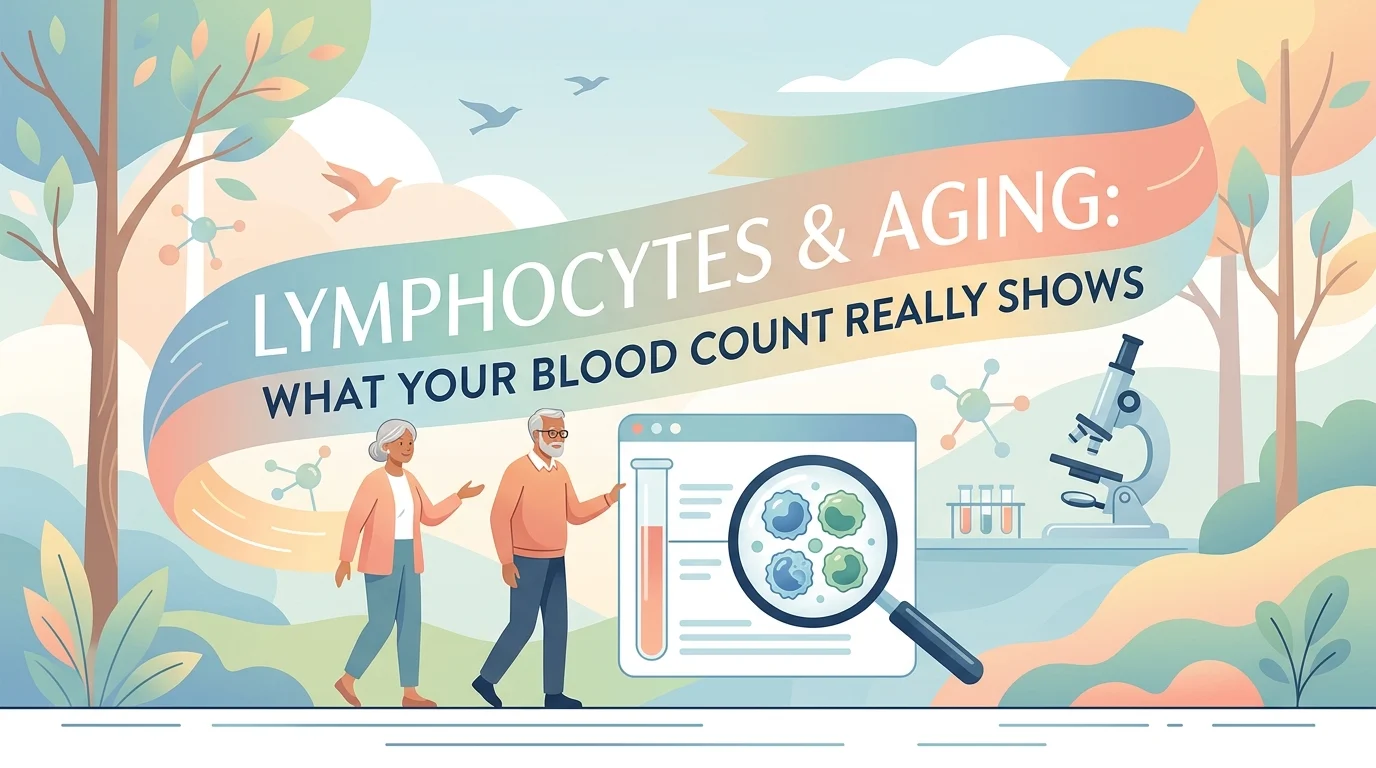
Un estudio que recorrió la prensa científica el 25 de agosto de 2026 traía un titular llamativo: las personas que viven más de 110 años tienen una cantidad inusualmente alta de una célula inmunitaria rara que detecta y destruye células anormales. Lo retomaron las páginas de noticias de Nature y medios como ScienceDaily y The Scientist, y contradice una idea muy extendida: que el sistema inmunitario simplemente se desgasta con la edad.
Este artículo no explica qué son los linfocitos; nuestra guía sobre biometría hemática (BH) ya cubre ese tema. Aquí respondemos la pregunta más concreta que ese titular plantea a cualquier persona que tiene un resultado de laboratorio en la mano: ¿puede tu biometría hemática decirte algo sobre cómo está envejeciendo tu sistema inmunitario?
Qué encontró el estudio del 25 de agosto de 2026
Investigadores de la Universidad de Osaka y la Universidad Keio analizaron muestras de sangre de 28 adultos divididos en tres grupos de edad: de 70 a 99 años, de 100 a 109 años, y de 110 años en adelante. Estudiaron un tipo raro de glóbulo blanco llamado linfocito T citotóxico CD4, o CD4 CTL — una célula T colaboradora que ha aprendido a matar. Su proporción dentro del grupo de células T aumentó de forma constante entre los grupos: de una mediana de alrededor del 4% en el grupo más joven, al 9.6% entre los centenarios y al 17.6% en los mayores de 110 años. La expansión pareció comenzar alrededor de los 100 años.
Dos detalles hacen que el resultado vaya más allá de la simple curiosidad. Las células no estaban agotadas — habían perdido los marcadores de superficie CD27 y CD28, lo que normalmente indica una larga vida activa, pero conservaban su capacidad de matar. Además, estaban dominadas por clones muy grandes: en promedio, el clon más grande representaba un tercio de los CD4 CTLs de cada participante, y en un centenario un solo clon constituía más de la mitad. Ese patrón es la huella inmunológica de un sistema que responde, una y otra vez, a algo que no desaparece.
Cuando el equipo comparó esas secuencias de receptores con una base de datos pública, varias coincidían con células T que se encuentran en expansión dentro de tumores, en particular de cáncer de pulmón. Ninguno de los participantes había sido diagnosticado con esos cánceres, lo que llevó a los autores a proponer que estas células podrían estar reaccionando de forma temprana ante células anormales, antes de que se desarrolle una enfermedad establecida.
Las advertencias son reales y los propios autores las señalan. Veintiocho personas es un grupo muy pequeño. El análisis examinó células que circulan en la sangre, no lo que esas células hacen dentro de los tejidos. Y como todos los participantes del estudio ya habían llegado a una edad extremadamente avanzada, el diseño no puede demostrar si las células los ayudaron a llegar ahí o simplemente los acompañaron en el camino.
Por qué tu biometría hemática no puede detectar estas células
Aquí está la parte que importa cuando estás revisando tus propios resultados. Las células de este estudio son invisibles para un análisis de sangre de rutina. Una biometría hemática (BH) estándar clasifica los glóbulos blancos en cinco familias y se detiene ahí; identificar un linfocito T citotóxico CD4 requirió secuenciación unicelular en un laboratorio de investigación.
| Línea en tu reporte | Qué mide | Lo que no puede mostrar |
|---|---|---|
| Leucocitos (glóbulos blancos, WBC) | Todos los leucocitos en conjunto | Qué familia está generando un cambio |
| Linfocitos, porcentaje y valor absoluto | Generalmente entre 1,000 y 4,800 por microlitro en adultos | Si son células B, células T o células NK |
| Neutrófilos, monocitos, eosinófilos, basófilos | El resto de la fórmula diferencial | Nada sobre subpoblaciones de células T |
| Conteo de CD4 | Células T colaboradoras (CD4), solicitadas por separado y principalmente en el manejo del VIH | Si esas células CD4 son citotóxicas |
| Linfocitos T citotóxicos CD4 | Secuenciación unicelular en un entorno de investigación | No disponible en laboratorios clínicos |
Así que no, no puedes pedir este estudio, y tampoco habría nada útil que hacer con el resultado aunque pudieras. Lo que sí te da tu reporte es la línea de linfocitos — y esa línea sí cambia con la edad de maneras que vale la pena entender. Si no estás seguro de qué panel te realizaron, nuestra comparación de la BH y la química sanguínea (QS) explica qué marcadores corresponden a cada una.
Qué cambia realmente en tu línea de linfocitos con la edad
Dos cosas se modifican, lentamente, a lo largo de décadas. El conteo absoluto de linfocitos tiende a ser un poco más bajo en etapas avanzadas de la vida. Y la composición del grupo cambia: hay menos células T vírgenes, las que nunca han enfrentado una amenaza, y más células de memoria y efectoras, las que ya están comprometidas con un blanco específico. El número en la página puede mantenerse perfectamente estable mientras las células que lo conforman cambian por completo su función.
Por eso un solo valor rara vez aclara todo por sí solo. Un conteo que ha bajado del límite estándar genera las mismas preguntas en un adulto mayor que en uno más joven — nuestra página sobre linfocitos bajos explica las causas más comunes, desde una infección viral reciente hasta efectos de medicamentos. Un conteo por encima del rango tiene su propia lista, que abordamos en nuestra guía sobre linfocitos altos, y la actividad viral persistente es una explicación frecuente y a menudo sin mayor importancia, como explica nuestro artículo sobre reactivación del virus de Epstein-Barr describe.
Los últimos avances científicos, en lenguaje sencillo
Buscar en la literatura indexada en PubMed y en la base de datos Consensus durante los últimos tres años arroja cuatro hallazgos que ponen en contexto el titular de agosto.
Primero, la longevidad extrema se parece menos a una conservación y más a una remodelación. Una revisión de 2026 sobre lo que los centenarios han enseñado a los inmunólogos describe el envejecimiento inmunológico como un conjunto de caminos divergentes, no como una sola pendiente hacia abajo: las personas que mejor lo llevan no son las que conservaron un sistema inmune joven, sino las que mantuvieron uno equilibrado. Un comentario en Trends in Genetics llegó a la misma conclusión sobre el estudio de agosto en particular, interpretando la expansión de las células asesinas como una reestructuración y no como un deterioro.
Segundo, la sangre de los supercentenarios no refleja una juventud imposible. Cuando un equipo independiente construyó un reloj de envejecimiento a partir de datos sanguíneos de células individuales y lo aplicó a supercentenarios, su sangre quedó dentro del rango habitual para personas de entre ochenta y poco más de cien años: vieja, pero no caótica. Lo que los distinguía era un estado de baja inflamación, no un calendario biológico rejuvenecido.
Tercero, y lo más útil en la práctica clínica, los rangos de referencia para los linfocitos no han avanzado al mismo ritmo que el conocimiento sobre el envejecimiento. Un análisis de 2025 publicado en una revista de hematología lo señaló con claridad: aplicar un rango fijo de adulto a todas las personas conlleva el riesgo de etiquetar como linfopénicas a personas mayores sanas y someterlas a estudios innecesarios. Grandes investigaciones en adultos sanos —una de ellas con más de cuarenta mil participantes— han trazado cómo estos conteos cambian a lo largo de las décadas y han propuesto intervalos específicos por edad. Lo que esto significa para ti es sencillo: un valor de linfocitos ligeramente por debajo del rango impreso en el reporte a los 78 años no tiene el mismo peso que tendría a los 38, y es una pregunta para tu médico, no un veredicto.
Cuarto, la relación entre las familias de células blancas puede decir más que cualquier conteo individual. Investigaciones de largo plazo sobre el envejecimiento han encontrado que el equilibrio entre neutrófilos y linfocitos cambia con la edad, y que esta proporción está relacionada con la acumulación de enfermedades crónicas. Se calcula a partir de los números que ya aparecen en un reporte ordinario, lo que la convierte en una de las pocas señales de envejecimiento inmunológico que realmente puedes ver. Nuestras páginas sobre neutrófilos altos y sobre una PCR elevada cubren los dos marcadores que con mayor frecuencia se mueven junto a ella.
Cómo leer tu propio resultado de linfocitos
Léelo junto con el resto del diferencial, no de forma aislada. Un resultado de linfocitos solo tiene sentido cuando sabes qué están haciendo los neutrófilos, los monocitos y el conteo total de glóbulos blancos, y si estuviste combatiendo alguna infección en las semanas previas a la toma de muestra. Las infecciones, los corticosteroides, la quimioterapia y el estrés físico pueden mover este valor de forma temporal.
Léelo también junto con el resultado anterior. Un valor estable que ha permanecido en el mismo nivel durante años es tranquilizador de una manera que ninguna lectura aislada puede serlo. Un resultado puntual que claramente se ha alejado de tu propia línea base es el que vale la pena mencionar, sin importar en qué dirección se movió.
Y léelo frente a la pregunta correcta. Linfocitos persistentemente bajos junto con infecciones repetidas apuntan hacia un estudio diferente que un conteo persistentemente alto con ganglios inflamados — el primero puede llevar hacia un panel autoinmune o una revisión de medicamentos, el segundo hacia las posibilidades descritas en nuestro panorama general de linfoma. Ninguna de las dos preguntas se responde solo con el conteo, que es también la razón por la que la actual ola de pruebas de detección temprana de múltiples tipos de cáncer se está evaluando con tanto cuidado antes de llegar a la atención de rutina.
Preguntas frecuentes
¿Los linfocitos bajan con la edad?
En promedio, sí, de forma moderada — y la composición cambia más que el total. La consecuencia práctica es que un valor ligeramente por debajo del rango de referencia impreso tiene menos significado en un adulto mayor que el mismo valor en una persona joven, que es exactamente por qué ahora se están proponiendo intervalos específicos por edad.
¿Puedo pedir un conteo de CD4 para revisar mi envejecimiento inmunológico?
Puedes hacerte la prueba, pero no responderá esa pregunta. Los conteos de CD4 existen para monitorear el VIH y ciertas inmunodeficiencias, y fuera de esos contextos un resultado no tiene una interpretación establecida. Las células del estudio sobre supercentenarios no pueden medirse con ningún análisis clínico disponible.
¿Cuál es el conteo normal de linfocitos en un adulto?
La mayoría de los laboratorios trabajan con aproximadamente 1,000 a 4,800 linfocitos por microlitro, o alrededor del 20 al 40 por ciento de los glóbulos blancos, y muchos definen linfopenia por debajo de aproximadamente 1,500 por microlitro. Los rangos varían entre laboratorios, así que siempre compara tu cifra con la que aparece impresa en tu propio reporte.
¿Un conteo alto de linfocitos significa que mi sistema inmunológico es más fuerte?
No. Un conteo elevado generalmente refleja que el organismo está respondiendo a algo, con mayor frecuencia una infección viral, y no dice nada sobre qué tan bien está funcionando esa respuesta. La calidad inmunológica no es algo que puedas leer en un número.
¿Debería este estudio cambiar algo de lo que hago?
No directamente. Es un trabajo observacional temprano en 28 personas, y no existe ningún suplemento, medicamento ni cambio de estilo de vida que haya demostrado aumentar estas células en particular. Su valor es conceptual: cuestiona la suposición de que el envejecimiento inmunológico es un declive en un solo sentido.
Glosario
- Linfocito: un glóbulo blanco del sistema inmunológico adaptativo, que se cuenta en cada biometría hemática (BH) de rutina.
- Célula T CD4: una célula T colaboradora que coordina la respuesta inmunológica; el blanco del VIH y la célula que se mide en el seguimiento del VIH.
- Linfocito T citotóxico CD4 (CTL CD4): una célula T colaboradora poco común que puede destruir directamente células infectadas o anormales.
- Expansión clonal: la multiplicación de una célula en un gran grupo de copias casi idénticas después de que reconoce un objetivo.
- Inmunosenescencia: el conjunto de cambios que experimenta el sistema inmunológico con la edad, incluyendo la reducción de células T naïve e inflamación de bajo grado.
- Célula T naïve: una célula T que aún no ha encontrado su objetivo; estas se vuelven más escasas con la edad.
- Linfopenia: un conteo de linfocitos por debajo del rango de referencia.
- Diferencial de sangre: la parte de la biometría hemática (BH) que separa los glóbulos blancos en sus cinco tipos.
- Supercentenario: una persona de 110 años o más.
- Índice neutrófilo-linfocito: el conteo de neutrófilos dividido entre el conteo de linfocitos, ambos obtenidos de una biometría hemática (BH) de rutina.
Entiende tus propios resultados
Un valor de linfocitos no significa nada por sí solo. Su significado depende de tus neutrófilos, tus monocitos, tu conteo total de glóbulos blancos, tus marcadores inflamatorios y tus propios resultados anteriores — todo ello presentado en un reporte lleno de abreviaturas y rangos de referencia que no explican nada sobre tu situación. AI DiagMe lee todo tu reporte de laboratorio y te dice, línea por línea, qué significa cada resultado para ti. Sube tu reporte en aidiagme.com para entender tus resultados antes de tu próxima consulta.
Lecturas recomendadas
- Biometría hemática (BH): cómo leer tus resultados
- Linfocitos altos: causas, síntomas y tratamientos
- Linfocitos bajos: causas, síntomas y cuándo preocuparse
- BH vs QS: entendiendo los dos estudios
- Panel de autoinmunidad: qué evalúa
Fuentes
- ScienceDaily. Las personas que viven más de 110 años tienen una abundancia inusual de células inmunológicas asesinas. 25 de agosto de 2026. sciencedaily.com
- Nature. ¿Cómo viven las personas más allá de los 110 años? La abundancia de células que destruyen el cáncer podría ser clave. Agosto de 2026. nature.com
- Hashimoto K, Kojima-Ishiyama M, Inokuchi H, et al. CD4 CTLs in supercentenarians: signs of adaptive expansion in healthy aging. Cell Reports. 2026;117728. doi.org (PubMed)
- Wang P. Uncovering an adaptive immune hallmark of extreme longevity. Trends in Genetics. 2026. doi.org (PubMed)
- Anaya JM, Lozada-Martinez ID, Acosta-Ampudia Y, Tobon G. Immunosenescence and human healthspan: lessons from centenarians. Current Opinion in Immunology. 2026;100:102777. doi.org (PubMed)
- Zhu H, Chen J, Liu K, et al. Human PBMC scRNA-seq-based aging clocks reveal ribosome to inflammation balance as a single-cell aging hallmark and super longevity. Science Advances. 2023;9(26):eabq7599. doi.org (PubMed)
- Elmahdi S, et al. Age-related decline in lymphocyte counts: establishing age-specific reference intervals for clinical practice. American Journal of Hematology. 2025. Referencia
- Chang ST, et al. Age-dependent immune profile in healthy individuals: an original study, systematic review and meta-analysis. Immunity and Ageing. 2024. Referencia
- Jia Z, et al. Immune-ageing evaluation of peripheral T and NK lymphocyte subsets in Chinese healthy adults. Phenomics. 2023. Referencia
- Pellegrino R, et al. Neutrophil, lymphocyte count, and neutrophil to lymphocyte ratio predict multimorbidity and mortality: results from the Baltimore Longitudinal Study on Aging. GeroScience. 2024. Referencia
- MedlinePlus, National Library of Medicine. Blood Differential. medlineplus.gov
- MedlinePlus, National Library of Medicine. CD4 Lymphocyte Count. medlineplus.gov
- National Heart, Lung, and Blood Institute. Lymphopenia: Diagnosis. nhlbi.nih.gov