










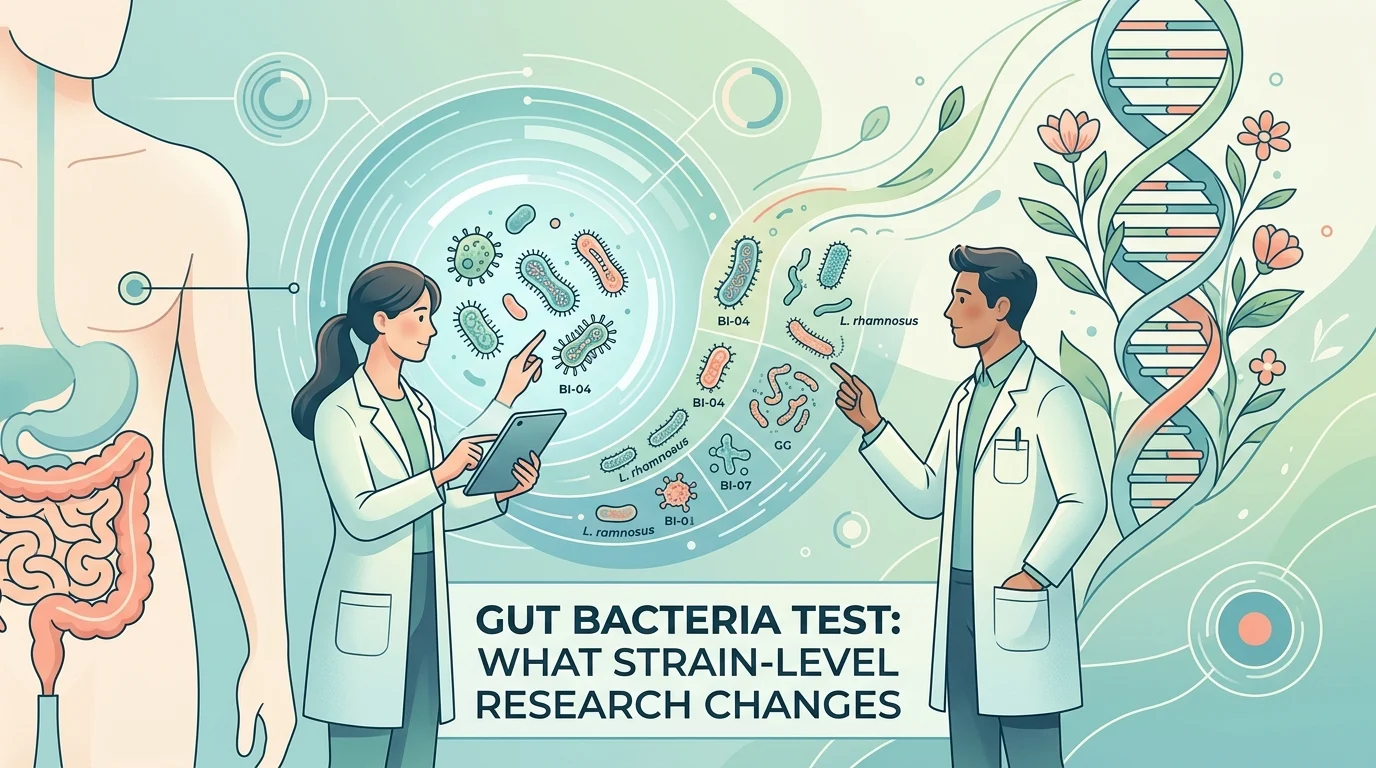
Una prueba de bacterias intestinales identifica los microbios presentes en una muestra de heces, y una investigación publicada en Nature acaba de cambiar la forma en que los científicos entienden qué son realmente esos microbios. Un equipo liderado por la Universidad de Viena demostró que una sola especie de bacteria intestinal suele contener varias poblaciones evolutivamente distintas, cada una adaptada a condiciones diferentes dentro del intestino. Algunas de esas poblaciones se asociaron con el envejecimiento, la enfermedad inflamatoria intestinal, el cáncer colorrectal y la diabetes tipo 2. Los investigadores también reportaron que las poblaciones más competitivas pueden propagarse entre personas y entre continentes en pocas décadas. En este artículo conocerás qué encontró el estudio, por qué importa la diferencia entre una especie y una cepa, y qué puede decirte realmente un análisis de heces hoy en día.
Lo que reportó el nuevo estudio
Los investigadores analizaron miles de aislados bacterianos obtenidos del intestino humano, junto con datos metagenómicos —el material genético completo de toda una comunidad microbiana— de personas en varios países y de distintos grupos de edad y salud.
Utilizaron un enfoque llamado ecología inversa, que deduce cómo un organismo se ha adaptado a su entorno a partir de su genoma, en lugar de experimentos de laboratorio. La señal que buscaban era un barrido selectivo a nivel genómico: una bacteria adquiere una mutación útil, supera a sus parientes cercanos y sus descendientes se imponen. Lo que queda es una población cuyos miembros son inusualmente similares entre sí y claramente distintos de las poblaciones vecinas. Muchas especies intestinales conocidas resultaron dividirse en varios de estos linajes.
Qué significa esto para ti
La mayoría de los reportes de microbioma disponibles hoy identifican especies. Este trabajo sugiere que nombrar la especie puede simplemente no ser suficientemente preciso, ya que dos poblaciones de la misma especie pueden comportarse de manera muy diferente dentro del cuerpo. Esa es una de las razones por las que los resultados del microbioma han sido tan difíciles de interpretar hasta ahora.
Por qué las cepas importan más que las especies
Agrupar bacterias por especie es práctico, pero mezcla organismos que ocupan nichos distintos. La consecuencia es concreta: se vuelve difícil distinguir qué bacterias están genuinamente relacionadas con una enfermedad, cuáles simplemente están de paso y cuáles pueden ser protectoras.
Según la autora principal Xiaoqian Annie Yu, tomar en cuenta la adaptación evolutiva —en lugar de solo contar especies— permite identificar con mucha mayor precisión las unidades biológicamente relevantes del microbioma. Dentro de una misma especie, algunas poblaciones aparecen con más frecuencia que otras en ciertas enfermedades, un patrón que desaparece cuando todo se agrupa en conjunto.
Esto es importante para cualquier persona que alguna vez se haya preguntado qué significa realmente un resultado intestinal. Es la misma lógica que ya se aplica en otros estudios de laboratorio: nuestro artículo explica por qué la prueba de calprotectina fecal mide la inflamación y no un diagnóstico, y otro artículo describe la prueba de cultivo de heces, que busca organismos específicos en lugar de una puntuación general de equilibrio.
Bacterias intestinales que se transmiten entre personas
El segundo hallazgo es el que más atención generó. El equipo encontró evidencia de que poblaciones bacterianas muy competitivas pueden propagarse rápidamente a grandes distancias y, en algunos casos, expandirse por continentes enteros en apenas unas pocas décadas. Hasta ahora, ese patrón se había documentado principalmente en patógenos, no en habitantes comunes del intestino.
El líder del estudio, Martin F. Polz, concluyó que las bacterias intestinales son más dinámicas de lo que se pensaba, y que las cepas bien adaptadas pueden propagarse a nivel internacional y establecerse en nuevos nichos. La implicación práctica es que la alimentación, los medicamentos y el estilo de vida quizás no sean las únicas fuerzas que moldean tu microbioma. La transmisión entre personas también podría tener un papel.
Eso no significa que el microbioma sea contagioso como un virus estomacal. Nadie en este estudio se enfermó por convivir con alguien más. Lo que los datos sugieren es algo más lento y silencioso: con el paso de los años, las versiones particulares de las bacterias comunes que tienes pueden reflejar en parte a las personas y los lugares que te rodean.
Qué puede y qué no puede decirte un examen de heces hoy en día
Nada de esto está disponible en una clínica todavía. La brecha entre lo que la investigación puede medir y lo que un laboratorio puede validar es lo más importante que debes tener en cuenta antes de pedir cualquier estudio. Cleveland Clinic señala claramente que los profesionales de salud clínica generalmente no utilizan ni recomiendan los kits comerciales de análisis del microbioma intestinal, porque todavía no sabemos lo suficiente sobre cómo la microbiota intestinal afecta la salud como para que ese tipo de reporte sea útil.
| Preguntas que puedes tener | Lo que los estudios actuales pueden decir |
|---|---|
| ¿Tengo una infección o un parásito? | Sí. El cultivo de heces y los estudios para detectar parásitos buscan organismos específicos y se usan en la atención médica de rutina. |
| ¿Tengo inflamación en el intestino? | En gran medida, sí. La calprotectina fecal refleja la inflamación intestinal y ayuda a distinguir una enfermedad inflamatoria del síndrome de intestino irritable. |
| ¿Hay sangre oculta en mis heces? | Sí. La prueba inmunoquímica fecal detecta sangre que no se puede ver a simple vista y es la base de los programas de detección de cáncer colorrectal. |
| ¿Mi microbioma está equilibrado? | No hay una respuesta establecida. No existe un umbral validado para definir un microbioma saludable, y los reportes comerciales no se utilizan en la atención clínica de rutina. |
| ¿Mis bacterias indican que voy a desarrollar alguna enfermedad? | No. Las asociaciones a nivel de cepa son hallazgos de investigación a nivel poblacional, no una predicción para una persona en particular. |
Hay otra advertencia importante que debes conocer antes de pagar por un panel: los resultados también guardan un registro prolongado de tu historial médico. Lo explicamos en un artículo aparte sobre el efecto de los medicamentos previos en los resultados del microbioma intestinal.
Avances científicos recientes
El trabajo de Viena forma parte de un cambio más amplio. Tres estudios recientes muestran lo que el análisis a nivel de cepa ya puede aportar y hasta dónde llega su alcance.
Un análisis combinado publicado en Nature Medicine reunió 3,741 metagenomas de heces de 18 cohortes de personas con cáncer colorrectal, adenomas o sin enfermedad. Usando únicamente la metagenómica intestinal, los autores mejoraron la precisión en la predicción del cáncer colorrectal e identificaron firmas específicas de cepas dentro de dos bacterias intestinales comunes, lo que significa que subgrupos dentro de una misma especie ordinaria se asociaron con enfermedad en etapas más avanzadas. Lo que esto significa para ti: el microbioma está siendo evaluado seriamente como objetivo de detección, pero se trata de una precisión a nivel poblacional, no de una prueba casera.
Un segundo análisis cruzado de cohortes examinó 8,117 metagenomas de heces de diez cohortes de personas con diabetes tipo 2, prediabetes o glucosa en sangre normal en Estados Unidos, Europa, Israel y China. Diecinueve especies se relacionaron con la diabetes tipo 2 y —más cercano al hallazgo de Viena— los autores identificaron diversidad dentro de las especies para cepas de 27 especies que ayudaron a explicar por qué el riesgo varía de una persona a otra. Lo que esto significa para ti: dos personas pueden albergar la misma especie y aun así tener versiones distintas de ella, lo cual es una de las razones por las que estudios anteriores del microbioma llegaron a conclusiones contradictorias.
Una revisión de 2025 sobre marcadores del microbioma en enfermedad inflamatoria intestinal, cáncer colorrectal y enfermedad celíaca llega a una conclusión mesurada: la secuenciación ha revelado tanto cambios globales como biomarcadores candidatos, pero aún se necesita combinar varios tipos de datos antes de que el diagnóstico o el tratamiento puedan basarse en ellos. Lo que esto significa para ti: son pistas prometedoras, no herramientas clínicas consolidadas.
Todo esto es incipiente. Nada de esto cambia lo que un laboratorio te reportará este año.
Cuándo hablar con un médico
Los síntomas siguen siendo lo que debe motivar una consulta, no la curiosidad sobre tus bacterias. Habla con un profesional de la salud si tienes diarrea que dura más de dos semanas, sangre en las heces, pérdida de peso sin explicación, dolor abdominal persistente o fiebre acompañada de síntomas digestivos. Cualquier persona que esté en el grupo de edad de detección nacional también debe realizarse el tamizaje de cáncer colorrectal cuando se le ofrezca, independientemente de lo que diga un reporte del microbioma.
Si ya tienes un resultado en tus manos y no estás seguro de lo que significa, nuestro artículo cubre los estudios de heces que realmente ayudan en la diarrea persistente, y otro explica síntomas y detección del cáncer colorrectal.
Glosario
| Término | Definición |
|---|---|
| Microbioma | El conjunto completo de bacterias, virus, hongos y otros microorganismos que viven en un lugar determinado, como el intestino. |
| Metagenómica | Lectura del material genético de toda una comunidad microbiana a la vez, en lugar de cultivar los organismos uno por uno. |
| Especie | El nivel habitual en el que se nombran y reportan las bacterias. Puede ocultar diferencias importantes dentro del grupo. |
| Cepa | Una subdivisión más específica dentro de una especie. Dos cepas comparten el mismo nombre, pero pueden diferir en lo que hacen en el organismo. |
| Barrido selectivo | Una mutación favorable se extiende en una población con tanto éxito que sus descendientes reemplazan a sus parientes cercanos. |
| Ecología inversa | Determinar cómo un organismo se ha adaptado a su entorno estudiando su genoma en lugar de observarlo directamente. |
| Biomarcador | Una señal biológica medible que se usa para detectar una condición, estimar el riesgo o seguir cómo evoluciona. |
| Disbiosis | Una comunidad microbiana intestinal desequilibrada. No existe un umbral numérico acordado que la defina. |
| Calprotectina fecal | Una proteína que se mide en las heces y que aumenta cuando la mucosa intestinal está inflamada. |
| Prueba inmunoquímica fecal | Un examen de heces que usa anticuerpos para detectar pequeñas cantidades de sangre que son invisibles a simple vista. |
Preguntas frecuentes
¿Puedes contagiarte de bacterias intestinales de otra persona?
No de la misma forma en que te contagias de un resfriado. Un estudio publicado en Nature encontró que ciertas poblaciones bacterianas exitosas pueden propagarse entre personas y entre regiones a lo largo de años o décadas, lo cual es un proceso ecológico lento y no una infección. Compartir hogar, dieta y entorno probablemente contribuye a esto. Sin embargo, esto no significa que vivir con alguien te transmita su riesgo de enfermedad, y el estudio no evaluó esa pregunta.
¿Debería comprar una prueba comercial de microbioma intestinal?
La mayoría de los médicos no recomienda depender de una sola prueba. Actualmente no existe una definición acordada de microbioma sano o no sano, por lo que una puntuación etiquetada como buena o mala no tiene un significado validado. Si tienes síntomas digestivos, los estudios que puede ordenar tu médico son más útiles porque cada uno responde una pregunta específica.
¿Qué estudios de heces piden realmente los médicos?
Los más comunes son el cultivo de heces para detectar infección bacteriana, el examen de huevos y parásitos, la calprotectina fecal para evaluar inflamación intestinal y la prueba inmunoquímica fecal que se usa en la detección de cáncer colorrectal. La medición de grasa en heces puede añadirse cuando se sospecha malabsorción.
¿Llegará pronto a los consultorios la prueba de cepas bacterianas específicas?
No de inmediato. Los equipos de investigación ya pueden identificar cepas en grandes conjuntos de datos, pero convertir eso en una prueba validada con umbrales claros, resultados reproducibles y beneficio demostrado lleva años. Los propios autores describen mejores biomarcadores como una posibilidad futura, no como algo disponible hoy.
¿Puede la dieta cambiar las cepas bacterianas que tengo?
La dieta claramente influye en la composición general del microbioma intestinal, y una dieta variada y rica en fibra favorece la diversidad microbiana. Sin embargo, si eso puede reemplazar una cepa de una especie por otra está mucho menos establecido. La conclusión razonable es que los consejos dietéticos generales siguen siendo válidos, mientras que modificar cepas específicas a través de la alimentación no es algo que se pueda lograr hoy en día.
Mi examen de heces salió anormal. ¿Qué hago ahora?
Un resultado anormal es un punto de partida, no una conclusión. Lo que importa es qué marcador está alterado, en qué medida y junto con qué síntomas. Lleva el reporte al médico que lo solicitó para que el hallazgo pueda analizarse en contexto y se decida si se necesita algún seguimiento.
Fuentes
- Yu XA, Strachan CR, Herbold CW, et al. — Genome-wide sweeps create ecological units in the human gut microbiome — Nature, 2026 — nature.com
- University of Vienna — Evolutionary processes shape bacterial populations in the human gut — Press release, 2026 — univie.ac.at
- Piccinno G, et al. — Pooled analysis of 3,741 stool metagenomes from 18 cohorts for cross-stage and strain-level reproducible microbial biomarkers of colorectal cancer — Nature Medicine, 2025 — consensus.app
- Mei Z, et al. — Strain-Specific Gut Microbial Signatures in Type 2 Diabetes Revealed by a Cross-Cohort Analysis of 8,117 Metagenomes — Nature Medicine, 2024 — consensus.app
- San-Martin MI, et al. — Microbiome Markers in Gastrointestinal Disorders: Inflammatory Bowel Disease, Colorectal Cancer, and Celiac Disease — International Journal of Molecular Sciences, 2025 — consensus.app
- Cleveland Clinic — Gut Microbiome: overview, function and testing — Health Library — my.clevelandclinic.org
- National Institute of Diabetes and Digestive and Kidney Diseases (NIH) — Gastrointestinal Microbiology and Infectious Diseases — niddk.nih.gov
- American Cancer Society — Colorectal Cancer Screening Tests — cancer.org
Lecturas recomendadas
- Examen de huevos y parásitos: cómo funciona y qué significan los resultados
- La prueba de heces en casa reduce las muertes por cáncer de colon en un 43%
- Consistencia de las heces: la escala de Bristol y qué es normal
- Heces grasosas: causas, estudios y qué significa la esteatorrea
- Prueba de Cyclospora en heces: por qué los exámenes de rutina no la detectan
Entiende tus resultados de laboratorio con AI DiagMe
La investigación sobre cepas bacterianas avanza rápido, pero los estudios que realmente te hacen siguen siendo los clásicos: coprocultivo, calprotectina fecal, examen de parásitos y biometría hemática (BH) como complemento. Esos reportes están llenos de números y abreviaturas que casi nunca vienen con una explicación. AI DiagMe lee tus resultados de sangre, orina y heces, y te explica en palabras sencillas qué significa cada valor y cuáles merecen atención. Te ayuda a entender tu reporte y a preparar tus preguntas para el médico; no hace diagnósticos ni sustituye a tu doctor.
Obtén la lectura de tus resultados en minutos