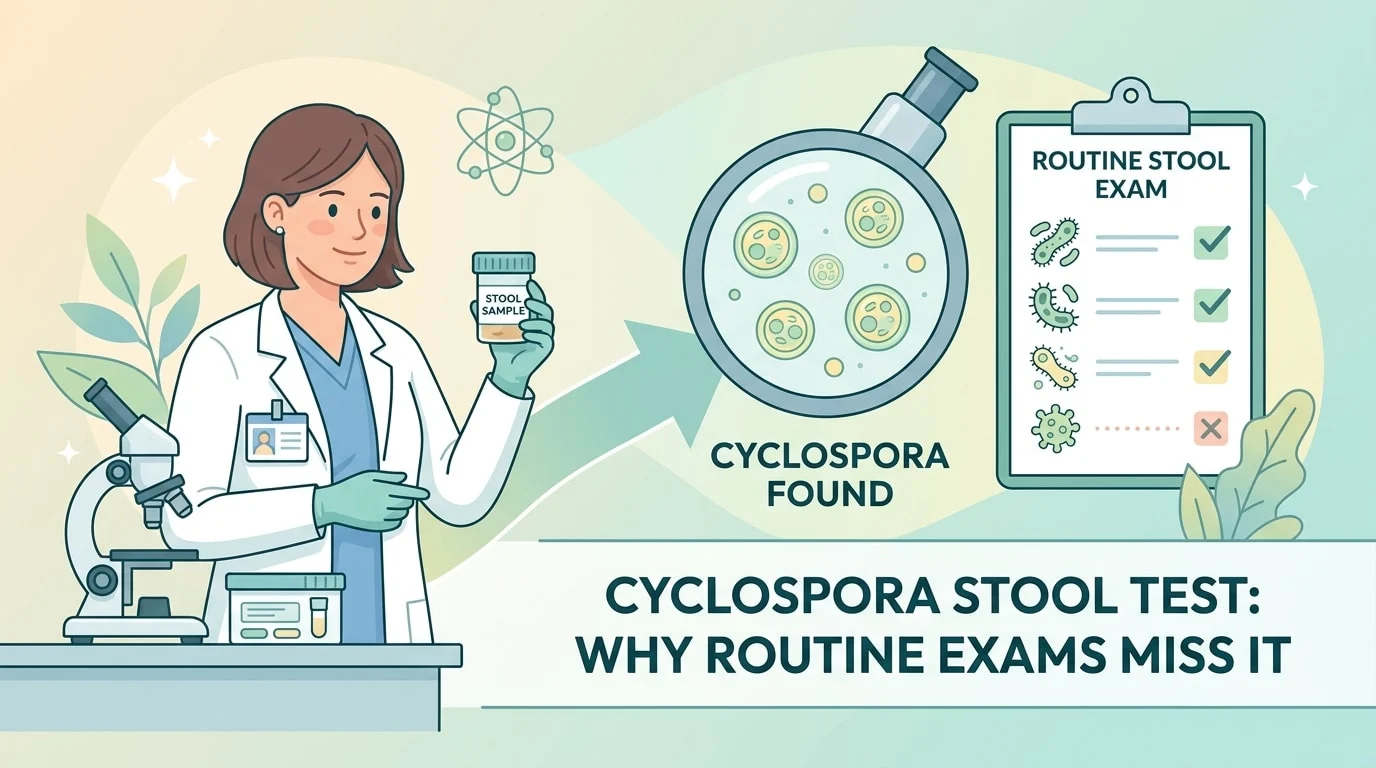
El examen de heces para Cyclospora no forma parte de un estudio coproparasitoscópico de rutina — y en el verano de 2026 esa omisión importa. Desde el 1 de mayo de 2026, los CDC han registrado 10,468 casos confirmados por laboratorio de ciclosporosis adquiridos dentro de Estados Unidos, en 47 estados, con 517 hospitalizaciones y 2 muertes. En el mismo período de 2025, el total nacional era de 249. El parásito responsable, Cyclospora cayetanensis, provoca diarrea acuosa que puede durar semanas y reaparecer después de parecer que ya se fue. El problema diagnóstico es que el examen de heces que la mayoría de los laboratorios realizan por defecto no lo detecta de forma confiable. En este artículo aprenderás por qué los estudios estándar no encuentran este parásito, qué prueba solicitar y cómo interpretar un reporte de heces que no coincide con cómo te sientes.
Lo que realmente dicen los números del brote de 2026
Los CDC cambiaron a actualizaciones de vigilancia semanales en 2026 porque el número de casos en varios estados está muy por encima del mismo período en 2025. Además de los 10,468 casos domésticos confirmados, la agencia está revisando más de 12,255 reportes adicionales que aún no han sido confirmados por laboratorio. Otros 1,341 casos confirmados fueron adquiridos durante viajes fuera del país.
Parte del aumento se relaciona con un brote multiestatal vinculado a lechuga iceberg rallada proveniente del centro de México, retirada del mercado por Taylor Farms el 17 de julio de 2026. Sin embargo, los CDC están investigando varios grupos de casos por separado y advierten que el total real es mayor al reportado, ya que muchas personas se recuperan sin consultar a un médico y nunca son estudiadas.
La temporada de ciclosporiasis en Estados Unidos va del 1 de mayo al 31 de agosto, y la fecha mediana de inicio de síntomas en 2026 hasta ahora es el 4 de julio. En otras palabras, estamos en plena temporada alta, y las decisiones sobre estudios de heces que se tomen ahora son las que realmente importan.
Por qué un examen rutinario de huevos y parásitos puede no detectar Cyclospora
Cuando se envía una muestra de heces por sospecha de parásitos, la mayoría de los laboratorios realizan primero el estudio de huevos y parásitos en heces. Un técnico examina la muestra al microscopio en busca de huevos y quistes de parásitos. Es una prueba de tamizaje general válida — pero Cyclospora es un punto ciego conocido.
Dos factores dificultan la detección. Primero, los ooquistes de Cyclospora —la forma similar a un huevo que el parásito elimina en las heces— aparecen de manera intermitente, por lo que una sola muestra tomada en un día de baja eliminación puede dar resultado negativo aunque la infección siga activa. Segundo, esos ooquistes no se distinguen fácilmente con las preparaciones que se usan en un examen general de huevos y parásitos; se necesita una tinción ácido-alcohol resistente específica (Ziehl-Neelsen modificada o Kinyoun) o fluorescencia ultravioleta para poder verlos.
Por eso, el aviso de salud de los CDC emitido el 14 de julio de 2026 indica a los médicos que soliciten específicamente la prueba de Cyclospora en las muestras de heces, en lugar de asumir que un examen estándar la incluye, y pide a los laboratorios que verifiquen que sus protocolos de heces contemplen un método específico para Cyclospora. El Manual Merck señala lo mismo respecto a la toma de muestras: pueden necesitarse tres o más muestras de heces, ya que la eliminación del parásito es intermitente.
Qué estudio de heces solicitar
| Prueba | Qué busca | Tiempo de entrega típico | Principal limitación |
|---|---|---|---|
| Examen rutinario de huevos y parásitos | Huevos y quistes de una amplia variedad de parásitos, al microscopio | 1 a 3 días | Puede no detectar Cyclospora; con frecuencia se necesitan muestras repetidas |
| Tinción ácido-resistente para Cyclospora | Ooquistes visibles mediante tinción modificada de Ziehl-Neelsen o Kinyoun | 1 a 3 días | Debe solicitarse por nombre; la eliminación es intermitente |
| Panel de PCR múltiple en heces | ADN del parásito, frecuentemente junto con bacterias y virus, en una sola prueba | Unas horas a 1 día | No todos los laboratorios la ofrecen; puede tener un costo mayor |
| Cultivo de heces | Bacterias como Salmonella o Campylobacter | 2 a 4 días | No detecta parásitos en absoluto |
Si tienes diarrea acuosa que lleva más de unos días este verano —con o sin viaje al extranjero— la solicitud práctica es sencilla. Pide que Cyclospora se mencione explícitamente en la orden de estudio, y pregunta si hay disponible un panel de PCR múltiple en heces en tu localidad.
Cuando tu resultado de heces no coincide con tus síntomas
Un resultado negativo para parásitos no cierra la conversación, especialmente durante un brote activo. Hay varias situaciones que merecen una segunda revisión con tu médico:
- Diarrea acuosa que dura más de tres días o que reaparece durante más de una semana.
- Síntomas que mejoran y luego regresan: el patrón recurrente típico de la ciclosporiasis.
- Pérdida de peso, falta de apetito o cansancio inusual junto con la diarrea.
- Solo se entregó una muestra de heces, y fue recolectada un día en que los síntomas eran leves.
- La orden de laboratorio decía “huevos y parásitos” y nunca mencionó Cyclospora.
Otros hallazgos en las heces apuntan en distintas direcciones. Los reportes a veces incluyen la prueba de calprotectina fecal, que mide la inflamación intestinal y no la infección. Otro dato a considerar es heces grasosas, que sugiere una absorción deficiente de grasas. Los médicos también registran consistencia de las heces para dar seguimiento a cómo evoluciona una enfermedad gastrointestinal, y puede solicitar un cultivo de heces para descartar causas bacterianas. Algunas personas también reportan puntos negros en las heces, que generalmente tiene una explicación mucho más común, y el ayuno prolongado por sí mismo puede provocar diarrea por ayuno.
Busca atención médica de inmediato, sin esperar, si estás embarazada, tienes más de 65 años, tomas medicamentos inmunosupresores, vives con VIH o cuidas a un niño pequeño con diarrea persistente. La deshidratación, más que el parásito en sí, es la razón más común por la que la ciclosporiasis lleva a una hospitalización.
Avances científicos recientes
Los métodos de laboratorio para detectar este parásito han avanzado rápidamente en los últimos tres años, y la tendencia se aleja del microscopio.
Lo que encontraron los investigadores: un panel de PCR múltiple automatizado —una sola prueba que busca en las heces el ADN de varios parásitos a la vez— detectó Cyclospora en todas las muestras positivas en un estudio de validación con 461 muestras de heces, y redujo el tiempo de procesamiento en el laboratorio aproximadamente siete horas por lote en comparación con la microscopía. Lo que esto significa para ti: donde este tipo de panel esté disponible, el resultado puede estar listo el mismo día, en lugar de esperar varios días de tinción y lectura de laminillas.
Una segunda evaluación comparó un panel molecular comercial diferente con la microscopía en 167 muestras de heces, y nuevamente encontró una detección de Cyclospora cercana al 100%. Un amplio estudio multicéntrico de un panel sindrómico de 17 blancos —que analiza bacterias, virus y parásitos al mismo tiempo en aproximadamente 80 minutos— reportó una concordancia sólida con los métodos de referencia en más de 2,800 muestras en Europa y Estados Unidos. Lo que esto significa para ti: una sola muestra puede responder cada vez más varias preguntas a la vez, lo cual es importante cuando la diarrea podría ser viral, bacteriana o parasitaria.
De cara al futuro, los investigadores han descrito métodos portátiles que no requieren un laboratorio completo: una prueba basada en CRISPR capaz de detectar tan solo 30 ooquistes por gramo de heces, y una prueba de amplificación con cambio de color orientada a la vigilancia de brotes y alimentos. Estos resultados aún son preliminares y no están en uso clínico de rutina, pero apuntan hacia pruebas que algún día podrían realizarse cerca del lugar donde ocurre un brote, en lugar de en un laboratorio de referencia lejano.
Una cosa no ha cambiado: el tratamiento. El trimetoprim-sulfametoxazol durante 7 a 10 días sigue siendo el tratamiento de elección, y la mayoría de las personas sanas se recuperan sin él, aunque la enfermedad puede prolongarse durante semanas.
Glosario
| Término | Definición |
|---|---|
| Cyclospora cayetanensis | El parásito unicelular microscópico que causa la ciclosporosis. Se transmite a través de alimentos o agua contaminados, no directamente de persona a persona. |
| Ciclosporiasis | La enfermedad intestinal causada por Cyclospora, caracterizada por diarrea acuosa que puede reaparecer. |
| Ooquiste | La etapa similar a un huevo del parásito que se elimina en las heces. Necesita días o semanas en el ambiente antes de poder infectar a alguien. |
| Examen de huevos y parásitos | Un examen microscópico de heces que busca huevos y quistes de parásitos. Frecuentemente se abrevia como O y P. |
| Tinción ácido-resistente | Una técnica de tinción que hace visibles ciertos parásitos, incluida la Cyclospora, bajo el microscopio. |
| PCR múltiple | Una prueba que busca el ADN de varios gérmenes distintos en una sola corrida con una misma muestra. |
| Panel sindrómico | Una prueba agrupada que detecta las bacterias, virus y parásitos que producen síntomas similares. |
| Tiempo de entrega de resultados | El tiempo que transcurre entre que el laboratorio recibe una muestra y entrega el resultado. |
| Recaída | El regreso de los síntomas después de un período de mejoría. |
| Caso confirmado por laboratorio | Una enfermedad confirmada mediante una prueba de laboratorio positiva, y no solo por los síntomas. |
Preguntas frecuentes
¿Un examen de heces estándar detecta la Cyclospora?
No de manera confiable. Un examen rutinario de huevos y parásitos revisa las heces en busca de una amplia variedad de huevos y quistes de parásitos, pero los ooquistes de Cyclospora requieren una tinción ácido-resistente específica o fluorescencia ultravioleta para poder verse. Por eso, los CDC recomiendan a los médicos que indiquen explícitamente Cyclospora en la orden, y a los laboratorios que confirmen que sus protocolos para heces incluyen un método capaz de detectarla. Un panel molecular que busca ADN de parásitos es otra opción.
¿Cuántas muestras de heces debo dar?
Pueden necesitarse tres o más muestras, recolectadas en días distintos. El parásito se elimina de forma intermitente, por lo que una muestra tomada en un día de baja eliminación puede dar negativo aunque la infección continúe. Si tu laboratorio te entrega un kit de recolección de varios días, usarlo tal como se indica realmente aumenta las posibilidades de obtener una respuesta clara.
¿Cuánto tiempo duran los síntomas?
Los síntomas suelen comenzar aproximadamente una semana después de la exposición, aunque el rango va de 2 a 14 días. Sin tratamiento, la enfermedad puede durar desde unos pocos días hasta un mes o más, y puede parecer que se resuelve para luego regresar una o más veces. La mayoría de las personas con un sistema inmunológico sano se recuperan solas, aunque esa recuperación puede ser lenta.
¿Puedo contagiarme de Cyclospora de alguien en mi casa?
La transmisión directa de persona a persona es muy poco probable. Los ooquistes eliminados en las heces aún no son infecciosos y necesitan días o semanas en el ambiente antes de poder infectar a alguien. La infección casi siempre proviene de frutas y verduras frescas o agua contaminadas, razón por la cual las investigaciones de brotes se enfocan en la cadena alimentaria.
¿Las frutas y verduras frescas siguen siendo un riesgo?
Lavar los productos frescos bajo agua limpia corriente sigue siendo una medida sensata, pero la FDA es clara en que enjuagarlos puede no eliminar este parásito de forma confiable, y que los desinfectantes a base de cloro no lo matan. Cocinar a al menos 70 grados Celsius sí lo hace. Desechar las hojas externas de las verduras de hoja es un paso adicional razonable durante la temporada de brotes, incluyendo los productos prelavados en bolsa.
¿Qué descarta realmente un resultado negativo?
Descarta lo que el laboratorio buscó, en la muestra que recibió, el día en que fue recolectada, y nada más. Si la orden no indicó Cyclospora, un resultado negativo no dice nada sobre este parásito. Llevar el resultado a tu médico junto con las fechas de tus síntomas es la forma más rápida de decidir si vale la pena tomar otra muestra o hacer una prueba diferente.
Fuentes
- Centros para el Control y la Prevención de Enfermedades — Casos de ciclosporiasis adquirida en el país en múltiples estados de EE. UU., 2026, Red de Alertas de Salud CDCHAN-00531, 14 de julio de 2026 — cdc.gov
- Centros para el Control y la Prevención de Enfermedades — Vigilancia de la ciclosporiasis, actualizado el 4 de agosto de 2026 — cdc.gov
- U.S. Food and Drug Administration — Cyclospora, Foodborne Pathogens, actualizado el 16 de julio de 2026 — fda.gov
- Marie C, Petri WA — Ciclosporiasis — Edición Profesional del Manual Merck, revisado en mayo de 2024 — merckmanuals.com
- Lau R et al. — Validation of an Automated High-Throughput Multiplex Real-Time PCR Assay for Detection of Enteric Protozoa — Hygiene, 2025 — leer el estudio
- Chauvin P et al. — Evaluation of the Performance of the Novodiag Stool Parasites Assay for the Detection of Intestinal Protozoa and Microsporidia — Pathogens, 2023 — leer el estudio
- Szymczak WA et al. — Multicenter evaluation of the QIAstat-Dx Gastrointestinal Panel 2, a multiplex PCR platform for the diagnosis of acute gastroenteritis — Journal of Clinical Microbiology, 2025 — doi.org/10.1128/jcm.01983-24
- Qin Z et al. — Development of a field-deployable RPA-CRISPR/Cas12a assay for the detection of Cyclospora cayetanensis in human feces — Parasites and Vectors, 2025 — doi.org/10.1186/s13071-025-07150-x
- Meymandy M et al. — Development of a loop-mediated isothermal amplification (LAMP) assay for the detection of Cyclospora cayetanensis — Food and Waterborne Parasitology, 2026 — leer el estudio
Lecturas recomendadas
- Examen de huevos y parásitos: cómo funciona y qué significan los resultados
- Cultivo de heces: qué detecta y qué significan los resultados
- Resultados de la prueba de calprotectina fecal: qué indican tus niveles
- Paneles de sangre completos: ¿de verdad los necesitas?
- Diarrea durante el período: por qué ocurre y cuándo consultar al médico
Entiende tus resultados de laboratorio con AI DiagMe
Un reporte de heces lleno de nombres de estudios, abreviaturas y resultados negativos rara vez explica qué fue lo que realmente se buscó, que es justo la pregunta clave durante un brote como este. AI DiagMe lee tus resultados y los traduce a un lenguaje claro y sencillo, ya sea que el reporte incluya un examen coproparasitoscópico, un cultivo de heces, un nivel de calprotectina fecal o una biometría hemática (BH) tomada al mismo tiempo. Te ayuda a entender qué dicen tus resultados y qué preguntas hacerle a tu médico. No hace diagnósticos ni reemplaza a tu médico.
Obtén la lectura de tus resultados en minutos