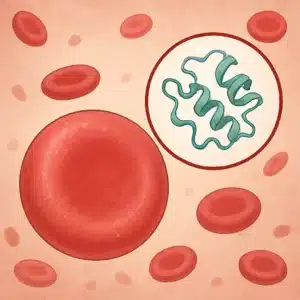




La prueba de procalcitonina mide una proteína en tu sangre, llamada procalcitonina (PCT), que sube rápidamente cuando tu cuerpo combate una infección bacteriana grave. Como los niveles suelen mantenerse bajos durante enfermedades virales, los médicos usan este marcador para evaluar qué tan probable es una infección bacteriana, detectar sepsis a tiempo y decidir cuándo es seguro iniciar o suspender antibióticos. Si has visto PCT en un resultado de laboratorio, puede ser difícil entender qué significa ese número. En este artículo aprenderás qué mide la prueba de procalcitonina, qué pueden indicar los niveles normales y elevados de PCT, cómo se compara este marcador con la proteína C reactiva y cuándo conviene hablar con tu médico sobre un resultado.
¿Qué es la procalcitonina y qué mide esta prueba?
La procalcitonina, conocida frecuentemente como PCT, es una proteína que tu cuerpo produce como precursor de una hormona llamada calcitonina. En condiciones normales, solo circula una cantidad muy pequeña en tu sangre, por lo que los niveles se mantienen muy bajos. Durante una infección bacteriana grave, muchos tejidos comienzan a liberar procalcitonina al mismo tiempo, y la cantidad en tu sangre puede subir de forma notable en cuestión de horas.
La prueba de procalcitonina es un análisis de sangre sencillo. Una enfermera o técnico de laboratorio toma una pequeña muestra de una vena en tu brazo, y el laboratorio mide cuánta procalcitonina hay, expresando el resultado en nanogramos por mililitro (ng/mL). No necesitas estar en ayuno ni hacer ninguna preparación especial.
De dónde viene la procalcitonina
Normalmente, células especializadas de la glándula tiroides producen procalcitonina y la convierten rápidamente en calcitonina, que ayuda a regular el calcio. Su nombre proviene de esa hormona, y puedes conocer más sobre este marcador tiroideo en la guía sobre la prueba de calcitonina en sangre. Cuando una infección bacteriana se generaliza, las toxinas y las señales inflamatorias llevan a otros órganos a liberar procalcitonina sin convertirla en la hormona, por eso los niveles en sangre aumentan.
Qué busca la prueba de procalcitonina
La prueba no identifica un germen específico ni localiza exactamente dónde está la infección. En cambio, le da a tu equipo médico un número que refleja qué tan intensa es la respuesta de tu cuerpo, de una manera característica de las infecciones bacterianas. Los médicos interpretan ese número junto con tus síntomas, la exploración física y tus otros resultados, no de forma aislada. Como los niveles pueden medirse en pocas horas, esta prueba es muy útil en situaciones que evolucionan rápido, donde contar con una pista rápida sobre una posible infección es muy valioso.
Por qué tu médico puede pedir una prueba de procalcitonina
Un examen de procalcitonina es más útil cuando el médico necesita saber si una infección bacteriana está causando tu enfermedad y qué tan grave puede ser. Se usa con mayor frecuencia en urgencias y hospitales, especialmente en cuidados intensivos y en infecciones de las vías respiratorias bajas, como la neumonía sospechada. No es un estudio de detección de rutina para personas que se sienten bien.
Distinguir una infección bacteriana de una viral
Las enfermedades virales, como la mayoría de los resfriados, la gripe y muchas infecciones del pecho, generalmente mantienen la procalcitonina baja, porque las señales del sistema inmune que combaten los virus tienden a mantenerla en niveles bajos. Un nivel más alto inclina la balanza hacia las bacterias. Esto es una probabilidad, no una certeza, por lo que los médicos suelen compararlo con el marcador de inflamación proteína C reactiva (PCR) y otros hallazgos antes de decidir el tratamiento.
Detectar y monitorear la sepsis
La sepsis es la respuesta extrema y potencialmente mortal del cuerpo ante una infección. Como la procalcitonina sube rápidamente con una infección bacteriana generalizada, un nivel alto o en aumento puede apoyar el diagnóstico temprano de sepsis e indicar qué tan grave puede ser la enfermedad. Los médicos también pueden solicitarla cuando evalúan las señales de alerta de meningitis bacteriana y otras infecciones graves.
Orientar las decisiones sobre antibióticos
Uno de los papeles más importantes de la procalcitonina es ayudar a los equipos hospitalarios a decidir cuándo se pueden iniciar los antibióticos de forma segura y, lo que es igual de importante, cuándo se pueden suspender. Si los niveles bajan a medida que te recuperas, esa tendencia puede respaldar terminar el tratamiento antes. Este uso cuidadoso de los antibióticos, conocido como uso racional de antibióticos, ayuda a reducir los efectos secundarios y frena el aumento de bacterias resistentes a los medicamentos.
Cómo interpretar los resultados de tu examen de procalcitonina
Los resultados se agrupan en rangos amplios, cada uno de los cuales sugiere qué tan probable es una infección bacteriana generalizada. La tabla a continuación muestra una guía general para adultos. No es un diagnóstico, y el mismo número puede significar cosas distintas según tu situación. Si las abreviaturas del laboratorio te resultan confusas, puedes consultar nuestra guía para leer tus resultados de laboratorio.
| Nivel de procalcitonina (ng/mL) | Interpretación general en adultos |
|---|---|
| Por debajo de 0.1 | Es poco probable que se trate de una infección bacteriana generalizada; es más probable una causa viral o la ausencia de infección. |
| 0.1 a 0.5 | Una zona gris; es posible una infección bacteriana local o temprana, por lo que el resultado se interpreta junto con tus síntomas. |
| 0.5 a 2 | Una infección bacteriana sistémica se vuelve más probable y generalmente requiere una revisión más detallada. |
| 2 a 10 | Un resultado alto que apunta hacia una infección bacteriana significativa y en expansión. |
| Por encima de 10 | Un resultado muy alto que se observa con frecuencia en casos de sepsis grave o choque séptico en pacientes hospitalizados. |
Estas bandas son guías generales que se usan principalmente en el ámbito hospitalario. Los valores de corte y rangos de referencia exactos varían según el laboratorio, el método de análisis, la edad y el contexto clínico, por lo que tu propio reporte de laboratorio y tu equipo médico siempre tienen prioridad sobre cualquier tabla en línea. Para entender cómo se construyen los rangos en general, puedes conocer los típicos valores normales en estudios de laboratorio.
Cómo es un nivel normal de procalcitonina
Muchos laboratorios consideran bajo un valor por debajo de aproximadamente 0.1 ng/mL, lo que significa que una infección bacteriana sistémica es poco probable. Un resultado bajo es tranquilizador, pero no descarta completamente una infección, especialmente en etapas tempranas o cuando la infección se limita a una zona pequeña. Si los síntomas continúan, tu médico puede repetir el estudio o investigar más, ya que una sola medición refleja únicamente un momento en el tiempo.
Qué puede significar un nivel alto de procalcitonina
Un valor más alto aumenta la probabilidad de una infección bacteriana significativa y, en los niveles más elevados, de sepsis. Aun así, un nivel alto es una señal para investigar más de cerca, no un diagnóstico automático, ya que varias situaciones no infecciosas también pueden elevarlo. Un número fuera del rango rara vez cuenta toda la historia, algo que explicamos con detalle en la guía sobre resultados de laboratorio anormales.
Por qué la tendencia suele importar más que un solo valor
En el hospital, los médicos suelen medir la procalcitonina más de una vez. Un nivel que sigue subiendo puede indicar que la infección está avanzando, mientras que un nivel que baja día a día generalmente es señal de que el tratamiento está funcionando. Este patrón de cambio, más que cualquier cifra aislada, es lo que con frecuencia guía las decisiones sobre continuar o suspender los antibióticos.
Procalcitonina vs PCR: cómo se comparan estos dos marcadores
La procalcitonina y la proteína C reactiva (PCR) son dos marcadores en sangre que aumentan con la inflamación, pero se comportan de manera diferente. La procalcitonina es más específica de infección bacteriana y sube más rápido, mientras que la PCR reacciona ante una amplia variedad de problemas. El cuerpo produce varias de estas proteínas de fase aguda durante una infección, incluyendo el marcador de inflamación amiloide A sérico (SAA). Para tener una visión más completa, tu médico también puede solicitar marcador de inflamación velocidad de sedimentación globular (VSG), una prueba más antigua y más lenta.
| Característica | Procalcitonina (PCT) | Proteína C reactiva (PCR) |
|---|---|---|
| Qué detecta | Sube principalmente con infección bacteriana | Sube con casi cualquier inflamación, lesión o infección |
| Qué tan rápido sube | En aproximadamente 3 a 6 horas | En aproximadamente 12 a 24 horas |
| ¿Específica de bacterias? | Más específica para infección bacteriana | Menos específica, con muchas causas posibles |
| Uso frecuente | Ayuda a evaluar la sepsis y orientar el uso de antibióticos | Monitorea la inflamación general a lo largo del tiempo |
| Disponibilidad y costo | Más especializada, generalmente en el ámbito hospitalario | Ampliamente disponible y de bajo costo |
Como la PCR es más económica y está ampliamente disponible, suele ser el primer marcador que se solicita. Puedes conocer más sobre las causas y síntomas de niveles altos de PCR por separado. La procalcitonina aporta valor cuando la pregunta clave es si una infección bacteriana es lo suficientemente grave como para necesitar antibióticos o para seguir tomándolos. En la práctica, ambos estudios responden preguntas ligeramente distintas, por eso los equipos médicos a veces usan los dos.
Qué puede elevar o bajar la procalcitonina además de una infección
La procalcitonina es útil, pero no es perfecta. Hay varias situaciones que pueden hacer que suba o baje por razones que tienen poco que ver con una infección bacteriana simple, por eso el contexto importa tanto al interpretar un resultado.
Causas de una procalcitonina elevada
Los niveles pueden subir después de una cirugía mayor, un traumatismo grave, quemaduras severas o un período de flujo sanguíneo muy bajo, como en el choque cardiogénico. Los recién nacidos presentan de forma natural niveles más altos de procalcitonina durante sus primeros días de vida. Algunos tipos de cáncer, como el cáncer medular de tiroides y el cáncer de pulmón de células pequeñas, así como ciertos tratamientos intensivos, también pueden elevarla. En estos casos, un valor alto refleja un estrés importante en todo el organismo, no necesariamente una infección.
Razones por las que el nivel puede mantenerse bajo
La procalcitonina puede mantenerse cerca de lo normal incluso con una infección bacteriana real cuando la infección se detecta muy temprano, antes de que el marcador haya tenido tiempo de subir, o cuando está localizada en un solo punto, como un absceso pequeño. Esta es una razón clave por la que un resultado bajo nunca descarta completamente una infección. Tu equipo médico lo evalúa junto con tus glóbulos blancos y tus síntomas, así que puedes revisar tus glóbulos blancos en una reporte de biometría hemática (BH), y muchos pacientes también revisan las causas de conteos elevados de neutrófilos.
El papel de la función renal
Como la procalcitonina se elimina en parte a través de los riñones, una función renal reducida puede elevar un poco los niveles sin que haya una infección adicional. Los médicos toman esto en cuenta al interpretar resultados en el límite en personas con enfermedad renal, y es otra razón por la que el número se evalúa en contexto y no como un umbral fijo.
Qué no puede decirte un estudio de procalcitonina
Tener expectativas claras te ayuda a entender mejor tu reporte. Un estudio de procalcitonina no puede confirmar exactamente qué bacteria es la responsable, dónde está ubicada la infección ni si un antibiótico en particular va a funcionar; esas preguntas requieren cultivos, estudios de imagen y criterio clínico. Tampoco puede, por sí solo, demostrar que tienes o no tienes una infección.
En cambio, piensa en la procalcitonina como una pista informativa entre varias. Sus ventajas son la rapidez y una fuerte inclinación hacia la infección bacteriana, lo que la hace valiosa en urgencias. Sus limitaciones significan que siempre se combina con tu historial, tu exploración física y otros estudios antes de tomar cualquier decisión. Leído de esta manera, el número se vuelve genuinamente útil en lugar de confuso.
Últimos avances científicos en las pruebas de procalcitonina
Las investigaciones de los últimos años han afinado la forma en que los médicos utilizan la procalcitonina, especialmente para decidir cuánto tiempo deben durar los antibióticos. Esto es lo que los estudios recientes sugieren, en términos sencillos.
Tratamientos con antibióticos más cortos y seguros
En un amplio ensayo hospitalario realizado en 2025 en unidades de cuidados intensivos del Reino Unido, conocido como ADAPT-Sepsis, revisar la procalcitonina cada día y seguir un protocolo establecido permitió a los médicos suspender los antibióticos un poco antes de lo habitual, sin aumentar el riesgo de muerte. Revisar la PCR de la misma manera no acortó el tratamiento. Lo que esto significa para ti: en el hospital, la tendencia de la procalcitonina puede ser una de las herramientas que ayuden a tu equipo médico a evitar que sigas con antibióticos más tiempo del necesario.
La evidencia acumulada apunta en la misma dirección
Una revisión de 2023 que combinó 26 ensayos aleatorizados —es decir, estudios en los que los pacientes son asignados al azar a un enfoque u otro— llegó a una conclusión similar. El manejo guiado por procalcitonina tendió a acortar los ciclos de antibióticos y se asoció con una mejor supervivencia, aunque un pequeño número de pacientes necesitó un ciclo adicional. Lo que esto significa para ti: este marcador funciona mejor como parte de un plan que tu equipo médico sigue durante varios días, no como una medición aislada.
Una visión equilibrada de sus limitaciones
No todos los expertos consideran la procalcitonina como un avance decisivo. Un análisis de 2026 señaló que el beneficio adicional puede ser modesto, que solo ayuda cuando los equipos realmente siguen el protocolo, y que a medida que los ciclos cortos y fijos de antibióticos se vuelven estándar, la procalcitonina puede aportar menos. Los investigadores también son cautelosos en no sobreestimar ningún marcador único para predecir cómo evolucionará una infección grave; una revisión de 2025 encontró que las puntuaciones de función orgánica y el lactato en sangre pueden predecir los desenlaces de la sepsis al menos tan bien como la procalcitonina. Lo que esto significa para ti: la procalcitonina apoya la toma de buenas decisiones, pero tu equipo médico sigue evaluando el panorama completo, no solo un dato aislado.
Cuándo consultar a un médico por tu resultado de procalcitonina
Un nivel de procalcitonina casi siempre es solicitado e interpretado por un equipo médico, generalmente mientras ya te están evaluando por una infección. Aun así, es útil saber qué situaciones requieren atención inmediata.
- Tienes fiebre alta, escalofríos con temblores o una fiebre que sigue subiendo a pesar del tratamiento.
- Te sientes confundido, con mucho sueño inusual o de repente muy mal.
- Estás respirando rápido, tu corazón late acelerado, o tu piel se ve moteada o grisácea.
- Tienes una infección conocida que empeora en lugar de mejorar después de iniciar el tratamiento.
- El reporte de laboratorio muestra una procalcitonina alta o en aumento y aún no has hablado con un médico.
Estas señales pueden indicar una infección grave que afecta todo el cuerpo y requiere atención urgente. Si tienes dudas, contacta a un profesional de la salud o busca ayuda de emergencia en lugar de esperar a repetir el estudio.
Glosario de términos sobre procalcitonina
| Término | Definición |
|---|---|
| Procalcitonina (PCT) | Proteína que aumenta en la sangre principalmente durante una infección bacteriana grave; se utiliza como marcador de infección. |
| Biomarcador | Una sustancia medible en el cuerpo, como una proteína en la sangre, que da indicios sobre la salud o una enfermedad. |
| Sepsis | La respuesta extrema y potencialmente mortal del cuerpo ante una infección, que puede provocar daño en los órganos. |
| Uso racional de antibióticos | El uso cuidadoso de los antibióticos, administrándolos solo cuando son necesarios y por el tiempo adecuado, para reducir efectos secundarios y resistencia. |
| Proteína C reactiva (PCR) | Una proteína producida por el hígado que aumenta con muchos tipos de inflamación; menos específica para bacterias que la procalcitonina. |
| Proteína de fase aguda | Una proteína cuyos niveles en sangre cambian rápidamente en respuesta a inflamación, infección o lesión. |
| Rango de referencia | El rango de valores considerados típicos en una población sana, que se usa para clasificar los resultados como bajos, normales o altos. |
| Nanogramos por mililitro (ng/mL) | La unidad que se usa para reportar la procalcitonina, que describe una cantidad muy pequeña de la proteína en un volumen determinado de sangre. |
Preguntas frecuentes sobre el estudio de procalcitonina
¿Necesito estar en ayuno para el estudio de procalcitonina?
No. El estudio de procalcitonina es una toma de sangre estándar que no requiere ayuno ni preparación especial. Por lo general puedes comer, beber y tomar tus medicamentos habituales con normalidad, a menos que tu médico te indique lo contrario, a veces porque se tomarán otras muestras al mismo tiempo. Si tienes dudas, pregunta en el consultorio o laboratorio que ordenó el estudio.
¿Qué significa tener un nivel alto de procalcitonina?
Un nivel elevado aumenta la probabilidad de que una infección bacteriana se haya extendido por el cuerpo, y valores muy altos pueden apuntar hacia sepsis. Por sí solo no es un diagnóstico. Las cirugías mayores, lesiones graves, quemaduras, los primeros días de vida de un recién nacido y algunos tipos de cáncer también pueden elevar la procalcitonina, por lo que los médicos interpretan el resultado junto con tus síntomas y otros estudios antes de sacar conclusiones.
¿El estudio de procalcitonina puede distinguir una infección bacteriana de una viral?
Puede ayudar, pero no con certeza absoluta. Las infecciones bacterianas tienden a elevar la procalcitonina, mientras que las virales generalmente la mantienen baja, lo que hace que este estudio sea una pista útil para distinguir entre ambas, especialmente en enfermedades graves. Algunas infecciones bacterianas mantienen el nivel bajo, y ciertas condiciones no infecciosas pueden elevarlo, por lo que el resultado orienta la decisión en lugar de definirla.
¿El rango normal de procalcitonina es el mismo para recién nacidos y niños?
No siempre. Los recién nacidos sanos presentan de forma natural niveles más altos de procalcitonina durante sus primeros dos o tres días de vida, por lo que los laboratorios utilizan valores de referencia específicos por edad para los más pequeños. En niños mayores y adultos, los umbrales generales son bastante similares. Como con cualquier resultado, los valores de referencia de tu laboratorio y el médico de tu hijo son quienes guían la interpretación.
¿Los medicamentos u otras condiciones pueden alterar mi resultado de procalcitonina?
Sí. Más allá de la infección bacteriana, situaciones como cirugías mayores, traumatismos, quemaduras graves, choque prolongado y algunos tipos de cáncer pueden elevar la procalcitonina. Ciertos tratamientos basados en el sistema inmunológico también pueden aumentarla, y una función renal reducida puede influir en el nivel. Por eso, un solo número se interpreta en contexto y no como una respuesta definitiva sobre si tienes una infección.
¿Qué tan rápido cambia la procalcitonina después de iniciar el tratamiento?
La procalcitonina responde con relativa rapidez. Puede elevarse en aproximadamente tres a seis horas desde que una infección bacteriana grave se establece, y tiende a bajar en alrededor de un día a medida que la infección se controla. Esa respuesta rápida es la razón por la que los equipos hospitalarios a veces la miden más de una vez, observando la tendencia para evaluar si el tratamiento está funcionando.
Fuentes
- MedlinePlus, Biblioteca Nacional de Medicina de EE. UU., Prueba de Procalcitonina, medlineplus.gov
- Mayo Clinic Laboratories, Procalcitonina, Suero (descripción general del estudio), mayocliniclabs.com
- Cleveland Clinic Laboratories, Procalcitonina, clevelandcliniclabs.com
- Dark P y colaboradores, Biomarker-Guided Antibiotic Duration for Hospitalized Patients With Suspected Sepsis: The ADAPT-Sepsis Randomized Clinical Trial, JAMA, 2025, doi.org/10.1001/jama.2024.26458
- Papp M y colaboradores, La terapia antibiótica guiada por procalcitonina puede acortar la duración del tratamiento y mejorar la supervivencia: una revisión sistemática y metaanálisis, Critical Care, 2023, doi.org/10.1186/s13054-023-04677-2
- Gupta S, Klompas M, Rhee C, Reassessing Procalcitonin-Guided Antibiotic Therapy in Critically Ill Patients With Sepsis: Lessons From the ADAPT-Sepsis Trial, Clinical Infectious Diseases, 2026, doi.org/10.1093/cid/ciaf336
- Lu J y colaboradores, Predictive value of SOFA, PCT, Lactate, qSOFA and their combinations for mortality in patients with sepsis: a systematic review and meta-analysis, PLoS One, 2025, doi.org/10.1371/journal.pone.0332525
Lecturas recomendadas
- Proteína C reactiva (PCR): qué es y qué indica este marcador de inflamación
- Velocidad de sedimentación globular (VSG): qué indica este marcador
- Biometría hemática (BH): cómo leer tus resultados
- Neutrófilos altos: qué puede revelar un conteo elevado
- Cómo leer tus resultados de análisis de sangre
Entiende tus resultados de laboratorio con AI DiagMe
Un resultado de procalcitonina casi nunca se interpreta solo. Tiene más sentido cuando se analiza junto con otros marcadores como la proteína C reactiva, el conteo de glóbulos blancos y el lactato en sangre, todos leídos en conjunto con tus síntomas. AI DiagMe te ayuda a entender qué significan estos valores de laboratorio en un lenguaje claro y sencillo, para que llegues a tu próxima consulta con preguntas más concretas y mejor informadas. Es una herramienta de apoyo para comprender tus resultados y no diagnostica ni reemplaza a tu médico.
Obtén la lectura de tus resultados en minutos