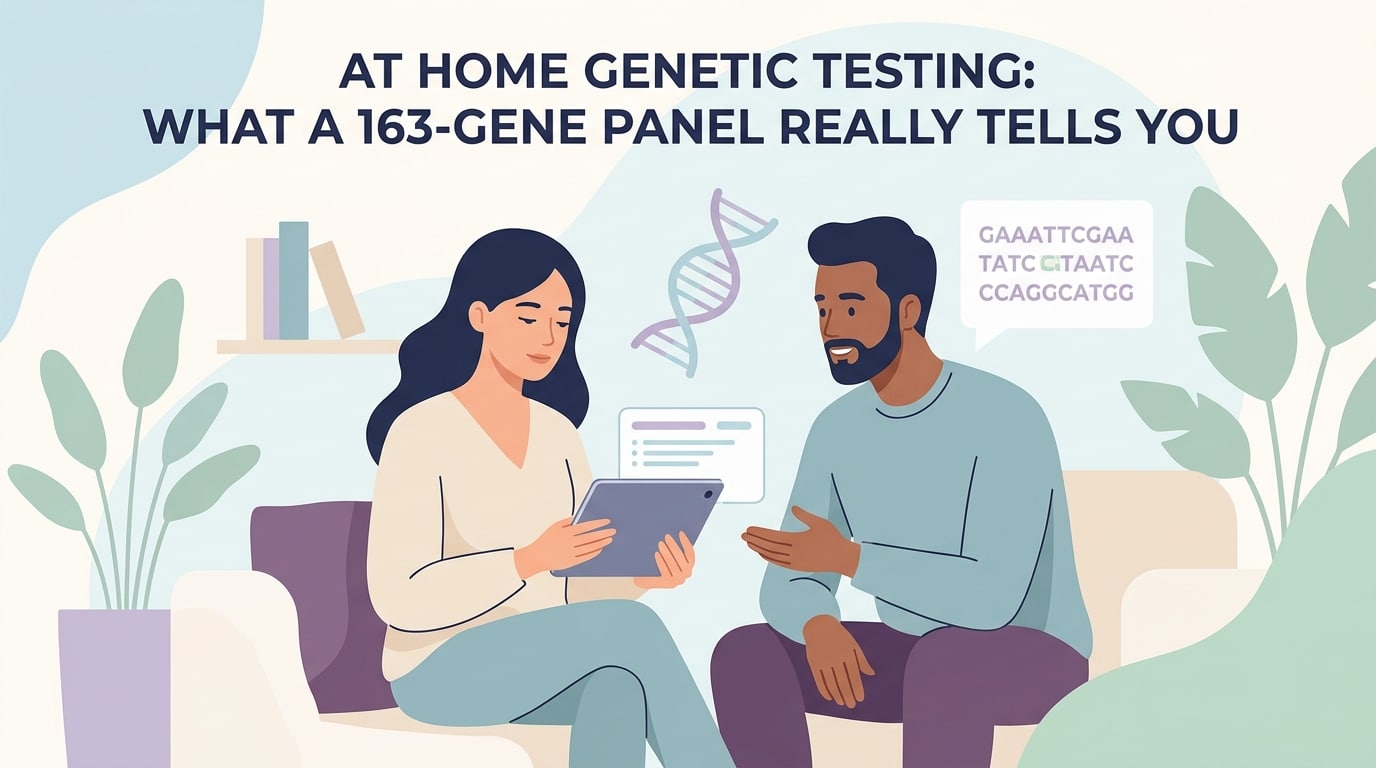
At home genetic testing took a visible step forward on August 3, 2026, when a large United States laboratory network opened a 163-gene health panel to consumers, with a blood draw at a local collection site and a licensed genetic counselor included. The offer is no longer about ancestry or curiosity. It targets inherited risks that clinicians can act on, across cancer, heart and metabolic conditions. That raises the practical question this article answers: once a panel flags an inherited risk, what happens next, and which ordinary laboratory tests actually follow that risk over the years? In this article you will learn what the new panel covers, where its limits sit, how a gene result connects to routine blood work, and what recent research shows.
What changed on August 3, 2026
The Marker by Labcorp Genetic Health Panel became available to consumers on August 3, 2026, after being announced on July 27. It analyses 163 genes tied to more than 100 conditions the company describes as medically actionable, meaning that knowing about them can change monitoring or prevention.
Two details set it apart from the saliva kits most people picture. The sample is a professional blood draw at one of more than 2,200 patient service centres, not a mail-in tube. And every purchase includes access to a licensed genetic counsellor, a professional trained to explain what a variant does and does not mean. The company states plainly that results are not diagnostic and must be read alongside personal and family history.
That framing matters, because it moves at home genetic testing closer to clinical genetics without becoming it. The panel can open a conversation. It does not close one.
What a 163-gene panel measures, and what it leaves out
A panel of this kind looks for pathogenic variants in a defined list of genes. Three well-established groups sit at the centre of that list, and the US Centers for Disease Control and Prevention groups them together as tier 1 conditions because the evidence supporting action is strongest: hereditary breast and ovarian cancer linked to BRCA1 and BRCA2, Lynch syndrome, and familial hypercholesterolemia. Together these affect a large number of adults who have no idea they carry a variant.
The limits are just as important. A panel reads a defined list, so a reassuring result never rules out every variant that could matter. Risk also depends on family history, environment and habits, not on the gene alone. And a positive finding on a consumer test is normally confirmed by a clinical laboratory before it changes any medical decision. Different companies test different variant sets, which is why two reports can disagree about the same condition.
There is one more practical limit. A gene tells you about predisposition, which is a lifelong statistical tilt. It does not tell you what your body is doing this year. That job belongs to ordinary laboratory work.
From a gene result to a blood test you can actually track
This is the part that rarely appears on a consumer report, and it is the most useful. An inherited finding usually comes with a monitoring plan, and much of that plan runs through tests you can already read. The table below maps the three tier 1 conditions plus hereditary hemochromatosis onto the follow-up that clinicians typically use.
| Inherited finding | What it raises the risk of | Typical follow-up, including laboratory tests |
|---|---|---|
| Familial hypercholesterolemia (LDLR, APOB, PCSK9) | Heart attack and stroke at an unusually early age | Repeated lipid testing, LDL cholesterol targets, ApoB, lipoprotein(a), and lipid-lowering treatment when indicated |
| Hereditary breast and ovarian cancer (BRCA1, BRCA2) | Breast, ovarian and some prostate cancers | Earlier and more frequent imaging; blood markers such as CA 125 and PSA are used in selected follow-up, never as a stand-alone screen |
| Lynch syndrome (mismatch repair genes) | Colorectal, endometrial and other cancers | Colonoscopy on a shortened schedule; stool and blood tests support monitoring but do not replace it |
| Hereditary hemochromatosis (HFE) | Iron building up in the liver, heart and joints | Ferritin and transferrin saturation checked regularly, with blood removal when iron rises |
Read that table from left to right and the point becomes clear. The gene is a one-off result. The right-hand column is what you will see on a laboratory report for the rest of your life. For the cardiovascular line, a routine draw already reports a standard perfil lipídico, and our guide sets out healthy LDL cholesterol ranges. Clinicians increasingly add the Análisis de sangre ApoB, and a 2026 United States guideline now recommends universal el cribado de lipoproteína(a).
For iron, doctors order an panel de estudios sobre el hierro, and our articles explain altos niveles de ferritina y tratamientos de la hemocromatosis. On the cancer side, our guide covers the CA 125 blood marker, and regulators have cleared a colon cancer blood test that adds an option for people who avoid colonoscopy. If any of this is new, start with the basics of lectura de los resultados de los análisis de sangre.
Últimos avances científicos
Research over the past three years has tested a simple idea: does screening healthy people for these genes actually improve anything? The answer is encouraging but conditional.
A 2023 modelling study in Annals of Internal Medicine asked whether screening the general adult population for the three tier 1 conditions is worth the cost. It found that screening younger adults, roughly under 40, is likely to be a reasonable use of health resources, but only if the test is inexpensive and if people who test positive can actually get preventive care. What this means for you: the value of a genetic result is created after the result, not by the result.
A 2025 study in Circulation: Genomic and Precision Medicine put that to the test in real life. Researchers screened more than 228,000 adults across nine US health systems and found roughly one person in 200 carrying a familial hypercholesterolemia variant. Around five in six of them had never been diagnosed with the condition. Among those whose treatment was adjusted after the result, LDL cholesterol fell substantially, far more than in people whose treatment stayed the same. In plain terms, the genetic finding only helped when it reached the medical record and changed a prescription.
On the consumer side, two 2025 reviews strike a cautious note. A review in NEJM Evidence describes the recurring difficulty clinicians face in interpreting consumer reports, and a scientific statement from the American Heart Association concludes that if this information is used in care, its limits must be assessed, the result placed in the person’s own context, and any potentially actionable single-gene finding corroborated with clinical testing. A broader 2023 review adds that in the United States, health-related consumer tests are not recognised for diagnostic purposes. These are expert consensus documents rather than trials, so they describe good practice rather than settled outcomes.
When to talk to a healthcare professional
A genetic report is not an emergency, and nothing on it needs to be acted on the same day. Some situations do deserve a prompt appointment.
- A consumer panel reports a pathogenic variant in a gene linked to cancer or heart disease, since confirmation by a clinical laboratory comes first.
- Close relatives had cancer, a heart attack or a stroke unusually young, even if your panel looked reassuring.
- Your LDL cholesterol has always been very high, or a relative was told they had inherited high cholesterol.
- Ferritin or transferrin saturation keeps rising on repeat testing, with or without joint or abdominal pain.
- You feel anxious about a result and want it put into context before making decisions.
Chest pain, sudden breathlessness or stroke warning signs always need emergency care rather than a blood test.
Glosario
| Término | Definición |
|---|---|
| Actionable condition | A condition where knowing about the risk can change monitoring, prevention or treatment. |
| ApoB | Apolipoprotein B, a protein carried by every particle that can build plaque in arteries. |
| Hipercolesterolemia familiar | An inherited condition causing very high LDL cholesterol from an early age. |
| Genetic counsellor | A trained professional who explains genetic results and their consequences for a person and their family. |
| Hemocromatosis hereditaria | An inherited tendency to absorb too much iron, which can accumulate in organs. |
| Lynch syndrome | An inherited condition raising the risk of colorectal, endometrial and other cancers. |
| Pathogenic variant | A change in a gene that is known to raise the risk of a specific disease. |
| Tier 1 condition | A genetic condition the CDC considers supported by strong enough evidence to justify public health action. |
| Saturación de transferrina | The percentage of iron-carrying proteins in the blood that are currently loaded with iron. |
Preguntas frecuentes
Does a negative result mean I will not get the disease?
No. A panel reads a defined list of genes and variants, so it can miss changes it was not designed to detect. Most common diseases also depend on family history, environment and habits rather than on a single gene. Regulators are explicit on this point: a negative result does not remove the need for routine screening appropriate to your age and situation. Treat a reassuring report as one piece of information, not as clearance.
Is a blood sample better than a saliva kit?
A professional blood draw is collected under controlled conditions, which reduces the chance of a sample failing and needing to be repeated. It does not, on its own, make the underlying analysis more meaningful. What determines the value of a test is which genes are examined, how the laboratory classifies variants, and whether qualified support is available to explain the report. Collection method and analytical quality are separate questions.
Why do two companies give me different results?
Because they usually do not test the same things. One company may look at a handful of variants in a gene while another looks at hundreds, and laboratories can also classify the same variant differently. The result is that two reports can genuinely disagree about the same condition without either being fraudulent. If reports conflict on something potentially serious, a clinical laboratory test ordered by a clinician settles the question.
What should I do first if a variant is reported?
Do not change medication, diet or supplements on the strength of a consumer report. Book an appointment with a clinician or a genetic counsellor, bring the full report rather than a summary, and ask whether a confirmatory clinical test is needed. If the finding is confirmed, the next conversation is about a monitoring schedule, which laboratory tests it involves, and whether relatives should be offered testing too.
Will my regular blood tests change if a variant is found?
Often yes, and usually in frequency rather than in kind. Someone with a confirmed inherited cholesterol disorder will have lipid testing more often and to stricter targets. Someone with an iron variant will have ferritin and transferrin saturation followed regularly. The tests themselves are the ordinary ones you already know; what changes is how closely and how early they are watched.
Can a genetic result affect my insurance?
It can, depending on where you live and the type of policy. In the United States, federal law restricts the use of genetic information by health insurers and most employers, but that protection does not extend to life, disability or long-term care insurance. National health information services list this among the drawbacks to weigh before testing. It is worth understanding the rules that apply to you before ordering a panel.
Fuentes
- MedlinePlus, National Library of Medicine — What are the pros and cons of direct-to-consumer genetic testing? (updated 2026) — medlineplus.gov
- U.S. Food and Drug Administration — Direct-to-Consumer Tests — fda.gov
- Centers for Disease Control and Prevention — Tier 1 Genomics Applications and their Importance to Public Health — cdc.gov
- Guzauskas GF, et al. — Population Genomic Screening for Three Common Hereditary Conditions — Annals of Internal Medicine, 2023 — consensus.app
- Levy ME, et al. — Population Genomic Screening and Improved Lipid Management in Patients With Familial Hypercholesterolemia — Circulation: Genomic and Precision Medicine, 2025 — consensus.app
- O’Daniel JM, et al. — Direct-to-Consumer Genetic Testing — NEJM Evidence, 2025 — consensus.app
- Hull LE, et al. — Direct-to-Consumer Genetic Testing for Cardiovascular Disease: A Scientific Statement From the American Heart Association — Circulation, 2025 — consensus.app
- Jiang S, et al. — Direct-to-Consumer Genetic Testing: A Comprehensive Review — Therapeutic Innovation & Regulatory Science, 2023 — consensus.app
- Labcorp — Labcorp Launches Marker by Labcorp Genetic Health Panel, July 27, 2026 — labcorp.com
Lecturas adicionales
- Prueba de detección temprana de múltiples tipos de cáncer: lo que realmente demostró el ensayo de 2026
- Comprehensive blood panels: do you really need one?
- Breast cancer: understanding, living better and prevention
- Cáncer colorrectal: causas, síntomas y tratamientos
- PSA: all you need to know about prostate-specific antigen
Comprenda los resultados de su laboratorio con AI DiagMe.
A genetic panel points to a risk. Your laboratory report shows what is happening right now, and it is the document you will read again and again over the years. AI DiagMe turns that report into plain language, whether it shows cholesterol and LDL, ApoB and lipoprotein(a), ferritin and transferrin saturation, or markers such as CA 125 and PSA. It is built to help you understand your results and prepare better questions for your appointment. It does not diagnose, and it does not replace your doctor.
Obtén la interpretación de tus resultados en minutos.