








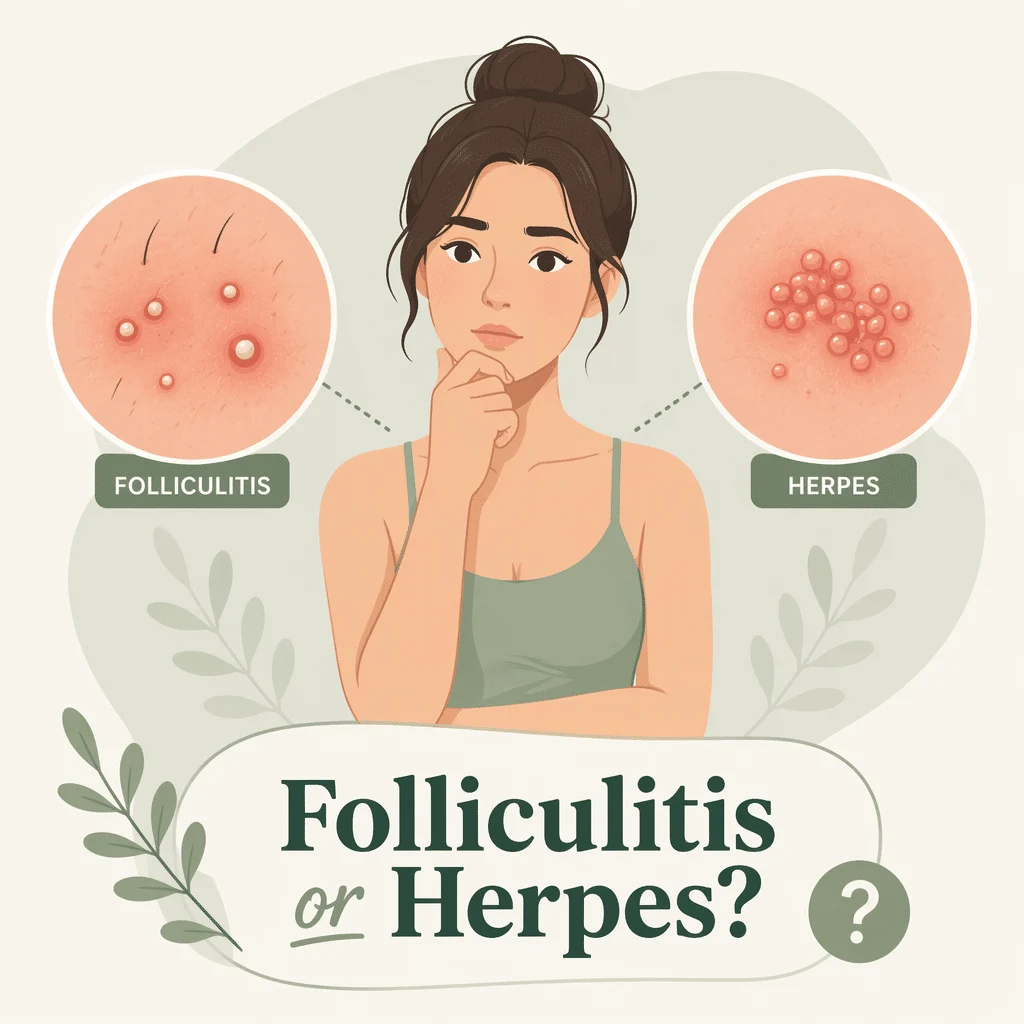
Deciding whether a cluster of small bumps is folliculitis or herpes is genuinely difficult, even for clinicians, because both can produce red, tender spots in the same areas of skin. Folliculitis is an inflamed or infected hair follicle, whilst herpes is a viral infection that produces grouped blisters. The two call for very different care, and one of them is a sexually transmitted infection that should never be self-treated. The reassuring news is that a handful of practical clues, backed up by a simple lab test, usually settles the question. In this article you will learn how the two conditions differ in appearance, pain, and timing, what causes each one, how doctors confirm a diagnosis with a swab, and when it is time to see a professional.
Folliculitis or herpes: two look-alikes with different roots
At first glance, folliculitis or herpes can look almost identical: small raised spots on reddened skin, sometimes sore, sometimes itchy. What separates them is what is happening underneath. One is a problem with a hair follicle; the other is a virus that hides in the nerves and resurfaces from time to time. Grasping that difference is the first step towards reading your own skin more calmly instead of fearing the worst.
What folliculitis is
Folliculitis is inflammation of a hair follicle, the tiny pocket in the skin from which a hair grows. It often begins when bacteria, most commonly Staphylococcus aureus, or sometimes a yeast or fungus, take hold in follicles that have been irritated by shaving, friction, heavy sweating, or a poorly maintained hot tub. The result is a crop of small red bumps or white-tipped pustules, and if you look closely, a hair usually sits at the centre of each one. Folliculitis can appear anywhere hair grows: the beard area, thighs, buttocks, chest, back, or scalp. Most mild cases clear on their own within a week or two.
What herpes is
Herpes is an infection with the herpes simplex virus, or HSV. HSV-1 is the usual cause of cold sores around the mouth, while HSV-2 is more often linked to genital herpes, although either type can appear in either place. When the virus settles in the mouth and throat, symptoms shift, and you can read more in our guide to throat herpes and its treatment. After the first infection, the virus stays dormant in nearby nerves and can reactivate, producing repeated outbreaks in the same spot. A classic herpes outbreak is a tight cluster of small fluid-filled blisters on a red base that soon break into shallow, painful sores before crusting over. Many people carry HSV without ever noticing clear symptoms.
Folliculitis vs herpes: the differences at a glance
Because the two conditions overlap, no single feature is proof on its own. Even so, a side-by-side look at appearance, sensation, and timing points you in the right direction. The table below summarises the patterns doctors weigh when they compare folliculitis vs herpes.
| Feature | Folliculitis | Herpes (HSV) |
|---|---|---|
| Core lesion | Red bumps or pus-filled spots, each often centred on a hair | Tight clusters of small blisters on a red base that break into shallow sores |
| Early warning | Usually none; may itch or sting mildly | Tingling, burning, or itching a day or two before blisters appear (the prodrome) |
| Main sensation | Itching or mild tenderness | Pain or burning, sometimes intense |
| Typical spots | Anywhere with hair: beard, legs, chest, back, buttocks, scalp | Lips and mouth, or genitals, anus, and buttocks |
| Pattern over time | Flares after shaving, sweating, or friction; not tied to one exact spot | Recurs in the same location; may follow stress, illness, or fatigue |
| Contagious to others | Generally not spread person to person; it is an irritated follicle | Spreads through skin-to-skin contact, sometimes even when no sores show |
| What confirms it | Clinical exam, sometimes a swab culture | A swab tested by PCR or culture, plus type-specific blood tests |
Appearance and location
The single most useful clue is the hair. In folliculitis, each bump tends to be centred on a hair, and the spots are scattered wherever you shave or sweat. Herpes blisters cluster tightly together, are roughly the same size, and are not linked to individual hairs. Herpes also favours predictable sites, such as the border of the lips or the genital and buttock area, and it tends to return to those same places.
Pain, itching, and the tingling prodrome
Sensation is another giveaway. Folliculitis is usually itchy or only mildly sore. Herpes is more often frankly painful, and many people feel a distinctive tingling, burning, or itching a day or two before anything is visible. This early warning, called a prodrome, has no real equivalent in folliculitis and is a strong hint towards a viral cause.
Recurrence and timing
Timing tells a story too. Folliculitis tends to flare after a trigger such as a close shave, a workout, or time in a hot tub, and it can show up in slightly different places each time. Herpes tends to return to the very same patch of skin, because the virus reactivates from the same nerve. A sore that keeps coming back in one exact location deserves a proper test. Shingles, a different rash from the same virus family, also blisters but wraps in a band around one side of the body; you can compare its pattern in our guide to shingles symptoms, causes, and testing.
What causes folliculitis and what triggers herpes
Folliculitis causes and triggers
Folliculitis begins when something lets microbes into irritated follicles. Common contributors include shaving or waxing, tight clothing that rubs, heavy sweating, greasy or occlusive skin products, long courses of antibiotics, and soaking in hot tubs or pools with unbalanced disinfectant, which can cause a form nicknamed hot tub rash. People with diabetes, obesity, or a weakened immune system are more prone to it. Depending on the culprit, folliculitis may be bacterial, fungal, or, less often, viral. Because a yeast-driven form can look almost exactly like acne, it also helps to review our article on acne, its causes, and treatments.
How herpes spreads and what sets off outbreaks
Herpes passes from person to person through direct skin-to-skin contact, including kissing and sexual contact. Crucially, the virus can spread even when no sores are present, a process called asymptomatic shedding. Once someone carries HSV, later outbreaks are often triggered by stress, illness or fever, fatigue, sun exposure on the lips, menstruation, or anything that taxes the immune system. Because herpes in its genital form is a sexually transmitted infection, a suspected case should be assessed by a clinician rather than treated on your own. Genital bumps have many possible causes, and you can explore another common one in our guide to HPV causes, symptoms, and treatments.
How doctors tell folliculitis and herpes apart
Here is the honest truth at the centre of this comparison: folliculitis and herpes can look so similar that they cannot be reliably told apart by eye alone, not even by experienced clinicians in every case. That is why testing matters. Trying to self-diagnose, especially a possible sexually transmitted infection, can lead to the wrong treatment and needless worry. Longer-lasting scaly or itchy patches may not be an infection at all, which is why doctors also weigh other skin conditions covered in our guides to psoriasis and its triggers and eczema and atopic dermatitis.
Diagnosing folliculitis
For folliculitis, a doctor usually starts with a physical examination, asking about shaving habits, hot tub use, sweating, and recent medications. Mild cases often need nothing more. If the rash is stubborn, spreading, or recurrent, the clinician may take a swab of a pustule for bacterial culture to identify the organism and guide the choice of medicine, or, more rarely, perform a small skin biopsy. Dermatology resources such as Cleveland Clinic describe the same practical self-care steps for mild folliculitis.
Confirming herpes with a swab
Herpes is confirmed in the laboratory. When blisters or sores are present, the most accurate approach is to swab the lesion and test the fluid, ideally with a PCR test that detects and types the virus’s genetic material; a viral culture is an older alternative. When no sores are present, a type-specific blood test can detect HSV-1 or HSV-2 antibodies and help tell a first infection from a long-standing one. In short, a swab or PCR test, not a visual guess, is what actually confirms herpes. The U.S. Centers for Disease Control and Prevention outlines how clinicians confirm the infection in its overview of genital herpes.
Blood tests that fill in the picture
Neither condition is diagnosed by routine blood work, but blood tests can show whether the body is fighting a wider infection, so you can see how to interpret one in our guide to reading a full blood count. Doctors sometimes add inflammation markers to the assessment, and you can learn about two of them in our explainers on C-reactive protein and the erythrocyte sedimentation rate. Genital sores also have several possible causes, so clinicians often test for more than one, and you can see other examples in our guides to chlamydia rash and its treatment and the RPR blood test for syphilis. Laboratory methods keep evolving for these infections too, as we describe in our report on drug-resistant gonorrhoea testing.
Treatment for folliculitis and herpes
Because the causes differ, so do the remedies. Matching the treatment to the true diagnosis is exactly why confirming which condition you have is worth the effort.
Treating folliculitis
Mild folliculitis often settles with simple measures: warm compresses, gentle antibacterial cleansers, loose clothing, and a pause from shaving the affected area. When treatment is needed, bacterial folliculitis may respond to a topical antibiotic or an antiseptic such as benzoyl peroxide, with oral antibiotics reserved for stubborn or deep infection. Fungal folliculitis needs antifungal treatment instead of antibiotics, which is one more reason a correct diagnosis matters. Avoiding the trigger, whether it is a razor or a hot tub, helps prevent the next flare.
Managing herpes
Herpes cannot be cured, but it is very manageable. Antiviral medicines such as acyclovir, valacyclovir, and famciclovir shorten outbreaks and ease symptoms, and taken daily as suppressive therapy they reduce how often outbreaks occur and lower the risk of passing the virus to others. These are prescription medicines, so a suspected genital herpes infection should be assessed by a clinician rather than managed with over-the-counter products or home remedies alone.
When to see a doctor
A quick self-check is fine for a mild razor bump, but some situations call for professional advice. See a doctor or clinician if any of the following apply:
- The sores are painful, blistered, or clustered, or were preceded by tingling or burning.
- A rash keeps returning to the same spot.
- You have new sores in the genital area, or any concern about a sexually transmitted infection.
- Bumps are spreading, filling with pus, or not improving after a week or two.
- You also have a fever, swollen glands, or feel generally unwell.
- You have diabetes, a weakened immune system, or a rash that is very painful or widespread.
- A newborn, a pregnant person, or someone with eczema has been exposed to an active herpes sore.
Getting the right diagnosis early means the right treatment sooner, and far less guesswork in the meantime.
Latest scientific advances
Research from the past few years keeps reinforcing one message: when skin lesions look alike, the laboratory settles the question. Here is what recent studies add, in plain terms.
A 2026 review of herpes in pregnancy restated how the infection is confirmed: because the virus often sheds without visible sores, doctors rely on a swab tested by PCR or a viral culture, with type-specific blood tests separating a brand-new infection from an old one. The same review notes that HSV-1, long thought of as the cold sore virus, is now a common cause of genital herpes as well. What this means for you: the site of a sore no longer reliably tells you which virus is involved, so a lab test is the dependable answer.
A 2024 case report, which is a detailed look at a single patient, described a man whose painful genital sores turned out to involve two different viruses at once, something only molecular testing could untangle. The authors recommend using PCR to confirm the exact virus in any genital herpes-like rash. What this means for you: look-alike sores are common enough that specialists themselves reach for a swab rather than trusting appearance.
On the folliculitis side, a 2025 review highlighted a fungal form, sometimes called Malassezia or pityrosporum folliculitis, that is frequently mistaken for acne and therefore treated with the wrong medicines. Simple bedside tools, from a close-up skin scope to a quick microscope preparation, help confirm it. What this means for you: even within folliculitis, the exact cause changes the treatment, which is why a stubborn breakout is worth showing to a professional.
A 2024 clinical review of common bacterial skin infections reaffirmed that ordinary folliculitis is usually self-limited and that a non-antibiotic option, benzoyl peroxide, is a sensible first step, with swab cultures kept for recurrent or resistant cases. What this means for you: not every crop of spots needs antibiotics, and a culture helps avoid using them when they will not help.
Finally, a 2025 study that followed people with recurrent genital herpes over time found that the emotional burden, including anxiety and stigma, was often heavier than the physical symptoms, and that good control of the virus and social support eased it. What this means for you: a clear diagnosis is not only about the skin; it opens the door to effective treatment and support, and there is no shame in seeking it.
Glossary of key terms
| Term | Definition |
|---|---|
| Folliculitis | Inflammation or infection of a hair follicle, the small pocket in the skin that holds a hair. |
| Herpes simplex virus (HSV) | The virus that causes herpes; HSV-1 is linked mainly to cold sores and HSV-2 to genital herpes. |
| Pustule | A small bump filled with pus, a frequent feature of folliculitis. |
| Vesicle | A tiny blister filled with clear fluid; herpes typically produces clusters of them. |
| Prodrome | Early warning symptoms, such as tingling or burning, that appear before a herpes outbreak. |
| PCR (polymerase chain reaction) | A laboratory method that detects and identifies a virus’s genetic material from a swab. |
| Viral culture | A test that tries to grow a virus from a sample to confirm infection. |
| Type-specific serology | A blood test that distinguishes HSV-1 antibodies from HSV-2 antibodies. |
| Asymptomatic shedding | Release of virus from the skin when no sores are visible, which can still spread herpes. |
| Staphylococcus aureus | A common bacterium, often shortened to staph, that frequently causes bacterial folliculitis. |
Frequently asked questions
Can folliculitis be mistaken for herpes?
Yes. Both can cause small, sore red spots in similar areas, and herpes can even infect hair follicles in a form called herpetic folliculitis. Appearance alone is not reliable, which is why a swab test is the dependable way to tell them apart, especially in the genital area. If you are unsure, it is safer to have a clinician look and, when appropriate, test.
Can folliculitis turn into herpes?
No. Folliculitis and herpes have completely different causes, one from bacteria or fungi in a follicle and the other from a virus, so one cannot become the other. It is possible, though, to have both at the same time, or to mistake one for the other before testing. That overlap is exactly why a lab test is so useful.
How long does folliculitis take to heal?
Mild folliculitis often improves within one to two weeks, especially once you stop the trigger, such as shaving over the area. Deeper or recurrent cases can take longer and may need prescription treatment. If the bumps persist beyond two weeks, spread, or keep coming back, it is worth having them checked so the right cause can be treated.
Is herpes contagious when there are no symptoms?
Yes. The herpes virus can be passed on even between outbreaks, when the skin looks completely normal, through a process called asymptomatic shedding. This is one reason a confirmed diagnosis and a conversation with a clinician about prevention, including antiviral options and condoms, are so useful for you and your partners.
What triggers herpes outbreaks?
Common triggers include stress, illness or fever, tiredness, sun exposure on the lips, hormonal changes such as menstruation, and anything that lowers the body’s defences. Triggers vary from person to person, and some outbreaks have no obvious cause at all. Keeping a simple note of what precedes your flares can sometimes help you spot your own patterns.
Can I shave if I have folliculitis?
It is best to pause shaving over the affected skin until it clears, since a razor can spread bacteria and irritate follicles further. When you resume, a clean blade, shaving with the grain, and not stretching the skin too tightly can reduce flares. If shaving repeatedly triggers bumps, ask a clinician about gentler hair-removal options.
Sources
- Centers for Disease Control and Prevention — About Genital Herpes — CDC, 2024. https://www.cdc.gov/herpes/about/index.html
- Cleveland Clinic — Folliculitis: Appearance, Causes, Symptoms and Treatment — Cleveland Clinic, 2023. https://my.clevelandclinic.org/health/diseases/17692-folliculitis
- Mayo Clinic — Folliculitis: Symptoms and causes — Mayo Clinic, 2023. https://www.mayoclinic.org/diseases-conditions/folliculitis/symptoms-causes/syc-20361634
- Silva Pereira S, et al. — Maternal-Fetal Implications of Herpes Virus Infection: An Updated Review — Diagnostics (Basel), 2026. https://doi.org/10.3390/diagnostics16081147
- Sadhukhan S, et al. — An unusual co-reactivation of herpes genitalis and shingles confirmed by molecular testing — International Journal of STD and AIDS, 2024. https://doi.org/10.1177/09564624241229463
- Chalupczak NV, Lipner SR — Folliculitis: An Underdiagnosed Mimicker of Acneiform Eruptions — Journal of Fungi, 2025. https://doi.org/10.3390/jof11090662
- Zha M, Usatine R — Common Skin Conditions in Children and Adolescents: Bacterial Infections — FP Essentials, 2024. https://pubmed.ncbi.nlm.nih.gov/38896826/
- Gupta S, Chopra D — Beyond the outbreaks: the enduring psychological burden of recurrent symptomatic genital herpes — International Journal of STD and AIDS, 2025. https://doi.org/10.1177/09564624251376077
Further reading
- Throat herpes: symptoms, causes, and treatments
- Shingles: symptoms, causes, and testing
- HPV: causes, symptoms, and treatments
- Acne: causes, symptoms, and treatments
- How to read a full blood count
Understand your lab results with AI DiagMe
Telling folliculitis and herpes apart often comes down to a test result, and results are easier to act on when you understand them. AI DiagMe helps you make sense of reports such as an HSV PCR swab, a bacterial culture from a pustule, or a full blood count, explaining in plain language what each value suggests. It is a tool to help you understand your results and prepare better questions; it does not diagnose you and does not replace your doctor.
Get your results interpreted in minutes