




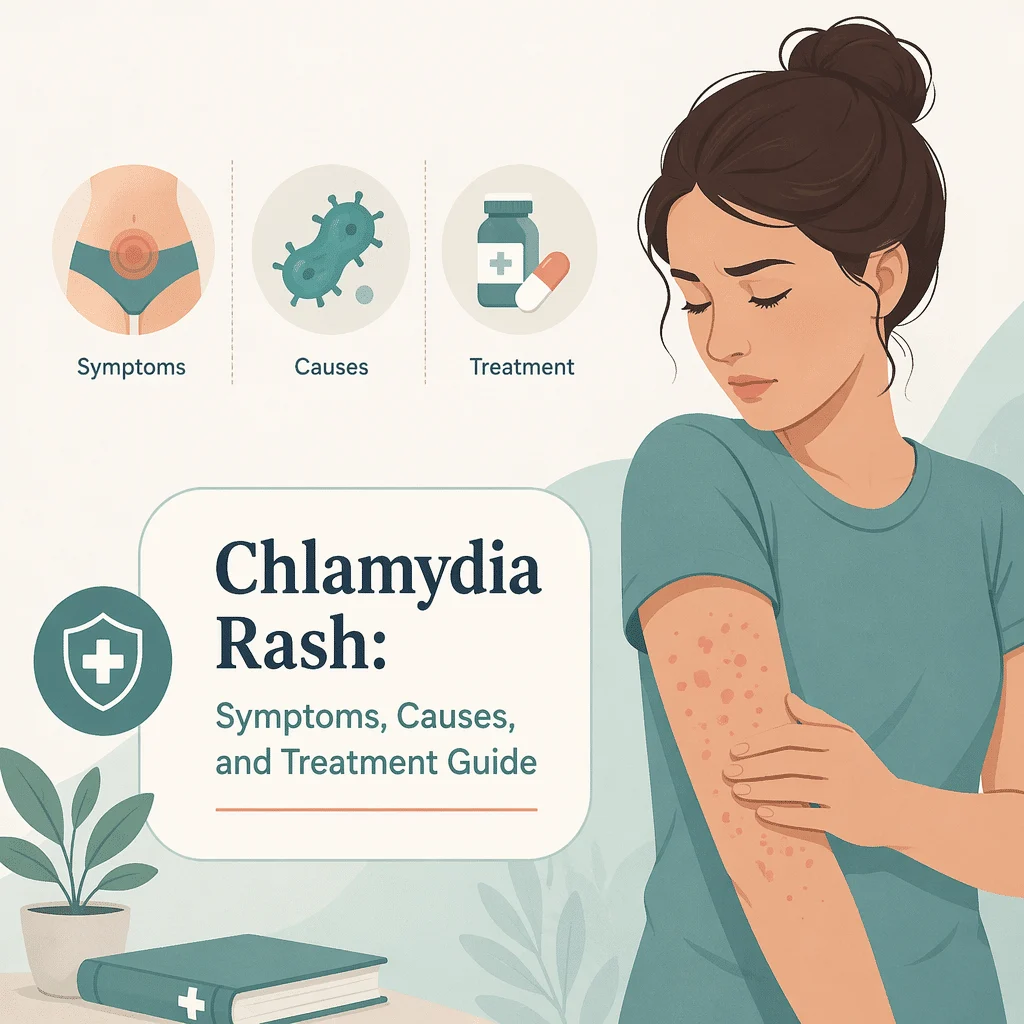
If you have searched for a chlamydia rash after noticing a new spot, bump, or sore, the honest answer may reassure you: chlamydia itself almost never causes a rash. Chlamydia is one of the most common sexually transmitted infections, yet it is usually silent, and when it does cause problems those problems are typically in the genitals, not on the skin. So why do so many people link chlamydia with a rash? The connection is real but indirect. It runs through a joint condition called reactive arthritis, through a rarer form of chlamydia called lymphogranuloma venereum, and through the simple fact that a genital “rash” is often caused by a completely different infection. In this article you will learn what a chlamydia rash really means, which skin signs deserve attention, how testing works, and when to see a doctor.
Does chlamydia really cause a rash?
Let us clear up the biggest myth first. Chlamydia trachomatis, the bacterium behind the infection, settles in the moist lining of the genitals, rectum, throat, and eyes. It does not usually produce a skin rash the way measles, an allergic reaction, or heat does. Major health authorities, such as the CDC’s chlamydia overview, describe the infection mainly through genital and urinary symptoms, not through spots on the arms, chest, or legs. When people describe a chlamydia rash, they are almost always dealing with one of three different situations, each of which we explain below.
This distinction matters because chasing an imaginary rash can delay the right test. Chlamydia is diagnosed from a urine sample or a swab, not by looking at your skin. If you treat the skin and ignore the infection, the infection can quietly continue and lead to complications. Reading the rest of this guide can help you point your attention, and your doctor’s attention, in the most useful direction.
So where does the idea of a chlamydia rash come from? Part of the confusion is understandable. Someone who tests positive may also have an unrelated skin problem and connect the two events. Others read about reactive arthritis, see the word chlamydia sitting next to a photo of a rash, and assume the infection caused it directly. Search results then reinforce the association, which is one reason “chlamydia rash” has become such a common query. Keeping the underlying biology straight helps you avoid both needless worry and false reassurance, and it points you towards the test that actually settles the question.
The real skin and mucosal links to chlamydia
Although a true chlamydia rash is uncommon, the infection is genuinely connected to several skin and mucous-membrane findings. Understanding these links is the key to knowing whether your skin sign deserves a chlamydia test, a different test, or simple reassurance.
Reactive arthritis and its skin signs
The most genuine connection between chlamydia and the skin runs through reactive arthritis, once called Reiter syndrome. Reactive arthritis is joint and sometimes skin inflammation triggered by an infection somewhere else in the body, often a genital chlamydia infection from a few weeks earlier. It is not the germ attacking the skin directly; it is the immune system overreacting after the infection.
Two skin signs are classic. Keratoderma blennorrhagicum is a scaly, sometimes crusted rash on the palms and soles that can look a little like psoriasis. Circinate balanitis is a ring-shaped rash or shallow sore on the head of the penis. Some people also develop small, painless mouth ulcers and red, irritated eyes at the same time. When these appear together with joint pain, doctors think of reactive arthritis rather than a direct chlamydia rash. If lasting joint swelling is part of your picture, our guide explains rheumatoid arthritis and how it differs from infection-triggered joint pain, and our team compares conjunctivitis and uveitis, the two kinds of eye inflammation that can accompany it.
Lymphogranuloma venereum (LGV)
A specific subtype of Chlamydia trachomatis causes lymphogranuloma venereum, or LGV. Unlike ordinary chlamydia, LGV can produce a small, often painless genital sore or ulcer that heals on its own, followed by swollen, tender lymph nodes in the groin. In people who have anal sex, LGV can also cause rectal pain, discharge, and inflammation. LGV is far less common than routine genital chlamydia in most countries, but it has been reported more often in recent years, particularly among men who have sex with men. Because its early sore can be mistaken for other infections, testing is what tells the difference.
When a “rash” is really another infection
Very often, the genital rash, sore, or bumps that someone blames on chlamydia turn out to be a different sexually transmitted infection. This is the single most useful idea in this guide. A cluster of small, painful blisters usually signals oral and throat herpes or genital herpes rather than chlamydia. A single painless sore can point to early syphilis, which doctors confirm with a syphilis RPR blood test. Soft, flesh-coloured growths more often reflect human papillomavirus and genital warts. Red bumps around hair follicles can be harmless irritation, so it helps to compare folliculitis and herpes before assuming the worst.
| Sign you noticed | More likely explanation | Sensible next step |
|---|---|---|
| Scaly rash on palms or soles with joint pain | Reactive arthritis after an infection | See a doctor and mention any recent STI risk |
| Ring-shaped sore on the head of the penis | Circinate balanitis linked to reactive arthritis | Get an STI test and a skin examination |
| Painless genital sore, then swollen groin nodes | LGV or early syphilis | Ask for STI testing, including syphilis |
| Cluster of small, painful blisters | Genital or oral herpes | Get a herpes evaluation |
| Soft, flesh-coloured bumps or growths | Genital warts from HPV | Ask about HPV testing and care |
| Burning when you urinate, plus discharge | Chlamydia, gonorrhoea, or a urinary infection | Get a urine STI test |
| Widespread rash on arms, chest, or legs | Allergy, heat, eczema, or another cause | See a doctor if it lasts or spreads |
What chlamydia usually feels like
Because a chlamydia rash is the exception, it helps to know the real symptoms, which are easy to miss. Most people with chlamydia notice nothing at all, which is exactly why the infection spreads so widely and so quietly.
Symptoms in women
When symptoms do appear, women may notice unusual vaginal discharge, burning during urination, bleeding between periods or after sex, and lower abdominal or pelvic pain. Burning when you urinate can also signal a urinary tract infection, so testing is the only way to be sure which one you have. Untreated chlamydia can spread to the uterus and fallopian tubes and cause pelvic inflammatory disease, which can affect future fertility.
Symptoms in men
Men may notice discharge from the penis, burning during urination, and, less often, pain or swelling in one testicle. Some men worry about a chlamydia rash on the penis when what they actually have is circinate balanitis from reactive arthritis, ordinary irritation, or a separate infection. Again, the appearance alone cannot confirm the cause.
Silent infections
The most important point is that chlamydia is frequently silent in every group. You can carry the infection and pass it on with no symptoms for months. That is why regular screening matters for anyone who is sexually active with new or multiple partners, even when the skin looks perfectly normal and nothing feels wrong.
How chlamydia is diagnosed
Chlamydia is not diagnosed by examining a rash. It is confirmed with a nucleic acid amplification test, or NAAT, a highly accurate lab test that detects the bacterium’s genetic material. For most people this means a simple first-catch urine sample or a self-collected vaginal swab; rectal and throat swabs are used when relevant. The results are objective and do not depend on how your skin looks.
If your signs suggest another infection, your clinician may test for several conditions at once, because chlamydia and gonorrhoea often travel together and laboratories now track the rise of drug-resistant gonorrhoea. Testing for syphilis, herpes, and HIV may be added depending on your symptoms and history. Getting the full picture in a single visit is faster and safer than treating a rash and hoping it was the right target.
How chlamydia and its complications are treated
Chlamydia is curable with antibiotics. Current guidance from major health authorities favours a short course of doxycycline, usually 100 mg twice a day for seven days, with azithromycin as an alternative in specific situations such as pregnancy. LGV is treated with a longer course of doxycycline, typically three weeks. Your clinician chooses the regimen based on the type of infection and your overall health.
Two extra steps matter just as much as the pills. First, recent sexual partners need testing and treatment too, or you can simply be reinfected; many clinics offer partner treatment to make this easier. Second, you should avoid sex until you and your partners have finished treatment. If reactive arthritis has developed, treating the chlamydia infection is still important, but the joint and skin inflammation itself is usually managed separately with anti-inflammatory medicines, because antibiotics do not shorten that part. Most rashes tied to reactive arthritis fade over weeks to months as the immune flare settles.
How to lower your risk and protect partners
Prevention is far more useful than trying to spot a chlamydia rash after the fact. Condoms used consistently and correctly lower the risk of chlamydia and many other sexually transmitted infections, even though they cannot remove the risk entirely. Talking openly with partners about testing, and getting screened together before starting a new sexual relationship, makes a genuine difference to how quietly the infection can spread.
Routine screening is the quiet hero here. Because chlamydia is so often silent, many guidelines suggest regular testing for sexually active young adults and for anyone with new or multiple partners, regardless of symptoms. If you are treated, most clinicians recommend a repeat test a few months later, since reinfection from an untreated partner is common. None of these steps rely on watching your skin, which is exactly the point: chlamydia is caught early by testing, not by hunting for a rash.
When to see a doctor or get tested
Skin signs are hard to read on your own, so use these simple prompts to decide when to seek care rather than searching for a chlamydia rash online and worrying.
- You have had unprotected sex or a new partner, along with any genital sore, bump, or unusual discharge.
- A scaly rash on your palms or soles appears together with joint pain or red, irritated eyes.
- You notice a ring-shaped sore on the penis or a painless genital ulcer.
- You have swollen, tender lymph nodes in the groin.
- Burning during urination, pelvic pain, or bleeding between periods does not settle.
- A partner has tested positive for chlamydia or another sexually transmitted infection.
None of these signs call for panic, but all of them are good reasons to get tested. Testing is quick, confidential, and far more reliable than trying to identify an infection by sight.
Latest scientific advances
Research on chlamydia and its complications keeps evolving. Here is what recent, high-quality work adds, translated into plain language.
A 2025 European guideline on managing chlamydia, published in the International Journal of STD and AIDS, recommends doxycycline as the first-choice antibiotic over a single dose of azithromycin, confirms that diagnosis should rely only on validated NAAT lab tests, and questions the value of broadly screening people who have no symptoms. What this means for you: if you are treated, a seven-day doxycycline course is now the usual standard, and an accurate urine or swab test matters far more than any check of your skin.
A 2024 review of reactive arthritis in the journal Zeitschrift fur Rheumatologie confirms that Chlamydia trachomatis is among the most common triggers of this immune reaction, which shows up as joint inflammation and sometimes the palm-and-sole rash described earlier. It also makes a practical point: antibiotics generally do not shorten the arthritis itself. What this means for you: treating the original chlamydia infection is still worthwhile, but the joint and skin flare is managed with anti-inflammatory care and usually settles on its own. An earlier 2023 overview of reactive arthritis reached the same conclusion about its skin, eye, and joint signs.
A 2023 report in The American Journal of Medicine on lymphogranuloma venereum highlights how this chlamydia subtype can begin with an easily missed genital sore before it causes swollen lymph nodes. What this means for you: an ulcer that seems to heal on its own is not a reason to skip testing, because LGV needs a longer antibiotic course than ordinary chlamydia. These findings line up well with each other, but medicine keeps refining the details, so a current test and a clinician’s advice remain your most reliable guide.
Glossary of key terms
| Term | Definition |
|---|---|
| Chlamydia trachomatis | The bacterium that causes chlamydia. It infects moist linings such as the genitals, rectum, throat, and eyes, and rarely the skin. |
| Reactive arthritis | Joint and sometimes skin inflammation triggered by an infection elsewhere in the body, once called Reiter syndrome. |
| Keratoderma blennorrhagicum | A scaly, sometimes crusted rash on the palms and soles that can occur during reactive arthritis. |
| Circinate balanitis | A ring-shaped rash or shallow sore on the head of the penis, another skin sign of reactive arthritis. |
| Lymphogranuloma venereum (LGV) | A subtype of chlamydia that causes a genital ulcer and swollen groin lymph nodes, needing a longer course of antibiotics. |
| NAAT | Nucleic acid amplification test, the accurate urine or swab test used to detect chlamydia’s genetic material. |
| Pelvic inflammatory disease | Infection spreading to the uterus and fallopian tubes, a complication of untreated chlamydia that can affect fertility. |
| Doxycycline | The antibiotic now recommended as first-line treatment for most chlamydia infections, taken for seven days. |
Frequently asked questions
Does chlamydia cause a rash on the body?
Not usually. Chlamydia mainly affects the genitals, rectum, throat, and eyes, and it does not typically produce a rash on the arms, chest, or legs. A widespread body rash is far more likely to come from an allergy, heat, eczema, or another condition. The only well-recognised skin signs tied to chlamydia appear through reactive arthritis, and they are limited to specific areas such as the palms, soles, and penis.
What does a chlamydia-related rash look like?
When a skin sign is genuinely related to chlamydia, it comes from reactive arthritis rather than the germ itself. It may look like a scaly, psoriasis-like rash on the palms and soles, called keratoderma blennorrhagicum, or a ring-shaped sore on the head of the penis, called circinate balanitis. These usually appear alongside joint pain and sometimes eye redness, not as isolated spots.
Can chlamydia cause a rash on the hands or feet?
Indirectly, yes. The scaly rash on the palms and soles seen in reactive arthritis can follow a chlamydia infection by a few weeks. It reflects the immune system’s reaction, not the bacterium spreading to the skin. If you notice this pattern with joint pain, tell your doctor about any recent infection or sexual health concern so the right tests can be arranged.
How can I tell a chlamydia concern from herpes?
You often cannot tell by looking, which is why testing matters. As a rough guide, herpes tends to cause clusters of small, painful blisters that come and go, while chlamydia usually causes no skin change at all and instead brings discharge or burning. A single painless sore points more towards syphilis or LGV. Only a lab test can confirm which infection you have.
How is chlamydia tested if there is no rash?
Chlamydia is confirmed with a NAAT lab test on a urine sample or a swab, so no rash or visible sign is needed. Many people with the infection feel completely well. If you have had a new or untreated partner, or any genital symptoms, a simple test can settle the question quickly and privately.
Will a reactive-arthritis rash go away after antibiotics?
Treating the underlying chlamydia infection with antibiotics is important, but the rash and joint inflammation of reactive arthritis are driven by the immune system and usually managed with anti-inflammatory medicines. Most flares fade over weeks to months. If your symptoms persist or return, your doctor can review whether other treatment is needed.
Sources
- Centers for Disease Control and Prevention (CDC) — About Chlamydia — 2024 — cdc.gov
- MedlinePlus, U.S. National Library of Medicine (NIH) — Chlamydia Infections — medlineplus.gov
- Mayo Clinic — Chlamydia: Symptoms and causes — mayoclinic.org
- Mayo Clinic — Reactive arthritis: Symptoms and causes — mayoclinic.org
- MedlinePlus Medical Encyclopedia (NIH) — Reactive arthritis (Reiter syndrome) — medlineplus.gov
- CDC — Lymphogranuloma Venereum (LGV) treatment guidance — cdc.gov
- White JA, Dukers-Muijrers NHTM, Hoebe CJPA, et al. — 2025 European guideline on the management of Chlamydia trachomatis infections — International Journal of STD & AIDS, 2025 — doi.org/10.1177/09564624251323678
- Rihl M, Kuipers JG — Reactive arthritis — Zeitschrift fur Rheumatologie, 2024 — doi.org/10.1007/s00393-024-01594-9
- Stegert M — Reactive arthritis — Therapeutische Umschau, 2023 — doi.org/10.1024/0040-5930/a001404
- Ishizuka K, Ohira Y — Lymphogranuloma Venereum — The American Journal of Medicine, 2023 — doi.org/10.1016/j.amjmed.2023.07.008
Further reading
- Understand the many skin rash causes and treatments.
- Learn to recognise psoriasis symptoms and triggers.
- Explore the main arthritis causes and testing options.
- Read our guide to vaginal burning causes and treatments.
- See what to make of a normal Pap smear with a positive HPV result.
Understand your lab results with AI DiagMe
Whether you are worried about a chlamydia rash or simply want clarity after a sexual health check, understanding your own results makes the next step easier. AI DiagMe helps you read tests such as a chlamydia NAAT urine test, a full STI panel, and a full blood count in plain language, so you can see what falls in the normal range and what deserves a conversation. It is built to help you understand your results, not to diagnose you, and it never replaces your doctor’s advice.
Get your results interpreted in minutes